


Inside ATCO’s Grimsby Expansion: What a Bigger Modular Plant Means for How Canada Builds
Walk through a modular manufacturing plant and you start to understand something that’s easy to miss from a finished photo: a building’s quality is decided long before anyone pours a foundation. ATCO Structures just gave Eastern Canada a lot more of that controlled, upfront process. The Calgary-based company has completed an expansion of its Grimsby, Ontario facility, consolidating what used to be spread across several smaller buildings into one 110,000-square-foot plant, plus another 75,000 square feet dedicated to warehousing and welding. That’s a serious jump in capacity, and it’s worth looking at closely, because it tells you something about where construction methods are heading, not just where one company is growing.
Modular construction gets pitched a lot as a speed play, and that’s fair, shifting the bulk of the build into a factory setting does compress timelines. But the part that matters more to anyone who cares about build quality is predictability. When framing, mechanical rough-ins, and finishing happen in a weatherproof, climate-controlled environment with consistent crews and consistent material handling, you cut out a lot of the variability that causes problems on a traditional site: moisture exposure during framing, inconsistent trade scheduling, material waiting around and degrading before it’s installed. Benoit Gagne, ATCO’s executive vice-president of modular for Canada, put it simply when he told RENX the company sees itself as a solutions provider for “anybody who has a need for a type of shelter.” That range is real. The same core manufacturing process is turning out housing, schools, healthcare space, workforce lodges, and industrial units.
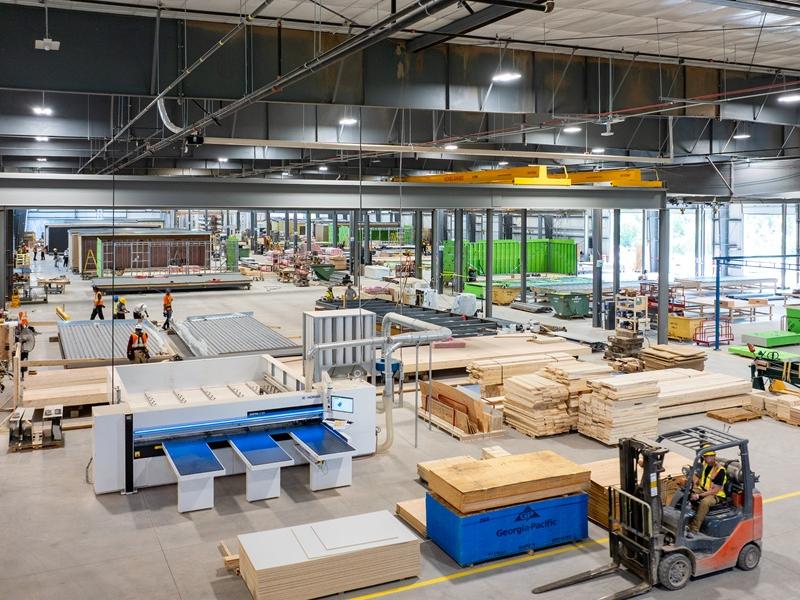
What stands out from a builder’s perspective is the vertical integration angle. Before this expansion, ATCO wasn’t fully self-sufficient in the eastern half of the country. Now it is, which means fewer handoffs between suppliers, less time lost to logistics gaps, and tighter quality control from raw material to finished module. The facility supports five existing Ontario sales branches and employs more than 140 people on site, a sizable share of ATCO’s roughly 190-person Ontario workforce. Gagne made a point that’s easy to underestimate: the ripple effect extends well past that headcount, into trucking, material supply, the trades ATCO relies on, and the contractors who install the product in the field. That’s how construction capacity actually scales, not just through one company’s payroll, but through the whole supply chain that supports it.
“We are very varied in what we offer and see ourselves as a solutions provider to anybody who has a need for a type of shelter.”
It’s also notable that ATCO still offers traditional-style project delivery, overseeing assembly and installation, but also lets customers bring their own labour force where that makes sense for their quality or scheduling needs. That flexibility matters on real job sites, where no two clients want the exact same arrangement. On the housing side specifically, the company’s acquisition of Triple M Housing in 2023 and its dedicated Alberta housing factory, capable of three homes a day, show where the real volume opportunity sits. A 20-year warranty on those homes is a meaningful quality signal in an industry where buyers are often wary of anything built off-site.
None of this means modular replaces conventional building. It means the toolbox is getting bigger, and for an industry under real pressure to deliver housing, schools, and infrastructure faster without sacrificing build quality, that’s a development worth tracking. Expansions like Grimsby are a sign that the manufacturing capacity to back up that demand is actually being built, not just promised.
Source: RENX, “ATCO’s 185,000-sq.-ft. expansion to boost modular construction in Eastern Canada”