

What a Projected $237 Billion Market Tells Investors About Canadian Real Estate’s Next Decade
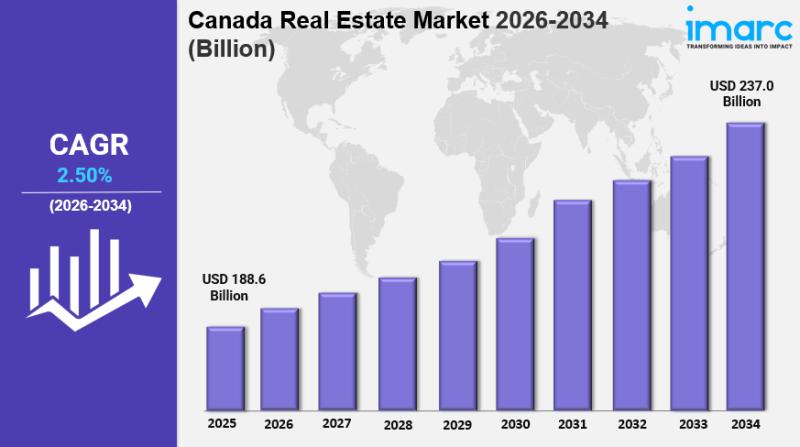
New research from IMARC Group puts a number on something seasoned investors have felt in their bones for years: Canadian real estate is not slowing down, it is compounding. The firm values the market at USD 188.6 billion in 2025, climbing to USD 194.6 billion this year, with a path toward USD 237.0 billion by 2034. That works out to a 2.50 percent compound annual growth rate through the forecast window. On its own, a mid single digit CAGR will not turn heads. What matters is what sits underneath that number.
I look at three things when I size up a market like this: demand pressure, supply discipline, and capital behaviour. Canada is checking all three boxes right now. Urban demand in Toronto, Vancouver, and Montreal continues to outpace available inventory, and Toronto alone recorded a 14 percent year on year increase in home sales in 2024 against a backdrop of constrained new residential development. That is the classic setup for value stability, and it is exactly why developers are pivoting harder toward high rise condominiums rather than fighting for scarce low rise land.
The luxury segment deserves a closer look too. Winnipeg posted a 61.9 percent year over year jump in luxury home sales over the first eight months of 2024, while Toronto luxury pricing rose 3.9 percent over the same period. Resilience at the top end during a period of elevated rates tells you something about the depth of high net worth capital still flowing into premium Canadian property. That is not speculative froth. That is patient money positioning for the long game.
Policy is also doing quiet work on the risk side of the ledger. The federal government extended the Green and Inclusive Community Building program through 2029 with an added USD 500 million in funding, and a coalition including EllisDon, RBC, and Mattamy Homes launched the Climate Smart Buildings Alliance with a target of cutting embodied construction emissions by as much as 40 percent. For investors, that is not just an environmental footnote. Green certified and energy efficient assets are increasingly the ones that hold value through a cycle, command stronger tenant demand, and attract institutional capital that now screens for exactly these credentials.
The strongest opportunities here are not in chasing the headline growth rate. They are in reading where immigration, supply constraints, and capital discipline intersect.
Segment by segment, the thesis holds together. Residential remains the anchor, but commercial and industrial infrastructure are benefiting from the same immigration driven population growth and the same scarcity of developable urban land. Ontario, British Columbia, Quebec, and Alberta continue to absorb the bulk of this demand, which keeps capital concentrated in markets investors already understand well.
My read for readers building a position in Canadian real estate: this is a market rewarding patience and selectivity over speculation. Urban infill, vertical residential, and energy efficient retrofits sit at the intersection of where demand, policy, and capital are all pointing at once. A 2.50 percent CAGR understates the opportunity sitting inside the segments doing the real heavy lifting.
Source: openPR, “Canada Real Estate Market Size, Growth Opportunities,” via IMARC Group.