

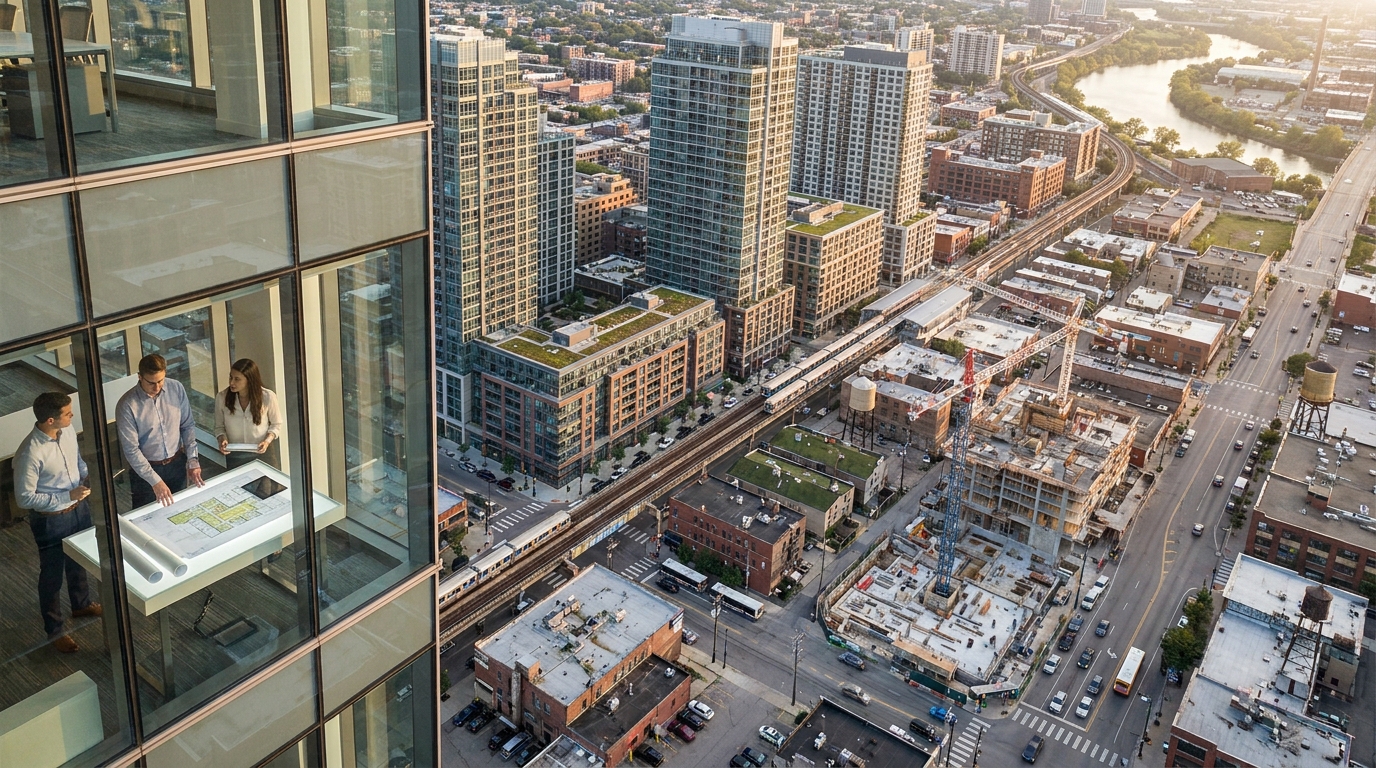

Resort communities are entering a new era. For decades, they were often imagined as seasonal destinations built primarily around leisure, hospitality, and second-home ownership. That model still exists, but it no longer explains the full reality of how these places function. Today, the most important resort communities are becoming hybrid environments where tourism, housing demand, local employment, infrastructure planning, and climate adaptation all intersect.
Table Of Content
- Why Resort Communities Matter More Than Ever
- The End of the Single-Season Resort Model
- Housing Is No Longer a Side Issue. It Is Core Infrastructure
- What a Better Housing Strategy Looks Like
- Mixed-Use Village Cores Will Define the Strongest Projects
- Climate Resilience Is Becoming a Baseline Requirement
- From Green Features to Resilient Systems
- The Rise of Hybrid Resort Living
- Transportation and Infrastructure Must Catch Up to the New Reality
- The Role of Public-Private Partnerships in Unlocking Opportunity
- The Main Barriers Developers and Municipalities Must Solve
- What the Next Decade Will Reward
- Conclusion: Resort Communities as a Model for Smarter Growth
- Key Strategic Priorities for Future Resort Community Development
This shift matters because resort communities are no longer peripheral to broader development conversations. They sit at the centre of several major policy and market forces at once. Tourism remains a powerful economic engine in Canada, generating about $130 billion in direct annual revenue in 2024 and supporting more than 265,800 businesses across 5,000 communities. At the same time, Canada faces a national housing challenge of extraordinary scale, with CMHC estimating that the country may need roughly 430,000 to 480,000 new housing units annually over the next decade to restore affordability to 2019 levels.
Those two realities are now converging in resort communities. Places once planned mainly for visitors increasingly need to function as complete communities for workers, families, service providers, and year-round residents. This changes the development equation. It means resort planning can no longer focus on hospitality product alone. It has to address housing supply, mobility, climate risk, municipal finance, land use efficiency, and long-term livability.
The future of resort communities will be defined by how well they respond to this complexity. The strongest projects will be those that understand tourism not as a stand-alone land use, but as part of a broader urban and regional system. In that future, resort communities can become models for sustainable growth, mixed-income housing, and resilient place-making. If planned strategically, they can help meet the demands of future urban living while continuing to deliver strong visitor economies.
The next generation of resort communities will succeed not because they attract visitors alone, but because they create places where residents, workers, and tourists can coexist within a durable and well-planned local economy.
Why Resort Communities Matter More Than Ever
It is easy to underestimate resort communities because they are often seen through the narrow lens of recreation. In reality, many of them are critical economic nodes. Tourism in Canada supports roughly one in 10 jobs, and the sector continued to strengthen in 2024, with tourism GDP rising 3.8% for the year, outpacing overall real GDP growth of 1.6%. Statistics Canada also reported tourism spending increased 1.5% in the fourth quarter of 2024. These are not niche numbers. They indicate a sector with durable momentum and a continued capacity to shape land markets and local growth.
For resort municipalities, that growth creates both opportunity and pressure. More visitors can mean more jobs, stronger tax bases, and expanded interest from private capital. But stronger visitation can also intensify competition for land, push up housing prices, strain transportation systems, and expose the weaknesses of older planning frameworks. If a community is designed only to maximize short-term visitor spending, it may eventually undermine the workforce and infrastructure base that supports the tourism economy in the first place.
This is why resort communities have become strategically important in housing development discussions. They reveal, in concentrated form, many of the tensions visible across major urban regions: land scarcity, rising construction costs, affordability challenges, infrastructure limits, and political resistance to change. In many cases, those pressures are even more pronounced in high-amenity resort markets because demand is intensified by both lifestyle appeal and tourism investment.
The opportunity lies in treating these places not as exceptions, but as sophisticated development environments. When approached properly, resort communities can demonstrate how to align economic development with inclusive housing outcomes, better public spaces, and stronger environmental stewardship. That is a far more valuable model than the older approach of building isolated vacation enclaves.
The End of the Single-Season Resort Model
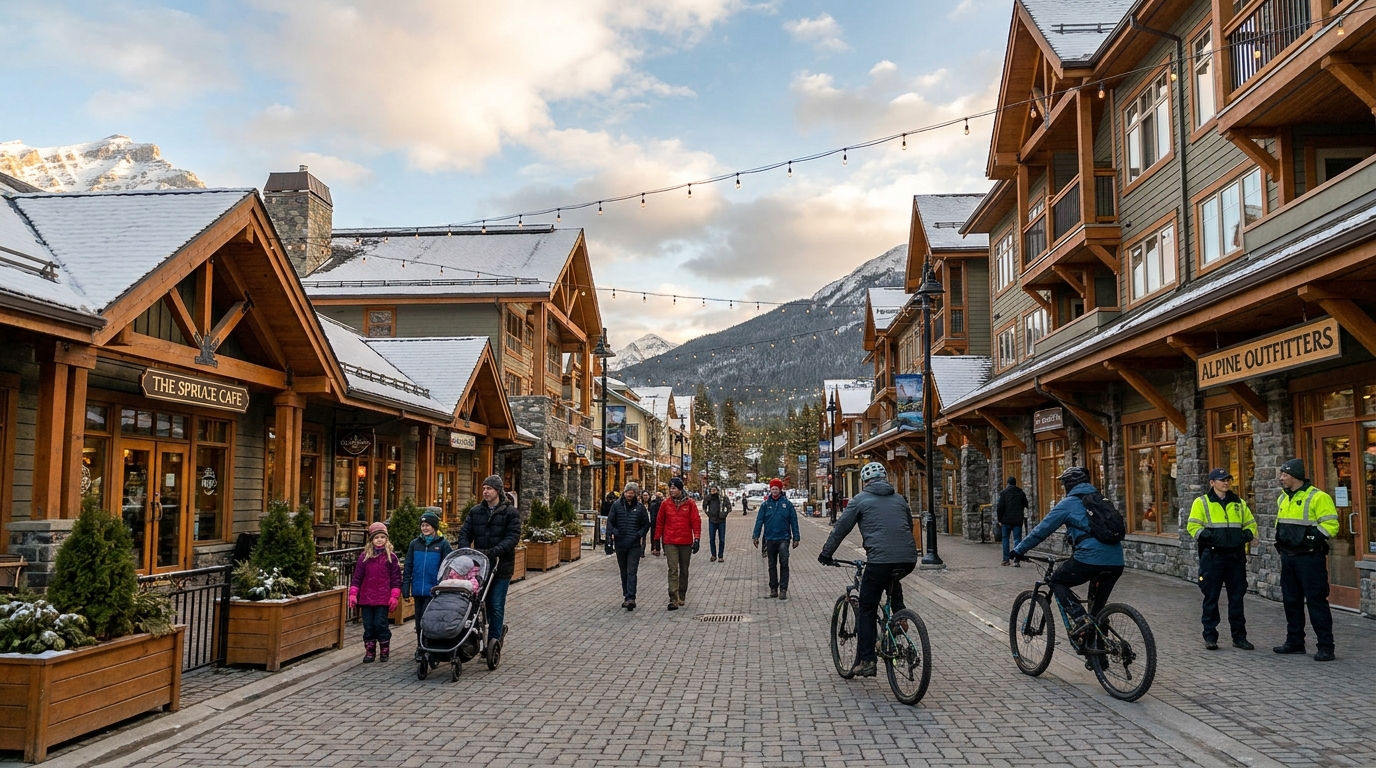
One of the clearest trends shaping the future of resort communities is the move toward year-round tourism. Historically, many resort towns depended heavily on one season. Ski destinations relied on winter. Waterfront communities relied on summer. This seasonal concentration created peaks of economic activity followed by quieter periods in which local businesses, workers, and municipal systems had to absorb volatility.
That model is becoming less attractive and, in many markets, less feasible. Destination Canada has pointed to continued tourism growth through 2030, and governments are increasingly supporting resort amenities that extend activity beyond peak months. The rationale is straightforward. A four-season destination creates a more stable local economy, stronger utilization of infrastructure, and more consistent support for retail, hospitality, and services.
For developers and planners, the implications are significant. A community built for year-round use requires a different mix of land uses and building types than one designed around seasonal peaks alone. It needs housing that can support permanent residents and workers. It needs village cores with enough daily activity to justify commercial services across more of the year. It needs transportation systems that function beyond event-driven surges. It also benefits from public spaces and amenities that support wellness, remote work, recreation, and community life in every season.
The future resort community is therefore not just a destination. It is a place where leisure and living are integrated. That shift opens new possibilities for development because it broadens the market beyond short-stay visitors. Increasingly, resort communities can appeal to remote workers, retirees, young families, entrepreneurs, and residents seeking a lifestyle-oriented but connected place to live. This broadening of the user base can support more diverse housing products and stronger long-term project feasibility.
Housing Is No Longer a Side Issue. It Is Core Infrastructure
The most important planning lesson emerging from resort communities is that housing is infrastructure. A resort economy depends on people who clean rooms, maintain properties, operate lifts, staff restaurants, provide childcare, deliver healthcare, and run municipal services. If those workers cannot find stable and attainable housing near where they work, the entire system becomes fragile.
Whistler is one of the clearest examples of this reality. Recent federal and municipal action there aims to accelerate the delivery of 62 homes over three years, reflecting a practical recognition that workforce housing is central to the community’s viability. This is not simply a social policy discussion. It is an economic development issue, a transportation issue, and a land-use issue all at once.
Across North America, resort communities are increasingly confronting the limitations of a housing model dominated by vacation homes, large detached dwellings, and constrained rental supply. In high-amenity markets, tourism demand and investor demand can drive values up faster than local incomes. That means higher revenue in the visitor economy does not automatically translate into local affordability. In fact, it can intensify displacement pressure for workers and long-term residents if housing policy is weak.
This is where a more strategic housing approach becomes essential. Resort communities need a broader supply mix that includes rental units, purpose-built workforce housing, missing-middle forms such as townhomes and multiplexes, accessory units where appropriate, and mixed-income neighborhoods close to employment areas. They also need policies that support delivery rather than merely expressing intent. Restrictive zoning, slow approvals, and fragmented land ownership can make attainable housing nearly impossible to build in high-value resort markets.
The national housing picture reinforces this point. CMHC has estimated that Canada needs between 430,000 and 480,000 homes annually to return to 2019 affordability levels. Its 2026 Housing Supply Report also found that rental housing accounted for more than 80% of housing starts in 2025. That trend matters for resort communities because it suggests that future housing supply will increasingly rely on rental formats rather than ownership alone. In practical terms, resort municipalities that continue to rely mainly on ownership product may be planning against the direction of the market.
What a Better Housing Strategy Looks Like
A more durable resort housing strategy begins with land use. Municipalities and developers need to identify where housing can be delivered close to employment, services, and transportation. This often means increasing density in village centres, allowing mixed-use buildings, and supporting forms of development that use scarce land more efficiently. Compact growth is not simply an urbanist preference in these settings. It is often the only realistic path to balancing housing need with environmental constraints and infrastructure cost.
It also requires governance and implementation tools. Public-private partnerships can help unlock supply where land costs are too high for affordable or attainable units to pencil out under standard development assumptions. Municipal land strategies, housing accelerator programs, covenant structures, and employer-assisted housing models can all play a role. The strongest resort communities of the next decade will not be the ones that discuss workforce housing most often. They will be the ones that institutionalize delivery mechanisms.
Equally important is the need to think beyond emergency measures. Too often, housing interventions in resort towns are reactive and narrow. They target immediate shortages without reshaping the overall development pattern. A forward-looking strategy instead asks how a resort community can function as a complete housing ecosystem over time, with room for workers, families, seniors, and different income levels. That is what allows a resort economy to remain stable as it grows.
Mixed-Use Village Cores Will Define the Strongest Projects
If housing is infrastructure, then the spatial form of a resort community becomes critical. The most successful future projects are likely to be organized around mixed-use village centres rather than isolated, low-density patterns. This format is increasingly attractive because it aligns multiple goals at once: it supports walkability, reduces transportation pressure, increases land efficiency, creates a more animated public realm, and strengthens the economics of retail and services.
In practical terms, a mixed-use village core can combine hospitality uses, rental housing, workforce units, retail, recreation, civic functions, and flexible public space in one coherent framework. That matters because resort towns often face physical limits on growth. They may be bounded by water, mountains, environmental protection areas, or hazard zones. Sprawl is not only expensive in these contexts. It can be environmentally destructive and operationally inefficient.
Compact, transit-supportive development offers a better alternative. It enables a resort community to increase population and economic activity without multiplying infrastructure costs at the same rate. It also improves the daily experience of both visitors and residents. A place that is easier to walk through, easier to access, and more active throughout the day and evening is generally more resilient from both a market and urban design perspective.
This is also where resort communities intersect with broader urban development trends. Many of the same ideas shaping metropolitan planning, including density near services, mixed-use intensification, public realm quality, and mobility choice, are increasingly relevant in resort settings. The difference is that these places also have to manage highly visible amenity landscapes and strong expectations around experience. That makes design quality especially important. Density alone is not enough. It has to be paired with careful architecture, strong place-making, and a public environment that enhances rather than erodes the destination identity.
Climate Resilience Is Becoming a Baseline Requirement
No serious discussion about the future of resort communities can ignore climate risk. Many of these places are located in some of the most environmentally sensitive and hazard-exposed landscapes in the country. Coastal resort communities face sea-level rise, erosion, flooding, and storm impacts. Mountain communities confront changing snow conditions, extreme weather, slope risk, and wildfire exposure. Forest-edge developments face expanding wildfire interface concerns. These are no longer distant planning scenarios. They are current development conditions.
Canada’s climate adaptation guidance already points toward limiting development in high-risk coastal areas, and Natural Resources Canada’s Climate-Resilient Coastal Communities Program, a $41 million initiative running from 2023 to 2028, is supporting adaptation efforts across coastal and Great Lakes regions. For resort projects, this signals a clear shift in expectations. Climate resilience is moving from an optional enhancement to a foundational design and feasibility requirement.
That has several implications for development strategy. First, site selection matters more than ever. Building in hazard-prone areas may create long-term cost and insurability issues that undermine project viability. Second, land-use planning must incorporate risk avoidance, not just engineering response. Third, buildings and infrastructure need to perform under greater stress, whether that means flood resilience, heat mitigation, utility redundancy, snow variability, water management, or fire-resistant materials and landscape planning.
There is also a financial dimension. Investors, insurers, regulators, and municipalities are all becoming more sensitive to climate exposure. A project that fails to account for resilience may face weaker long-term economics even if it appears attractive in the short term. Conversely, a resort community that plans proactively for climate conditions can strengthen its competitiveness by reducing disruption risk and preserving the quality of the landscape that underpins its value.
From Green Features to Resilient Systems
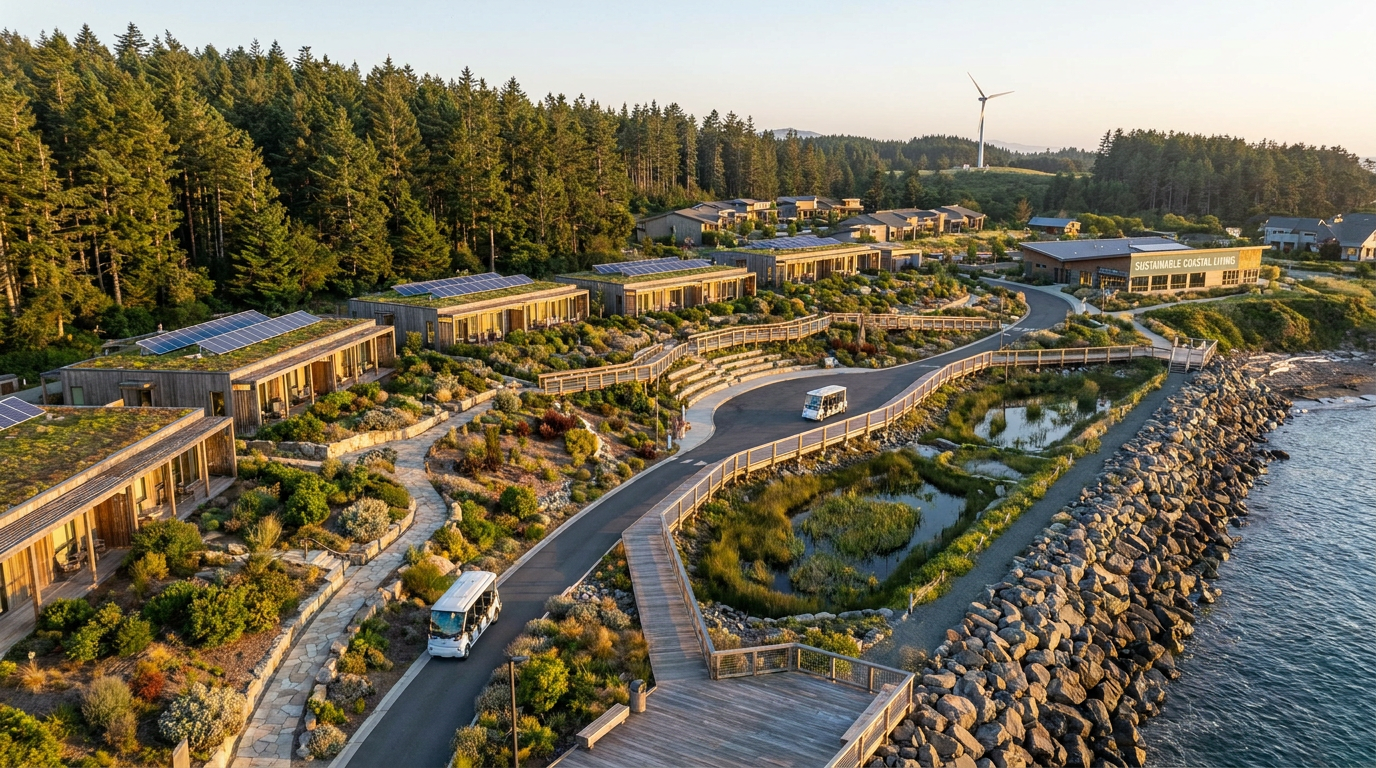
It is important to avoid a common misconception here. Sustainable resort development is not just about adding green roofs or energy-efficient buildings. Those features matter, but they are only one layer of what resilience requires. True sustainability in a resort community also includes transportation access, hazard-aware land use, durable public infrastructure, protected ecological systems, and housing patterns that reduce long commuting distances for workers.
In other words, resilience is systemic. A resort municipality that relies heavily on distant commuting because local housing is unavailable may be exposing itself to both transportation vulnerability and labour instability. A waterfront community that maximizes shoreline development without adequate setbacks may be increasing its future adaptation costs. A mountain destination that does not diversify its year-round activity may be overexposed to seasonal climate volatility. The strongest projects are the ones that connect these issues early in planning rather than addressing them in isolation later.
The Rise of Hybrid Resort Living
Another defining trend is the emergence of resort communities as places for hybrid living. This reflects a broader change in how people think about residence, work, and quality of life. The rise of flexible work has expanded the number of households willing to live outside major urban centres if they can access strong amenities, digital connectivity, and a high-quality everyday environment. Resort communities are increasingly positioned to capture that demand.
But this is not simply a story about affluent migration. It is a structural shift in the role these communities play. The resort town of the future may serve as a tourism hub, a remote work location, a small business environment, a wellness destination, and a family-oriented community all at once. That makes planning more complicated, but it also creates more diverse development opportunities.
Developers who understand this shift can think beyond narrow hospitality product. Residential formats may need to accommodate longer stays, flexible work areas, multigenerational households, and service-rich daily life. Commercial areas may need a mix of restaurants, local retail, health services, co-working environments, and community amenities. Public spaces may need to support both tourism activity and routine local use. This is a different proposition than a resort built only for periodic occupation.
The strategic advantage of hybrid living is that it reduces dependence on a single demand stream. Communities that combine tourism with year-round residency, local entrepreneurship, and recreation-based lifestyle demand are often better positioned to withstand economic shifts. They can also justify investments in schools, transit, healthcare, and civic amenities that purely seasonal places struggle to sustain.
Transportation and Infrastructure Must Catch Up to the New Reality
As resort communities evolve into more complete places, infrastructure planning becomes more consequential. Transportation is especially important. Many resort towns still depend heavily on private vehicle access, but that model can create congestion, parking pressure, emissions, and inefficient land use. It also weakens the quality of the visitor and resident experience in places where walkability and natural character are part of the destination appeal.
Future-ready resort communities will need to prioritize transportation systems that support compact growth. That may include local shuttles, seasonal and year-round transit links, active transportation networks, and parking strategies that avoid overwhelming village centres. In some settings, employee housing located near job clusters may be one of the most effective transportation interventions available because it reduces commuting demand at the source.
Infrastructure planning also has to reflect the transition from seasonal peaks to more continuous use. Water systems, wastewater, energy networks, broadband, waste management, and public facilities must be sized and funded for a more complex pattern of occupancy. Resort communities that continue to build around old assumptions of temporary use may find themselves underprepared for the demands of permanent population growth and longer-stay visitors.
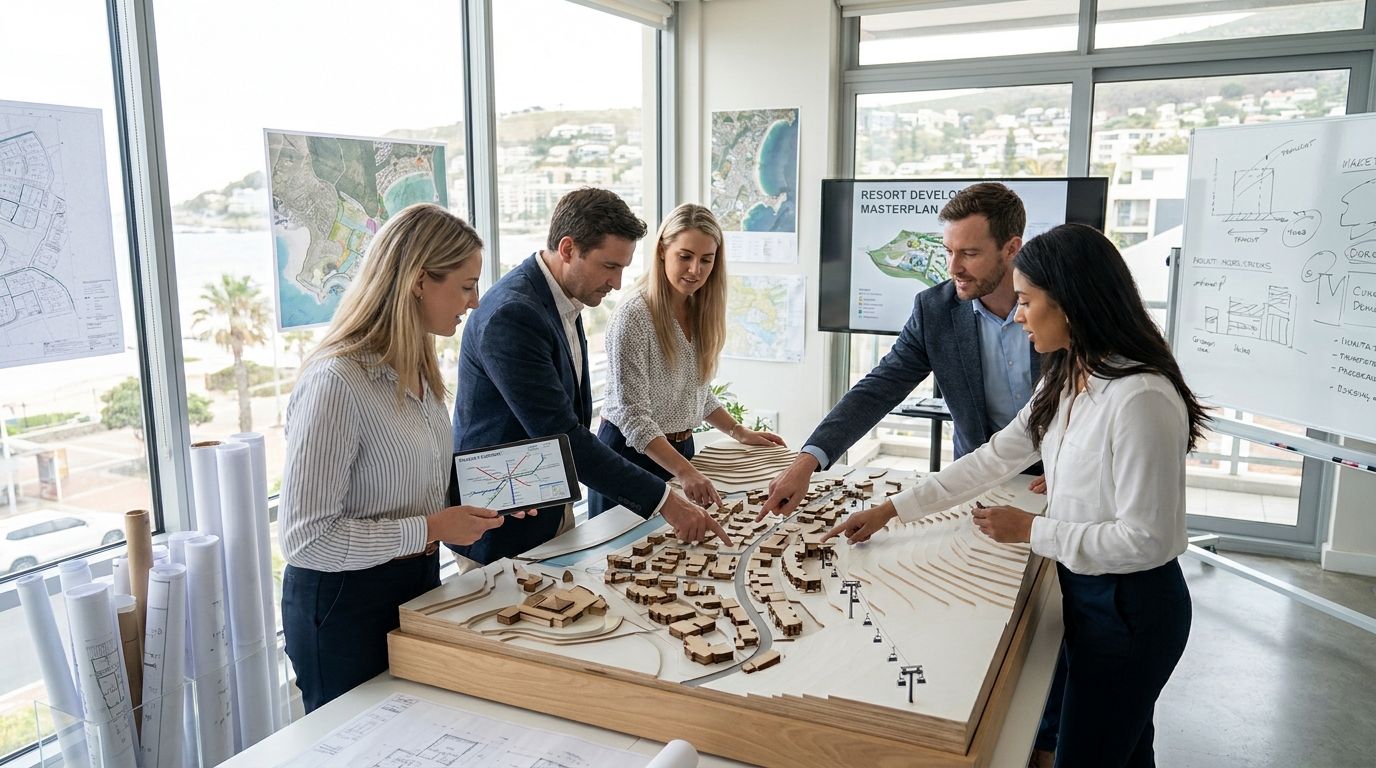
This is where integrated planning becomes essential. Land use, housing, infrastructure, and tourism management cannot be handled as separate files if the goal is long-term feasibility. They need to be aligned under one development vision, with clear sequencing and realistic assumptions about service capacity and municipal finance.
The Role of Public-Private Partnerships in Unlocking Opportunity
One of the strongest opportunities in resort community development lies in the use of public-private partnerships. These communities often face a difficult economics problem. Land is expensive, construction costs are high, and public expectations around design and environmental protection are significant. At the same time, there is pressure to provide attainable housing and community-serving infrastructure that the market alone may not deliver.
This is precisely the kind of environment where partnership structures can add value. Municipalities can contribute land, planning flexibility, servicing coordination, or targeted incentive frameworks. Private partners can bring capital, execution capacity, hospitality expertise, and phased development delivery. In some cases, employers, resort operators, or institutional partners may also play a role in workforce housing or shared amenity models.
The larger principle is that tourism value should help support local livability. Resort communities generate significant economic activity. The question is whether that activity is captured and reinvested in ways that strengthen the community over time. The most successful places of the next decade are likely to be those that use tourism-driven revenue and investment to support housing, public realm improvements, resilience infrastructure, and year-round services.
That is not just a policy ideal. It is a practical feasibility strategy. A resort that protects its workforce, upgrades its infrastructure, and maintains a strong public realm is likely to be more competitive over the long term than one that prioritizes short-run luxury inventory while neglecting community systems.
The Main Barriers Developers and Municipalities Must Solve
While the opportunities are substantial, the barriers are equally real. Restrictive zoning remains one of the most common obstacles, especially in places where existing development patterns favour low density or highly segmented land uses. In resort communities with limited land supply, this can severely constrain housing delivery and push prices even higher.
NIMBY resistance is another recurring issue. Many residents may support the idea of workforce housing or diversified supply in principle, but oppose specific projects that add density, alter neighbourhood character, or challenge long-standing assumptions about who the community is for. This tension can be particularly acute in high-amenity markets where preservation pressures are strong.
Financing is also difficult. Attainable housing often does not pencil out easily in land-constrained resort markets without some combination of public support, policy intervention, or cross-subsidy. Developers have to navigate high upfront costs, strict design requirements, servicing expenses, and market expectations that may favour premium product over community-serving supply.
These are not peripheral issues. They are core feasibility issues. A resort community cannot be future-ready if its planning framework makes inclusive growth nearly impossible. That is why strategic leadership matters. Municipalities and developers need to move beyond reactive approvals and toward long-term implementation frameworks that identify priorities, pre-zone key sites where appropriate, coordinate infrastructure, and establish realistic housing targets tied to economic needs.
What the Next Decade Will Reward
Looking ahead, the resort communities that outperform will likely share several characteristics. They will treat tourism as part of a broader settlement strategy rather than an isolated economic activity. They will plan for year-round use. They will build more housing diversity, especially rental and missing-middle forms. They will intensify thoughtfully around village centres and transit corridors. They will price climate resilience into the project from the beginning rather than as an afterthought.
They will also understand that destination value increasingly depends on local quality of life. Visitors are drawn to places that feel authentic, functional, and well cared for. A resort town that struggles with visible labour shortages, traffic dysfunction, housing scarcity, or failing infrastructure ultimately weakens its own competitive position. By contrast, a community that works well for residents usually works better for visitors too.
This is an important shift in development thinking. For years, some resort projects were evaluated primarily on the basis of amenity, branding, and sales absorption. Those factors still matter, but they are no longer enough. Future value will come from integrated performance: how well a project supports housing, public life, resilience, mobility, and long-term operational stability. In that sense, the future of resort communities looks increasingly like the future of city-building itself, just expressed in a different landscape and market context.
Conclusion: Resort Communities as a Model for Smarter Growth
Resort communities are no longer just vacation destinations at the edge of urban systems. They are increasingly functioning as tourism hubs, housing markets, employment centres, and climate adaptation zones all at once. That makes them highly relevant to the larger conversations shaping Canadian development today. Questions about densification, affordability, infrastructure capacity, sustainability, and long-term growth are all present here in a concentrated and visible form.
The path forward is clear even if the execution is challenging. Resort communities must be planned as complete places. That means recognizing workforce housing as essential infrastructure, embracing mixed-use and transit-supportive growth, expanding year-round economic strategies, and embedding climate resilience into every stage of planning and design. It also means using the strength of the visitor economy to help fund investments that support both residents and tourists.
Canada’s tourism sector is growing. Housing demand remains intense. Climate risk is rising. These trends are not separate. In resort communities, they meet on the same sites, in the same municipal budgets, and within the same development decisions. The next generation of successful resort projects will be the ones that acknowledge this reality and build accordingly.
From a strategic development perspective, that is the real opportunity. Resort communities can become more than destinations. They can become models of balanced growth where economic vitality, housing delivery, environmental stewardship, and quality of life reinforce one another. In a market that increasingly rewards resilience and integration, that is not just good planning. It is smart long-term value creation.
Key Strategic Priorities for Future Resort Community Development
- Plan for year-round use by diversifying amenities, employment, and public services beyond one peak season.
- Treat housing as infrastructure with clear targets for rental, workforce, and missing-middle supply near jobs and services.
- Focus growth in mixed-use village centres to improve land efficiency, walkability, and fiscal sustainability.
- Design for climate resilience from the start through risk-aware land use, durable infrastructure, and environmental protection.
- Use public-private partnerships strategically to unlock land, financing, and delivery mechanisms that the market cannot solve alone.
- Align tourism revenue with community investment so that destination success strengthens long-term local livability.
The future of resort communities will belong to places that can think like destinations and plan like complete communities. That is the standard the next decade will demand, and the communities that meet it will be the ones best positioned to grow with confidence.



No Comment! Be the first one.