



There are few design gestures as immediate and persuasive as beautifully composed facade lighting. By day, a home may charm through material, proportion, and landscaping. By night, however, light becomes the language that reveals its character. A thoughtfully illuminated exterior can make a modest facade feel composed and welcoming, and it can give an already elegant home the final layer of refinement that allows it to feel complete.
Table Of Content
- Why Facade Lighting Matters More Than Ever
- The French Design Parallel: Restraint, Symmetry, and Grace
- How Facade Lighting Reflects Personal Style
- The Core Layers of a Beautiful Facade Lighting Plan
- Entry Lighting
- Architectural Accent Lighting
- Path and Transition Lighting
- Landscape Integration
- Choosing Fixtures That Suit the Architecture
- Color Temperature, Color Rendering, and the Mood of the Exterior
- Efficiency, Controls, and the New Luxury of Intelligent Lighting
- Dark Sky Thinking and Why Less Glare Creates More Beauty
- Common Facade Lighting Mistakes to Avoid
- A Practical Approach to Planning Your Facade Lighting
- How Elegant Lighting Supports Property Value
- The Lasting Appeal of a Well Lit Home
Facade lighting is often discussed in practical terms, and rightly so. It improves visibility, supports safer movement around entry doors and pathways, and can strengthen a sense of security. Yet its deeper value lies in how it shapes perception. It frames architecture, softens darkness, highlights craftsmanship, and gives the home a presence that feels intentional rather than incidental. In many neighborhoods, especially across Canada and the northern United States where winter evenings arrive early, exterior lighting becomes a defining part of how a property is seen for much of the year.
What makes facade lighting especially compelling is that it can transform curb appeal without requiring major construction. Unlike a full exterior renovation, a lighting plan works with what already exists. It draws attention to symmetry, texture, and detail. It can make older materials appear richer, entrances more generous, and proportions more graceful. For homeowners who want a visible upgrade that feels both aesthetic and practical, lighting is one of the most intelligent places to begin.
This is also where personal style enters the conversation. The most memorable homes do not simply glow brighter than their neighbors. They reveal a point of view. A traditional home may call for soft lantern light and warm pools of illumination around the entry. A contemporary facade may suit precise, low glare beams that skim stone or concrete with restraint. A French inspired exterior may benefit from symmetry, hierarchy, and a disciplined elegance that feels effortless. The aim is not excess. The aim is expression.
Research consistently supports this balanced approach. The U.S. Department of Energy describes outdoor residential lighting as serving three primary roles: aesthetics, security, and utility. The most successful facade lighting schemes do not favor one at the expense of the others. They make the house look beautiful, they help residents and guests move comfortably, and they do so efficiently. That efficiency matters, particularly when lighting can account for roughly 15 percent of a typical home’s electricity use. The Department of Energy also notes that LED lighting can use up to 90 percent less energy and last up to 25 times longer than incandescent alternatives, making today’s exterior lighting far more sophisticated and sustainable than older approaches.
Seen through a design lens, facade lighting is not merely an accessory. It is an architectural layer. When carefully chosen and precisely placed, it can reflect the homeowner’s taste, reinforce the identity of the facade, and support property value by elevating first impressions. In that sense, the home at night becomes a portrait of its owners: composed, welcoming, and quietly expressive.
Why Facade Lighting Matters More Than Ever
In contemporary residential design, curb appeal no longer ends at sunset. Buyers, guests, and neighbors often encounter homes in the evening, especially during colder months when darkness arrives early. A house that appears beautifully resolved at night can feel more expensive, more cared for, and more secure. This is one reason exterior lighting is increasingly understood not only as decoration but also as part of a property investment strategy.
While the exact resale effect of lighting varies by market, there is broad industry agreement that exterior improvements supporting first impressions and nighttime usability tend to strengthen buyer perception. A well lit facade suggests maintenance, thoughtfulness, and quality. Even before a person steps inside, lighting can imply that the same level of attention continues throughout the house. That perception is powerful. Real estate value often begins not with square footage alone but with the emotional impression a home creates in the first few moments.
There is also the matter of safety and comfort. People want to approach a home confidently. They want to see steps, transitions in paving, and the front door clearly. They want house numbers to be legible, pathways readable, and dark corners minimized without the property feeling overexposed. Good facade lighting makes movement intuitive. It quietly removes friction from everyday life, whether someone is arriving home with groceries, welcoming guests for dinner, or returning on a winter evening.
At the same time, modern homeowners are far more aware of energy use than previous generations. This has changed expectations around outdoor lighting. It is no longer acceptable for beauty to come at the cost of waste. The Department of Energy notes that switching to LED lighting can save the average household about $225 per year in energy costs, and the outdoor sector has been one of the strongest adopters of LED technology. That progress means homeowners can now enjoy subtle, luxurious exterior lighting while consuming far less electricity than older systems required.
What emerges is a new standard for curb appeal: elegant, efficient, layered, and sensitive to context. Facade lighting matters because it addresses multiple aspirations at once. It helps a home feel safer, look more sophisticated, and operate more intelligently. Very few design choices offer such a broad return.
The French Design Parallel: Restraint, Symmetry, and Grace
French design offers a particularly beautiful framework for thinking about facade lighting because it values composition over spectacle. Whether one looks to a Parisian townhouse, a provincial manor, or a neoclassical facade, the underlying principles are remarkably consistent. There is hierarchy in the architecture, discipline in the arrangement of details, and a confidence in letting proportion speak for itself. Lighting that follows these ideas tends to feel timeless.
The first principle is restraint. French elegance rarely depends on too much. Instead of flooding the entire exterior with indiscriminate brightness, it favors fewer, better placed points of illumination. This creates softness, shadow, and visual hierarchy. The eye is guided to the entrance, the rhythm of windows, the verticality of columns, or the depth of a cornice. Such an approach feels far more luxurious than uniform brightness, which can flatten the facade and erase the mystery that makes a home alluring.
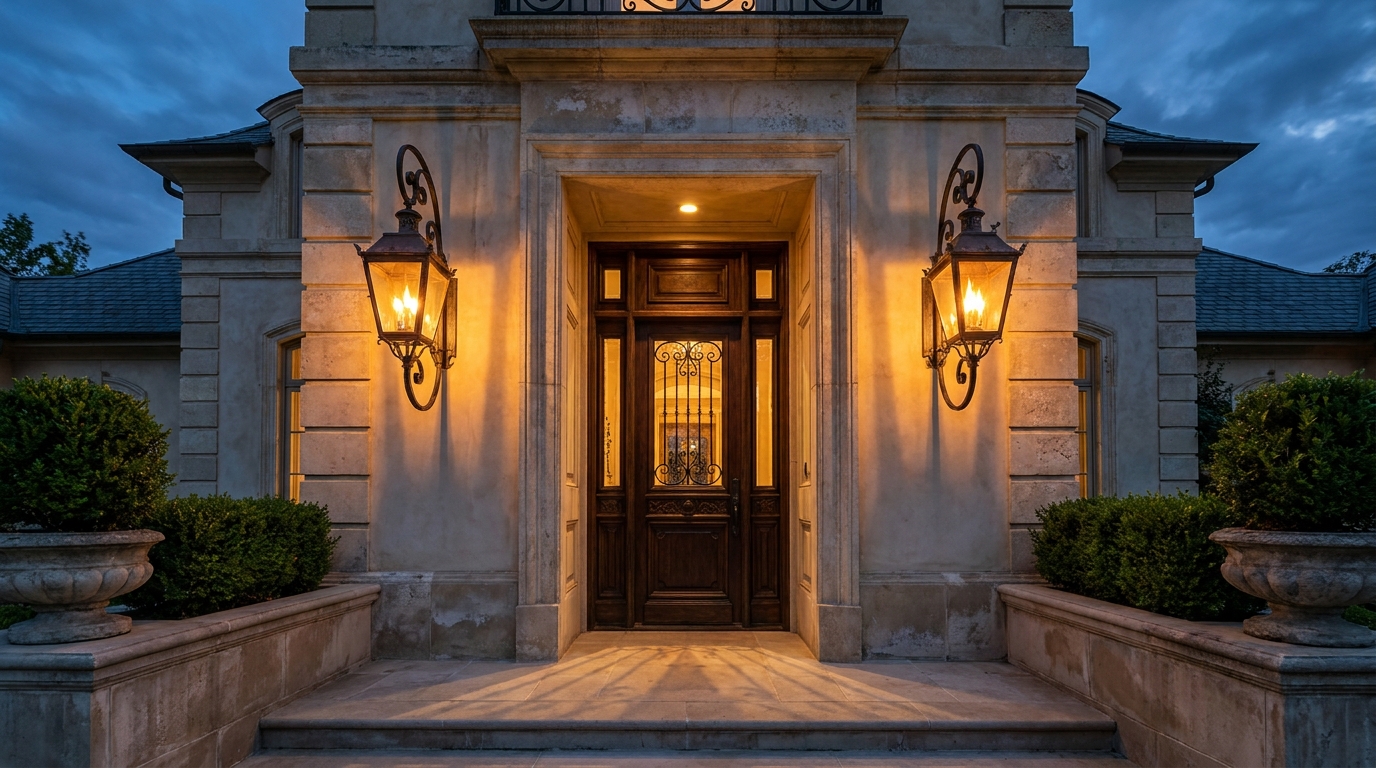
The second principle is symmetry. Many French inspired homes rely on balanced composition, and lighting should reinforce that order. Matching lanterns at the front door, evenly spaced sconces along a terrace wall, or paired uplights marking key architectural elements can strengthen the sense of harmony. Even on less formal houses, balanced lighting brings calm and coherence to the exterior.
The third principle is hierarchy. Not every part of the home deserves equal attention. In classic design, the entry is often the focal point, followed by major architectural gestures such as columns, gables, stonework, or a central bay. Lighting should mirror that ranking. The front door may receive the warmest, most welcoming treatment, while secondary areas remain gentler and quieter. This preserves depth and elegance.
Finally, French design teaches the value of material sensitivity. Limestone, stucco, wrought iron, painted wood, slate, and clipped greenery all respond differently to light. A warm, low glare source can make stone appear velvety and rich. A narrow beam can sharpen a pilaster’s edge. Soft side lighting can reveal the texture of plaster in a way broad floodlighting never could. The result is not a brighter house but a more articulate one.
Elegant facade lighting is less about adding light everywhere and more about revealing what is already beautiful.
How Facade Lighting Reflects Personal Style
One of the most appealing aspects of facade lighting is its ability to personalize a home without changing its structure. Paint color, hardware, and landscaping all contribute to identity, but light animates those decisions. It determines whether a house feels romantic, tailored, dramatic, modern, or serene. In that sense, facade lighting is deeply expressive. It allows the exterior to communicate atmosphere as much as architecture.
A homeowner drawn to classic, European inspired design may prefer warm white light, lantern style fixtures, and gentle accenting that feels intimate rather than theatrical. This style pairs beautifully with brick, stone, stucco, shutters, iron railings, and symmetrical landscaping. It suggests hospitality and permanence. The home appears settled and quietly confident.
Someone with a more contemporary sensibility may lean toward recessed details, concealed sources, and crisp beam control. Here, the beauty comes from precision. Light may wash a smooth wall evenly, graze a textured cladding surface, or create graphic vertical lines beside a minimalist entry. Even in modern contexts, however, the best results still avoid glare and excess. Refinement comes from control, not from intensity.
For those who enjoy entertaining, smart exterior lighting can also become part of the home’s social identity. A scene can be programmed for everyday evenings, another for dinner parties, and another for holiday gatherings. Warm dimmed lighting around the entry and terrace can make the exterior feel like an extension of the interior. This is especially useful in climates where patios, porches, and front gardens are part of seasonal living.
Personal style can also emerge through what is left dark. Not every shrub, wall plane, or roof edge must be illuminated. Selectivity signals confidence. It says the homeowner understands composition. The negative space between lit areas allows the facade to breathe, creating depth and softness that feel much more sophisticated than a house outlined with light from end to end.
The Core Layers of a Beautiful Facade Lighting Plan
The most successful facade lighting schemes are layered. They do not depend on a single fixture type or one blanket effect. Instead, they combine distinct lighting roles so the exterior feels both beautiful and useful. Thinking in layers helps homeowners create a scheme that works from multiple viewpoints and for multiple purposes.
Entry Lighting
The front entrance is the emotional heart of the facade. It should be illuminated clearly enough to welcome visitors, reveal hardware, and support visibility at the threshold, yet softly enough to feel elegant. Wall lanterns or sconces on either side of the door are a classic solution because they reinforce symmetry and create a sense of ceremony. Their scale should relate to the height and width of the door, and their finish should harmonize with other exterior details such as railings, house numbers, and door hardware.
Entry lighting is also where warmth matters most. A gentle, inviting color temperature creates a human atmosphere. Rather than making the door appear harshly spotlighted, the light should flatter the surrounding materials and subtly announce the transition from outdoors to indoors. If there is a porch ceiling, a recessed fixture or understated pendant can complement wall lights and improve visibility without disrupting the composition.
Architectural Accent Lighting
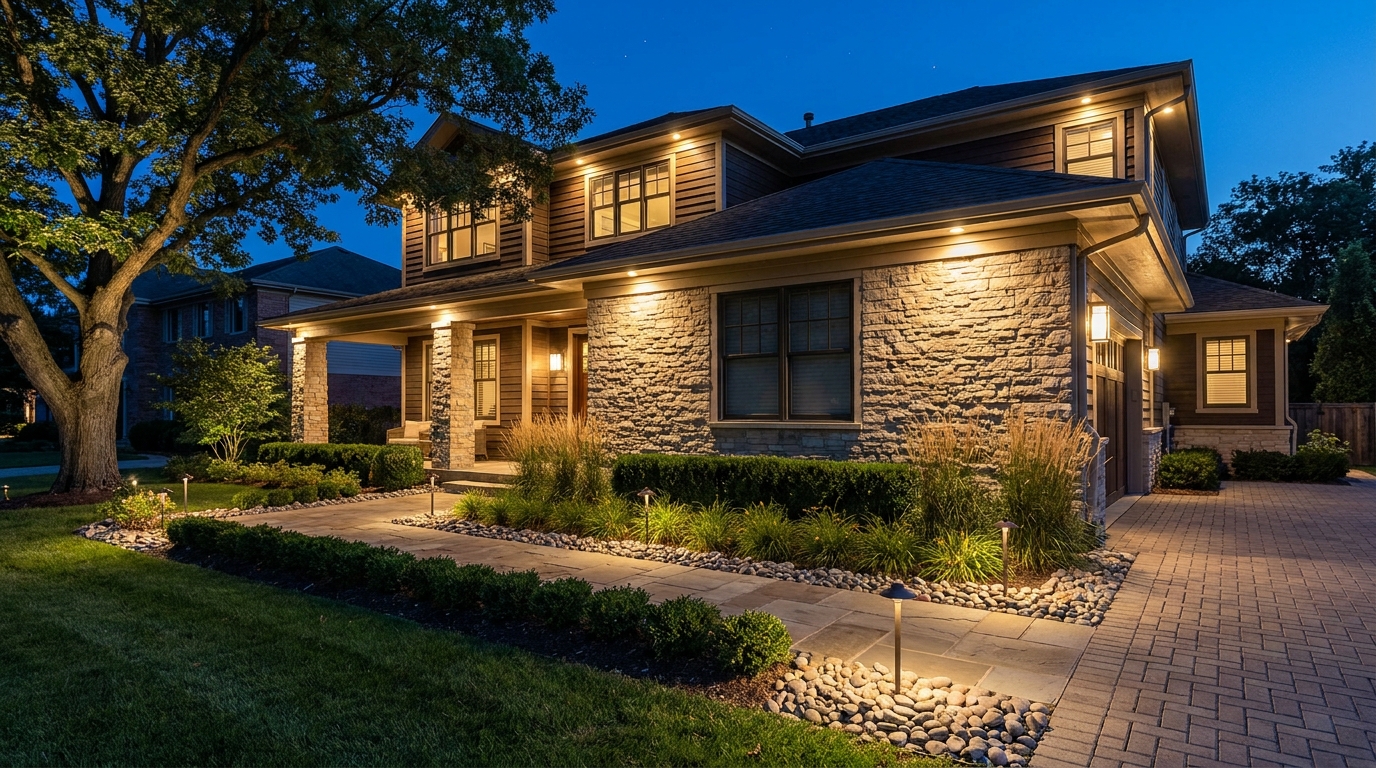
Accent lighting reveals the facade’s craftsmanship. It may highlight columns, arches, stone textures, shutters, or vertical massing. The goal is not to decorate randomly but to underline the architecture’s logic. Uplighting can be very effective on columns and larger wall planes, while grazing can dramatize textured surfaces such as stone or brick by casting controlled shadow across the material.
Precise beam spread is essential here. A fixture that is too wide can spill light where it is not wanted and flatten the effect. A beam that is too narrow may create hot spots and visual clutter. This is why facade lighting should always be matched to the size, texture, and spacing of the architectural features being illuminated. Thoughtful accent lighting makes the house look composed. Poorly scaled lighting makes it look restless. Kingsgate Luxury Homes applied this exact principle on a custom build with a hand-carved limestone facade, using precisely placed exterior accent lighting to draw out the stone’s texture after dark — the finished result is a good real-world illustration of the effect: 203 Newton Dr, North York.
Path and Transition Lighting
While not always considered part of facade lighting, path and step lighting strongly influence how the facade is perceived. A beautifully lit house loses much of its grace if visitors approach through darkness or glare. Low level path lights, recessed step lights, or discreet bollards can define circulation and make the front approach feel polished. The effect should be subtle. These fixtures are there to guide the eye and the body, not to dominate the landscape.
Path lighting also supports the practical side of curb appeal. It improves usability in rain, snow, and ice, and it makes the entire front zone feel finished. In French inspired exteriors especially, this measured guidance contributes to the feeling of order. The home seems not only beautiful but graciously planned.
Landscape Integration
Trees, clipped hedges, planters, and architectural planting can enrich facade lighting when handled lightly. A softly illuminated tree canopy can frame a house beautifully. A sculptural olive tree, boxwood parterre, or layered foundation planting can add depth between the street and the wall of the house. Yet landscaping should remain secondary to the architecture unless the garden itself is the focal point.
The most elegant solutions treat landscape lighting as a companion rather than a rival. It extends the composition outward, making the home feel rooted in its site. Overly bright garden lighting, by contrast, can distract from the facade and create a fragmented appearance.
Choosing Fixtures That Suit the Architecture
Exterior fixtures are both tools and objects. In daylight they are visible pieces of hardware attached to the house. At night they shape the atmosphere. This dual role means their design should never be chosen casually. A fixture needs to be visually compatible with the architecture, physically appropriate for outdoor use, and technically capable of producing the intended effect.
For traditional and French inspired homes, lanterns and sconces often work beautifully because they echo historical precedents and bring sculptural presence to the facade. Matte black, bronze, aged iron, and warm metallic finishes tend to sit gracefully against stone, stucco, and painted wood. The fixture should feel proportional. A lantern that is too small can disappear and feel timid. One that is too large can become costume rather than architecture.
For contemporary homes, many designers prefer simpler forms with concealed light sources and cleaner profiles. Cylindrical up and down lights, linear wall washers, or recessed architectural fixtures may suit these facades better. The key is consistency. Fixtures should belong to the same visual language as the house rather than introducing unrelated ornament.
Performance matters just as much as appearance. Residential exterior fixtures should be outdoor rated, and wet location suitability is essential where exposure demands it. Homeowners should also look for high quality optics, shielded sources, and durable finishes that age well. ENERGY STAR certified fixtures are available in both the United States and Canada, which helps homeowners combine efficiency with reliable performance. A decorative fixture that produces glare or fails in harsh weather is never truly elegant.
Color Temperature, Color Rendering, and the Mood of the Exterior
Light has color, and that color influences emotion immediately. For most residential facades, warm white light tends to be the most flattering. It softens materials, feels welcoming, and aligns with the glow people associate with domestic comfort. On traditional, French provincial, or classically detailed homes, warm temperatures often enhance the richness of stone, plaster, and wood far better than cooler, bluer tones.
Consistency is particularly important. One of the most common mistakes in residential facade lighting is mixing too many color temperatures. A warm lantern at the door combined with cool path lights and neutral uplights can make the exterior look unresolved, even if each fixture is attractive on its own. Choosing a coherent palette allows the home to read as a single composition.
Color rendering also deserves attention. Good color rendering helps natural materials appear true and refined after dark. Stone should still look nuanced, greenery should still feel alive, and painted surfaces should maintain their intended depth. Poor rendering can make even an expensive facade look dull or oddly tinted. Since lighting is meant to reveal beauty, not distort it, this specification is worth asking about.
Tunable white lighting is becoming increasingly available, offering the ability to shift ambiance when appropriate. This can be useful for homeowners who want slightly brighter, clearer settings for winter evenings and gentler, more atmospheric scenes for entertaining. The advantage of tunability is flexibility. The risk is overuse. A graceful home still benefits from restraint and consistency, even when the technology allows for variation.
Efficiency, Controls, and the New Luxury of Intelligent Lighting
Modern luxury is no longer defined only by appearance. It is also defined by ease, intelligence, and responsibility. Facade lighting today can be beautiful and remarkably efficient, especially when paired with LED technology and thoughtful controls. According to the Department of Energy, LEDs can use up to 90 percent less energy than traditional incandescent bulbs and last up to 25 times longer. That performance changes the economics of exterior lighting, making a layered lighting plan more practical over time.
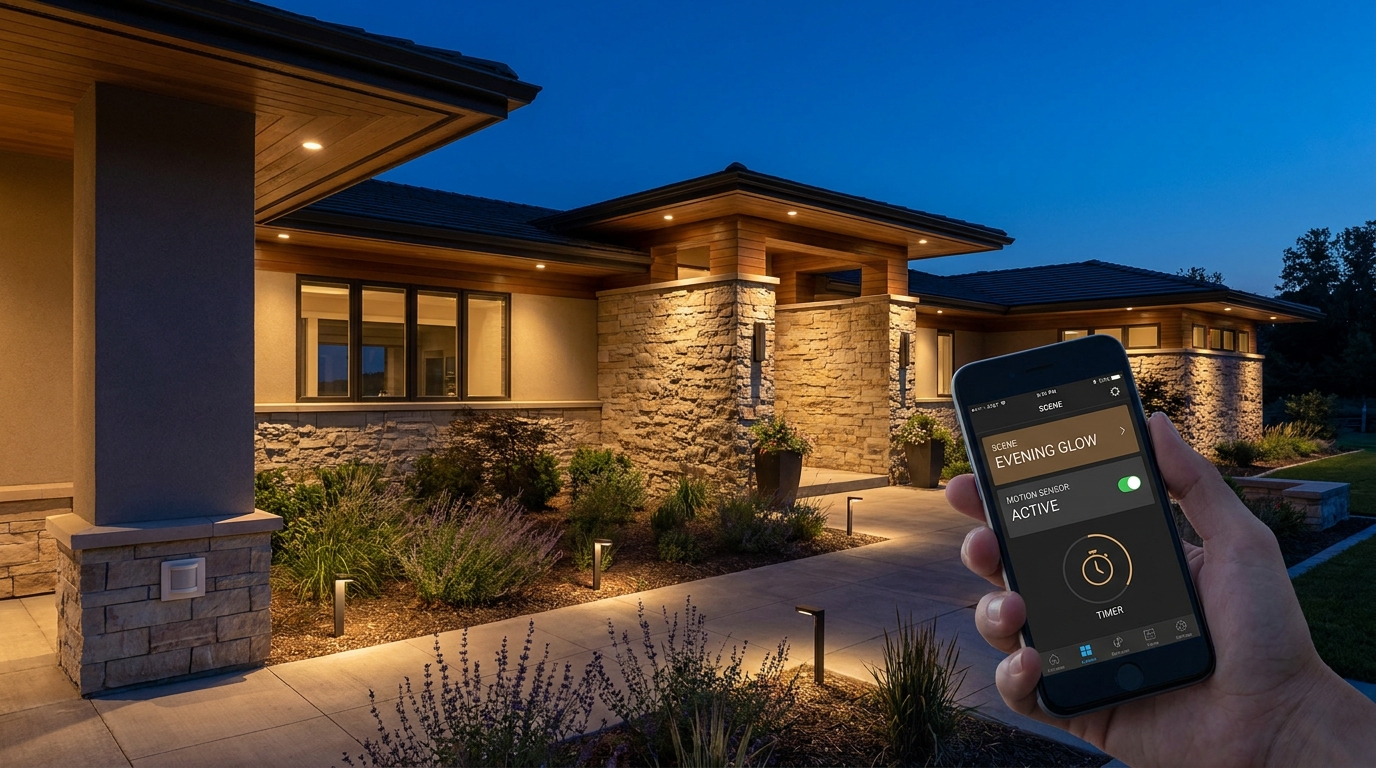
Controls are where elegance becomes truly livable. The Department of Energy recommends timers, dimmers, motion sensors, and photosensors for outdoor lighting performance and efficiency. These allow the home to respond to actual use rather than remaining fully illuminated all night. An entry lantern can activate at dusk, path lighting can dim late in the evening, and motion sensors can quietly bring utility lighting to a higher level only when needed.
This matters aesthetically as much as financially. A house that is always at maximum brightness can feel static and overexposed. One that responds to time and activity feels more composed. The exterior remains welcoming when it needs to be, while avoiding unnecessary spill and wasted energy when the household is asleep or away.
Smart home integration adds another layer of convenience. Homeowners can create scenes, adjust schedules seasonally, and control lighting remotely. In practice, this means the facade can shift from everyday calm to event ready charm with very little effort. The best systems remain discreet. Their purpose is not to advertise technology, but to make the atmosphere feel effortless.
Dark Sky Thinking and Why Less Glare Creates More Beauty
One of the most important shifts in outdoor lighting design is the growing emphasis on dark sky performance. Good lighting should illuminate what matters while limiting spill, skyglow, and trespass. This approach is not only environmentally responsible. It is also aesthetically superior. Low glare lighting makes a facade appear calmer, richer, and more expensive because the eye can appreciate contrast and shadow rather than fighting brightness.
The DesignLights Consortium developed LUNA requirements in part to reduce skyglow and light trespass while improving efficiency in controllable outdoor white light LED luminaires. Parks Canada guidance also emphasizes reducing illumination levels that reflect into the sky and recommends turning lights off after a reasonable time. These principles, while often discussed in broader planning contexts, are highly relevant to private homes. A beautifully lit property should not send harsh light into neighboring windows or upward into the night sky.
This is where shielding, aiming, and output selection become crucial. A well shielded fixture directs light downward or onto the intended architectural surface. It does not expose the lamp directly to the viewer. This reduces discomfort and creates a more polished effect. In many cases, the most luxurious exterior lighting is the kind you feel before you consciously notice it.
Dark sky thinking also aligns naturally with French inspired restraint. By using fewer, better positioned sources, homeowners can create an atmosphere that feels intimate and sophisticated. The house glows where it should and recedes where it should. Darkness becomes part of the composition rather than something to eliminate entirely.
Common Facade Lighting Mistakes to Avoid
Even expensive fixtures can produce disappointing results if the design lacks discipline. One of the most frequent mistakes is overlighting. Homeowners sometimes assume that brighter automatically means better curb appeal or better security. Yet the Department of Energy explicitly notes that security and utility lighting do not need to be bright in every instance to be effective. Excessive brightness can flatten the architecture, create glare, and make the property feel exposed rather than elegant.
Another common issue is inconsistency in color temperature. When different fixtures cast noticeably different tones, the facade can look accidental. This often happens when new fixtures are added over time without a whole home lighting plan. A coordinated scheme should feel visually continuous from the front door to the pathway to the garage area.
Poor beam spread is another subtle but important problem. Without considering how light actually lands on surfaces, homeowners may end up with hot spots, dark gaps, or spill onto neighboring property. Architectural lighting works best when optics are chosen for the scale and texture of the facade. A small textured stone pier needs a different treatment from a broad stucco wall or a tall entry gable.
Decorative fixtures that are not properly rated for outdoor use can also create long term frustration. Weather resistance, wet location suitability, and durable finishes are not glamorous topics, but they are essential. Exterior lighting must withstand moisture, temperature change, and seasonal wear while maintaining performance and appearance.
Finally, many homeowners overestimate what solar lighting can do in every condition. The Department of Energy notes that outdoor solar lighting can work well, but only when the site receives the manufacturer’s recommended amount of sunlight. In shaded properties or regions with long winter darkness, solar may be useful as a supplement rather than the primary facade strategy. A realistic assessment of site conditions leads to much better results.
A Practical Approach to Planning Your Facade Lighting
The most successful facade lighting plans begin with observation. Walk outside at dusk and study the home as a composition. What is the central focal point? Which materials deserve emphasis? Where does the eye naturally land, and where does the facade feel too dark or too visually busy? Understanding the architecture first prevents lighting from becoming arbitrary.
Next, think in terms of priorities rather than products. The entry should almost always come first, followed by circulation zones such as paths and steps, then key architectural accents. Landscape lighting can follow once the facade itself is resolved. This sequence helps ensure the design supports both beauty and daily use.
It is also useful to consider the home from multiple viewpoints. The facade is seen not only straight on from the street but also obliquely from the driveway, from inside the house looking out, and from neighboring approaches. A balanced lighting plan respects all of these perspectives. What feels pleasing from one angle should not cause glare or awkward brightness from another.
Whenever possible, test before finalizing. Temporary aiming at night can reveal whether an uplight should move slightly, whether a lantern feels too bright, or whether a path light spacing needs adjustment. Lighting is experiential. Small refinements can make a dramatic difference in the final atmosphere.
- Define the architectural focal point so the lighting has a clear hierarchy.
- Layer entry, path, and accent lighting rather than relying on one fixture type.
- Choose warm, coordinated color temperatures that flatter the facade materials.
- Use outdoor rated, efficient fixtures with good optics and minimal glare.
- Add controls such as timers, motion sensors, dimmers, and photosensors for comfort and efficiency.
- Review the design at night and refine aiming, output, and balance before considering it complete.
How Elegant Lighting Supports Property Value
Property value is influenced by many factors, but presentation remains one of the most immediate. Facade lighting contributes to presentation in a uniquely persuasive way because it affects mood, visibility, and perceived quality at once. A home that looks polished after dark often appears more complete overall. Buyers and guests register this impression quickly, even if they cannot immediately explain why the property feels elevated.
There is also a practical signal embedded in good lighting. It suggests that the homeowner has invested thoughtfully in maintenance and comfort. Well lit entry points, legible paths, and balanced architectural accents imply care. This matters because buyers often use exterior cues to imagine the condition of less visible systems inside the home. Lighting can therefore influence the narrative people tell themselves about the property.
Unlike some highly personal renovations, facade lighting tends to offer broad appeal when done tastefully. Most people appreciate a home that feels welcoming and safe. Most buyers also respond positively to efficient LED systems and automated controls because they promise lower upkeep and easier daily use. In this way, lighting supports value not by shouting but by reassuring.
Perhaps most importantly, facade lighting enhances the emotional memory of the house. In real estate, memory is powerful. A property that glows softly in the evening, reveals its architecture with grace, and feels easy to approach is often the one people continue thinking about after they leave. That lingering impression is a form of value in itself.
The Lasting Appeal of a Well Lit Home
Elegant facade lighting is ultimately about more than illumination. It is about authorship. It allows a homeowner to decide how the house is seen, how it welcomes, and how it belongs to the landscape after dusk. When guided by restraint, proportion, and an understanding of architecture, lighting becomes one of the most poetic tools in exterior design.
The French design parallel is especially useful because it reminds us that beauty does not require excess. Symmetry, hierarchy, softness, and material awareness can turn a simple lighting plan into a deeply refined one. The house does not need to perform for the street. It needs only to reveal itself with confidence.
At the same time, today’s technology makes it easier than ever to achieve that elegance responsibly. LEDs, smart controls, and dark sky friendly strategies allow homeowners to enjoy atmosphere, safety, and efficiency together. The result is a facade that feels current without becoming cold, and luxurious without becoming wasteful.
If curb appeal is the first conversation a home has with the world, facade lighting determines its evening voice. Let that voice be warm, composed, and unmistakably personal. A beautifully lit home does not simply stand out. It stays with you.



No Comment! Be the first one.