



Property management has always been a balancing act between cost control, tenant satisfaction, maintenance planning, and risk reduction. What has changed in recent years is the quality of information available to make those decisions. IoT property systems are giving owners and managers a far clearer view of how buildings actually perform day to day, from energy use and equipment behavior to occupancy patterns and water loss. Instead of waiting for complaints, failures, or utility bill surprises, teams can now monitor conditions in near real time and respond earlier.
Table Of Content
- Why IoT matters in property management now
- What an IoT property system actually includes
- The most practical IoT use cases for property managers
- HVAC optimization and fault detection
- Smart metering and submetering
- Occupancy-based control
- Lighting automation
- Leak detection and water-loss prevention
- Indoor air quality and comfort monitoring
- Smart access control and security integration
- How IoT improves the tenant experience
- From reactive maintenance to predictive maintenance
- What the data means for owners and capital planning
- Implementation realities: what property managers need to get right
- A practical roadmap for getting started
- Common misconceptions about IoT property systems
- The future of IoT in smart property data
- Conclusion
This is why the conversation around smart buildings has matured. It is no longer just about installing trendy devices or adding automation for its own sake. The real value of IoT in property management comes from turning a building into an operational data system, where sensors, controls, and analytics work together to reveal what needs attention, what is wasting money, and what is affecting the tenant experience. For owners of residential, commercial, and mixed-use properties, that visibility can have a direct impact on expenses, service quality, and long-term asset planning.
The scale of the opportunity is especially clear in Canada. Statistics Canada reported that there were 555,951 commercial and institutional buildings in the provinces in 2019, covering 709.0 million square metres and consuming 948.2 million gigajoules of energy. The average energy use intensity was 1.31 GJ/m², and total building energy use was equivalent to the annual energy consumption of more than 10.7 million Canadian households. Those figures make one point impossible to ignore: building performance is not a niche technical issue. It is a major operating cost issue, a major emissions issue, and a major management issue.
This article takes a hands-on approach to show how IoT systems are transforming property management in practical terms. We will look at the most useful use cases, explain where the savings really come from, and show what property owners and managers need to get right if they want smart technology to deliver measurable results.
IoT does not make a building efficient by itself. It makes building performance visible, which gives managers the ability to act faster and with better evidence.
Why IoT matters in property management now
Buildings have always generated signals. An HVAC unit starts cycling too often. A boiler runs longer than expected. A corridor feels too warm. A water line leaks slowly behind a wall. A lobby is fully lit long after traffic has dropped. Traditionally, managers only discovered these patterns after a complaint, a site visit, or a costly failure. IoT systems change that timing by collecting data continuously through connected sensors and control devices.
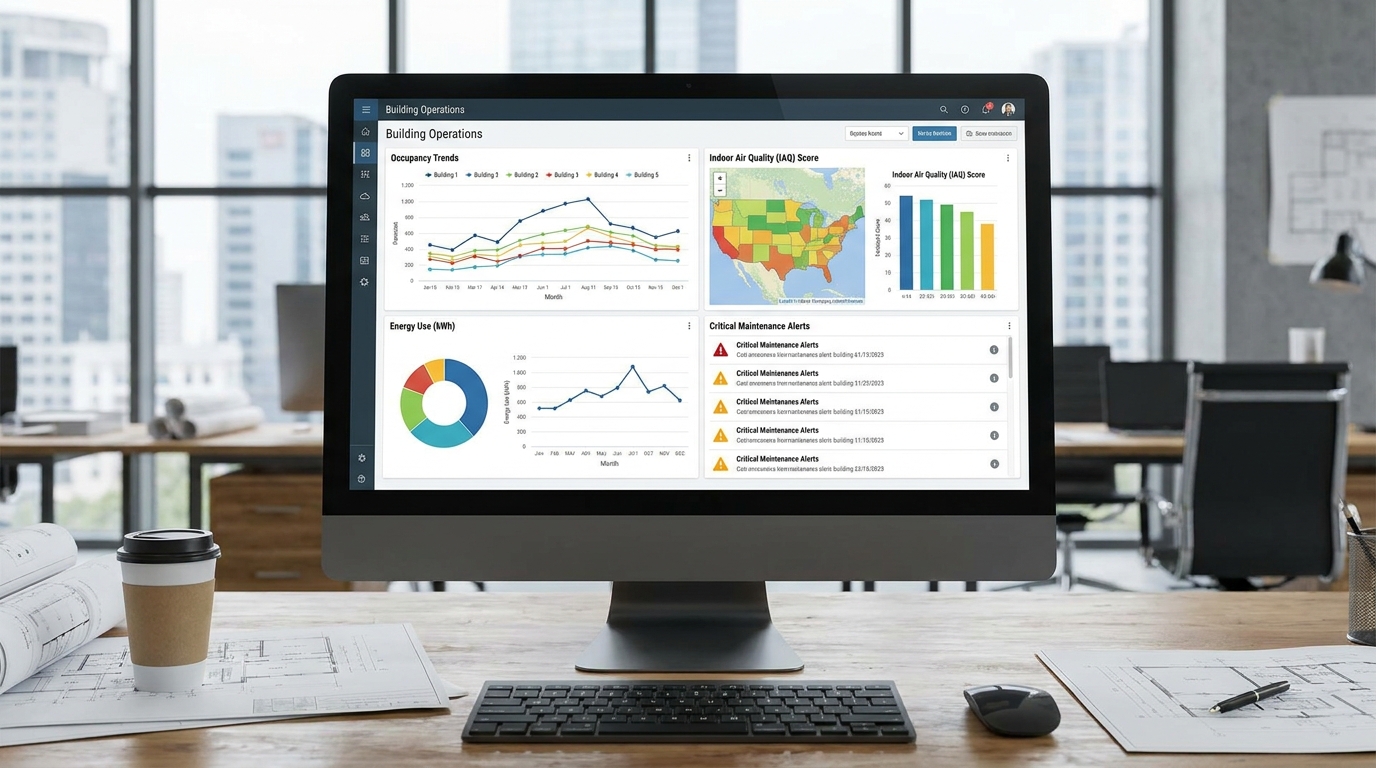
That shift matters because property management is often constrained by limited staff time and inconsistent visibility across multiple assets. A manager may be responsible for several buildings, each with different equipment, tenant expectations, and utility profiles. Without connected systems, decisions rely heavily on manual inspections, contractor feedback, and monthly bills that arrive long after waste has already happened. With IoT, the same manager can see alerts, trends, anomalies, and performance comparisons across a portfolio from a single dashboard.
The timing also aligns with broader market pressure. Many buildings across North America are aging, utility costs remain volatile, and regulatory interest in decarbonization continues to grow. In Canada, federal and policy conversations increasingly position building efficiency as part of the net-zero transition. In the United States, the Department of Energy has highlighted the role of sensors, controls, analytics, and smart integration in moving buildings from reactive control toward optimized whole-building performance. For property managers, that policy language becomes practical very quickly. It affects retrofit decisions, capital planning, reporting requirements, and tenant expectations.
There is also a cultural shift in how tenants evaluate buildings. Occupants increasingly notice comfort consistency, air quality, digital access, and service responsiveness. They may never ask whether a building uses fault detection diagnostics, but they do notice whether the office is too hot at 3 p.m., whether the hallway smells damp after a leak, or whether management resolves recurring issues quickly. IoT systems help teams deliver a more stable building experience, which in turn supports retention and reputation.
What an IoT property system actually includes
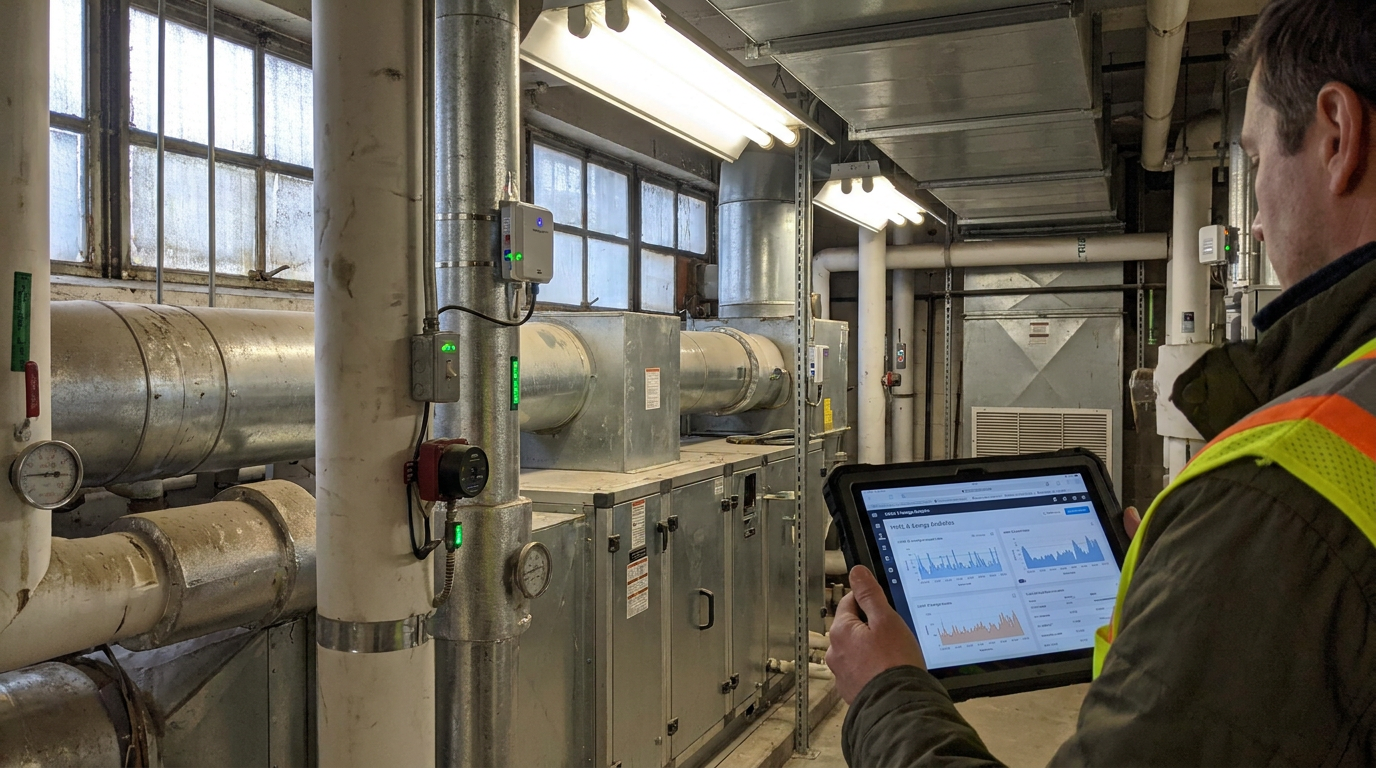
When people hear the term IoT property systems, they often imagine a single product. In practice, it is a connected stack of devices, software, and operating workflows. The hardware layer typically includes sensors for temperature, humidity, occupancy, carbon dioxide, vibration, energy consumption, water flow, and leak detection. It may also include smart thermostats, lighting controls, submeters, connected locks, and gateway devices that move data into a central platform.
Above that hardware layer sits the software and controls environment. This may connect to a Building Management System, an Energy Management Information System, or a dedicated analytics platform that brings together information from multiple devices and sites. Increasingly, these systems also support Fault Detection and Diagnostics, which means they do more than display readings. They identify patterns that suggest something is wrong, such as simultaneous heating and cooling, unusual equipment runtime, poor ventilation, or drifting sensor calibration.
What makes the system useful is not just connectivity. It is the connection between data and action. A sensor detects a problem, the platform classifies it, staff receive an alert, someone investigates, and the corrective action is tracked. That operational loop is where value is created. Without it, a building may simply generate more data than the team has time to use.
The most practical IoT use cases for property managers
Although the smart building market is broad, a few use cases consistently deliver the most practical value in property management. These are the areas where data tends to connect directly to cost, risk, and tenant satisfaction. A building does not need every possible device to benefit from IoT. In most cases, the strongest programs begin with high-impact operational problems and expand from there.
HVAC optimization and fault detection
Heating, ventilation, and air conditioning usually represent one of the largest energy and maintenance categories in a building. They also generate a large share of tenant complaints because comfort problems are immediately noticeable. IoT sensors can monitor room temperature, humidity, airflow indicators, equipment runtime, setpoints, and occupancy to show whether HVAC systems are performing as intended.
This becomes especially powerful when combined with analytics. Rather than waiting for an air handler or rooftop unit to fail, a manager can detect unusual cycling, simultaneous heating and cooling, filter issues, sensor drift, or after-hours operation that should not be happening. The U.S. Department of Energy has emphasized that building sensors and advanced controls are shifting from reactive control toward optimized whole-building control, with research targets that include an additional 10% savings in total building energy consumption from more advanced analytics and control strategies. For property managers, that translates into fewer comfort complaints, lower utility waste, and better scheduling of service calls.
In a multi-unit residential building, HVAC optimization may help reduce hot and cold spots between suites and common areas. In an office or retail property, occupancy-linked scheduling can reduce unnecessary conditioning in underused spaces. In both cases, the practical advantage is the same: systems run closer to actual need instead of defaulting to fixed assumptions.
Smart metering and submetering
Many buildings still rely on utility bills as their main source of energy insight. The problem is that a monthly bill tells you what happened, but not when, where, or why. Smart metering and submetering fill in those missing layers. They allow managers to track consumption at a more granular level by circuit, floor, tenant area, equipment type, or time of day.
That visibility is valuable for benchmarking and accountability. If one building consistently spikes overnight, the issue can be investigated. If one tenant area shows unusual load growth, management has evidence to review. If a retrofit was expected to reduce energy use, smart meters help confirm whether the savings actually materialized. This matters in a country where commercial and institutional buildings consume enormous amounts of energy. Better measurement is often the first step toward meaningful efficiency gains because it shows where waste is concentrated.
Submetering also supports fairer cost allocation in some property models, especially when utilities need to be divided more accurately among occupants or uses. Beyond billing, it helps managers prioritize capital improvements by showing which systems are driving costs most aggressively.
Occupancy-based control
One of the most common forms of avoidable waste in buildings comes from treating all spaces as if they are fully used all the time. Occupancy sensors and connected scheduling tools help align lighting, ventilation, and temperature control with actual use patterns. This is particularly relevant in properties that now see fluctuating attendance, hybrid work schedules, or uneven use across meeting rooms, lobbies, amenity spaces, and common areas.
Occupancy data can be used carefully and appropriately to reduce waste without compromising comfort. If a conference floor sits mostly empty on Fridays, ventilation and lighting can be adjusted. If a shared amenity room experiences predictable evening demand, conditioning can ramp up ahead of use and taper down afterward. The result is not just lower energy use. It is a more responsive operating model that matches building service levels to real behavior.
A common misconception is that occupancy systems are simply labor-saving devices. In reality, they are decision-support tools. They help staff spend less time reacting to generic schedules and more time refining how spaces perform. The staff role does not disappear. It becomes more targeted and analytical.
Lighting automation
Lighting remains one of the simplest and most effective places to apply IoT in property management. Connected lighting systems can respond to occupancy, daylight levels, time-based schedules, and remote commands. In practical terms, this means corridors, parking areas, offices, and common spaces can avoid being fully lit when they do not need to be.
The advantage of lighting automation is that savings are often straightforward to understand and verify. Managers can compare runtime, energy draw, and schedules before and after implementation. In large portfolios, the gains become easier to standardize because lighting controls tend to be more modular than some HVAC systems. They also contribute to tenant experience by improving reliability and consistency, especially in shared spaces where poor lighting can quickly feel like poor management.
For older buildings, lighting is often one of the easiest retrofit entry points into broader IoT adoption. It introduces controls, dashboards, and alerting in a way that is less complex than full mechanical system integration, while still delivering visible operational value.
Leak detection and water-loss prevention
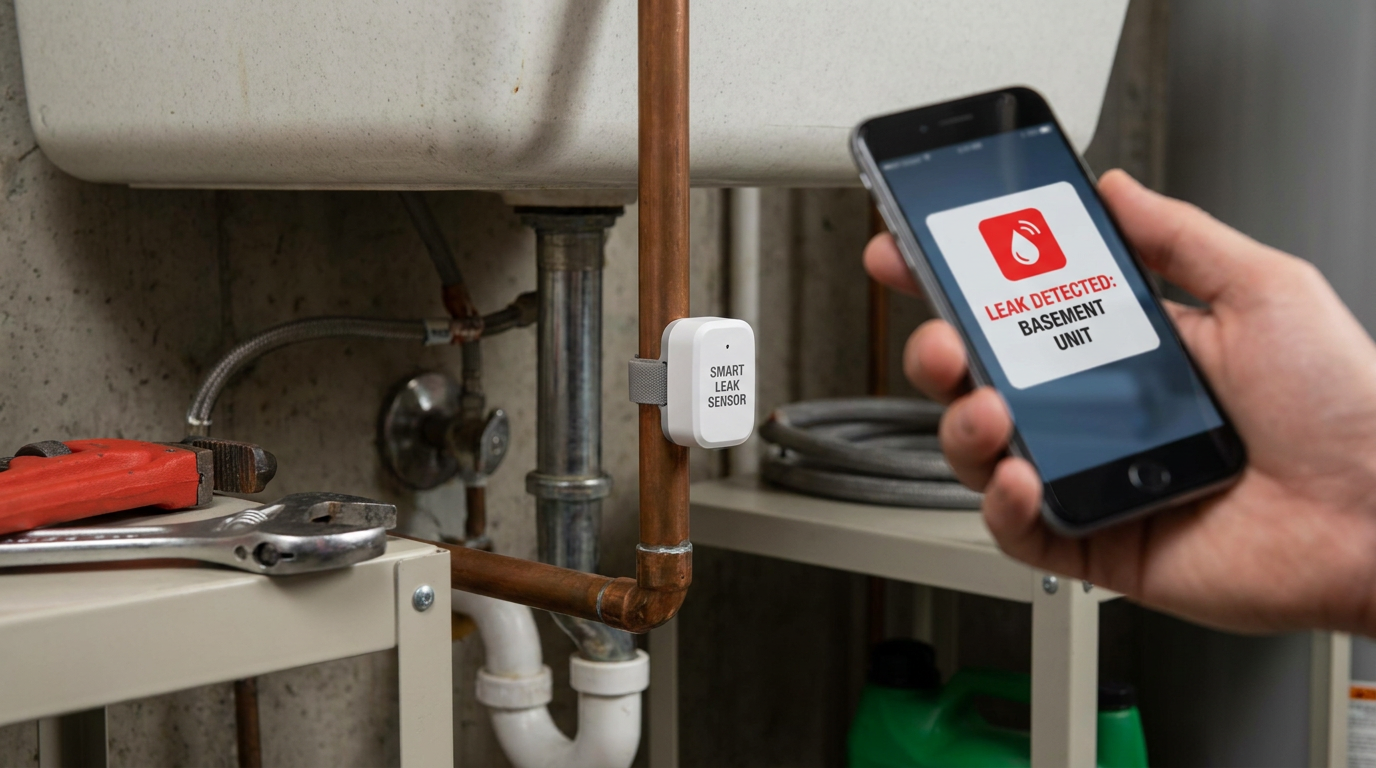
Water damage is one of the most disruptive and expensive issues in property management. A small leak can escalate into structural damage, mould risk, tenant displacement, insurance claims, and prolonged restoration work. IoT leak detection systems are effective because they focus on timing. Instead of discovering a problem hours or days later, teams can receive alerts at the first sign of moisture or abnormal water flow.
This is especially useful in multi-unit residential, student housing, mixed-use properties, and commercial buildings with vulnerable mechanical spaces. Sensors can be placed near boilers, pumps, domestic water lines, under sinks, near appliance hookups, or around areas with past leak history. Some systems also monitor continuous flow to identify hidden leaks that might otherwise show up only as a billing anomaly.
The value here extends beyond repair costs. Faster response can reduce disruption for tenants, protect finishes and equipment, and prevent emergency callouts from spiraling into full after-hours crises. From a management perspective, leak detection is one of the clearest examples of how relatively simple IoT devices can prevent outsized losses.
Indoor air quality and comfort monitoring
Tenant satisfaction is not only about whether equipment works. It is also about how the building feels. Sensors that track temperature, humidity, carbon dioxide, and related indoor air quality indicators can help managers identify ventilation and comfort issues before they trigger complaints. This is particularly useful in buildings with varied occupancy, enclosed meeting spaces, gyms, classrooms, or older ventilation systems.
For managers, the operational benefit is confidence. Rather than relying only on anecdotal reports, teams can review actual conditions and compare them across zones and times of day. If one area consistently exceeds comfort thresholds, that pattern can guide investigation. If a tenant reports stale air, the issue can be evaluated against measured trends rather than guesswork. In a market where occupants are more aware of indoor environments, that level of transparency matters.
Indoor air quality monitoring also supports broader ESG and wellness narratives. It provides data that can be used in sustainability reporting, tenant communications, and operational reviews, especially when linked with ventilation performance and energy efficiency efforts.
Smart access control and security integration
Access systems are also becoming part of the IoT property ecosystem. Connected locks, entry systems, visitor management tools, and door sensors can improve security while reducing administrative friction. In residential settings, this may mean easier management of common-area access, temporary credentials for contractors, or audit trails for entries. In commercial settings, it may support more flexible use of suites, after-hours management, or integration with occupancy and security systems.
The practical benefit is not limited to convenience. Smart access can help identify doors left open, unusual patterns of use, or areas that require more attention. It can also reduce some of the time spent managing physical credentials and manual entry issues. As with any connected building technology, though, access control needs careful cybersecurity and permissions management because the operational stakes are higher than they are with a simple temperature sensor.
How IoT improves the tenant experience
It is easy to frame IoT primarily as a cost and efficiency tool, but that misses a major part of its impact. Buildings are lived in, worked in, visited, and judged by the people inside them. Tenants may never see the dashboard behind the scenes, yet they feel the results in daily comfort, issue resolution, and service consistency. This is where property technology becomes more than an operational upgrade.
When HVAC faults are caught earlier, tenants experience fewer hot or cold complaints. When leak sensors alert maintenance before visible damage spreads, tenants avoid disruption and stress. When occupancy-based systems keep common areas appropriately lit and conditioned, spaces feel better managed. When indoor air quality is monitored consistently, managers can respond with evidence rather than promises. These are practical service improvements, not abstract technical benefits.
There is also a trust element. Tenants increasingly expect transparency and responsiveness from property managers. IoT systems support that by creating usable records of what happened, when it happened, and how the issue was addressed. This can improve communication during service events and reduce ambiguity around recurring problems. In competitive markets, that kind of reliability can influence retention as much as cosmetic upgrades do.
From reactive maintenance to predictive maintenance
One of the most important changes IoT introduces is the move from reactive maintenance to preventive and predictive maintenance. In a reactive model, equipment is serviced after it breaks or after occupants complain. In a preventive model, it is serviced on a fixed schedule whether it needs it or not. Predictive maintenance goes further by using performance data to estimate when intervention is actually needed.
For example, vibration data, runtime trends, temperature performance, and fault alerts can reveal that a fan motor is degrading before it fails. A chiller may show efficiency drift that signals the need for servicing. A heating loop may reveal control instability that points to valve or sensor problems. Instead of dispatching based on rough intervals or waiting for disruption, the team can intervene at a more optimal time.
This does not eliminate routine maintenance, and it does not mean software replaces experienced technicians. What it does is improve prioritization. Staff and contractors can focus attention where risk is rising fastest. Emergency repairs can become less frequent. Asset life may improve when issues are corrected earlier. For property managers responsible for multiple sites, predictive approaches are especially useful because they reduce the blind spots that come with portfolio scale.
The Department of Energy’s Smart Energy Analytics Campaign reinforces this point. It reported continued energy and cost savings across 96 commercial organizations, 518 million square feet, and nearly 6,000 buildings, showing that analytics can produce real results when paired with corrective action. That last phrase is essential. Analytics alone do not deliver value. The follow-through does.
What the data means for owners and capital planning
Owners often face a familiar problem when planning capital expenditures. Several systems appear to need attention, but it is not always clear which one is driving the most cost, waste, risk, or tenant frustration. IoT systems help answer that question with evidence. They show which assets are underperforming most often, which zones trigger the most complaints, which mechanical systems consume disproportionate energy, and which faults recur despite maintenance.
That changes capex conversations from opinion-based to data-informed. Rather than replacing equipment simply because it is old, owners can compare actual performance across assets and prioritize the systems that are causing the greatest operational drag. In some cases, a controls upgrade or recommissioning effort may solve a problem more cost-effectively than full replacement. In other cases, persistent fault patterns may justify larger investment because they reveal chronic inefficiency and service risk.
IoT data also strengthens benchmarking, ESG reporting, and portfolio comparisons. If an owner is managing multiple buildings, normalized performance metrics help identify which sites need intervention first. For investors and asset managers, that creates a clearer intelligence layer for understanding portfolio quality beyond occupancy and rent figures alone.
Implementation realities: what property managers need to get right
It is important to stay realistic. IoT does not automatically save money just because devices are installed. Many projects underperform because they start with hardware enthusiasm instead of operational planning. Sensors generate information, but information only becomes value when teams know what to monitor, what thresholds matter, who receives alerts, and how issues are resolved.
One common mistake is deploying too many devices without a clear use case. More sensors do not always mean better outcomes. Poorly selected data can create noise, confusion, and dashboard fatigue. Another common issue is underestimating integration complexity, especially in older buildings with legacy controls, inconsistent documentation, or multiple vendors. A retrofit can absolutely work in older stock, but it requires realistic planning and interoperability checks.
Cybersecurity is another non-negotiable issue. As buildings connect more devices and systems, they expand their digital attack surface. Access credentials, remote connectivity, data flows, and vendor permissions all need governance. Property managers do not need to become cybersecurity experts overnight, but they do need vendors and internal processes that treat connected infrastructure seriously.
Commissioning and staff training are just as important as the technology itself. If sensors are poorly placed, calibration is ignored, or staff do not trust the dashboard, the system will not deliver reliable value. Successful IoT programs are operating programs, not one-time hardware purchases. They require procedures, ownership, and periodic review.
A practical roadmap for getting started
For owners and managers considering IoT adoption, the best approach is usually focused rather than expansive. Start with the operational pain points that create the clearest business case. These often include repeated HVAC complaints, unexplained utility spikes, recurring water incidents, poor visibility into common-area usage, or maintenance teams stretched thin across multiple sites.
Once the problem is defined, identify the smallest meaningful set of data needed to improve it. That may mean leak sensors in high-risk locations, submeters for major loads, occupancy-based lighting controls in underused areas, or HVAC analytics tied to the most complaint-prone zones. The goal is to create an actionable feedback loop, not to digitize every corner of the property at once.
- Define the objective clearly. Decide whether the first goal is energy reduction, comfort improvement, water-loss prevention, maintenance prioritization, or reporting visibility.
- Audit existing systems. Review what controls, meters, and management platforms are already in place because many buildings have underused infrastructure that can be connected before new devices are added.
- Choose interoperable tools. Favor systems that can integrate with existing platforms and future expansion plans instead of locking the property into isolated data silos.
- Set workflows before launch. Determine who receives alerts, how quickly they are reviewed, what qualifies as an escalation, and how corrective actions are documented.
- Measure results against baseline conditions. Compare utility use, complaints, response time, and maintenance trends before and after deployment to confirm that the system is delivering real value.
This staged approach helps reduce risk and builds internal confidence. It also creates a more credible path for expansion across a portfolio because the team can show what worked, what required adjustment, and where the next investment should go.
Common misconceptions about IoT property systems
Several misconceptions still slow adoption or create unrealistic expectations. One of the biggest is the belief that IoT systems automatically generate savings. In reality, devices reveal opportunities, but human action and operating discipline capture the value. A sensor that flags a failing damper does nothing financially unless someone investigates and corrects the fault.
Another misconception is that smart property systems are only suitable for new luxury buildings. Many useful solutions can be retrofitted into older commercial and residential properties, especially where aging systems create the strongest need for visibility. In fact, older buildings often stand to gain the most because inefficiencies are harder to detect through manual oversight alone.
There is also a tendency to reduce IoT to energy management. Energy is important, but it is only part of the picture. IoT also supports comfort, maintenance planning, water-loss prevention, security integration, indoor air quality, and compliance reporting. That broader value matters because owners rarely make decisions based on a single metric.
Finally, some worry that automation makes property staff less necessary. The more accurate view is that it changes how staff spend time. Instead of chasing routine surprises and avoidable emergencies, teams can focus more on diagnosis, planning, tenant communication, and higher-value service work.
The future of IoT in smart property data
The next phase of IoT in property management is increasingly tied to AI-enabled analytics, portfolio-wide reporting platforms, and deeper integration between building systems. Managers are moving beyond isolated alerts toward broader operating intelligence that can compare buildings, detect patterns across assets, and recommend priority actions. This is where concepts like digital twins, autonomous energy management, and advanced fault detection are becoming more relevant.
At the same time, the pressure to decarbonize buildings will keep growing. In Canada and the United States, the building sector is under increasing scrutiny as a major lever for energy efficiency and emissions reduction. That makes operational data more valuable, not less. Property owners will need better tools to understand performance, justify retrofits, support electrification planning, and report progress in credible ways.
Still, the winning strategy will remain practical. The buildings that benefit most will not necessarily be the ones with the most devices. They will be the ones where data is linked to clear operational goals, where staff trust the system, and where owners use insights to guide maintenance and capital planning with discipline.
Conclusion
IoT systems are transforming property management because they make building operations visible in ways that manual processes never could. They help managers detect HVAC faults earlier, control lighting and conditioning based on actual occupancy, prevent water damage, improve indoor comfort, and prioritize maintenance with better evidence. In a sector shaped by rising utility costs, aging infrastructure, and growing decarbonization pressure, that visibility has become a strategic advantage.
The most important takeaway is that IoT should be treated as an operational program, not a gadget purchase. The technology is powerful, but its value depends on commissioning, interoperability, cybersecurity, staff workflows, and consistent follow-through. For owners and managers willing to approach it that way, IoT property systems can reduce waste, improve tenant experience, and create a smarter foundation for both day-to-day decisions and long-term asset strategy.
In other words, the transformation is not just that buildings are becoming smarter. It is that property management is becoming more informed, more proactive, and more accountable. That is the real intelligence layer behind modern housing and commercial real estate decisions.



No Comment! Be the first one.