


Remote work in 2026 is no longer a temporary fix or a culture war headline. It has matured into something more interesting and more complex: a long-term operating model that is reshaping how people live, collaborate, commute, and evaluate employers. For workers across Canada and North America, the conversation has shifted away from whether remote work will survive and toward how it should be designed to actually work well. That distinction matters because the biggest opportunities now sit in the details, from team norms and AI tools to schedule design and career visibility.
Table Of Content
- Remote work is not over. It is entering its refinement era
- Hybrid work is becoming the default for remote-capable jobs
- Why hybrid often beats all-or-nothing models
- AI is changing remote work faster than location policy is
- What smart AI use looks like in 2026
- Asynchronous work is becoming a serious design priority
- Work-life balance is still a top benefit, but boundaries are now the real battleground
- How employees can create healthier remote boundaries
- Outcome-based management is replacing attendance-based oversight
- Flexibility is now a recruitment and retention signal
- Remote work still has an equity problem
- The broader impacts go beyond the workplace
- What employees should do in 2026
- What employers should do in 2026
- The most exciting trend is not remote work itself. It is smarter work
- Quick takeaways for 2026
The data strongly support this new phase. In the United States, Census Bureau figures show that 13.8% of workers usually worked from home in 2023, up from 5.7% in 2019. Over that same period, the number of home-based workers rose from about 9 million to more than 22 million. In Canada, Statistics Canada reported in 2025 that 77.6% of workers usually worked exclusively outside the home in May, a sign that commuting patterns have continued to normalize, while hybrid work remains a durable part of the labor market rather than a short-lived exception.
That combination tells us something important about 2026. Remote work is not taking over every job, and it is not disappearing either. Instead, it is settling into a more stable pattern where organizations are learning to combine office time, home time, and digital coordination with more intention. For employees, this means flexibility is still on the table, but it increasingly comes with clearer expectations. For employers, it means flexibility is less a perk and more a managed system that affects hiring, retention, productivity, and brand reputation.
This article looks at the most exciting remote work trends of 2026 through a practical, data-driven lens. The goal is not to romanticize remote work or dismiss its tradeoffs. It is to understand where the market is heading, why certain trends matter, and how both employers and employees can adapt in ways that improve performance and everyday life.
The most exciting remote work trends of 2026 include the rise of structured hybrid schedules, AI tools that reduce coordination friction, asynchronous work design, outcome-based management, and a sharper focus on boundaries and equity. Hybrid work has become the default arrangement for remote-capable jobs, with roughly half of eligible employees splitting time between home and office rather than working fully remote or fully on-site. AI is increasingly used to summarize meetings, draft updates, and organize tasks, helping distributed teams communicate with less friction. Asynchronous workflows and defined core hours are replacing constant availability, while managers are shifting from tracking attendance to evaluating outcomes. Flexibility itself has become a recruitment and retention signal, though access to remote work still favors higher-paying, knowledge-based roles. Together, these trends show that the defining shift in 2026 is not remote work’s existence, but how deliberately it is being designed and managed.

Remote work is not over. It is entering its refinement era
One of the biggest misconceptions about the future of work is that remote work has peaked and is now fading away. The numbers do not support that idea. What they show instead is that the early volatility of the pandemic era is giving way to a more settled reality. Some organizations have brought people back to the office more often, but that has not erased the structural increase in work from home arrangements compared with 2019.
The better way to describe 2026 is as a refinement phase. Companies are moving away from emergency remote work and toward more disciplined hybrid systems. That means fewer improvised rules, more role-specific expectations, and greater attention to what kind of work should happen in person versus what can happen asynchronously or from home. It also means workers are becoming more selective. Many now judge a job not only by salary and title, but by whether its flexibility is real, coherent, and sustainable.
For a consumer and lifestyle audience, this refinement matters because remote work changes daily life in very concrete ways. A worker who gains back even a few commuting hours per week can redirect that time into family routines, exercise, side projects, or rest. At the same time, if remote work is poorly designed, those hours can simply be replaced by fragmented calendars, longer message chains, and work that stretches into the evening. The promise of flexibility depends on structure.
In 2026, the most successful remote work systems are not the loosest ones. They are the clearest ones.
Hybrid work is becoming the default for remote-capable jobs
The single most important trend in remote work for 2026 is the continued dominance of hybrid work. Gallup’s 2025 U.S. tracking found that among remote-capable employees, roughly 51% to 52% were in hybrid arrangements, about 26% were exclusively remote, and about 22% were fully on-site. That distribution is telling because it shows that flexibility is not synonymous with staying home all the time. For many workers and employers, the center of gravity has moved toward a blended model.
Hybrid work has become attractive because it offers a practical compromise. Workers gain flexibility, reduced commuting burden, and more control over their routines. Employers retain periodic face-to-face collaboration, easier onboarding, and a stronger sense of shared rhythm. In theory, hybrid work can deliver the best of both environments. In practice, it only works when the arrangement is intentionally designed rather than vaguely announced.
The strongest organizations in 2026 are formalizing hybrid norms instead of relying on informal assumptions. They are deciding which meetings should happen in person, how teams coordinate office days, what core collaboration windows look like, and how to prevent remote team members from becoming second-tier participants. This shift reflects a larger management truth. Flexibility without clarity creates inequity, because the people with better managers or more visible roles often benefit more than everyone else.
Employees should also read hybrid policies carefully rather than assuming all flexibility is equal. A role advertised as hybrid can mean two predictable office days each week, or it can mean constantly shifting expectations that make planning difficult. The most workable hybrid arrangements usually have three features: stable scheduling, transparent decision rules, and manager behavior that matches the written policy. If one of those is missing, the employee experience often deteriorates quickly.
Why hybrid often beats all-or-nothing models
Hybrid work is winning because modern work is not uniform. Some tasks benefit from deep, uninterrupted focus and are easier to complete at home. Other activities such as coaching, relationship building, brainstorming, and sensitive conversations are often stronger in person. A blended model allows people to match the environment to the task, which is more realistic than forcing every form of work into one setting.
There is also a lifestyle dimension that should not be underestimated. Many workers do not want a full return to commuting five days a week, but they also do not want total isolation. Hybrid schedules can preserve social contact while still reducing travel costs and time loss. In large urban regions across Canada and the United States, where commute times can be substantial, this tradeoff has direct effects on household stress, childcare coordination, and quality of life.
AI is changing remote work faster than location policy is
If hybrid work is the structural trend of 2026, AI is the operational trend. Remote work is no longer just about where work happens. It is increasingly about how work moves across tools, channels, and time zones. Microsoft’s recent Work Trend Index research has highlighted the problem of the “infinite workday,” where employees face a constant stream of email, chat, meetings, and after-hours communication that expands work beyond normal boundaries. This issue is especially acute in distributed teams because digital work has a tendency to reproduce itself.
AI is now being positioned as part of the solution. In many workplaces, AI tools are summarizing meetings, drafting follow-up notes, organizing action items, rewriting messages, surfacing missed decisions, and automating repetitive administrative work. These use cases may sound small in isolation, but together they can reduce a meaningful amount of coordination friction. For remote teams, friction matters because distance increases the cost of confusion.
The most exciting part of this trend is not simple automation. It is the possibility of better orchestration. When AI can capture a meeting summary for someone in another time zone, remote work becomes more asynchronous. When it can draft a clean status update from fragmented notes, managers get clearer visibility without needing extra meetings. When it can sort and prioritize communication, employees have a better chance of protecting focus time. In other words, AI has the potential to make distributed work less noisy and more legible.
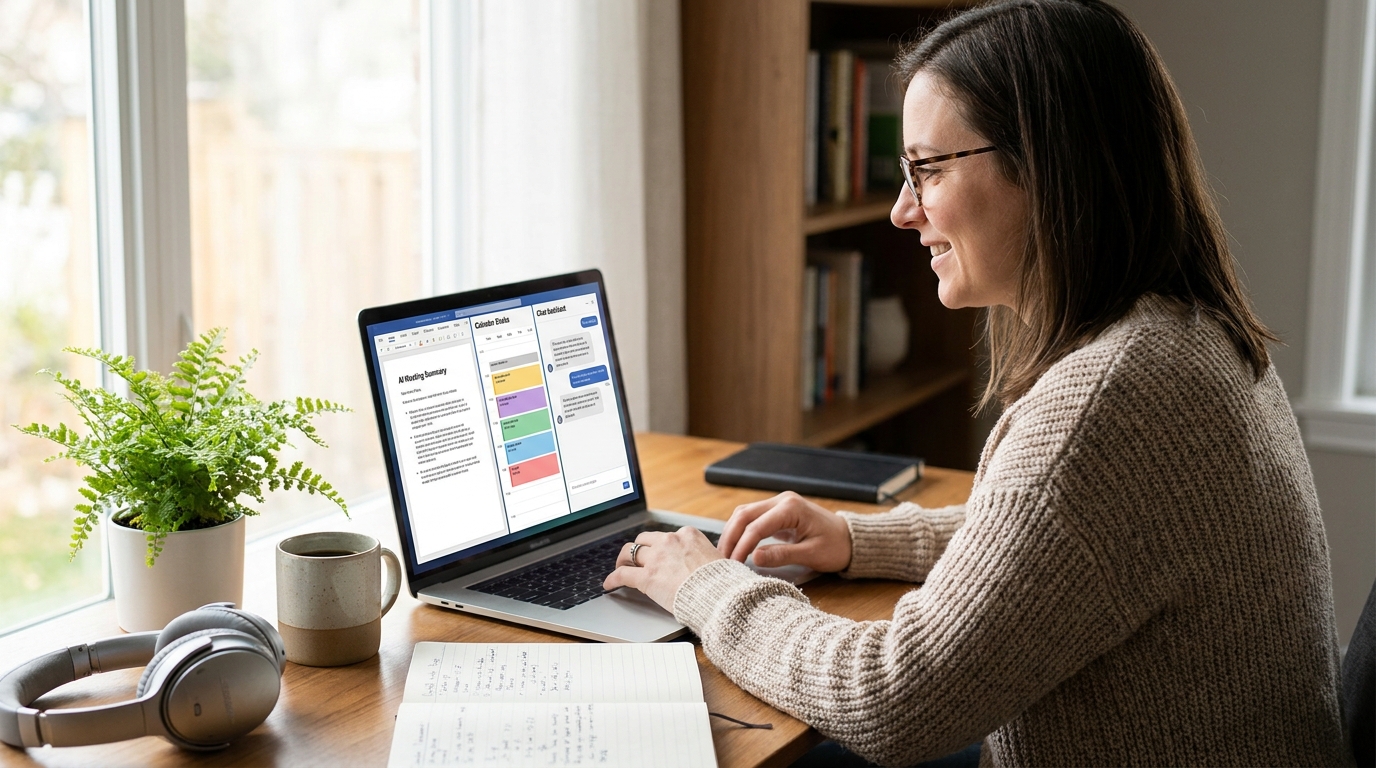
Still, there is an important caution here. AI does not automatically create better work habits. In some cases, it can accelerate overload by making it easier to generate more communication, more tasks, and more expectations. The real advantage comes when organizations pair AI adoption with stronger workflow rules. If not, the technology may increase volume rather than reduce it.
What smart AI use looks like in 2026
The healthiest remote teams are using AI in targeted, disciplined ways. They are applying it to recurring pain points rather than treating it as a novelty. Useful examples include drafting first-pass documents, creating meeting recaps, preparing onboarding materials, building searchable knowledge bases, and converting informal chat decisions into trackable project updates. These are not flashy interventions, but they improve consistency and reduce hidden workload.
For employees, the practical question is not whether to use AI, but where it meaningfully saves cognitive energy. If a tool removes routine effort and gives back attention for analysis, communication, or rest, it has value. If it produces more channels to monitor or more low-priority output to review, it may be a net negative. The signal to watch in 2026 is not AI adoption alone, but whether AI is reducing coordination overhead in measurable ways.
Asynchronous work is becoming a serious design priority
Another major trend shaping remote work in 2026 is the rise of asynchronous work design. This is one of the most important shifts because it addresses the core limitation of digital collaboration: too much of it still tries to mimic live office interaction. When every decision requires a real-time meeting and every update depends on instant responses, remote work becomes exhausting. The result is a calendar packed with check-ins and a workday filled with interruptions.
Asynchronous work offers a different model. Instead of assuming everyone needs to respond immediately, it creates systems where information is documented clearly, tasks are visible, and people can contribute on a reasonable timeline. This is especially useful for hybrid teams, where some employees may be on-site while others are remote, and for companies with distributed staff across multiple regions. It also helps workers with caregiving responsibilities or varied energy patterns manage their time more effectively.
The increased interest in core hours policies reflects this same logic. Rather than expecting perpetual availability, some organizations are defining a limited daily window when live collaboration should happen, while protecting the rest of the day for focused work or flexible scheduling. This approach can reduce meeting sprawl and set clearer expectations around response times. It is a direct response to the infinite workday problem identified in recent workplace research.
For modern living, asynchronous work has major implications. It can turn flexibility into something more than just a change of location. It can allow people to step out for school pickup, schedule concentrated work during their best mental hours, or avoid spending their entire day in reactive mode. But it depends on strong writing, reliable documentation, and management patience. Asynchronous systems fail when leaders still reward whoever answers fastest rather than whoever communicates most effectively.
Work-life balance is still a top benefit, but boundaries are now the real battleground
One reason remote and hybrid work remain so popular is their connection to work-life balance. For many workers, flexibility makes everyday life more manageable. It reduces commuting strain, creates more autonomy, and allows better integration of personal responsibilities. This is particularly valuable in households balancing childcare, eldercare, health needs, or simply the desire for more control over daily time use.
But there is a catch, and it is a big one. Working from home can improve work-life balance while also making it easier for work to spill into home life. The same laptop that creates flexibility can become a permanent portal to unfinished tasks. The same chat tool that replaces hallway conversations can produce a low-grade pressure to stay reachable at all times. This is why 2026 conversations about flexibility are increasingly becoming conversations about boundaries.
Research across Canada and the United States continues to show that workers value flexible scheduling and some access to remote work. Yet these advantages can erode when organizations fail to define response expectations, overload calendars, or normalize after-hours communication. In that environment, flexibility becomes ambiguous. Employees may have the option to work from home, but not the freedom to disconnect.
The practical lesson is straightforward. Remote work succeeds when it is designed with deliberate limits. Fewer and better meetings help. Clear core hours help. Explicit norms around when messages should be answered help. Managers who protect focus time and model healthy boundaries help most of all. These choices sound cultural, but they are also operational. The shape of a workday is the product of policy, systems, and leadership behavior.

How employees can create healthier remote boundaries
Even in a well-run workplace, employees need personal systems that support sustainable remote work. The most effective routines are often simple. A dedicated workspace, a defined start and end ritual, and limited notification windows can help create psychological separation between work time and personal time. So can keeping a written task list that makes closure visible at the end of the day.
It is also useful to negotiate expectations directly. Many workers assume they need to be constantly available because no one has stated otherwise. In reality, good managers often appreciate clarity. Asking when responses are actually needed, which channels are urgent, and what flexibility looks like in practice can prevent a great deal of unnecessary stress. Boundaries work best when they are shared rather than silently improvised.
Outcome-based management is replacing attendance-based oversight
One of the most important management shifts of 2026 is the move from monitoring presence to evaluating outcomes. In traditional office environments, visibility often stood in for value. Employees who appeared busy, stayed late, or attended many meetings could be perceived as high performers, even when their actual output was uneven. Remote work makes that style of supervision less reliable and, in many cases, less defensible.
As distributed work becomes normalized, better organizations are building management systems around deliverables, timelines, collaboration quality, and measurable progress. This is healthier for employees because it rewards clarity and competence rather than performative availability. It is also healthier for employers because outcome-based systems are more scalable, more transparent, and easier to align with productivity goals.
This trend also changes what good managers look like. In 2026, strong remote managers are not the ones who check in constantly. They are the ones who create clear priorities, document expectations, remove blockers, and maintain regular but efficient communication. They know that distributed teams need predictability more than surveillance. They also understand the risks of proximity bias, where people seen more often in person may receive more trust, praise, or promotion opportunities than equally capable remote peers.
For workers, this means it is increasingly important to communicate progress in ways that are visible and useful. Keeping work documented, sharing concise updates, and making contributions easy to trace are now professional advantages. In a hybrid environment, communication quality becomes part of career resilience.
Flexibility is now a recruitment and retention signal
Another exciting development in 2026 is that flexibility has become a competitive labor-market signal rather than a fringe benefit. Employee preference for flexibility remains strong, and many workers actively compare employers based on how remote and hybrid arrangements are structured. A company that offers a thoughtful hybrid model with clear norms can look far more attractive than one that offers similar pay but treats flexibility inconsistently.
This is especially true in knowledge work, where a large share of remote-capable roles sit. Skilled workers are increasingly attentive to whether flexibility is genuine, whether managers know how to lead distributed teams, and whether remote participation affects advancement. Employer brand now includes operational design. The firms that understand this are often better positioned to attract talent beyond their immediate geography, reduce turnover, and maintain engagement.
There is a household economics angle here as well. Remote or hybrid work can lower commuting expenses, reduce wardrobe and meal costs, and widen housing choices for some workers. In expensive metropolitan regions, even partial flexibility can change where people are willing to live and how they evaluate job offers. That makes remote work relevant not just to career planning, but to broader lifestyle strategy.
Remote work still has an equity problem
For all its benefits, remote work is not equally available to everyone. Census and Gallup data show that home-based workers are overrepresented in higher-paying, more knowledge-intensive roles. They are less common in frontline, service, manufacturing, logistics, and other occupations that require physical presence. This creates an uncomfortable reality. Flexibility can expand opportunity for some workers while reinforcing inequality across the labor market.
That does not mean employers should abandon remote work. It means they need to think more broadly about what flexibility can look like. In roles that cannot be performed from home, organizations can still improve working conditions through compressed schedules, shift swapping, more predictable rostering, location-aware benefits, and transparent pathways for advancement. Equity is not achieved by pretending every job can be remote. It is achieved by designing fair forms of flexibility across different job types.
In Canada, geography adds another dimension. Commuting burdens differ widely between major urban centers, suburban regions, and smaller communities. Remote and hybrid work can make labor-market participation easier for people who live farther from employment hubs, who face mobility challenges, or who want to remain in lower-cost regions. That creates real opportunity. It also means employers that limit flexibility too narrowly may miss out on regional talent they could otherwise attract.
There is also a career development question embedded in this trend. If remote workers are less visible, they may receive fewer informal opportunities, less sponsorship, or weaker access to leadership networks. In 2026, equitable remote work requires more than policy. It requires structured onboarding, clearer promotion criteria, deliberate inclusion in meetings, and manager training that reduces bias toward whoever is physically present most often.
The broader impacts go beyond the workplace
Remote work is often discussed as an HR issue, but in reality it is part of a larger system. It affects commercial real estate demand, downtown business activity, transportation networks, emissions patterns, and how households use time. When fewer people commute daily, office occupancy changes. So does foot traffic for cafés, retailers, and transit systems that once depended on concentrated weekday flows. These are not side effects. They are structural consequences of how work is being reorganized.
For individual households, the impact can be deeply personal. A reduced commute may free up hours each week. That time can be redirected into sleep, exercise, cooking, parenting, or simply lower stress. Yet there are also tradeoffs, including social isolation, reduced spontaneous interaction, and the possibility that home begins to feel like an extension of work rather than a refuge from it. The remote work story in 2026 is therefore not one of simple gain. It is one of reallocation, where benefits in one area can create pressure in another.
Public institutions are paying closer attention to these patterns as well. OECD and U.S. federal analyses have increasingly emphasized that telework is tied to productivity, management quality, trust, training, and organizational capability. In other words, remote work outcomes do not emerge automatically from technology. They are shaped by the quality of systems around the worker. That is why the most useful discussion of remote work is no longer ideological. It is operational and evidence-based.
What employees should do in 2026
For workers trying to navigate this landscape, the smartest approach is to treat remote work as a skill set rather than just a benefit. The people who thrive in hybrid and remote environments tend to be strong at self-management, written communication, documentation, and boundary setting. They know how to make work visible without oversharing, and they understand when synchronous conversation is necessary versus when an asynchronous update is enough.
If you are evaluating a new employer, ask specific questions. How many days are expected in office, and who decides? Are there core hours? How are promotions handled for remote staff? What tools are used for collaboration and knowledge sharing? Is after-hours communication normalized or discouraged? These details often matter more than the label “hybrid” or “remote.”
It is also worth investing in your own environment. A comfortable workspace, good lighting, reliable internet, and a routine that marks the beginning and end of the day can materially improve both productivity and well-being. Remote work is often discussed at the policy level, but its success is also built from mundane infrastructure. Small improvements to setup and routine often produce outsized benefits over time.
Finally, use AI and digital tools deliberately. Let them reduce repetitive work, improve note-taking, and make planning easier. Do not let them become another layer of interruption. In 2026, digital maturity is not about using the most tools. It is about using fewer tools more intelligently.
What employers should do in 2026
For employers, the path forward is clear even if execution is not always easy. First, treat hybrid work as an operating model, not a symbolic compromise. Define when in-person collaboration matters and why. Clarify scheduling expectations at the team level. Make sure remote participants can fully contribute during meetings and decision-making processes.
Second, redesign communication. Set norms for response times, protect blocks of focus time, and reduce unnecessary meetings. Encourage documentation that helps employees work across time and location without needing constant live coordination. Pair AI adoption with workflow discipline so that automation reduces load instead of amplifying noise.
Third, invest in manager capability. The future of remote work depends less on software than on leadership behavior. Managers need training in outcome-based supervision, inclusive meeting design, bias reduction, coaching at a distance, and workload planning. A good policy cannot compensate for poor day-to-day management.
Fourth, broaden the definition of flexibility. Not every job can be remote, but many jobs can still be redesigned to give workers more control, predictability, or dignity. Organizations that ignore this divide risk creating a two-tier workforce, where some employees receive autonomy and trust while others receive rigidity. The long-term cost of that imbalance can show up in morale, turnover, and employer reputation.
The most exciting trend is not remote work itself. It is smarter work
The most exciting remote work trend of 2026 is not that people can work from home. That is already familiar. The real shift is that companies and workers are beginning to understand that flexibility only delivers value when it is supported by better systems. Hybrid schedules, asynchronous communication, AI assistance, clearer boundaries, and outcome-based management are all part of a broader redesign of work itself.
That makes this moment more significant than it may first appear. We are not simply adjusting where people open their laptops. We are deciding how time, attention, and coordination should function in modern life. The answers will influence productivity, employee well-being, housing choices, commuting patterns, and labor-market access for years to come.
For readers trying to adapt, the best strategy is to be both realistic and optimistic. Remote work is not perfect, and it is not universal. But it is now substantial, durable, and influential enough that understanding its next phase is essential. In 2026, the future belongs less to organizations that offer flexibility in theory and more to those that manage it intelligently in practice.
That is the real story of remote work now: not a temporary experiment, not a total revolution, but a smarter, more deliberate system for how people live and work. And for millions of workers across Canada and North America, that system is becoming one of the defining lifestyle questions of the decade.
Quick takeaways for 2026
- Hybrid work remains the dominant model for many remote-capable jobs, outperforming all-remote and all-office arrangements in prevalence.
- AI is becoming central to remote coordination, especially for summaries, drafting, task tracking, and reducing digital friction.
- Asynchronous work design is gaining importance as teams try to reduce meetings and protect focus time.
- Work-life balance remains a major benefit, but only when employers and employees establish clear boundaries around availability.
- Outcome-based management is replacing attendance-based oversight, changing how performance and visibility are measured.
- Flexibility is now a talent signal that influences retention, recruitment, and employer reputation.
- Equity still matters because remote work is concentrated in higher-paying knowledge roles, making broader flexibility design essential.
As remote work trends continue to evolve, the most valuable mindset is one that combines data, pragmatism, and curiosity. The future of work is no longer about choosing one place over another. It is about building the right system around the people doing the work.



No Comment! Be the first one.