



Urban development projects succeed or fail long before construction crews arrive on site. The decisive work often happens in meetings, consultations, negotiations, and community conversations that shape whether a proposal is trusted, challenged, refined, or delayed. In an environment where cities are trying to add housing, upgrade infrastructure, improve sustainability, and accommodate growth, stakeholder management has become a core strategic capability rather than a soft secondary function. It sits at the center of project feasibility, approval certainty, and long-term place-making.
Table Of Content
- Why stakeholder management matters more than ever
- Who counts as a stakeholder in urban development
- Stakeholder mapping as the foundation of project strategy
- What a practical stakeholder map should include
- Social license and why legitimacy matters
- From consultation to participatory planning
- Indigenous consultation and urban engagement
- Communication that builds trust instead of resistance
- Questions every project team should be able to answer clearly
- Conflict resolution and the management of competing interests
- Community benefits and the economics of shared value
- Adaptive governance and long project timelines
- Real-world patterns behind successful engagement
- A practical framework for mastering stakeholder management
- Conclusion: better relationships create better cities
Stakeholder management in urban development is the disciplined, two-way process of identifying everyone with a stake in a project — residents, municipal staff, investors, utilities, Indigenous communities, and elected officials — and using their input to shape decisions before conflict hardens into opposition. It is often mistaken for public relations, but the two are fundamentally different. Public relations aims to persuade people to accept a plan that is already finished. Stakeholder management works the other way: it surfaces interests and concerns early enough to inform the plan itself, helping project teams identify friction, clarify trade-offs, and improve design and approval strategy before problems become expensive. Done well, this produces a better project, not just a better presentation. Done poorly or too late, it produces exactly the delays, redesigns, and opposition it was meant to prevent. That distinction is why leading developers treat it as core project strategy rather than a communications add-on.
For developers, landowners, planners, municipalities, investors, and community institutions, the stakes are high. Urban projects today are shaped by more actors than at any point in recent memory, including residents, business owners, Indigenous communities, agencies, utilities, environmental groups, elected officials, and financing partners. Canadian policy guidance increasingly reflects this reality by emphasizing that engagement should be transparent, relevant, inclusive, accountable, and adaptable, with a clear explanation of purpose and how public input will be used. Those principles are not abstract ideals. They are practical tools for reducing risk and building legitimacy.
The strategic lesson is simple. Good stakeholder management does not slow strong projects down. When done early and well, it can reduce redesign costs, narrow approval uncertainty, lower reputational risk, and strengthen social license. Most importantly, it helps urban development produce places that are not only buildable, but durable, accepted, and useful to the people who will live, work, and invest in them over time.
Why stakeholder management matters more than ever
Urban development is now operating under conditions of greater complexity. Housing demand remains intense across many Canadian cities. Infrastructure systems are under pressure. Climate adaptation and energy performance expectations are rising. Public trust in institutions can be fragile, and communities are more informed and organized around local change. Against this backdrop, even technically sound projects can run into difficulty if stakeholder relationships are weak or reactive.
Modern development projects are rarely judged on land use alone. They are assessed through a wider civic lens that includes affordability, mobility, environmental impact, neighborhood character, public realm quality, and whether communities believe the process has been fair. This is why stakeholder management is inseparable from project strategy. It shapes not only how a development is perceived, but how it evolves through entitlement, design refinement, infrastructure coordination, and delivery.
Canadian engagement guidance supports this broader view. Federal principles emphasize that engagement must be transparent, inclusive, and accountable. Natural Resources Canada has also highlighted that engaging stakeholders early and throughout policy development helps align objectives with community priorities, understand needs, gather input from affected groups, and secure buy-in. Although that guidance may be framed in policy terms, its lessons apply directly to urban development. The earlier concerns are surfaced, the more room a project team has to respond intelligently.
Large projects also require meaningful public participation because approvals often involve cumulative consequences beyond the site boundary. Traffic patterns shift. School enrollment changes. Utility demand increases. Public space needs become more visible. The Impact Assessment Agency of Canada has noted that meaningful participation can help identify community concerns, scope issues, and consider mitigation measures. In urban development, this translates into better issue definition at the stage where problems are still manageable.
Stakeholder management is best understood as a form of strategic risk management that also improves the social and physical quality of development outcomes.
That point matters because many teams still treat engagement as a communications exercise that begins after core decisions are already made. By then, options are narrower, trust is lower, and the cost of change is higher. Strong teams reverse that sequence. They use stakeholder insight to inform land strategy, design assumptions, consultation planning, and approval sequencing from the beginning.
Who counts as a stakeholder in urban development
One of the first mistakes in urban development is assuming the stakeholder group is obvious. In reality, the public in development-related decision making is broad and layered. Canadian sustainable development consultation guidance defines the public expansively to include governments at different levels, industry, civil society, academics, and diverse individuals. Urban development teams need the same broad perspective.
At a minimum, stakeholders usually include immediate neighbors, local residents, tenant groups, community associations, business improvement areas, small business owners, service providers, advocacy organizations, municipal staff, utility agencies, transportation agencies, conservation authorities, lenders, equity partners, and elected officials. In many cases, schools, hospitals, faith institutions, cultural organizations, and major local employers also have legitimate interests in project outcomes.
Indigenous communities and organizations require particular care, respect, and structure in urban development engagement. Municipal practice is evolving in this area. Vancouver, for example, announced a formal urban Indigenous engagement process, highlighting the growing role of Indigenous participation in city planning. This reflects a broader recognition that engagement must go beyond generic outreach and move toward relationship-based processes that respect distinct rights, histories, knowledge systems, and governance expectations.
Understanding stakeholders also means understanding that they do not all want the same thing. Investors may prioritize certainty and timing. Residents may focus on built form, affordability, shadows, and local infrastructure. Municipal staff may be concerned with policy conformity and servicing capacity. Elected officials may be weighing broader political sentiment. Businesses may be focused on access, foot traffic, or construction disruption. Strong stakeholder management does not force false alignment. It identifies where interests overlap, where trade-offs are real, and where mitigation is possible.
Stakeholder mapping as the foundation of project strategy
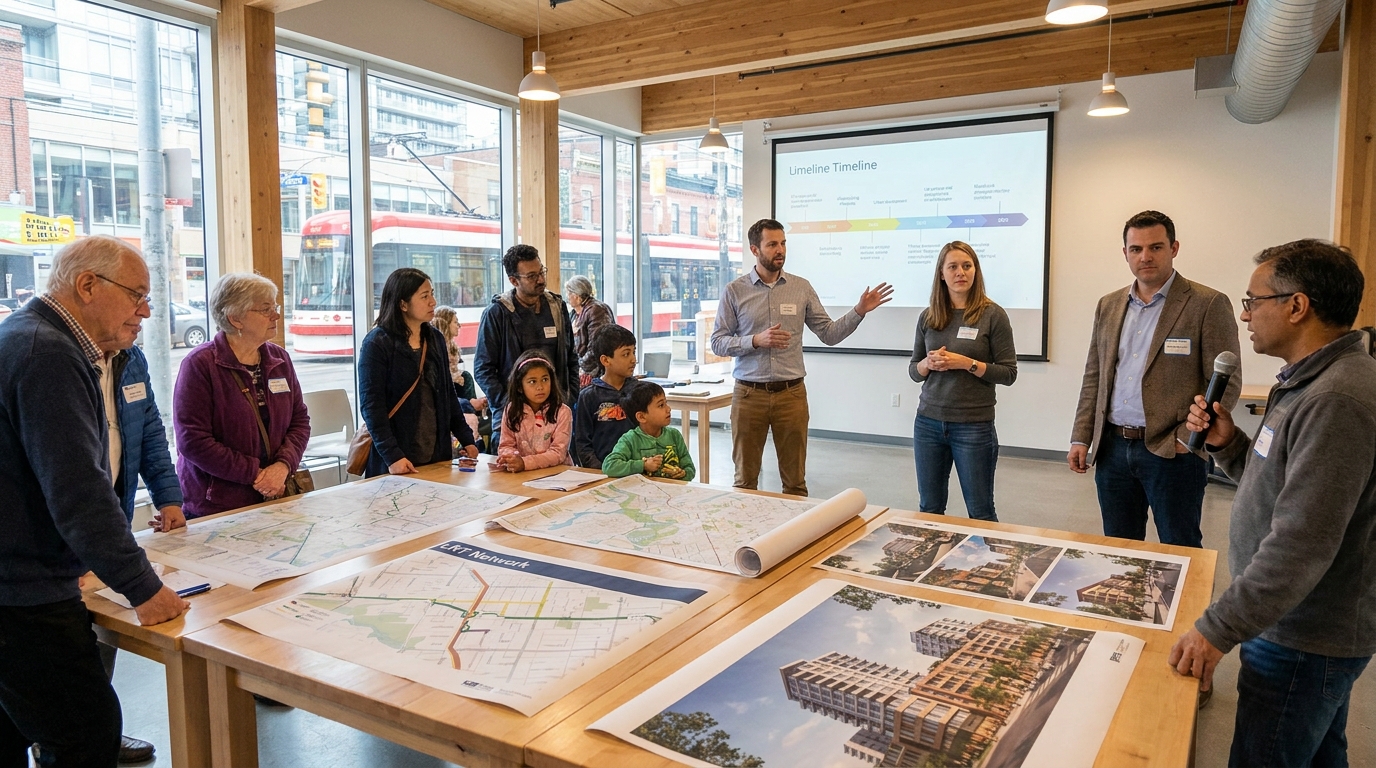
If stakeholder management is strategic, then stakeholder mapping is the analytical starting point. A good stakeholder map goes beyond a contact list. It identifies who is affected, who has influence, who can shape approvals, who can amplify support or opposition, and who may become important later as the project evolves. It should also distinguish between formal authority and informal influence. In many projects, the two are not the same.
For example, a small neighborhood group may have limited formal power but substantial local credibility. A transit agency may not be highly visible in public debate, yet its operational concerns could materially affect phasing or access design. A local institution may not oppose development in principle but may need careful coordination around traffic, servicing, or construction timing. If these dynamics are discovered too late, even a promising project can stall.
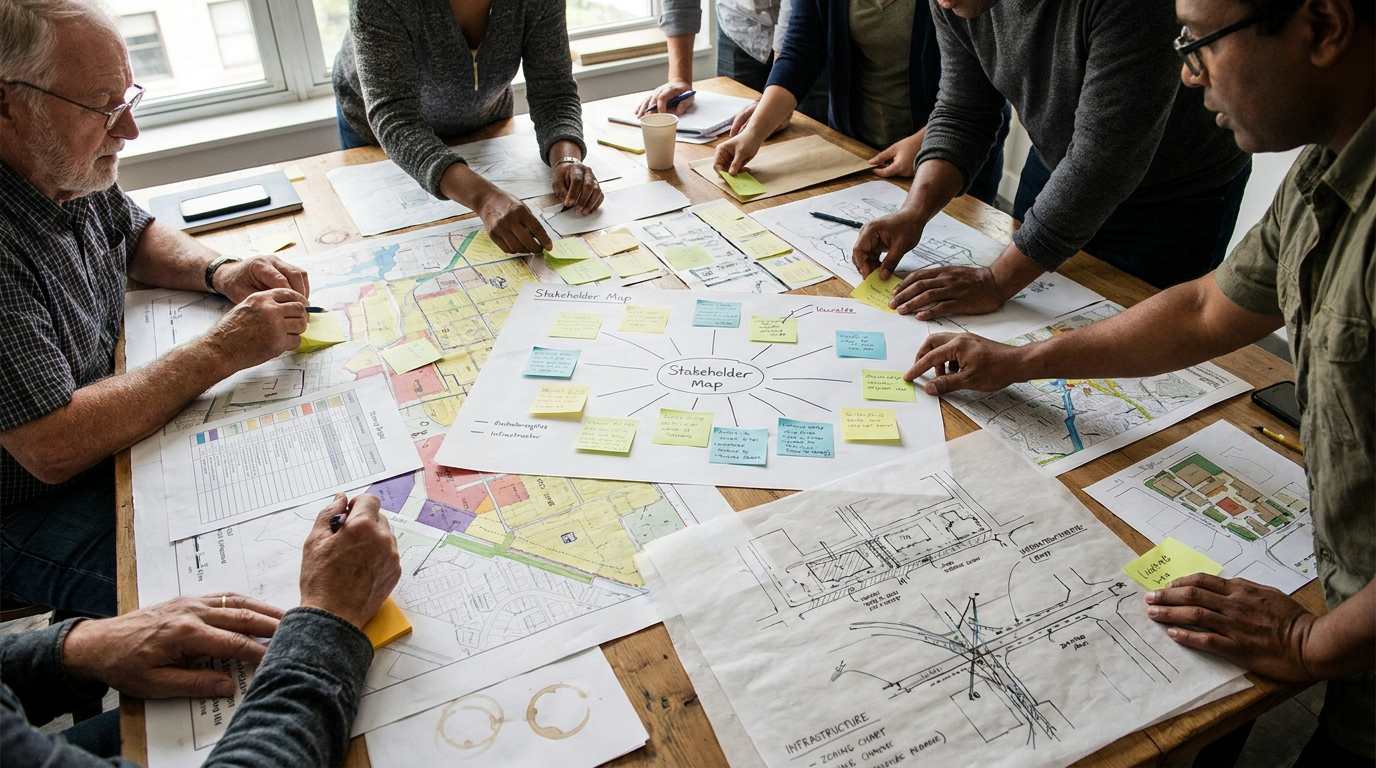
Effective stakeholder mapping usually considers several dimensions at once. Teams should assess each stakeholder’s interests, level of impact, decision-making power, level of trust in the process, likely concerns, preferred communication channels, and timing sensitivity. They should also assess what the project needs from that relationship. Sometimes the need is support. Sometimes it is information. Sometimes it is procedural fairness. Sometimes it is a workable mitigation pathway.
Stakeholder mapping is not static. Urban projects often run for years, and priorities shift as plans become more detailed. An initially quiet stakeholder may become highly engaged once built form, servicing impacts, or public realm details are understood. A supportive political environment may change after an election. Capital partners may revise risk thresholds if community opposition intensifies. The map therefore needs regular updating, not one-time completion.
What a practical stakeholder map should include
In most large urban projects, a useful stakeholder map includes a combination of qualitative and operational detail. It should identify not just names and organizations, but also relationship history, issue sensitivity, likely desired outcomes, and the project phase when engagement is most important. This creates a more realistic basis for planning than a simplistic high-power, low-power matrix on its own.
- Stakeholder category, such as residents, agencies, Indigenous organizations, utilities, capital partners, or advocacy groups.
- Level of project impact, including whether the stakeholder is directly, indirectly, or symbolically affected.
- Influence on approvals or public opinion, recognizing both formal and informal channels.
- Primary issues, such as height, density, affordability, transit, heritage, access, or environmental performance.
- Engagement approach, including information sharing, dialogue, co-design elements, technical coordination, or formal consultation.
- Key timing points, such as pre-application, rezoning, site plan, impact assessment, construction, and occupancy.
When this exercise is done well, it becomes easier to prioritize effort and avoid the common mistake of giving the same message, at the same time, in the same format, to everyone. That approach may seem efficient, but it often creates confusion and mistrust because it ignores how different stakeholders experience the project.
Social license and why legitimacy matters
In urban development, legal approval and social acceptance are related but not identical. A project may technically comply with planning policy and still face deep resistance if communities believe the process was dismissive, opaque, or predetermined. This is where the concept of social license becomes useful. While not a formal permit, social license refers to the degree of ongoing public trust and acceptance that allows a project to move through its lifecycle with less friction.
Social license is especially important in intensification, infill, and redevelopment contexts where change is highly visible and local. Existing residents often evaluate a proposal not only on the merits of additional housing or investment, but on whether they feel they were heard. Developers sometimes underestimate this. People can accept change more readily when they understand the rationale, see that local knowledge influenced outcomes, and believe benefits and burdens are being addressed honestly.
Legitimacy grows when process quality is strong. Federal engagement principles stress clarity about purpose and how input will be used. That point cannot be overstated. Communities become cynical when consultations feel symbolic. If stakeholders are invited into a process, they should be told what is fixed, what is flexible, and what decisions are still genuinely open. This level of transparency often strengthens credibility, even when disagreements remain.
The business case for legitimacy is also compelling. Projects with stronger social license tend to face fewer last-minute surprises, less adversarial escalation, and more durable public narratives. They are often better positioned when phasing, financing, construction coordination, or future amendments become necessary. In other words, legitimacy is not just good civic practice. It is a long-term project asset.
From consultation to participatory planning
Traditional consultation often begins too late and asks too little. Teams present a near-final concept, collect comments, and then explain why most core elements cannot change. This model invites frustration because it treats stakeholder knowledge as a procedural step rather than as an input into shaping the project. Participatory planning offers a more effective alternative.
Participatory planning involves communities earlier, before major assumptions harden. It recognizes that local stakeholders can improve project quality by identifying overlooked circulation issues, public space needs, community services gaps, heritage concerns, and design opportunities that may not be obvious from a desktop analysis. The American Planning Association has long supported inclusive and informative public notice and participation processes as part of best redevelopment practice, and that principle is increasingly relevant to growth-oriented Canadian cities.
This does not mean every design decision is crowdsourced or that professional judgment is replaced by community preference. Rather, participatory planning creates structured opportunities for dialogue, scenario testing, and problem-solving. A project team might show different massing options, explain trade-offs among height, open space, and unit count, and ask stakeholders to react to realistic alternatives. That type of engagement produces more useful feedback than a simple yes-or-no debate about a single finished concept.
Participatory planning is particularly valuable in neighborhoods facing major transition. If a community is being asked to absorb substantial growth, the discussion should include more than the immediate site. It should touch infrastructure, streets, parks, services, active transportation, retail needs, and public realm quality. People are more likely to support density when they see a coherent vision for livability alongside growth.
Indigenous consultation and urban engagement
No serious discussion of stakeholder management in Canadian urban development is complete without addressing Indigenous consultation and engagement. This area requires legal awareness, cultural competence, institutional humility, and a commitment to relationship-building that goes beyond generic municipal outreach. Urban contexts can create the false impression that Indigenous interests are less relevant than in resource development settings. That assumption is outdated and strategically unwise.
Cities are increasingly formalizing urban Indigenous engagement processes, and project teams should expect this trend to continue. Vancouver’s move to establish a formal urban Indigenous engagement process is part of a wider shift toward recognizing Indigenous participation as an essential dimension of urban planning. This matters not only for procedural completeness, but for better city-building outcomes. Indigenous perspectives can deepen how projects address land history, public space, cultural expression, stewardship, and community benefit.
For development teams, the practical takeaway is that Indigenous engagement should be considered early in project strategy, not as a late-stage add-on. Teams need to understand who the relevant communities and organizations are, how municipal and provincial frameworks apply, what the project’s potential effects may be, and what engagement pathways are appropriate. Respectful timing, clear information, and a willingness to listen are basic requirements.
Importantly, urban Indigenous engagement should not be reduced to symbolism. Meaningful participation requires substance. That could include dialogue about public realm design, naming, cultural spaces, procurement opportunities, housing partnerships, or land-based knowledge relevant to site conditions and community context. The right approach depends on the project, but the underlying principle is consistent. Engagement must be real enough to influence decisions where appropriate.
Communication that builds trust instead of resistance
Communication quality often determines whether stakeholder engagement creates momentum or conflict. In development, poor communication usually takes recognizable forms. It may be too technical, too defensive, too generic, too late, or too polished to feel credible. Stakeholders do not need marketing language. They need clarity, honesty, and evidence that the project team understands how the proposal affects them.
The most effective communication starts with transparency. Explain what the project is, why the site is being developed, what policy framework applies, what the likely benefits and impacts are, and where there is still room to improve the plan. If a project needs height or density to support affordability, infrastructure delivery, or financial feasibility, that rationale should be explained plainly. Communities may still disagree, but many will respond better to an honest explanation than to vague messaging.
Accessibility also matters. Canadian guidance emphasizes reducing barriers related to language, culture, geography, digital access, and disability. In practice, that means engagement cannot rely only on dense planning documents posted online. It may require translated materials, multiple formats, in-person and virtual options, plain language summaries, visual diagrams, and meeting times that work for different schedules. Good engagement is designed for real people, not idealized participants.
Trust is built when communication is two-way and consistent over time. Teams should not disappear after a public meeting and return months later with little explanation. Feedback loops matter. If stakeholders raised concerns, the project team should report back on what was heard, what changed, what did not change, and why. This accountability is one of the most overlooked trust-building practices in urban development.
Questions every project team should be able to answer clearly
- Why is this project proposed on this site, and why now?
- What community needs does it address, including housing, services, jobs, or public space?
- What aspects of the plan are fixed, and what elements are still open to feedback?
- How will traffic, servicing, shadows, public realm, and construction disruption be managed?
- How will input be documented, evaluated, and reflected back to participants?
- What long-term benefits will remain in the neighborhood after the project is built?
When teams answer these questions well, they lower uncertainty and improve the quality of dialogue. When they answer them poorly, rumors and opposition fill the gap.
Conflict resolution and the management of competing interests
Urban development inevitably involves conflict. The goal of stakeholder management is not to eliminate disagreement. That would be unrealistic in projects where housing need, land value, environmental performance, heritage concerns, financial constraints, and neighborhood expectations all intersect. The goal is to manage conflict productively so that it informs better decisions rather than derails the process.
Conflict often intensifies when stakeholders feel surprised, dismissed, or boxed into false choices. For example, framing a discussion as either full support for the proposal or opposition to all growth is usually counterproductive. A more constructive approach is to break issues into their components. Stakeholders may support additional housing but question loading design, park access, transition conditions, or construction management. Separating these issues makes problem-solving possible.
Conflict resolution in urban development benefits from structure. Teams should document concerns, categorize them, assign internal responsibility, and evaluate which items can be mitigated through design, phasing, operations, or community benefits. They should also identify concerns that are rooted in broader distrust rather than project specifics. Those situations often require more listening, more continuity in relationship management, and less reflexive defense.
Not every conflict will end in consensus. That is not the standard. The standard is whether the process was fair, informed, responsive, and clear about trade-offs. Projects can still move forward amid disagreement if stakeholders believe their concerns were considered seriously and addressed where possible. In many approvals environments, that distinction can determine whether opposition remains manageable or becomes politically decisive.
Community benefits and the economics of shared value
One reason stakeholder management is so important in urban development is that land value uplift often creates expectations around shared benefit. Communities want to know what they gain when density increases, public assets are leveraged, or neighborhoods absorb substantial change. This is where the concept of community benefits becomes central.
Community benefits can take many forms. They may include affordable housing, improved public space, childcare facilities, cultural amenities, mobility upgrades, local hiring pathways, or resilience-related infrastructure. The right package depends on policy context, project economics, and community priorities. What matters strategically is that benefits should be discussed as part of a credible value exchange rather than as disconnected concessions offered late in the process.
When project teams engage early, they are better positioned to understand which benefits matter most locally. In one neighborhood, the priority may be family-sized housing and safer pedestrian connections. In another, it may be public open space, heritage integration, or support for displaced small businesses during construction. Stakeholder management helps identify these priorities before the project narrative becomes overly narrow.
There is also an important realism here. Community benefits must be feasible. Promising too much can damage trust just as much as offering too little. Strong teams align benefit discussions with financial reality, planning frameworks, and delivery capacity. The objective is not to satisfy every request. It is to create a transparent, balanced case for how the project contributes to broader city-building goals as well as private returns.
Adaptive governance and long project timelines
Major urban development projects unfold over long time horizons. Market conditions change. Political leadership changes. Community demographics change. Infrastructure assumptions change. A stakeholder strategy that works at pre-application may be insufficient during rezoning, construction, or occupancy. This is why adaptive governance matters.
Adaptive governance means building stakeholder management into the operating structure of the project rather than treating it as a one-time event. Teams need internal ownership, decision protocols, documentation systems, and regular checkpoints to revisit stakeholder conditions. It is not enough to have a successful open house if lessons from that event are never translated into design changes, approval strategy adjustments, or updated communication plans.
Cities are moving in this direction as well. Toronto’s planning division has framed engagement reform as a way to improve relationships with residents and stakeholders and aims to become highly engaged on planning issues. This reflects a broader shift from one-off consultation toward process redesign and ongoing relationship management. Developers and project sponsors who align with this evolution will be better equipped to navigate contemporary planning environments.
Adaptive governance also helps manage construction and post-approval phases, which are often neglected in stakeholder strategy. Even a well-supported project can lose goodwill if noise, access disruptions, or safety concerns are handled poorly during delivery. Long-term trust depends on carrying stakeholder discipline through the full lifecycle, not only the entitlement phase.
Real-world patterns behind successful engagement
While every project is different, successful urban development initiatives tend to share a set of recurring patterns. They begin engagement early, before stakeholders conclude that decisions have already been made. They explain trade-offs clearly rather than hiding behind technical jargon. They treat community concerns as design intelligence rather than as obstacles. They maintain feedback loops. And they equip project representatives to speak consistently across public meetings, agency discussions, and investor conversations.
These projects also understand the local context. A transit-oriented intensification project in a fast-growing corridor requires a different engagement strategy than a heritage-sensitive infill proposal in a stable residential neighborhood. The tools may include workshops, technical briefings, walking tours, design charrettes, digital platforms, Indigenous engagement pathways, business outreach, or agency working groups. The principle is not to maximize the number of tactics. It is to match methods to stakeholder needs and project risk.
Another common trait is integration. The strongest teams do not isolate stakeholder management from planning, design, finance, and approvals. They create internal coordination so that what is heard externally can influence internal decision-making. This is one of the clearest differences between authentic engagement and performative consultation. If the engagement lead has no pathway to affect the project, the process will eventually feel hollow to everyone involved.
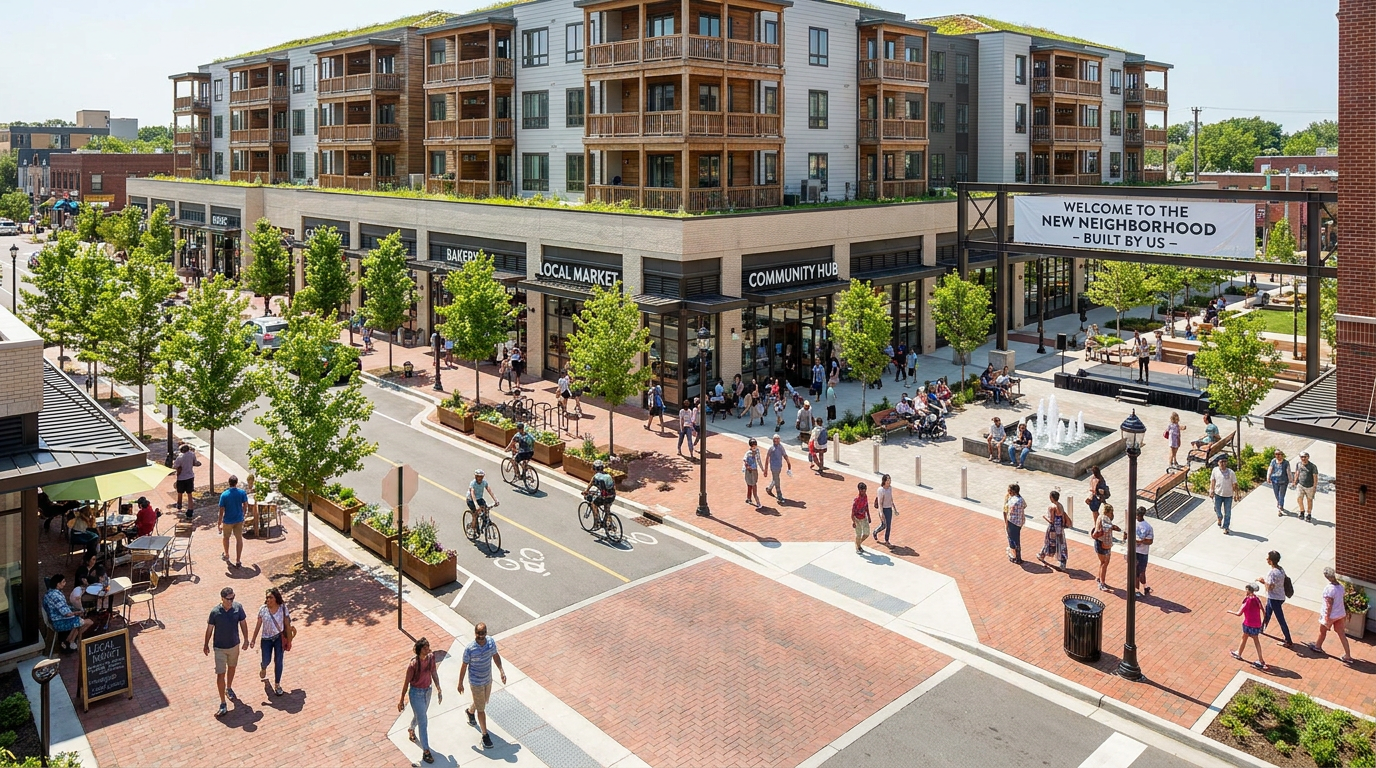
Finally, successful projects keep the long-term vision visible. Stakeholders often engage more constructively when they can see how a proposal fits into a bigger story of housing supply, infrastructure alignment, complete communities, and public value. Urban development is not only about buildings. It is about how land decisions shape access, opportunity, resilience, and quality of life over decades.
A practical framework for mastering stakeholder management
For teams looking to strengthen their approach, stakeholder management can be organized into a practical framework that connects strategy to execution. The first step is diagnosis. Understand the site, policy environment, market rationale, local history, stakeholder landscape, and likely issues. The second step is segmentation. Distinguish among audiences instead of treating all stakeholders as one public. The third step is engagement design. Choose methods, timing, messages, and participation formats that fit the project.
The fourth step is integration. Build mechanisms so insights from engagement actually reach planners, designers, legal advisors, and decision-makers. The fifth step is response. Show how feedback changed the proposal or why certain elements could not change. The sixth step is continuity. Maintain communication through approvals, construction, and occupancy. This sequence sounds simple, but it requires discipline to do well under real development pressure.
Project leaders should also measure performance. Useful indicators include attendance quality rather than just attendance volume, diversity of participant groups, reduction in unresolved issues over time, approval timeline stability, stakeholder sentiment trends, and the extent to which identified concerns are resolved before formal decision points. Measurement helps move stakeholder management out of the vague category of goodwill and into the domain of strategic project control.
Perhaps most importantly, the framework must be led from the top. Stakeholder management cannot succeed if senior decision-makers see it as expendable when schedules tighten. Executive leadership sets the tone for whether engagement is treated as risk prevention and value creation, or merely as a compliance task. In urban development, that cultural choice often becomes visible to the public very quickly.
Conclusion: better relationships create better cities
Mastering stakeholder management in urban development projects is not about pleasing everyone. It is about recognizing that land development happens inside a web of relationships, institutions, expectations, and public consequences. Projects that ignore this reality may still advance, but they usually do so with more friction, more uncertainty, and weaker long-term outcomes. Projects that engage seriously with stakeholder dynamics tend to build more resilient foundations for approvals, delivery, and lasting community value.
The strategic opportunity is significant. Cities need more housing, better infrastructure, stronger public spaces, and climate-resilient growth. Meeting those needs will require faster and smarter development, not less development. But speed without legitimacy is brittle. The most durable path is one where stakeholder management is embedded early, managed consistently, and tied directly to project design, feasibility, and governance.
In the years ahead, the winners in urban development will not only be the teams with the best sites or the strongest capital stacks. They will be the teams that understand people, process, and place at a deeper level. They will know how to map interests, build trust, manage conflict, engage Indigenous partners respectfully, design meaningful participation, and communicate with clarity. That is not peripheral work. It is central to building cities that can grow well.
When stakeholder management is treated as a strategic discipline, urban development becomes more credible, more buildable, and more valuable over the long term. That is how better projects get approved. It is also how better communities are made.

No Comment! Be the first one.