Edmonton’s New Sports Centre Proves Architecture Can Make Movement Visible
There is a particular kind of architectural courage in deciding that a building’s most technical element should also be its most visible one. In Edmonton, the newly completed Coronation Park Sports and Recreation Centre does exactly this, lifting its cycling track a full storey into the air and wrapping it in glass so that speed itself becomes part of the spatial experience. Designed jointly by hcma architecture + design and Dub Architects, with velodrome specialists FaulknerBrowns brought in for their technical expertise, the project treats athletic performance as a form of theatre, and the building as its stage.
What draws my eye here is not the ambition of housing a high-performance training facility inside a community centre, though that alone is worth noting. It is the decision to establish an unobstructed sightline between the ground-level urban court and the elevated track above it. This single architectural gesture changes everything about how the building is inhabited. A parent waiting courtside, a child shooting hoops, a passerby cutting through the atrium, all of them are given a view upward into a world of motion that would otherwise remain hidden behind closed doors and locker rooms. Architecture, at its best, does not simply contain activity. It reveals it.
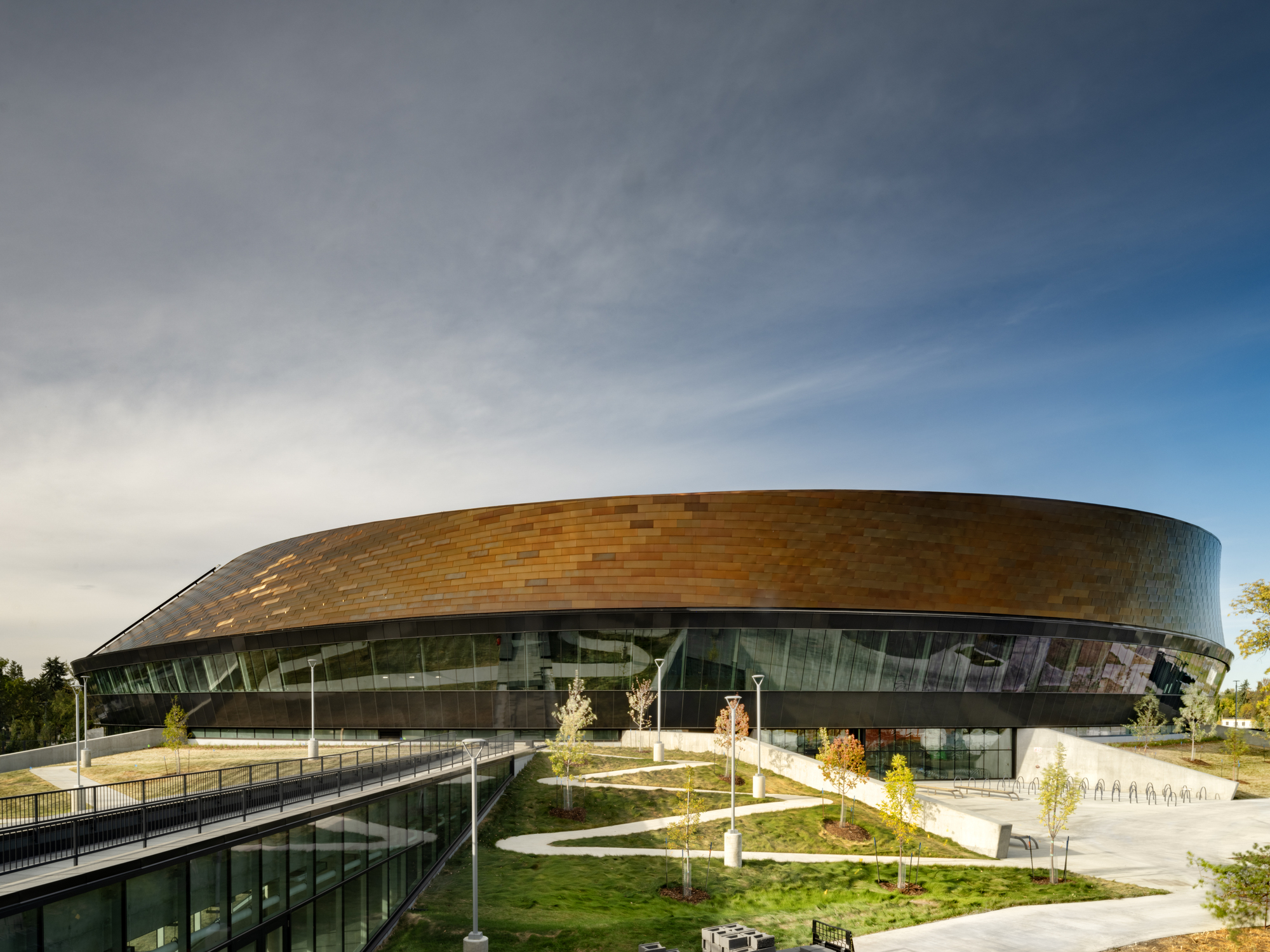
There is also something quietly poetic in how the design handles hierarchy. Rather than burying the running track and cycling loop as purely functional infrastructure, the architects allowed them to define the building’s section, its silhouette, and its relationship to the surrounding park. Community spaces are tucked beneath, within, and around this elevated ring, which means the building’s most everyday moments, a child’s swim lesson, a community meeting, a casual pickup game, unfold in constant visual dialogue with elite athletic training happening just above. That layering of the ordinary and the exceptional within one continuous architectural gesture is what elevates this from a functional recreation facility to a genuinely considered piece of civic design.
Architecture, at its best, does not simply contain activity. It reveals it.
For readers who follow design as a discipline rather than a trend, this project offers a useful lesson in restraint paired with spectacle. Nothing about the exterior needs to shout. The dusk photography shows a building that reads calmly against Edmonton’s winter light, its glazing catching the last colour of the sky, its form legible without excess ornament. The drama is internal, structural, spatial. It is the kind of confidence that comes from architects who trust their plan more than their facade.
Civic and recreational buildings rarely receive this level of architectural attention, often treated as budget-driven exercises in square footage rather than opportunities for genuine spatial invention. Coronation Park suggests a different possibility, one where a municipal facility can hold both technical rigour and emotional resonance, where the everyday act of walking through a lobby can include a glimpse of something extraordinary happening overhead. That, to me, is what thoughtful design should always aim to do: make the exceptional feel within reach, and the everyday feel a little more alive.
Source: ArchDaily, “Coronation Park Sports and Recreation Centre”