



Transform Your Balcony into a Charming Outdoor Retreat with French-Inspired Style
There is something undeniably romantic about a balcony. Even the smallest one suggests possibility: a quiet coffee at sunrise, a gentle pause with a book in the afternoon, a candlelit drink under the evening sky. Yet many balconies are left underused, treated as awkward exterior ledges rather than as meaningful extensions of the home. With thoughtful styling, even a modest balcony can become a refined outdoor retreat that feels both beautiful and deeply functional.
Table Of Content
- Begin by Defining the Balcony’s Purpose
- Four graceful balcony identities to consider
- Read the Space Before You Design It
- Bring French Elegance into a Small Balcony
- Choose Furniture That Fits the Space and the Lifestyle
- What to prioritize when selecting balcony furniture
- Layer Textiles to Make the Balcony Feel Like an Outdoor Room
- Use Lighting to Create Evening Magic
- Let Container Gardening Bring Life and Fragrance
- Smart plant choices for a stylish small balcony
- Use Vertical Space Without Sacrificing Airiness
- Balance Style with Balcony Safety and Building Rules
- Create Privacy with Grace Rather Than Bulk
- Style the Balcony for Entertaining in a Small Footprint
- Refresh the Space Seasonally
- A Simple Step by Step Formula for a Beautiful Balcony Makeover
- Final Thoughts: Small Space, Lasting Charm
The most successful balcony design ideas begin with a simple shift in perspective. Instead of thinking of the balcony as an afterthought, imagine it as an outdoor room with its own atmosphere, purpose, and personality. This is where French elegance offers such a graceful lesson. Parisian balconies have long mastered the art of charm through restraint. They do not rely on excess. They rely on proportion, mood, silhouette, and the quiet pleasure of well chosen details.
For homes across Canada and North America, this approach is especially useful. Balcony spaces are often compact, exposed to wind, and shaped by building rules that demand practical choices. A lovely outdoor retreat must therefore do more than look good. It must handle sunlight, drainage, weight, maintenance, and seasonal change. It must welcome relaxation without creating clutter. It must balance aspiration with reality.
In this guide, you will discover how to transform your balcony into a stylish and livable oasis. We will explore layout, furniture, textiles, lighting, container gardening, privacy, and seasonal care, all through a lens of timeless refinement. Whether your dream is a morning coffee nook, a reading corner, a miniature dining terrace, or a polished entertaining space, your balcony can become one of the most enchanting parts of your home.
Begin by Defining the Balcony’s Purpose
Before choosing a chair, a planter, or a lantern, the most important design decision is to define how you want the balcony to serve you. This first step is what gives a small space clarity. Without it, balconies often become a mixture of unrelated pieces that feel crowded but not complete. With it, every element gains direction, and even the smallest footprint can feel composed.
Ask yourself what moment you want the balcony to hold most beautifully. Perhaps you want a peaceful morning retreat where coffee and quiet sunlight begin the day. Perhaps you imagine a reading corner softened by cushions and greenery. Perhaps your balcony is best suited to intimate entertaining, with a small table for drinks and light conversation. Some balconies can support dining, while others are more naturally lounge oriented. Choosing one primary function helps you scale every other decision correctly.
This approach aligns closely with current outdoor design trends, which increasingly treat exterior spaces as genuine living areas rather than purely decorative zones. Lounge driven layouts, natural materials, and flexible furniture all support the idea that the balcony should feel as intentional as your interior. When the purpose is clear, the styling becomes more elegant because it is rooted in use rather than impulse.
If you are unsure which direction to choose, observe your routines for a week. Notice when you are most likely to step outside and what would make that moment better. A balcony that supports your habits will always feel more luxurious than one styled only for appearance. True elegance, after all, comes from the harmony between beauty and everyday life.
Four graceful balcony identities to consider
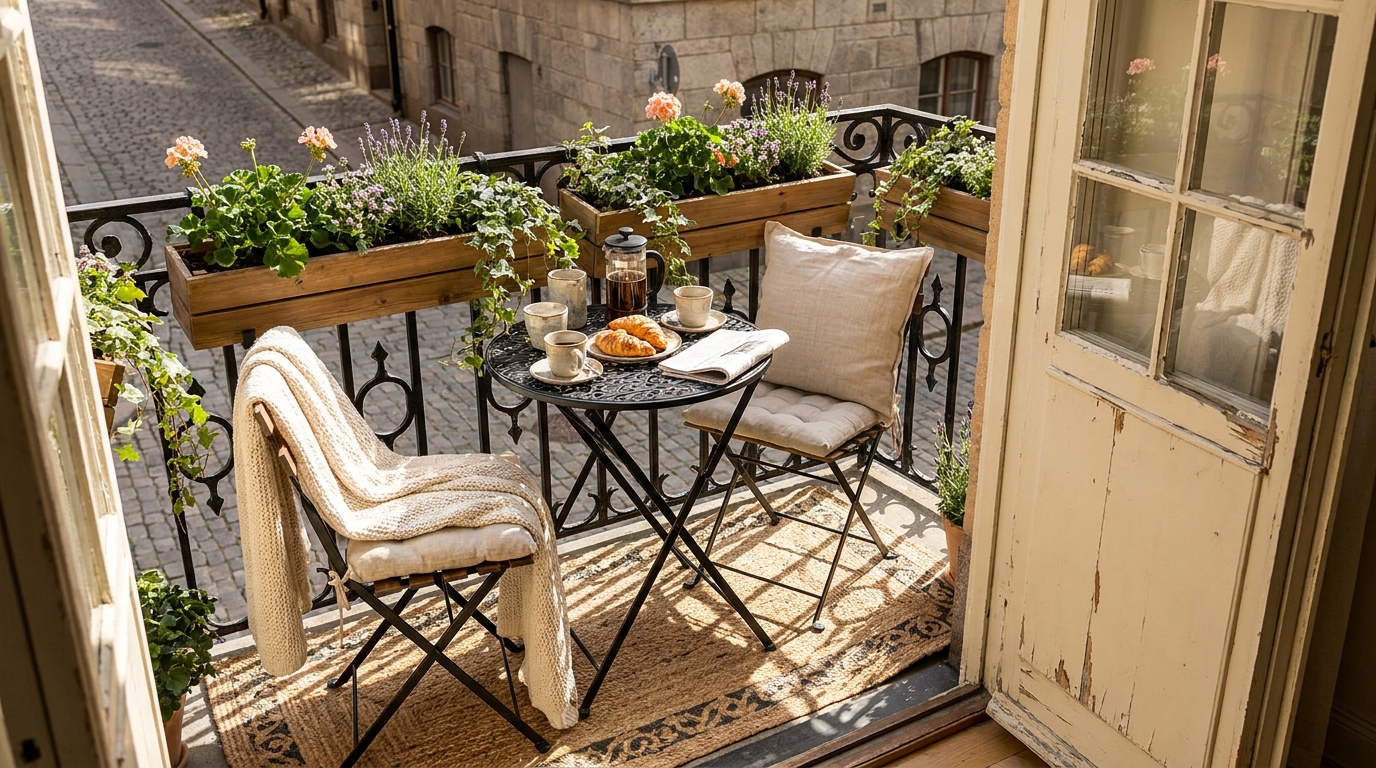
- The morning café nook, centered around a slim bistro table, two compact chairs, and perhaps a pot of herbs nearby.
- The reading retreat, with one comfortable chair, a side table, soft textiles, and layered planting that creates calm.
- The compact dining terrace, designed for light meals outdoors with foldable furniture and simple table styling.
- The evening entertaining corner, where low lighting, small lounge seating, and a drinks surface create atmosphere.
Read the Space Before You Design It
Good balcony styling is not only about taste. It is also about attention. The most polished spaces emerge when design responds carefully to the actual conditions of the site. A balcony may receive intense afternoon sun, remain shaded for much of the day, catch strong wind, or offer only a narrow path for movement. Understanding these realities before you buy anything saves both money and frustration.
Begin with measurement. Record the width, depth, railing height, door swing, and the clearance needed to move comfortably. On small balconies, a few inches matter immensely. A chair that looks compact online may feel oversized once placed beside a planter and a side table. A graceful layout depends on circulation, which means you should be able to sit, stand, and pass through the space without strain.
Then evaluate light. Many flowers, herbs, and vegetables perform best with generous direct sunlight, often in the range of six to eight hours for sun loving crops, but not every balcony provides this. A north facing balcony may favor foliage and shade tolerant planting instead. The elegant solution is never to force unsuitable plants into the wrong environment. It is to select varieties that naturally thrive where you live.
Wind is another defining condition. Upper floor balconies can experience stronger gusts that dry soil quickly, topple lightweight décor, and make certain candles, plants, or privacy screens less practical. This is why balcony design should always combine romance with resilience. The loveliest retreat is one that continues to function on a breezy afternoon, after a rain shower, or through a changing season.
A beautiful balcony is not designed against its conditions. It is designed in conversation with them.
Bring French Elegance into a Small Balcony
French inspired outdoor styling is especially suited to small balconies because it celebrates proportion and atmosphere rather than excess. The goal is not to recreate a theatrical terrace. It is to borrow the subtle language of Parisian charm and translate it into a space that feels light, poised, and welcoming. The result should feel effortless, even when every detail has been carefully considered.
Start with silhouette. Slim black metal furniture, café tables, folding chairs, and pieces with gently curved lines evoke the spirit of classic European balconies without consuming valuable floor area. Wrought iron inspired forms are especially effective because they create visual presence while remaining physically delicate. In a compact setting, this distinction matters. Heavy furniture can quickly flatten the room and make it feel static.
Color also plays a central role. A restrained palette of black, cream, stone, taupe, muted green, terracotta, and weathered wood tones creates a timeless softness. These shades pair beautifully with planting and allow textures to shine. French styling rarely depends on loud color contrasts. It creates richness through layering, patina, and tactile variation.
To complete the mood, choose a few details with care rather than many decorative objects. A linen cushion, a striped outdoor pillow, a petite lantern, a ceramic pot, or a simple tray can be enough. This is where sophistication lives: in the discipline to stop before the space feels crowded. A balcony should breathe. The charm comes from ease, not accumulation.
Choose Furniture That Fits the Space and the Lifestyle
Furniture is the foundation of any small balcony makeover, and in limited square footage, scale is everything. The right furniture feels graceful and useful. The wrong furniture, even if stylish, can make the entire balcony feel unusable. That is why compact, foldable, stackable, or multipurpose pieces are often the most luxurious choices. They support flexibility, preserve circulation, and respond elegantly to small space living.
For a café style arrangement, a narrow round bistro table is often ideal. Its smaller footprint encourages easier movement than square tables, and its shape softens a balcony lined with straight architectural edges. Pair it with folding chairs that can be tucked away when needed. If your balcony is too narrow for dining, consider one sculptural lounge chair and a petite side table instead. A single well chosen seat can feel more indulgent than forcing in a full set.
Materials should also reflect climate and maintenance. Powder coated metal, teak, acacia, weather resistant wicker, and high quality outdoor fabrics are practical options for North American balconies, especially where seasonal fluctuations are pronounced. Lightweight materials are particularly useful because furniture may need to be repositioned for cleaning, storage, or changing weather. This matters not only aesthetically but also physically. What seems easy to move when dry may become difficult when exposed to moisture and daily use.
If your balcony doubles as an entertaining area, look for pieces that perform more than one role. A stool can become a side table. A bench can offer hidden storage if building rules allow it. Nesting tables can expand when guests arrive and disappear when they leave. These thoughtful choices support a lifestyle of beauty without burdening the space.
What to prioritize when selecting balcony furniture
- Scale so the furniture suits the exact dimensions of the balcony.
- Mobility so pieces can be shifted with weather, cleaning, or seasonal needs.
- Weather resistance for longevity through sun, rain, and temperature changes.
- Visual lightness so the balcony feels airy instead of overcrowded.
- Comfort because a retreat must invite you to stay, not simply admire it.
Layer Textiles to Make the Balcony Feel Like an Outdoor Room
One of the simplest ways to make a balcony feel inviting is to soften it with textiles. Hard surfaces dominate most exterior spaces, from concrete floors to metal railings to glass doors. Textiles introduce warmth, absorb visual severity, and make the balcony feel connected to the interior. This is especially important when you want the space to read as an extension of your living area rather than as a separate outdoor utility zone.
An outdoor rug is often the first transformative layer. It defines the seating area, adds pattern or texture, and visually anchors furniture in place. Choose a rug scaled to the balcony rather than one that nearly touches every edge. Leaving a border of visible flooring around it helps the balcony feel larger and more intentional. Stripes, subtle geometrics, and woven natural tones can all support a refined European mood.
Cushions and throws add comfort and atmosphere, but they should be edited carefully. Two or three well chosen pillows in durable outdoor fabric often create a more elegant effect than an abundance of mismatched color. Look for shades that echo your palette and include tactile richness such as linen inspired weaves or classic stripes. If the balcony is partially exposed, store softer accessories indoors when not in use to preserve their beauty.
These layers are what turn a functional setup into a retreat. They invite the body to relax and the eye to linger. They also help bridge the visual language between inside and outside, which is one of the strongest strategies in contemporary outdoor design. When a balcony carries subtle echoes of your interior style, the home feels more complete.
Use Lighting to Create Evening Magic
No balcony retreat feels finished without thoughtful lighting. In fact, light is often what gives a small outdoor space its emotional depth after sunset. During the day, the balcony may look attractive. In the evening, lighting determines whether it feels atmospheric, intimate, and memorable. This is where modest elements can create an outsized effect.
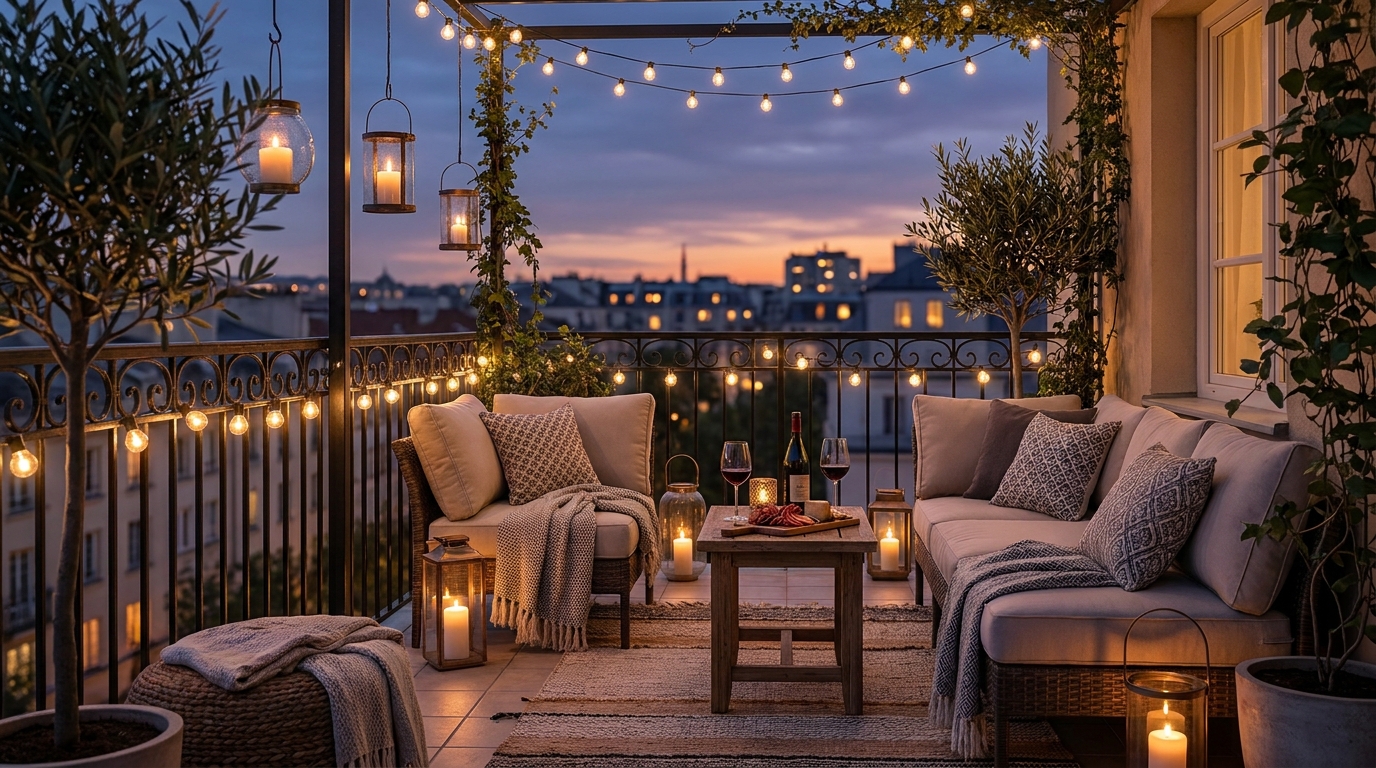
Start by thinking in gentle layers rather than a single bright source. A small lantern on the floor, a candle style rechargeable lamp on the table, or delicate string lights can all contribute to a warm glow. Bistro lighting suits the French inspired mood beautifully, but it should be used with restraint on small balconies. The goal is not visual noise. It is softness and invitation.
If you rent or live in a building with restrictions, choose lighting that does not require permanent installation. Portable LED lamps, solar lanterns where sunlight allows, and battery powered candles can all create charm while remaining practical. On windier balconies, enclosed lanterns usually perform better than open flame solutions. Safety should never be treated as separate from style. The most sophisticated spaces understand that peace of mind is part of the atmosphere.
Lighting also extends the usability of the balcony. A space that glows comfortably after dark is more likely to be used for conversation, a quiet drink, or a late dinner in warm weather. It transforms the balcony from a daytime corner into an all day retreat.
Let Container Gardening Bring Life and Fragrance
Plants are often what make a balcony feel truly enchanted. They soften architecture, filter views, introduce movement, and create the sense of being held within a private garden even in an urban setting. For small balconies, container gardening is one of the most effective and accessible ways to add both beauty and function. Herbs, flowers, foliage plants, vegetables, and even some compact fruiting varieties can thrive in containers when their light, water, and root space needs are properly matched.
The first rule of successful balcony planting is to use the right growing medium. Garden soil is usually too dense for containers and can reduce drainage and root oxygen. A lightweight potting mix or soilless medium is the better choice because it supports aeration, drainage, and healthy root growth. This practical detail may not seem glamorous, yet it is essential. Healthy planting is always more beautiful than decorative planting that struggles.
Choose containers with drainage holes and use saucers where appropriate to reduce water runoff, especially in apartment settings where water may drip onto neighbors below. Self watering planters can be helpful for busy households or sun exposed balconies that dry out quickly. Since large containers become much heavier once watered, it is wise to favor movable planters and to be realistic about weight. This is one of the most overlooked parts of balcony design, and one of the most important.
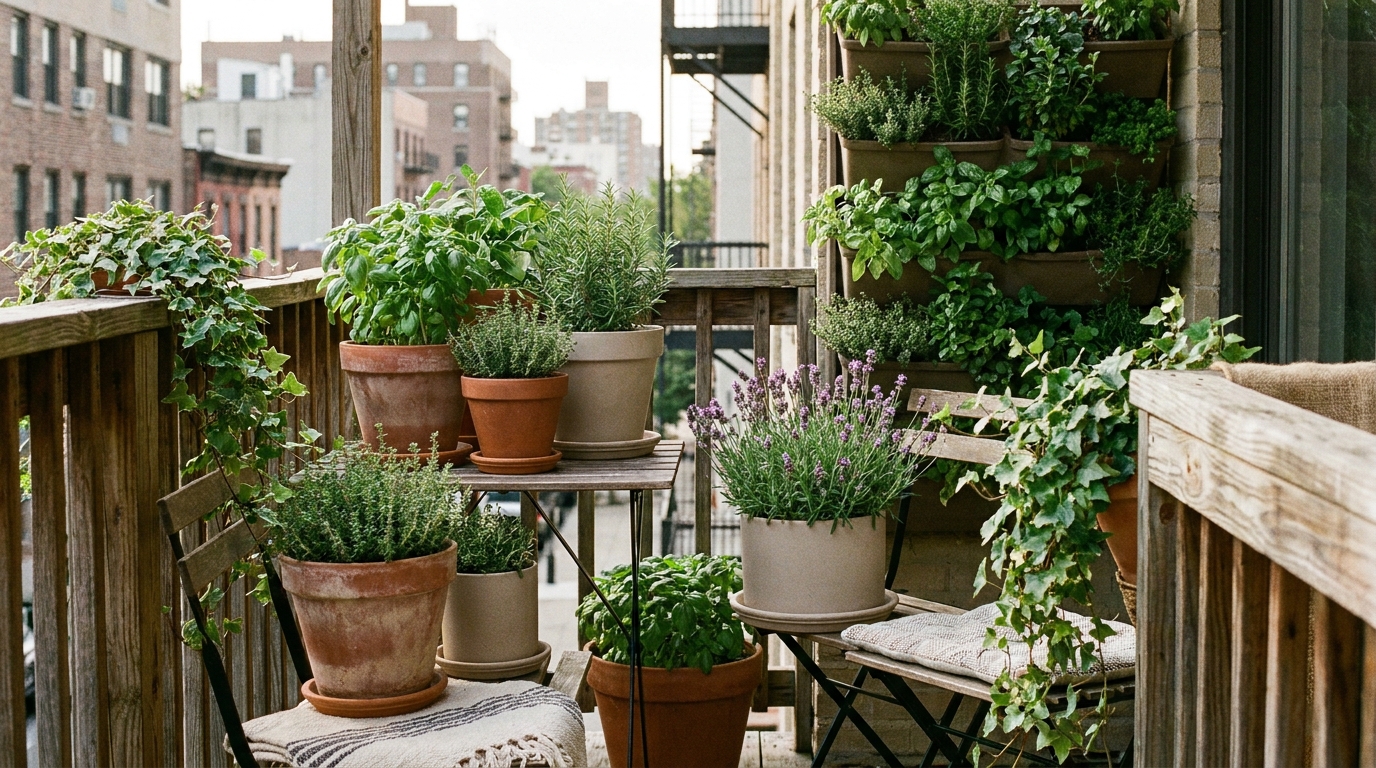
In terms of planting style, French inspired balconies often feel best when greenery is layered rather than overly formal. A few upright planters, one or two trailing forms, a pot of lavender, a cluster of herbs, and perhaps an olive toned foliage plant can create a wonderfully relaxed composition. The effect should feel curated but alive. Think less of a rigid display and more of a gentle terrace garden.
Smart plant choices for a stylish small balcony
- Herbs such as rosemary, thyme, basil, mint, and chives for fragrance and daily usefulness.
- Flowers like geraniums, petunias, calibrachoa, or shade tolerant blooms depending on exposure.
- Foliage plants including ivy, ferns, heuchera, or small ornamental grasses for texture.
- Edibles such as compact tomatoes, peppers, salad greens, or strawberries if sunlight is sufficient.
- Vertical accents through trellised vines or wall mounted planters where building rules permit.
Use Vertical Space Without Sacrificing Airiness
On a small balcony, the floor is precious. This is why vertical gardening and elevated storage ideas are so effective. By directing some visual interest upward, you can add lushness and function without losing usable square footage. Yet the key is moderation. Vertical elements should feel elegant and breathable, not crowded or heavy.
Wall mounted planters, freestanding ladder shelves, railing planters designed for balconies, and slim trellises can all expand planting opportunities. However, always check your building rules before attaching anything to walls, ceilings, or railings. In multifamily settings, these details can carry safety and maintenance implications. Decorative additions are never purely decorative when they interact with structure, drainage, or neighboring units.
Privacy screens and windbreaks deserve similar caution. In Canada, balcony guards and additions related to wind resistance, loads, anti climbing design, and guard height may be subject to code provisions. A fabric panel or reed screen may look charming online, but it may not be appropriate for your building or local regulations. If you want privacy, seek solutions that are approved, lightweight, and visually calm. A row of tall planters or strategically placed greenery can often soften views without creating structural concerns.
When using vertical space, preserve openness. Leave negative space between planters, vary heights, and avoid filling every surface. The eye needs room to rest. One of the secrets of elegant small space design is that restraint makes every chosen element appear more precious.
Balance Style with Balcony Safety and Building Rules
A truly successful balcony makeover is not only stylish. It is safe, code aware, and considerate of the building in which it sits. This practical layer of design is especially important in apartments and condominiums, where personal expression shares a boundary with collective safety. A balcony should never become so decorated that it compromises access, visibility, or structural sense.
Begin with weight. Heavy planters, stone décor, dense screens, and oversized furniture can all add up quickly. If you are considering substantial pieces, especially on an upper level balcony, it is wise to consult building guidance or management policies. Lightweight products are often the best choice not only because they are easier to move but also because they are more suitable for the realities of balcony living.
Storage is another area where style and safety intersect. Balconies are not ideal overflow closets. Many housing and fire safety rules discourage or restrict balcony storage because it can block egress, create clutter, and increase fire risk. Keep the balcony edited and purposeful. If an item does not support the retreat you are building, it likely belongs elsewhere.
Outdoor cooking appliances may also be regulated depending on your building and municipality. Before adding a grill, heater, or flame based feature, confirm what is permitted. Safety does not diminish beauty. In fact, it supports it. A balcony feels more luxurious when it is calm, clear, and responsibly designed.
Design note: The most elegant balcony is never overloaded. It leaves room for movement, room for light, and room for peace of mind.
Create Privacy with Grace Rather Than Bulk
Privacy is often one of the greatest challenges in balcony design. Close neighboring units, street views, and exposed sightlines can make an otherwise attractive balcony feel less restful. The solution is not to close the balcony off completely. It is to create a sense of gentle enclosure while preserving light, airflow, and visual lightness.
Plants are one of the most beautiful tools for this. Tall grasses, narrow upright shrubs in containers, or layered planters can soften direct views without creating a severe barrier. Sheer outdoor curtains may also suit some balconies if they are allowed and can be secured safely, though this depends greatly on wind and building rules. In many cases, the loveliest privacy strategy is simply to position seating slightly away from direct sightlines and allow greenery to do the rest.
Color helps here as well. Softer palettes tend to create a more serene threshold between your space and the outside world. Bright plastics and visually busy patterns draw attention, while natural tones recede gently. If your goal is retreat, every design move should support tranquility.
Think of privacy as atmosphere rather than obstruction. A balcony does not need to be hidden to feel intimate. It only needs enough softness to allow you to exhale.
Style the Balcony for Entertaining in a Small Footprint
Entertaining on a balcony can feel wonderfully special, precisely because it is intimate. A small outdoor space encourages closeness, conversation, and a slower rhythm. To host beautifully, focus on flexibility rather than abundance. You do not need a large dining arrangement to create a memorable evening. You need comfort, light, and a setting that feels cared for.
Start with one surface for serving, whether that is a small table, a tray on a stool, or a narrow console if space allows. Keep styling simple. A linen napkin, a carafe of something chilled, a bowl of olives, or a small plate of fruit can feel very chic in a compact setting. This is where French influence is particularly charming. Entertaining is not about spectacle. It is about ease.
Seating can be mixed if necessary, especially on small balconies. A chair, a stool, and a bench cushion arrangement can work if the palette is cohesive. Soft lighting and fresh greenery help unify the composition. If guests are likely to stand, leave enough open floor area for movement instead of trying to provide too many seats.
What matters most is mood. A breezy throw, a glowing lantern, and the fragrance of herbs can make even a very modest balcony feel elevated. The scale may be small, but the experience can still be deeply stylish.
Refresh the Space Seasonally
One of the joys of balcony living is that it invites seasonal styling. Unlike a larger garden, a balcony can be updated quickly and meaningfully with just a few changes. This keeps the retreat feeling alive and responsive throughout the year. In spring, fresh herbs and flowering pots can bring optimism. In summer, lighter textiles and evening lighting make the space linger worthy. In autumn, richer tones and cozy throws create softness. Even in colder months, a balcony can remain visually beautiful with evergreen accents and sculptural planters.
Seasonal updates should also include practical maintenance. Check drainage trays, clean furniture, refresh potting mix as needed, and inspect fabrics for wear. If winters are harsh in your region, store delicate textiles and any furniture not rated for snow or freezing conditions. A small balcony is easy to protect if you care for it in rhythm with the seasons.
Plants may change with weather as well. Some container arrangements can be replanted through the year, while others may need to be brought indoors or replaced. This is not a flaw. It is part of the charm. Outdoor spaces are meant to evolve. Their beauty is tied to time, weather, and use.
By embracing seasonal rhythm, your balcony becomes more than a decorated corner. It becomes a living part of the home, one that reflects both nature and daily life.
A Simple Step by Step Formula for a Beautiful Balcony Makeover
If you want a clear path forward, balcony design becomes much easier when approached in a thoughtful order. This prevents expensive mistakes and helps the final result feel cohesive. Begin with function and conditions, then move toward layout, comfort, and finishing details. When every layer builds on the one before it, the balcony feels naturally resolved.
- Define the main use so the balcony supports coffee, reading, dining, or entertaining with clarity.
- Measure and assess the space for light, wind, movement, and door clearance.
- Select compact furniture that fits comfortably and leaves open circulation.
- Add textiles through an outdoor rug and a few edited cushions for warmth.
- Introduce lighting for evening atmosphere and extended use.
- Layer in container planting with suitable potting mix, drainage, and plants matched to conditions.
- Review safety and rules before adding screens, attachments, grills, or heavy planters.
- Edit ruthlessly so the space remains serene rather than crowded.
Final Thoughts: Small Space, Lasting Charm
A balcony does not need grand dimensions to feel extraordinary. In many ways, small spaces respond most beautifully to careful design because every choice matters. When you treat the balcony as a true extension of the home, give it a clear purpose, and style it with restraint, it can become one of the most rewarding spaces you have. This is the quiet luxury of thoughtful outdoor living.
French inspired design teaches us that elegance is not created by excess. It is created by harmony. A slim table in the right place, a linen cushion touched by sunlight, herbs perfuming the air, a lantern glowing at dusk, and enough open space to breathe can transform the ordinary into something memorable. That is the essence of a charming outdoor retreat.
As you begin your own small balcony makeover, let beauty and practicality move together. Choose materials that last, plants that truly suit the light, and furnishings that honor the scale of the space. Respect building rules, keep the layout clear, and allow a few poetic details to soften the whole. The result will not simply be a nicer balcony. It will be a more graceful way to live at home.
Whether your balcony becomes a morning sanctuary, a hidden garden, or a petite terrace for evening conversation, its magic lies in intention. With a discerning eye and a little patience, even the smallest exterior space can become a refined retreat filled with atmosphere, comfort, and enduring charm.



No Comment! Be the first one.