



Real estate has always been a relationship business, but it is now equally a data business. Every inquiry, showing, lease renewal, valuation discussion, maintenance request, and marketing campaign creates information that can either be used intelligently or lost in disconnected tools. A real estate CRM, or Customer Relationship Management system, sits at the center of this shift. It gives agents, brokers, developers, and property managers a structured way to organize relationships, automate repetitive work, and turn everyday activity into usable operational intelligence.
Table Of Content
- What Is a Real Estate CRM?
- Why Real Estate Workflows Need Better Systems
- Core Functions of a Real Estate CRM
- Communication Tracking and Visibility
- How Automation Changes Daily Real Estate Operations
- Improving Client Relationships Through Better Data
- Real Estate CRMs as a Decision Support Layer
- Key Metrics a CRM Can Surface
- Integration With the Wider PropTech Stack
- Use Cases Across Different Real Estate Roles
- What to Look for When Choosing a Real Estate CRM
- Questions Worth Asking Before Adoption
- Implementation Challenges and How to Avoid Them
- The Role of AI and Intelligent Automation in Real Estate CRMs
- Why CRM Adoption Is Becoming a Strategic Necessity
- Final Thoughts
For years, many real estate businesses relied on spreadsheets, inbox folders, handwritten notes, and a patchwork of apps to manage leads and clients. That model still exists, but it creates friction at exactly the moments where speed and consistency matter most. A missed follow up can cost a deal. An outdated client record can damage trust. A team without a shared view of pipeline activity will struggle to scale. This is why real estate CRMs have become a foundational part of modern property operations rather than just a helpful add on.
The most important point is that a CRM is not simply a digital address book. In real estate, it often functions as an operational command layer that connects marketing, sales, leasing, after sales service, and reporting. When implemented well, it helps professionals respond faster, remember more, personalize communications, and make decisions based on patterns rather than guesswork. It brings structure to a field that is often busy, fragmented, and time sensitive.
This article explores what real estate CRMs actually do, why they matter in modern property management and brokerage, and how they transform traditional practices into streamlined systems. The focus is not on hype. It is on the practical mechanics of efficiency, automation, and intelligent data management. If real estate increasingly runs on information, then the CRM is one of the key systems that determines whether that information produces clarity or chaos.
A strong real estate CRM does more than store contacts. It captures operational signals, coordinates follow up, and turns everyday interactions into a reliable decision framework.
What Is a Real Estate CRM?
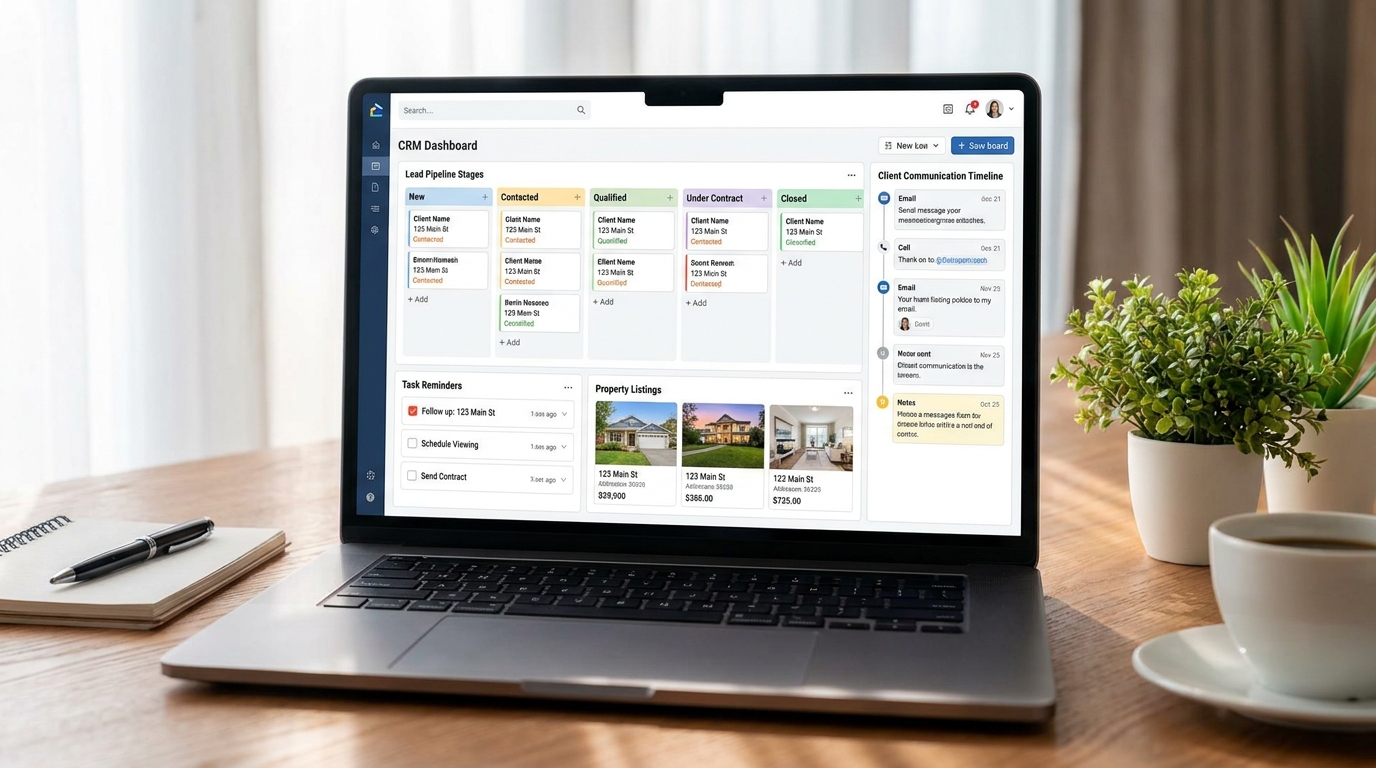
At a basic level, a CRM is software designed to manage interactions with prospects, clients, tenants, owners, buyers, sellers, and partners. In real estate, this means centralizing contact data, communication history, deal stages, tasks, documents, and performance metrics. The value comes from having one structured record of each relationship rather than spreading critical details across inboxes, notebooks, and team memory.
What makes a real estate CRM distinct from a generic CRM is the context in which it operates. Property transactions have their own workflows, timelines, and touchpoints. There are listing updates, viewings, lead sources, contract milestones, leasing cycles, tenant requests, renewal dates, and portfolio reporting needs. A CRM built or configured for real estate can map these processes in a way that feels operationally useful rather than abstract.
For an agent, the CRM may be the place where new inquiries are routed, viewings are scheduled, automated follow ups are triggered, and deal progress is tracked from first contact to closing. For a property manager, it may become the record of tenant communications, lease schedules, maintenance coordination, owner reporting, and service quality trends. For a brokerage leader, it may offer team visibility into conversion rates, pipeline health, campaign performance, and workload distribution.
The common thread is that the CRM brings discipline to movement. Real estate teams are constantly handling people, properties, and deadlines at once. Without a system, professionals rely on personal effort to keep everything moving. With a CRM, they can rely on process design, reminders, data structure, and automation. That difference is not just technical. It changes how capacity is managed and how consistently service is delivered.
Why Real Estate Workflows Need Better Systems
Real estate operations are often more complex than they appear from the outside. A single property can involve owners, prospective buyers or tenants, legal documents, maintenance teams, marketers, finance staff, and external vendors. A single client may engage through multiple channels, compare several properties, pause for months, and then reenter the market with different priorities. Without a central system, managing that level of complexity becomes dependent on individual memory and constant manual coordination.
Traditional workflows tend to break down in predictable ways. Information gets duplicated. Follow ups depend on whoever happens to remember them. Teams spend time searching for documents or message history rather than acting on it. Reporting becomes reactive because data is incomplete or trapped in separate tools. Even strong professionals can look disorganized when the underlying process is not designed for scale.
This matters because real estate clients increasingly expect speed, accuracy, and transparency. They are used to digital experiences in banking, travel, and retail. They notice when a property professional forgets context, sends duplicate messages, or takes too long to respond. The operational standard has shifted. Efficiency is no longer only an internal concern. It is now part of the client experience.
A CRM addresses this by creating continuity. It records what happened, what should happen next, who owns the next step, and where each relationship stands. That continuity has strategic value. It helps firms reduce leakage in the pipeline, protect service quality during busy periods, and create a more resilient business that does not depend entirely on a few highly organized individuals.
Core Functions of a Real Estate CRM
The best way to understand the impact of CRM software is to look at the functions it performs daily. While features vary by platform, most real estate CRMs are designed around a handful of operational needs. These needs include contact management, lead capture, workflow automation, task tracking, communication history, reporting, and integration with other systems such as listing portals, marketing tools, and calendar platforms.
Contact management remains the foundation. A CRM stores names, phone numbers, email addresses, property interests, transaction history, notes, and relationship context in one place. The difference between a contact list and a CRM record is depth. A CRM does not just tell you who someone is. It tells you how they entered the pipeline, which listings they viewed, when they were last contacted, what objections they raised, and what action is due next.
Lead capture is another major function. Modern real estate businesses receive inquiries from websites, ad campaigns, listing portals, social media, referrals, walk ins, and phone calls. A CRM can route those leads into one system automatically, assign them to team members, tag them by source or intent, and trigger the right follow up sequence. This is especially important because speed to response often has a measurable impact on conversion.
Task and workflow management translate activity into process. Instead of relying on memory, professionals can build predefined steps for onboarding a landlord, nurturing a buyer lead, preparing a unit for leasing, or handling renewal discussions. These workflows reduce inconsistency and help teams maintain service standards even as volume increases. The result is a more predictable operation with fewer dropped tasks.
Communication Tracking and Visibility
One of the most underrated benefits of a CRM is communication visibility. In many firms, client relationships become fragmented because one conversation sits in email, another in messaging apps, another in a colleague’s notebook, and another in a call log. A CRM creates a timeline of interactions so that anyone with the right access can understand the current status of the relationship without starting from zero.
This is valuable in both sales and property management contexts. If a tenant has raised a recurring issue, the CRM can show prior messages, service requests, and response times. If a buyer returns after several months, the agent can quickly review earlier preferences and concerns. This continuity helps conversations feel informed rather than transactional. It saves time, but it also preserves trust.
For managers, communication data also becomes operational evidence. It can reveal whether inquiries are being handled promptly, whether certain lead sources generate better quality prospects, and whether specific stages in the process repeatedly slow down. In other words, the CRM captures not just interactions but performance signals.
How Automation Changes Daily Real Estate Operations
Automation is one of the clearest reasons CRMs have become central to PropTech strategy. Real estate work includes many actions that are necessary but repetitive. Sending first response emails, assigning leads, booking reminders, requesting documents, updating statuses, and prompting follow ups all consume time. When these steps are performed manually, they absorb attention that could be used for advising clients, negotiating deals, or solving complex issues.
A good CRM automates these routine actions while still allowing the human side of the business to remain personal. For example, when a new inquiry comes in through a property page, the system can automatically acknowledge the inquiry, assign it to the correct agent, create a follow up task, and log the lead source. If the prospect does not respond within a set period, the CRM can trigger a second message or alert the team to call directly.
This type of automation reduces delays and standardizes service quality. It also lowers the risk of avoidable mistakes. In a manual process, a lead can be forgotten because someone was in a meeting, out on a viewing, or handling a different urgent matter. In an automated process, the system keeps the motion alive. The professional still controls the relationship, but the process no longer depends on memory alone.
Automation also helps property managers with recurring cycles such as lease renewals, maintenance follow ups, inspection reminders, and owner updates. These are not glamorous tasks, but they shape operational reliability. A CRM can schedule workflows around important dates, prompt staff to act in advance, and maintain a record of completion. Over time, this creates a more stable service environment and reduces administrative drift.

Improving Client Relationships Through Better Data
There is a common misconception that technology makes relationship businesses less human. In practice, the opposite is often true when the system is designed well. A real estate CRM improves relationships by preserving context. It helps professionals remember preferences, timing, objections, and life events that matter to the client. This allows communication to feel more relevant and less generic.
Consider a buyer who initially inquired about city center apartments but later shifted interest toward family homes near schools. Without structured records, that change can be missed, especially if months pass between interactions. A CRM captures the evolution of intent and makes it easier to reengage with useful recommendations rather than repeating the same questions. Clients notice when they are understood, and structured data makes that understanding more consistent.
The same principle applies in property management. Tenants and landlords care about responsiveness, reliability, and follow through. A CRM can document service issues, communication preferences, contract dates, and prior resolutions. This helps teams respond with more clarity and less friction. It also supports accountability because there is a visible record of what was promised and when.
Better data does not mean overwhelming teams with more fields to fill out. It means capturing the right signals in a usable format. The strongest CRM implementations balance discipline and practicality. They collect enough information to improve service and decisions, but not so much that the system becomes a burden. This is where thoughtful process design matters as much as the software itself.
Real Estate CRMs as a Decision Support Layer
One of the most powerful shifts in modern real estate is the move from anecdotal decision making to evidence based management. Professionals will always need intuition, local knowledge, and negotiation skill. But when the underlying data is organized well, those strengths can be applied more effectively. A CRM contributes to this by turning operational activity into measurable patterns.
For example, firms can analyze which marketing channels generate inquiries that actually convert, not just those that produce volume. They can identify how long different property types remain in the pipeline, where prospects tend to disengage, and which team workflows produce stronger outcomes. Property managers can review response times, maintenance resolution cycles, tenant retention patterns, and communication loads across portfolios.
This matters because many real estate decisions involve resource allocation. Where should marketing budget go? Which follow up process needs refinement? Which neighborhoods are generating stronger engagement? Which agents need support at specific funnel stages? Without a reliable data system, these questions are answered with partial visibility. With a CRM, they can be answered with more precision.
The CRM therefore becomes more than a record keeping tool. It becomes a decision support layer. It helps leaders move from reactive management toward structured optimization. In competitive markets, that shift can produce a meaningful advantage because operational improvements compound over time.
Key Metrics a CRM Can Surface
While every organization tracks different indicators, CRM reporting often helps teams monitor a useful set of business metrics. These metrics can reveal both performance and friction points across the customer lifecycle.
- Lead response time, which often influences conversion outcomes and early client perception.
- Source quality, showing which channels produce leads that move deeper into the pipeline.
- Conversion by stage, helping teams identify where prospects stall or drop off.
- Agent activity levels, including calls, emails, viewings, and follow up completion rates.
- Lease renewal timing and tenant retention trends for property management teams.
- Average time to close or lease, which helps forecast workload and cash flow patterns.
These metrics do not replace professional judgment. They sharpen it. When used responsibly, they help teams focus on the factors that actually influence outcomes rather than relying on assumptions that may no longer be accurate.
Integration With the Wider PropTech Stack
Real estate CRMs are most effective when they do not operate in isolation. Modern property businesses use multiple tools, including listing platforms, email marketing systems, document management software, accounting platforms, property management applications, e-signature tools, and analytics dashboards. A CRM adds the most value when it acts as a connective layer across this wider technology stack.
Integration reduces duplicate data entry and improves consistency. If a lead form on a website pushes directly into the CRM, staff do not need to manually copy details. If calendar tools sync with the CRM, appointments and reminders remain visible across systems. If marketing platforms connect to CRM segments, campaigns can be personalized based on actual client status rather than generic mailing lists.
In property management environments, integrations can also support maintenance workflows, invoicing, owner communications, and occupancy reporting. This does not mean every firm needs a highly complex system architecture. It means the CRM should fit naturally into the real operating model of the business. Efficiency is not created by having the most software. It is created by reducing friction between the systems that matter.
From a strategic perspective, integration also improves data quality. When systems share consistent identifiers and status updates, leaders can trust reporting more. That trust matters because weak data confidence often prevents teams from using analytics at all. A CRM that integrates well helps create a cleaner intelligence layer across the organization.

Use Cases Across Different Real Estate Roles
Real estate is not one job category, so CRM value appears differently across roles. For residential agents, the system often centers on lead nurture, listing matching, showing coordination, and deal progression. Speed, personalization, and follow up consistency are especially important because competitive markets reward the professionals who stay organized under pressure.
For brokers and team leaders, the CRM adds visibility and management structure. It becomes easier to monitor pipelines, evaluate source performance, standardize onboarding, and distribute leads more fairly. It also supports coaching because managers can see where process breakdowns occur rather than judging only final outcomes.
For property managers, the CRM can support tenant communication, lease administration, service issue tracking, owner reporting, and retention planning. The work is less about one time transactions and more about continuity over time. That makes communication history and recurring workflows especially valuable.
For developers and project sales teams, the CRM often helps coordinate buyer journeys across longer timelines. Off plan projects may involve early interest, financing questions, milestone updates, and extended nurturing before final commitment. The ability to segment prospects, automate updates, and track intent across months can improve both conversion and experience.
What to Look for When Choosing a Real Estate CRM
Selecting a CRM is not just a software purchase. It is a process decision. The right platform depends on the business model, team size, data maturity, and workflow complexity of the organization. A small brokerage with a fast moving sales cycle may need simplicity and speed. A larger property management company may need stronger workflow customization, reporting, and integration capabilities.
Usability should be one of the first evaluation criteria. If the interface is difficult or the workflow feels unnatural, adoption will suffer. In real estate, teams are busy and mobile. They need software that supports quick updates, easy search, clear reminders, and smooth access from multiple devices. Elegant complexity is still complexity, so practical usability matters more than long feature lists.
Customization is also important because no two firms structure their pipeline in exactly the same way. The CRM should allow teams to define stages, fields, tags, permissions, and automation rules that reflect actual operations. At the same time, too much customization can create maintenance problems. The goal is fit, not endless configuration.
Reporting, integration options, mobile access, support quality, and data migration tools should all be considered as well. A platform may look impressive in a demonstration but struggle in real deployment if migration is poor or support is weak. Real estate businesses should evaluate how the CRM performs under everyday conditions, not just in ideal scenarios.
Questions Worth Asking Before Adoption
- What core workflows do we want the CRM to improve first, and how will we measure that improvement?
- Which data fields are essential for service quality and reporting, and which are unnecessary?
- How will leads enter the system, and who is responsible for response at each stage?
- Which existing tools must integrate with the CRM for the process to feel seamless?
- What training and governance will ensure that the system remains accurate over time?
These questions shift the conversation from buying software to designing an operating system. That distinction often determines whether a CRM becomes a strategic asset or an underused database.
Implementation Challenges and How to Avoid Them
Even strong CRM platforms can fail if implementation is rushed or unclear. One common problem is trying to digitize every process at once. Teams become overwhelmed, fields are poorly defined, and adoption stalls. A more effective approach is phased implementation, starting with the workflows that create the most obvious friction or opportunity, such as lead intake, follow up scheduling, or tenant communication logging.
Another challenge is inconsistent data entry. If team members use different naming conventions, skip key fields, or work outside the system, reporting quality declines quickly. This is why governance matters. A CRM should have simple but explicit rules about required fields, stage definitions, note standards, and task ownership. Structure does not need to feel bureaucratic, but it does need to exist.
Training is equally important. People do not adopt systems simply because management says they should. They adopt them when the value is visible in daily work. Good training focuses on real scenarios, showing how the CRM saves time, protects deals, and reduces mental load. When professionals experience the platform as a support tool rather than an administrative burden, usage improves significantly.
Leadership behavior also matters. If managers ask for updates outside the CRM, staff will quickly conclude that the system is optional. If reporting, reviews, and workflow expectations all run through the CRM, adoption becomes part of normal operations. In this sense, implementation is as much a management practice as a technical project.
The success of a CRM depends less on installation and more on habit formation. Real efficiency appears when the system becomes the default place where work is captured, tracked, and improved.
The Role of AI and Intelligent Automation in Real Estate CRMs
As PropTech evolves, CRMs are becoming more intelligent rather than simply more digital. AI features are increasingly used to score leads, summarize conversations, recommend next actions, detect response gaps, and surface patterns that teams might miss. This does not mean the software replaces the judgment of experienced property professionals. It means the system can help prioritize attention and reduce cognitive overload.
For example, an AI enabled CRM may identify that leads from a specific channel have lower volume but stronger closing rates, prompting budget reevaluation. It may highlight buyers who are showing renewed engagement after a period of inactivity, suggesting the right time for outreach. It may summarize long communication threads so that a colleague can step in without rereading every message. These functions increase speed and clarity in environments where time matters.
In property management, intelligent automation may help categorize tenant requests, flag unresolved issues, or predict renewal risk based on communication patterns and service history. None of this removes the need for human empathy or nuanced problem solving. It simply improves the signal quality available to the team.
The most practical view of AI in real estate CRM is not futuristic replacement. It is augmentation. The system handles pattern recognition, reminders, and information compression so that professionals can focus on advice, negotiation, service recovery, and relationship building. That is the intelligence layer that increasingly defines competitive operations.
Why CRM Adoption Is Becoming a Strategic Necessity
There was a time when a CRM could be treated as optional infrastructure, especially for smaller firms with a few highly organized individuals. That time is fading. Real estate markets are more digitally mediated, client expectations are higher, teams are more distributed, and competitive pressure is stronger. In that context, informal process management becomes a liability.
A CRM helps firms protect revenue by reducing missed opportunities. It helps protect brand quality by improving consistency. It helps protect management visibility by turning activity into measurable performance. These benefits are not limited to large enterprises. In many cases, smaller teams gain even more because the software reduces operational dependence on a few people holding everything together manually.
There is also a long term knowledge advantage. Every interaction captured in a CRM contributes to institutional memory. If staff leave, the relationship history remains. If strategies change, historical patterns remain available for analysis. If the business expands into new markets or services, the CRM provides a structure for scaling without losing visibility. This accumulation of organized knowledge is one of the most underestimated benefits of adoption.
Seen this way, a real estate CRM is not just about efficiency today. It is about building operational intelligence for tomorrow. The firms that treat it as a strategic layer rather than a simple software category are often the ones best positioned to adapt.
Final Thoughts
Real estate CRMs matter because modern property work is too dynamic, data rich, and relationship dependent to run well on memory and fragmented tools alone. The strongest systems create one environment where contacts, communications, tasks, listings, documents, and analytics can work together. That coordination improves speed, consistency, and decision quality across the business.
For agents, brokers, developers, and property managers, the practical gains are clear. Follow ups become more reliable. Service becomes more personalized. Team coordination becomes less fragile. Reporting becomes more useful. Automation removes low value repetition while preserving the human judgment that clients still care most about. In an industry where timing and trust shape outcomes, these advantages are substantial.
The deeper lesson is that technology works best when it clarifies rather than complicates. A well chosen real estate CRM does not add process for its own sake. It creates structure around the work that already matters. It turns scattered activity into a system, and a system into insight. That is why CRM adoption has become central to modern property management and the wider future of PropTech.



No Comment! Be the first one.