



Master-planned communities have moved from a niche development model to one of the most strategically important formats in North American real estate. In a market shaped by higher borrowing costs, affordability pressure, shifting migration patterns, and changing household preferences, investors are increasingly looking for assets and development models that can deliver more than simple unit production. A well-executed master-planned community offers that broader proposition. It combines housing, amenities, land-use coordination, and long-term place-making into a product that can stay relevant across multiple market cycles.
Table Of Content
- What a master-planned community really is
- Why master-planned communities are gaining strategic relevance
- The demographic tailwinds behind the opportunity
- Amenities as pricing power, not decoration
- Why product mix matters more than ever
- What mixed density can unlock
- Location still decides the outcome
- How investors should evaluate a master-planned community
- Core questions to ask before investing
- The revenue opportunity beyond home sales
- The key risks investors cannot ignore
- How the best opportunities are likely to emerge in Canada
- Final perspective: a long-term place-making strategy with portfolio value
For investors, the appeal is not only scale. The real advantage lies in control, adaptability, and demand durability. Strong master-planned communities are designed to function as complete environments rather than isolated housing tracts. They often include parks, schools, pathways, retail, recreational space, and a mix of housing types that support different life stages. That structure can widen the buyer and renter pool, improve absorption, support resale values, and create optionality across residential, rental, and commercial uses.
This matters even more in the current market. RCLCO’s 2024 survey found that sales among the Top 50 U.S. master-planned communities were only about 2% below 2023 levels, despite elevated mortgage rates and affordability constraints. That result is notable because it suggests that the best communities can hold demand better than more generic suburban product. Buyers are not just purchasing square footage. They are buying convenience, identity, and a more complete lifestyle offering.
In Canada, the opportunity is similarly compelling, but it requires more selectivity. Population growth remains supportive in absolute terms, though the pace has moderated. Statistics Canada reported that the country added 744,324 people in 2024, while the population aged 65 and older reached 19.5% by July 1, 2025. At the same time, the population aged 0 to 14 remained roughly stable year over year. These demographic trends reinforce two durable pools of demand that well-designed master-planned communities are uniquely positioned to serve: families seeking infrastructure and community cohesion, and older households seeking low-maintenance, lifestyle-oriented housing.
The investment case, then, is not based on a single trend. It rests on the ability of master-planned communities to respond to several trends at once. They can support family formation, aging in place, mixed-density housing, rental demand, convenience-led living, and long-term land value creation. For investors building or reshaping a real estate portfolio in a changing market, that combination deserves close attention.
Key investment insight: The strongest master-planned communities are not simply large projects. They are long-duration place-making platforms that align land use, amenities, density, and phasing with how people actually want to live.
What a master-planned community really is
A common misconception is that any large suburban subdivision qualifies as a master-planned community. That is not the case. Size alone is not the defining feature. A true master-planned community is built around an integrated, long-term framework that coordinates residential uses with open space, transportation, recreation, schools, services, and often commercial components. The project is intentionally phased over time, with each phase contributing to a coherent end-state vision rather than operating as a standalone release of lots or homes.
This distinction is important because it changes how investors should evaluate the asset. A standard subdivision may rise or fall primarily on home pricing, local demand, and construction execution. A master-planned community is more complex. It has infrastructure strategy, design governance, amenity sequencing, density planning, product diversification, and sometimes multiple monetization streams. In practical terms, it behaves less like a single project and more like an operating platform with many linked components.
The best communities are typically led by a master developer that maintains design discipline and strategic control over how the project evolves. That leadership is often visible in coherent streetscapes, quality public realm design, product variety, and a clear hierarchy of community amenities. It also influences how builders are selected, how lots are released, and how later phases are calibrated to market conditions. Investors should see this governance structure as a strength because it reduces the risk of fragmented execution and protects the integrity of the original vision.
Modern master-planned communities are also broader in format than many investors assume. They are not limited to detached homes. Increasingly, they include townhomes, apartments, build-to-rent product, active-adult housing, mixed-use centres, and missing-middle forms that bridge the gap between low-density suburban housing and high-rise urban stock. That evolution makes them more adaptable in a market where affordability and demographic diversity are shaping demand.

Why master-planned communities are gaining strategic relevance
The current housing market is rewarding differentiation. As financing remains more expensive and households become more price-sensitive, buyers and renters are looking more carefully at total value. That means location, convenience, mobility, nearby services, and quality-of-life features carry more weight in the decision process. In this environment, amenities are no longer secondary. In many cases, they are the product itself.
CMHC’s 2025 rental market reporting showed softer conditions in major Canadian urban centres, with purpose-built vacancy rising to 3.1% from 2.2% in 2024 as supply increased and renter formation slowed. For investors, this points to an important shift. When demand is less automatic, communities that reduce daily friction can defend occupancy and pricing more effectively than undifferentiated projects. Proximity to parks, schools, convenience retail, transit links, and community services can become a practical hedge against softness in the broader market.
Master-planned communities are particularly well positioned because they can package these features in a way that is legible to households. A family comparing housing options may accept a similar or slightly higher price point if the community offers better access to schools, trails, playgrounds, and neighbourhood retail. An older downsizer may prioritize low-maintenance living if the environment supports walkability, recreation, and social connection. A renter may choose a well-located build-to-rent component within a larger community because it provides a stronger daily living experience than a standalone suburban building.
This is where strategic relevance becomes clear. In a slower and more selective market, assets that offer stronger lifestyle value can outperform because they compete on more than just shelter. They can compete on convenience, identity, and resilience of demand.
The demographic tailwinds behind the opportunity
Investors should pay close attention to the demographic alignment that supports the master-planned model. The most important demand pools in today’s market are not uniform, but they are highly compatible with communities that offer varied product types and amenity depth. The first pool is families, especially those pushed outward from core urban markets by affordability constraints. These households still want access to space, schools, green areas, and community infrastructure. A well-designed master-planned community delivers those needs more effectively than many ad hoc suburban expansions.
The second major pool is older households. Statistics Canada reported that the 65-plus population reached 19.5% by July 1, 2025, and this cohort continues to grow faster than younger age groups. Many of these households are not looking for institutional retirement settings. They want homes that are easier to maintain, better connected to services, and embedded in communities that support mobility and social engagement. Master-planned communities that include bungalow product, townhomes, low-rise multifamily, active-adult sections, or service-rich mixed-use nodes can meet that demand in a highly investable format.
There is also a generational bridge between these groups. Millennial buyers continue to influence demand as they move through family formation years, while retiring baby boomers reshape demand at the other end of the age spectrum. RCLCO has pointed to millennial homebuyers, retiring boomers, and domestic migration patterns as important supports for strong master-planned community performance. The result is a broadening of potential absorption rather than a narrow dependence on one buyer profile.
That breadth matters because long development timelines require confidence that demand can evolve over time. A community that only works for one household type carries more risk. A community that can accommodate first-time buyers, move-up families, renters, downsizers, and age-targeted buyers is better positioned to absorb supply across multiple phases and market conditions.
Amenities as pricing power, not decoration
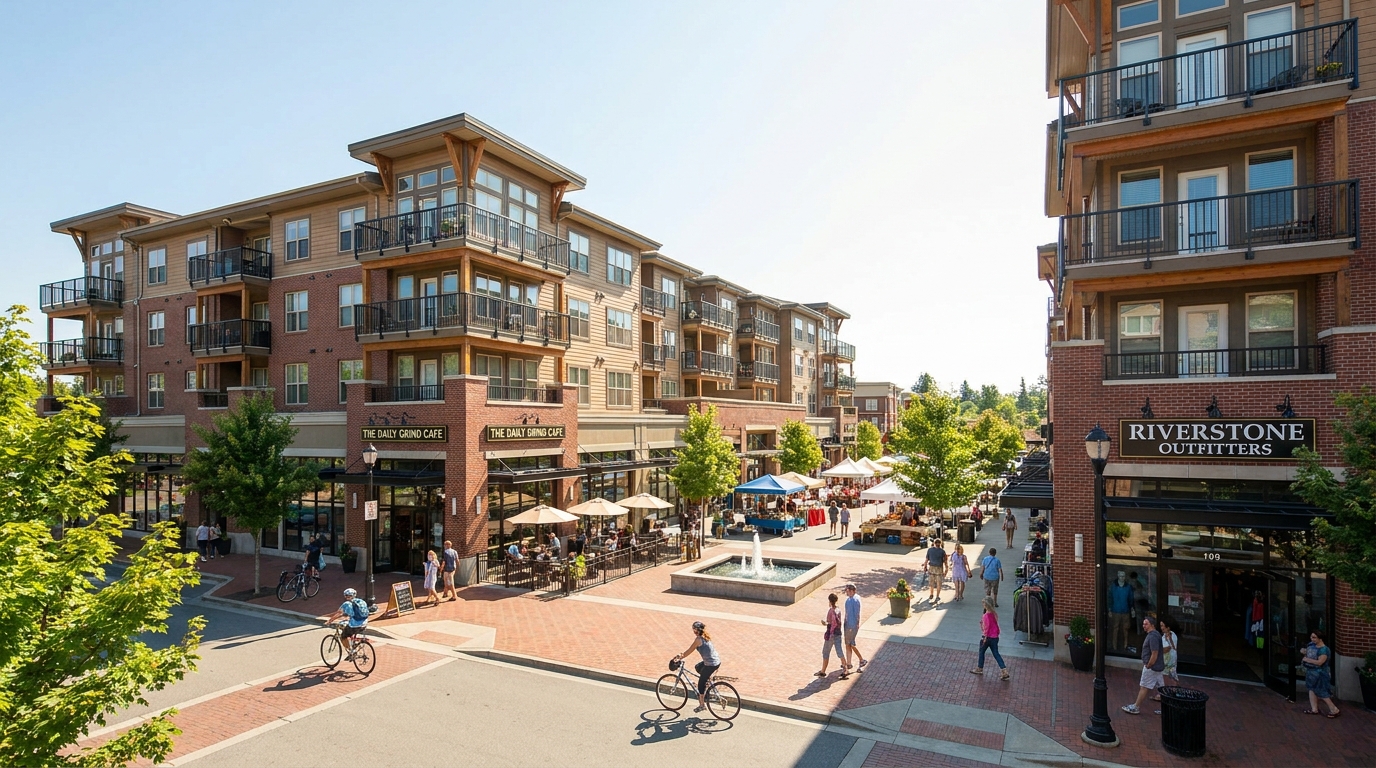
One of the most misunderstood aspects of master-planned communities is the role of amenities. In weaker projects, amenities are treated as marketing accessories. In stronger projects, they are central to the economic model. Parks, clubhouses, trails, schools, sports facilities, waterfront features, retail clusters, and programmed public spaces create perceived and practical value. They shape buyer urgency, increase time spent in the community, support resident retention, and help establish a premium identity that can carry across product types.
From an investor’s perspective, this matters because pricing power often depends on narrative as much as on specifications. In a market where many homes may offer similar interiors, the surrounding community becomes the differentiator. If households believe a community will improve daily life, they may accept stronger pricing, faster decision-making, or less discounting pressure. This is particularly relevant where affordability is stretched and consumers are scrutinizing whether a purchase justifies its cost.
That said, amenities alone do not guarantee performance. They must be aligned with the target demographic and introduced at the right time. A premium clubhouse has limited value if early residents arrive before essential infrastructure or retail is in place. Likewise, a beautiful trail system will not fully offset weak location fundamentals or poor product-market fit. The strongest communities use amenities strategically, sequencing them to support absorption and embedding them in a broader framework of governance, maintenance, and placemaking.
For investors, the practical lesson is simple: assess whether amenities are functional drivers of value or merely cosmetic additions. The answer can materially affect absorption rates, resale strength, lease-up performance, and long-term reputation.
Why product mix matters more than ever
Perhaps the most important strategic shift in the sector is the move away from single-product development. Historically, many suburban growth areas were built around detached housing. That model still has a place, but it is no longer enough on its own. Affordability constraints, policy pressure, demographic variation, and land efficiency requirements are all pushing developers toward more diversified housing formats.
CMHC’s Spring 2026 Housing Supply Report highlighted the growing importance of rental construction, missing-middle housing, and medium-density formats. In Calgary, for example, CMHC reported that two-thirds of housing starts in 2025 were medium-density. This trend is highly relevant for master-planned communities because they can integrate density changes within a broader framework rather than forcing a binary choice between low-density suburban housing and urban high-rise development.
A stronger product mix creates several advantages for investors. It broadens the pool of buyers and renters. It allows price points to be calibrated across a wider spectrum. It enables residents to remain in the community through different life stages. It can also improve land efficiency and support commercial activation by creating enough population density to sustain retail and services. For long-hold investors, it increases optionality by allowing sites to shift toward rental, for-sale, or mixed-use formats as market conditions evolve.
The phrase investors should focus on is product ladder. A true master-planned community offers a ladder that lets households move up, down, or across within the same environment. A renter may later buy a townhome. A family may move from a starter home to a larger detached property. A retiree may downsize into a low-maintenance unit nearby. That internal mobility can reinforce community stability and support sustained demand over multiple phases.
What mixed density can unlock
Mixed density is not simply a planning trend. It is a risk management tool. Communities that can adjust unit mix in response to mortgage rates, construction costs, or changes in demand are structurally more resilient than those locked into a single format. If detached home affordability weakens, townhomes or compact lots may preserve velocity. If ownership demand slows, rental components may become more compelling. If an aging population drives different preferences, active-adult or accessible multifamily formats may capture that shift.
This flexibility is especially valuable in Canada’s current environment. CMHC’s 2026 outlook points to slower housing starts as economic uncertainty and softer demand weigh on the market. In that setting, the value of resilient, diversified projects rises. Investors should treat flexible zoning, phased entitlement, and diversified housing capability as core underwriting strengths rather than secondary features.
Location still decides the outcome
Even the best plan cannot overcome the wrong location. Master-planned communities often succeed in metropolitan fringes and secondary nodes where households can access more space, improved affordability, or a better amenity package than the urban core can offer. But being outside the core does not mean being disconnected. The most investable locations typically sit within a larger pattern of employment growth, infrastructure investment, transportation access, and sustained household formation.
For Canada specifically, opportunity is strongest where developable land aligns with durable demand drivers such as immigration inflows, job creation, and public investment in roads, schools, utilities, and transit. Selectivity is essential because slower population growth and moderation in migration can change the pace and composition of demand. Investors should avoid assuming that any greenfield land on the edge of a major city will support a successful master-planned strategy. The surrounding economic engine still matters.
Investors should also examine the competitive landscape. If multiple projects in the same corridor are chasing the same buyer with similar product and limited differentiation, the advantage of scale can erode quickly. A strong location is one where the community can establish a distinct value proposition relative to nearby alternatives. That differentiation may come from better schools, stronger design, more advanced infrastructure, a mixed-use centre, a stronger builder lineup, or a better affordability profile.
Ultimately, location should be analyzed as a combination of current fundamentals and future relevance. Investors are not only buying today’s market. They are underwriting whether the area will still attract residents, employers, and capital through the next decade of development phases.
How investors should evaluate a master-planned community
Evaluating a master-planned community requires a broader lens than evaluating a single asset. The investor must understand not just what is being built, but how the entire community is intended to function over time. A disciplined review should look at land control, entitlement status, infrastructure readiness, amenity sequencing, product diversity, builder strategy, target demographics, and the financial logic of each development phase.
One useful way to approach this is to ask whether the community has true durable advantages or merely attractive marketing. Durable advantages are difficult for competitors to replicate quickly. They often include long-term land control, strong transportation access, quality schools, mixed-use integration, embedded recreation, coherent architectural standards, and a development program that can adapt over time. Marketing, by contrast, may create short-term attention without necessarily improving long-term value.
Governance is another underappreciated factor. Strong communities usually have clear rules around design, maintenance, amenity operation, and public realm quality. These controls protect the resident experience and help preserve value. Weak governance can lead to inconsistent execution, underfunded amenities, visual fragmentation, and eventual erosion of brand strength. Investors should view community association structure and operational planning as part of the underwriting, not as administrative details.

Core questions to ask before investing
- Is there a real master plan with long-term coherence? Look for integrated land use, phasing logic, and design standards rather than a simple collection of residential tracts.
- Does the location have durable economic support? Employment growth, infrastructure, and regional demand trends should support absorption over many years.
- Is the product mix flexible? Communities should be able to shift among detached, townhome, multifamily, rental, and age-targeted formats as market conditions change.
- Are amenities authentic demand drivers? Assess whether they genuinely improve daily life and support pricing power, not just promotional campaigns.
- Can the community serve multiple demographic groups? The more life stages and income bands the project can accommodate, the more resilient demand is likely to be.
- Is phasing realistic? Infrastructure timing, capital requirements, and absorption assumptions should align with market conditions.
- Who is the master developer? Track record, capital strength, design discipline, and operational governance are critical variables.
The revenue opportunity beyond home sales
Another strategic advantage of master-planned communities is their capacity to generate value across more than one asset category. Traditional subdivision economics often rely heavily on lot sales or home closings. A broader master-planned framework can layer in commercial parcels, multifamily rental income, land appreciation, association or service-related income, and in some cases healthcare, education, or office-related components. This diversification can improve return potential and reduce dependence on a single exit path.
For investors with a long-term view, this optionality is powerful. A site initially planned around for-sale housing may later support a build-to-rent program if ownership affordability weakens. A future mixed-use node may become more valuable once population thresholds are reached. Land held for later phases may appreciate as infrastructure is delivered and the community brand matures. In this sense, master-planned communities behave more like strategic ecosystems than static projects.
That does not mean every component should be pursued simultaneously. Timing remains critical. Premature retail can struggle if rooftops are insufficient. Rental product may be most effective in later phases once amenities and identity are established. Commercial uses require careful curation so they serve residents while also sustaining tenant economics. The strongest investors recognize that sequencing is central to unlocking value across the full plan.
This long-duration value creation is one reason master-planned communities remain attractive even when the macro environment becomes less forgiving. If executed well, they can create multiple pathways to return while retaining the core residential demand story.
The key risks investors cannot ignore
Despite their advantages, master-planned communities are not low-risk by default. The long timeline that creates optionality also introduces exposure. Interest rates can change materially between early land acquisition and later vertical delivery. Construction cost inflation can compress margins. Municipal approval processes can shift. Political priorities can alter infrastructure timing or density assumptions. Consumer preferences can also evolve in ways that require significant adaptation.
Investors should be especially careful about entitlement and infrastructure risk. A compelling site plan means little if servicing, transportation access, or municipal cooperation are uncertain. Likewise, overly optimistic absorption assumptions can create a mismatch between capital deployment and actual market velocity. In a more selective market, patience and phasing discipline matter as much as vision.
There is also execution risk in amenity strategy. High-quality amenities are expensive to build and maintain. If they arrive too late, the early sales story may weaken. If they arrive too early, the carrying cost may burden returns. The same applies to mixed-use elements. Retail and commercial uses can add value, but only if local demand and household density are sufficient to support them.
Perhaps the biggest mistake is assuming that all master-planned communities deserve a premium simply because of the label. Some are exceptional, some are average, and some are effectively conventional subdivisions with upgraded branding. Investors must distinguish between concept and execution. The market certainly does.
Important reminder: Master-planned communities are not recession-proof. Their strength comes from better positioning, stronger diversification, and deeper demand alignment, not immunity from market cycles.
How the best opportunities are likely to emerge in Canada
In Canada, the next wave of stronger opportunities is likely to come from communities that align with a few specific realities. The first is affordability pressure, which supports medium-density, townhome, rental, and missing-middle forms within broader master plans. The second is demographic bifurcation, where both family-oriented product and age-targeted or low-maintenance product can succeed within the same community. The third is slower, more selective demand, which places greater importance on phasing discipline, infrastructure readiness, and clear differentiation.
The most attractive opportunities are likely to be found in fast-growing suburban fringes and secondary urban nodes where households can still find value relative to core markets. But investors should prioritize locations with visible employment anchors and public investment, rather than relying only on population momentum. A community can offer attractive homes and amenities, but if the surrounding regional economy is weak, long-term absorption may disappoint.
There is also growing potential in hybrid communities that combine ownership and rental formats within the same plan. As CMHC’s supply data continues to highlight the importance of rental and medium-density construction, investors should expect successful master-planned communities to look increasingly mixed in tenure as well as form. This is a positive development because it widens the market and creates additional layers of cash flow opportunity.
In practical terms, the Canadian investment case is strongest where the master plan is flexible enough to respond to softer starts, policy changes, and evolving household budgets without losing its identity. That is what separates a durable community strategy from a one-cycle development play.
Final perspective: a long-term place-making strategy with portfolio value
For real estate investors, master-planned communities should be understood as more than large housing developments. At their best, they are integrated place-making strategies that convert land, infrastructure, housing, amenities, and time into a durable competitive position. In a changing market, that matters. Investors need projects that can respond to demographic shifts, protect value through product diversity, and maintain relevance when households become more selective.
The evidence supporting the segment is meaningful. RCLCO’s 2024 survey showing sales resilience among the Top 50 U.S. master-planned communities suggests that demand remains durable where the product is differentiated. In Canada, population growth, aging demographics, and changing housing preferences are reinforcing the need for communities that can serve more than one household type. CMHC’s reporting on vacancy, supply, and market uncertainty further strengthens the case for diversified, flexible, amenity-led projects rather than one-dimensional suburban expansion.
The strategic advantage is not scale for its own sake. It is the ability to create a community with enough depth to remain attractive through changing rate environments, affordability pressures, and demographic transitions. Investors who focus on strong locations, disciplined master developers, flexible product mix, infrastructure readiness, and authentic amenity value will be best positioned to identify the communities with lasting investment merit.
In the years ahead, some of the best-performing development investments in North America will likely be the master-planned communities that function as complete ecosystems. They will not succeed because they are large. They will succeed because they are deliberate, adaptable, and closely aligned with how people want to live now and in the future.



No Comment! Be the first one.