



An inspiring office space blends visual elegance with genuine function: it supports the body through ergonomic comfort, calms the mind through thoughtful lighting and acoustics, and reflects personal identity through material choices and considered decor. Rather than following a single aesthetic formula, a truly inspiring office adapts to how people actually work today, shifting between focused solo tasks, video calls, and collaborative moments, often across both home and workplace settings. It is arranged so that the desk, chair, monitor, and lighting reduce physical strain rather than create it, while biophilic elements, acoustic softness, and concealed storage keep the room feeling calm rather than cluttered. The result is a space that does not force a choice between beauty and efficiency. Elegant materials, calm proportions, and thoughtful detail can directly support concentration and comfort, making an inspiring office one that helps people feel better and perform better throughout the workday.
Table Of Content
- The New Meaning of an Inspiring Office Space
- Why Ergonomics Is the Foundation of Office Elegance
- Space Planning That Supports Focus and Flow
- Lighting as Atmosphere, Performance, and Wellbeing
- Biophilic Design and the Quiet Luxury of Nature
- Acoustics, Privacy, and the Art of Mental Calm
- Materials, Palette, and Personal Identity
- Storage, Decluttering, and Visual Serenity
- Designing for Hybrid Work and Flexibility
- Inclusive Comfort and Long-Term Usability
- How to Bring It All Together
- Final Thoughts
Today, this balance matters more than ever. Across Canada and North America, office life has changed. Many people move between home and workplace, between concentrated solo tasks and collaborative exchanges, between digital meetings and long hours at a screen. In that context, office design must become more intelligent. It must be adaptable, ergonomic, calming, and expressive. It should support focus, reduce physical strain, and create a sense of identity that makes work feel more intentional.
Research consistently supports this approach. Canadian ergonomic guidance emphasizes that work should be adapted to the worker, not the other way around. Occupational health resources in both Canada and the United States also warn that awkward posture, repetition, static positions, poor lighting, and environmental discomfort can contribute to fatigue and musculoskeletal strain. At the same time, growing evidence around biophilic design, acoustic comfort, and flexible workplace planning suggests that inspiring offices are not simply stylish spaces. They are spaces that help people feel better and perform better.
This is where refined design becomes especially powerful. Elegant interiors are often associated with calm proportion, material restraint, thoughtful detail, and visual harmony. Those same qualities can support concentration and emotional ease. A room with softened acoustics, layered lighting, concealed storage, natural materials, and considered ergonomics is not merely luxurious. It is also deeply functional. The office becomes less a place of visual pressure and more a place of poised productivity.
In this article, we will explore how to create an office that feels sophisticated yet practical, personal yet professional, and aspirational yet entirely livable. From workstation ergonomics and layout strategy to lighting, acoustics, storage, and biophilic design, each layer plays a role in shaping a workspace that is as efficient as it is beautiful.
The New Meaning of an Inspiring Office Space
For years, the phrase inspiring office space often referred to a certain aesthetic formula. It might have meant airy rooms, statement furniture, a carefully styled coffee table, and a wall painted in a fashionable shade. While appearance still matters, the definition has become more nuanced. Inspiration now comes from how a space supports real life. It is felt in the ease of sitting well for several hours, the relief of proper lighting during afternoon screen work, the sense of calm created by orderly storage, and the subtle lift that arrives when a room reflects your personal character.
That shift is both practical and cultural. The modern office, whether corporate or residential, is expected to serve more than one mode of work. It must hold concentration, communication, video calls, planning, reading, and often creativity itself. It should also accommodate changing needs over time. This makes rigid ideas of office design less useful than thoughtful frameworks that allow for flexibility. A beautiful office today is not fixed in one posture. It is composed to support movement, adjustment, and variation.
There is also a growing awareness that visual elegance can improve the emotional experience of work. Materials that feel warm rather than clinical, colors that soothe rather than overstimulate, and décor that conveys intention rather than clutter all shape our state of mind. When these choices are made with discipline, the office begins to feel less transactional and more cultivated. It becomes a place that encourages clarity, confidence, and sustained attention.
This is especially relevant in home offices, where the boundary between personal life and professional life can feel porous. In such spaces, design must work doubly hard. It must create focus without becoming cold, and comfort without becoming slack. The most compelling solution is not to imitate a commercial office. It is to design a room that honors domestic elegance while incorporating the ergonomic and environmental standards that productive work demands.
Why Ergonomics Is the Foundation of Office Elegance
Elegance in an office begins with proportion, and the most important proportion is the relationship between the body and the furniture that supports it. Canadian guidance on ergonomics defines the principle clearly: the job should be adapted to the worker. In design terms, this means that the desk, chair, monitor, keyboard, lighting, and surrounding reach zones should be arranged to reduce strain rather than create it. No amount of visual sophistication can redeem a workspace that leaves the shoulders tense, the neck extended, or the wrists unsupported.
This is not a small issue. Occupational health resources have long linked office discomfort to awkward postures, repetitive movements, and static positions. In the United States, musculoskeletal disorders have represented a substantial share of serious workplace injury cases. These realities remind us that comfort is not decorative. It is structural. A refined office must be one that can be inhabited for hours without quietly undermining wellbeing.
The chair is often the most consequential piece in the room. A supportive chair should allow the feet to rest flat or on a footrest, support the lower back, and encourage a neutral seated posture. Yet supportive does not have to mean visually uninspired. Today, many beautifully upholstered ergonomic chairs bring together graceful lines and technical performance. Choosing one in boucle, leather, linen blend, or a soft woven textile can preserve the room’s elegance while supporting daily use.
The desk deserves equal attention. Its height should allow the forearms to rest comfortably with the elbows near the body, avoiding unnecessary elevation in the shoulders. For many users, an adjustable desk is especially valuable because it makes the office responsive rather than fixed. This sense of adjustability aligns perfectly with modern luxury. A well-designed room should adapt discreetly to its occupant, just as a tailored garment does.
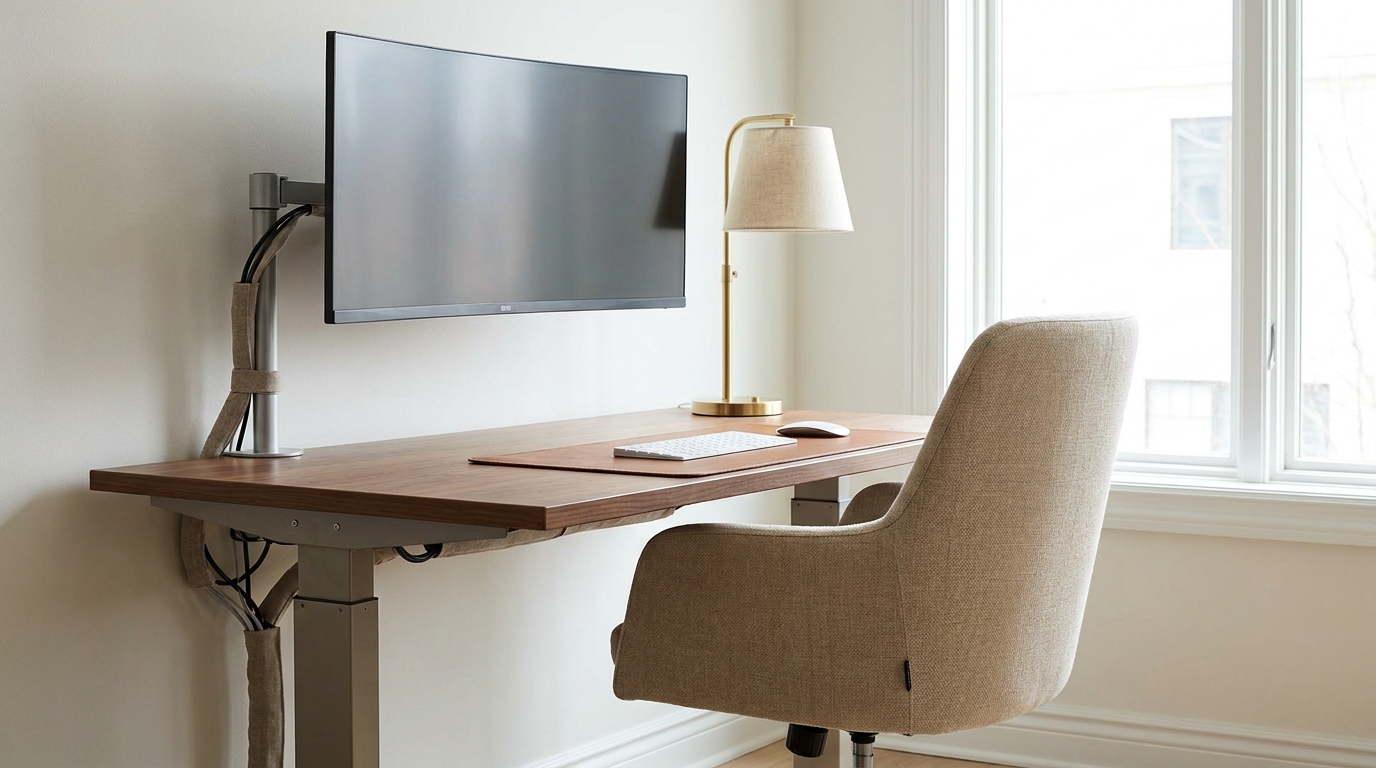
Monitor placement is another essential detail that is often overlooked in purely aesthetic planning. The top of the screen should generally sit at or slightly below eye level, with enough distance to avoid leaning forward. Glare should also be carefully managed, especially when the desk is positioned near a window. OSHA notes that bright light sources behind a screen can create viewing problems, which means elegant window placement must be accompanied by practical solutions such as sheer drapery, blinds, angled monitor placement, or layered task lighting.
To create a polished ergonomic setup, it helps to think in zones. The most frequently used items should remain within easy reach, reducing repetitive stretching and twisting. A refined desk surface is not only visually calm, it is physically intelligent. Pens, notebooks, charging stations, and reference materials should sit where they are needed most, while less frequently used items can be stored nearby but out of sight. The result is both cleaner to look at and easier to use.
The most luxurious office is not the one with the most expensive objects. It is the one that quietly supports the body, clarifies the mind, and makes work feel composed.
Space Planning That Supports Focus and Flow
One of the most persistent misconceptions in office design is that openness automatically creates energy, creativity, and modernity. In reality, research has shown that shared and open-plan offices are not inherently beneficial to health or productivity. In a number of reviewed studies, these environments were associated with poorer wellbeing and reduced performance when compared with more private settings. This does not mean that offices should feel enclosed or heavy. It means that openness should be balanced with control.
The most successful office layouts are planned around activity rather than image alone. A room should support different modes of work with subtle spatial cues. Even a compact office can include a primary work zone, a secondary reading or meeting zone, and carefully placed storage that keeps visual noise at bay. In larger settings, the same principle can be expanded into quiet focus areas, collaborative tables, and semi-private corners for calls or reflective tasks. The beauty lies in fluidity, not in forcing all work into one kind of setting.
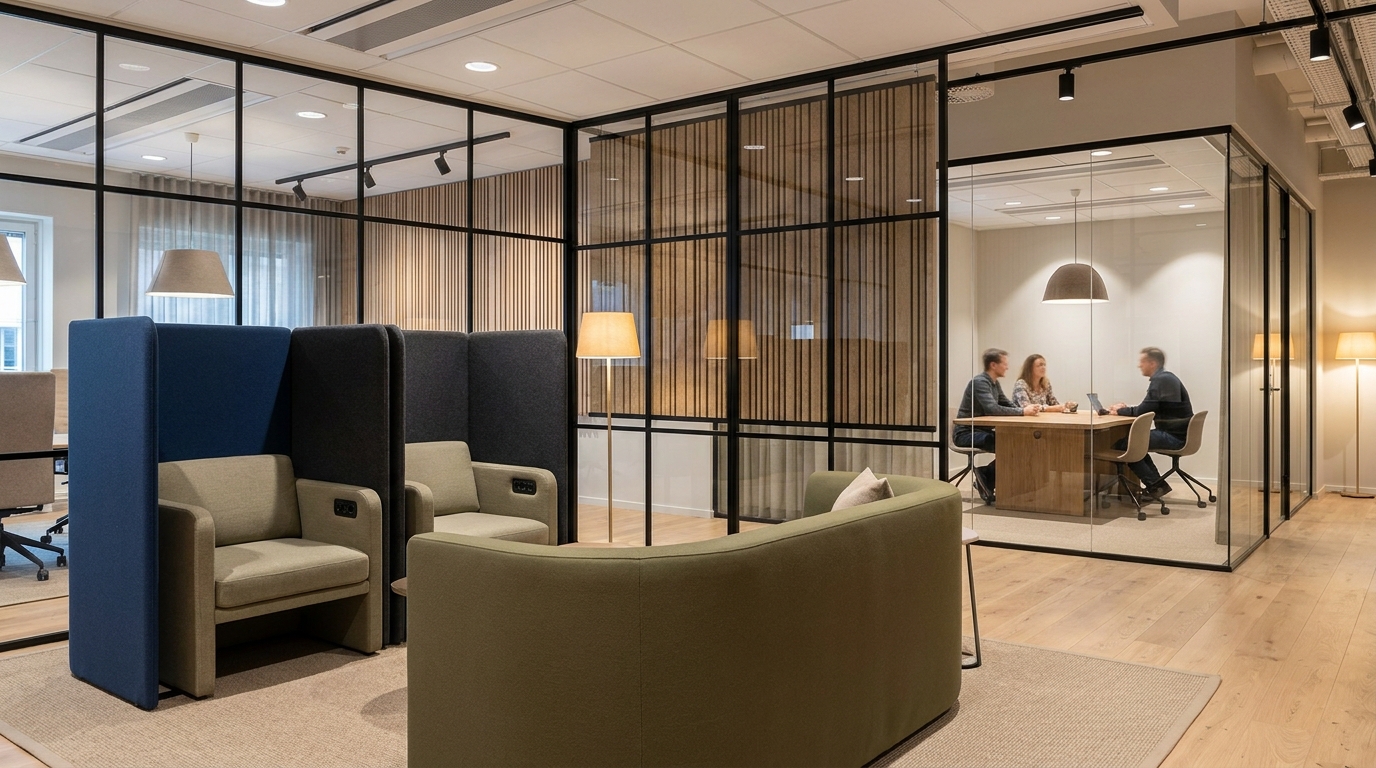
At home, this may mean positioning the desk so that it has a sense of orientation and calm, ideally with a view toward daylight but without direct glare on the screen. A nearby lounge chair or small round table can create an elegant alternate zone for reading, sketching, or taking a call. In a commercial office, it might mean using glass partitions, open shelving, drapery, or upholstered screens to preserve visual openness while improving acoustic privacy and concentration.
Circulation also matters. A graceful office is easy to move through. Paths should feel natural, not obstructed by oversized furniture, poorly placed cords, or storage that protrudes into useful space. This is one of the simplest ways to make a room feel more serene. Movement becomes intuitive, and the space begins to read as intentional rather than improvised.
When planning an office layout, it is useful to evaluate the room through a few key questions.
- Where does focused work happen best? This area should receive the greatest ergonomic and lighting attention.
- Where can collaboration or conversation occur without interrupting concentration? Even a modest shift in furniture placement can help separate these functions.
- What should remain visible, and what should disappear? Concealment is often the secret ingredient behind interiors that feel calm and elevated.
- How might the room need to change over the course of a day or week? Flexible pieces allow the office to respond to hybrid work rhythms.
These questions encourage a more architectural view of office design. Instead of decorating a desk in isolation, you begin composing an environment that supports attention, comfort, and mood with far greater sophistication.
Lighting as Atmosphere, Performance, and Wellbeing
Light is one of the most transformative tools in office design because it shapes both performance and emotion. A poorly lit office can cause eye strain, headaches, visual fatigue, and diminished concentration, while a thoughtfully lit office can feel restorative, expansive, and quietly luxurious. Natural light remains the ideal starting point, but it is only the beginning of a complete lighting strategy.
Daylight brings vitality to a room and helps connect interior life to the outside world. It sharpens materials, enriches color, and supports a more natural rhythm throughout the day. Yet daylight must be managed carefully. A window directly behind a monitor or excessive brightness at certain hours can create glare that disrupts screen work. This is where elegant window treatments become indispensable. Sheer curtains, woven shades, linen drapery, or tailored blinds can soften brightness while preserving the presence of daylight.
A refined office should also include layered artificial lighting. Ambient lighting establishes the general atmosphere of the room. Task lighting supports detailed work at the desk. Accent lighting brings warmth and visual depth, often through sconces, shelf lighting, or a sculptural table lamp placed away from the primary workstation. Together, these layers create a room that feels dimensional rather than flat. They also allow the user to adapt lighting to different tasks and times of day.
Circadian-friendly thinking is increasingly relevant in modern office design. This means considering how light exposure influences alertness, energy, and ease as the day unfolds. Cooler, brighter light may support focus during working hours, while warmer light later in the afternoon can soften the room’s mood and reduce visual harshness. The best offices do not flood every surface with the same brightness. They create variation, so the room feels responsive and humane.
Material selection can support lighting performance as well. Matte finishes tend to reduce harsh reflection, while pale walls and gently textured surfaces can diffuse light more beautifully than high-gloss materials. An elegant office is often visually luminous not because it is brighter, but because it uses light with more restraint and intelligence.
Biophilic Design and the Quiet Luxury of Nature
There is a reason nature feels immediately calming in an office. A growing body of research suggests that biophilic workplace design can improve wellbeing, support stress recovery, and enhance concentration and perceived productivity. This makes biophilic design one of the rare trends that is both aesthetically rich and evidence-based. It offers not only beauty, but also measurable emotional and cognitive benefits.
In refined office interiors, biophilia is most compelling when it goes beyond a token potted plant. It can be expressed through natural materials, organic textures, daylight, views, earthy color palettes, and subtle references to landscape. Wood grain, linen, stone, clay finishes, wool rugs, and plant life all help create a room that feels grounded. These elements introduce visual softness and sensory warmth, balancing the harder edges of screens, metal hardware, and task-oriented furniture.
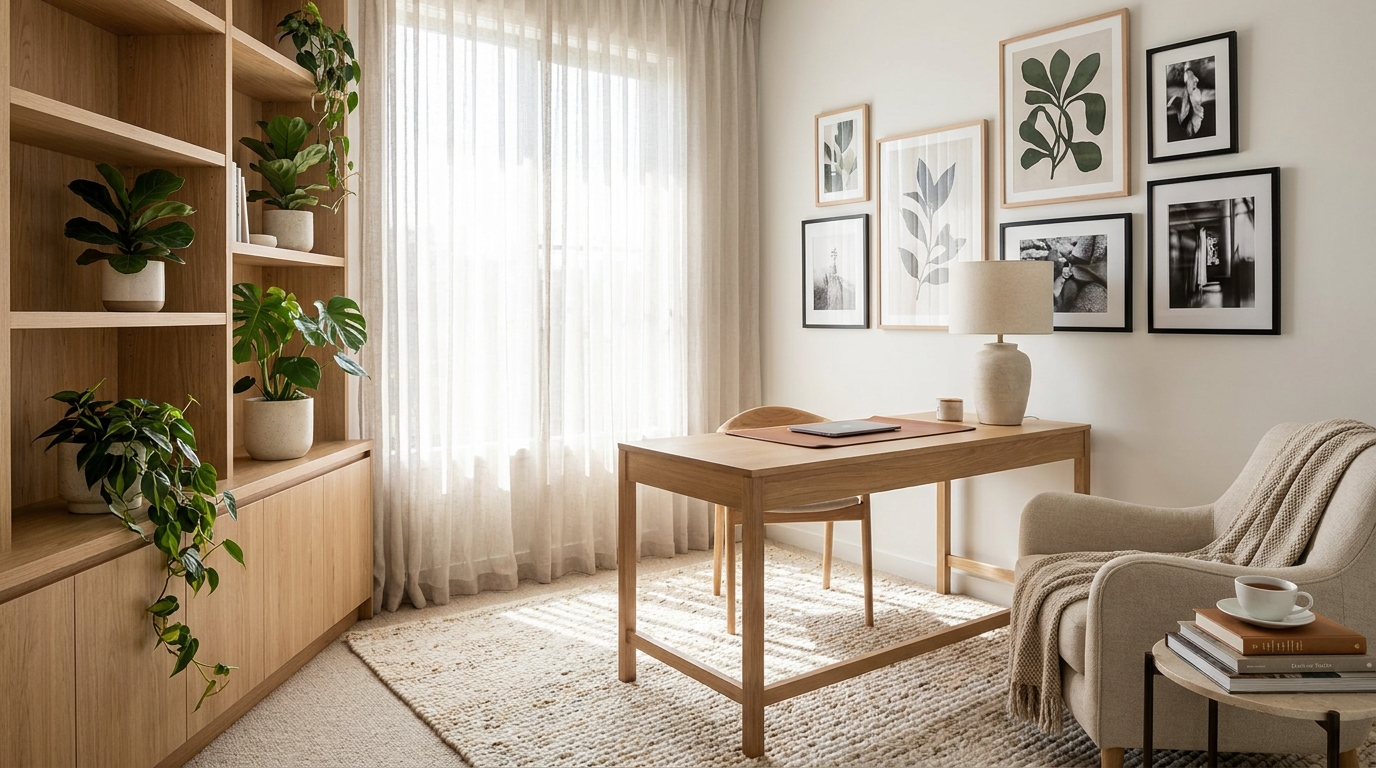
Plants are especially effective when used with intention. A sculptural tree can anchor a corner and soften architectural lines. A sequence of smaller plants on shelving can bring rhythm and freshness. Trailing greenery can make built-in cabinetry feel more alive and less static. The key is moderation. In a sophisticated office, nature should feel integrated rather than excessive. It should enhance clarity, not create visual clutter.
Color can also deepen the biophilic effect. Soft greens, warm taupes, muted clay tones, mushroom grays, and sand-colored neutrals evoke the natural world while remaining polished and versatile. These shades are especially successful when paired with tactile materials and restrained detailing. They create a mood that is serene and cultivated, ideal for focused work.
It is worth noting that plants alone cannot solve deeper workplace issues. They do not replace proper ergonomics, good ventilation, or acoustic control. But when these fundamentals are already in place, biophilic design becomes a powerful finishing layer. It lends the office a sense of life and elegance that purely utilitarian spaces often lack.
Acoustics, Privacy, and the Art of Mental Calm
One of the least visible yet most influential aspects of office design is sound. A room may look impeccable and still fail if it is acoustically fatiguing. Noise competes for attention, increases stress, and can make even a beautiful workspace feel irritating over time. This is especially true in open or hybrid offices, where concentration and communication often occur side by side.
Acoustic comfort begins with understanding that silence is not always the goal. What matters is control. Some tasks require quiet, while others tolerate a gentle level of ambient sound. The design challenge is to create layers of privacy and sound absorption so the room supports different activities without constant friction. This is where textiles, upholstery, rugs, curtains, acoustic panels, and padded furnishings become more than decorative choices. They soften reverberation and make a room feel more intimate.
In home offices, acoustic design may include a wool rug under the desk, full-height drapery, bookshelves, fabric wall panels, or a more enclosed position away from noisy household circulation. In commercial settings, acoustic booths, felt-lined partitions, upholstered banquettes, and discreet sound-masking systems can make a remarkable difference. These strategies allow openness to remain visually appealing while giving people the auditory calm they need to work well.
Privacy should be approached with equal nuance. Full enclosure is not always necessary, but psychological privacy often is. A desk that faces a wall of interruptions or a circulation path behind the chair can leave a person feeling subtly exposed. Reorienting the workstation, adding a partial screen, or using shelving to define boundaries can create an immediate sense of composure. Design at its best does not merely furnish a room. It protects attention.
Materials, Palette, and Personal Identity
An office should feel like an extension of the person or brand it serves. This does not mean filling the room with memorabilia or trend-driven statements. It means choosing materials, colors, and objects that communicate a coherent visual identity. The most elegant offices are rarely overstyled. They are edited. Each element contributes to a larger atmosphere of refinement.
A restrained palette often works best because it supports concentration while allowing texture and form to take the lead. Cream, ecru, stone, tobacco, deep olive, charcoal, walnut, and soft black are enduring choices for office design. These tones feel mature and grounded. They also pair beautifully with brass, bronze, blackened steel, honed marble, oak, and tactile fabrics, all of which can elevate the room without making it feel ostentatious.
Personal expression enters through art, books, collected objects, and details of craftsmanship. A framed print, a ceramic vessel, a beautiful paperweight, or a vintage desk lamp can bring character to the room. The secret is to curate rather than accumulate. Each object should feel chosen. When the office is visually disciplined, even small personal touches carry more presence.
This is where luxury becomes accessible. An inspiring office does not require extravagance in every category. A modest room can feel extraordinary if one or two materials are especially thoughtful, if lighting is well considered, and if the composition is calm. The feeling of elegance often comes less from expense than from proportion, harmony, and restraint.
Storage, Decluttering, and Visual Serenity
Productive work requires access, but inspiring design requires calm. Storage is the bridge between these two needs. In many offices, disorder is not caused by too many objects alone, but by the lack of a place for them to disappear. When technology, paperwork, chargers, books, and supplies remain constantly visible, the room begins to feel mentally noisy. Concealed storage restores visual clarity and allows the workspace to breathe.
Built-in cabinetry is one of the most elegant solutions because it can be tailored to the architecture of the room. Closed lower cabinets paired with a few open shelves above create a balance between utility and display. In smaller spaces, a desk with integrated drawers, a credenza, or a slim cabinet can perform the same role. The goal is not austerity. It is selective visibility.
Storage planning should be based on frequency of use. Daily items belong within immediate reach. Weekly items can be placed in nearby drawers or cabinets. Archival materials should move farther away. This quiet hierarchy makes an office more efficient and more graceful to inhabit. It also reduces the tendency to let objects accumulate on the desk simply because there is nowhere else for them to go.
Concealment extends to cables and technology as well. Cord management, docking stations, concealed outlets, and integrated charging areas may sound technical, but they have a profound effect on visual quality. A luxurious office often appears calmer because the necessary mechanics have been handled discreetly. Nothing is fighting for attention.
Designing for Hybrid Work and Flexibility
The office is no longer a one-setting environment. Many professionals now alternate between home and workplace, digital and in-person interactions, focused solo work and collaborative sessions. This has made flexibility one of the defining characteristics of a successful office. A room designed for only one posture or one routine can quickly feel outdated. A room designed for variation will remain useful and relevant far longer.
Hybrid work design begins with adaptability at the workstation. Adjustable desks, portable laptop stands, movable task lights, and ergonomic accessories can make it easier to shift between tasks and devices. In shared or multiuse offices, modular seating and lightweight tables allow the room to evolve without losing its composure. Elegance in this context comes from seamless transition. The room changes function without appearing chaotic.
For home offices, flexibility may also mean designing a space that can recede when the workday ends. Cabinet doors that close over office equipment, storage that conceals documents, and décor that feels residential rather than corporate all help the room integrate into the wider home. At the same time, the essentials of ergonomics should remain non-negotiable. Working from home does not reduce the body’s need for proper support, lighting, and movement.
North American guidance on remote work has increasingly recognized this reality. Home-office ergonomics are not a secondary concern. They are part of the contemporary office conversation. This means that a well-designed home workspace should be approached with the same seriousness as a commercial one, though translated through a more intimate and personal design language.
Inclusive Comfort and Long-Term Usability
The most timeless office interiors are not designed around a narrow idea of who will use them. They consider a range of bodies, abilities, tasks, and preferences. Inclusive design is not only a matter of access. It is a matter of hospitality. An office should welcome the person who spends all day there, the colleague visiting for a meeting, and the client or guest who experiences it for an hour.
This can take many forms. Adjustable seating and desk heights improve usability for different individuals. Clear circulation and thoughtful furniture placement support easier movement. Good contrast, balanced lighting, and comfortable acoustics make the environment easier to navigate and inhabit. Even something as simple as offering more than one type of seat can make the office feel more responsive and humane.
Designing for long-term usability also means choosing materials and systems that will age well. Durable upholstery, timeless finishes, quality joinery, and lighting that can be adjusted over time all contribute to an office that remains elegant beyond seasonal trends. Enduring beauty is often the result of sensible decisions made early.
How to Bring It All Together
Creating an inspiring office space is less about following a formula and more about composing a room around a set of relationships. The relationship between body and chair. Between daylight and screen. Between openness and privacy. Between beauty and order. Between identity and restraint. When these relationships are handled with care, the office begins to feel naturally elevated.
If you are redesigning your workspace, begin with fundamentals before decoration. Assess ergonomics first. Examine how the desk, chair, monitor, and lighting are functioning. Then study the room itself. Consider acoustics, circulation, temperature, air quality, and storage. Once those practical layers are resolved, turn to the aesthetic composition. Introduce materials with warmth, colors with calm, and personal objects with meaning.
It can be helpful to think of the process in sequence.
- Establish ergonomic comfort through proper seating, desk height, monitor placement, and reach zones.
- Plan the layout around focus, movement, and the specific tasks the office must support.
- Create a lighting strategy that combines daylight, glare control, ambient light, and task lighting.
- Improve environmental comfort through acoustics, ventilation awareness, and thermal balance.
- Add biophilic elements such as plants, natural materials, and nature-inspired tones.
- Refine storage so the room remains organized and visually serene.
- Curate identity with art, books, and details that express taste without overwhelming the room.
This order matters because the most beautiful office is one that works effortlessly. Decoration should not compensate for discomfort. It should crown a space that is already functioning with grace.
Final Thoughts
An office can be efficient without feeling sterile, and elegant without becoming impractical. In fact, the finest office spaces prove that these qualities are intimately connected. When posture is supported, light is flattering and useful, storage is concealed, acoustics are softened, and the room carries a personal visual language, work begins to feel more focused and more dignified. The environment does not distract from productivity. It enhances it.
That is the real promise of thoughtful office design. It gives shape to the way we want to live and work. It allows professionalism to coexist with beauty, and discipline to coexist with comfort. Whether you are designing a dedicated home office, reimagining a corporate suite, or simply refining one corner of a room, the goal remains the same. Create a space that serves you fully, looks graceful doing so, and inspires your best thinking every day.



No Comment! Be the first one.