



In construction, the way a project is bought matters almost as much as the way it is built. That is what procurement really comes down to. It is the framework that decides who designs the work, who prices it, who takes responsibility when something goes wrong, and how the owner moves from an idea on paper to a finished building. If that framework fits the project, the job usually runs smoother. If it does not, even a good design and a capable team can spend the next year fighting the contract instead of building.
Table Of Content
- What procurement means in construction management
- Why the procurement method has such a big effect on project success
- Design-bid-build: the traditional benchmark
- When design-bid-build makes sense
- Design-build: one contract, faster coordination
- Where design-build works well
- Construction management at risk: early contractor input with separate design
- Why owners choose CM at risk
- Construction management as adviser or agent: management support, not full delivery risk
- Integrated project delivery: high collaboration for complex work
- Comparing procurement methods by what owners actually care about
- Best value versus lowest bid
- Common mistakes owners make when choosing a procurement method
- How homeowners should think about procurement methods
- How public and institutional owners should think about procurement methods
- A practical framework for choosing the right method
- Procurement trends shaping current construction practice
- Final thoughts
That is why procurement methods in construction management deserve more attention than they often get. Many people hear the term and assume it only means bidding out materials or collecting contractor quotes. In practice, procurement is a strategic delivery decision. It shapes cost certainty, schedule flexibility, collaboration, claim exposure, and the amount of control the owner keeps through design and construction.
For homeowners, this might affect whether a custom home addition moves quickly or gets bogged down in redesign and change orders. For developers and institutional owners, it affects how risk is allocated across large teams and how early key construction decisions can be made. For public agencies, it also ties directly to transparency, fairness, and legal procurement requirements. There is no universal best method, which is exactly why understanding the options matters.
This article explains the major procurement methods used in North American construction, including design-bid-build, design-build, construction management at risk, construction management as adviser or agent, and integrated project delivery. It also clears up common misunderstandings, including the idea that procurement and project management are the same thing, or that lowest bid always equals best value. The practical goal is simple: help you match the right procurement method to the kind of project you actually have.
What procurement means in construction management
Procurement in construction is the system used to obtain design services, construction services, and sometimes materials or specialty trade packages. More importantly, it determines the contractual relationships between the owner, the designer, the builder, and often key consultants. Those relationships control communication paths, liability, schedule sequencing, and how decisions are made when the project changes, which it usually does.
It helps to separate procurement from project management. Project management is the ongoing process of planning, coordinating, tracking, and controlling a project. Procurement method is the delivery structure through which the work is contracted and executed. A project can be managed well or poorly under any procurement model, but the procurement model sets the boundaries of responsibility and greatly influences how manageable the job will be.
That distinction matters because some owners assume hiring a construction manager solves everything. It does not. You still need the right delivery structure for the project. A complex hospital expansion, a school renovation completed in summer, and a homeowner kitchen addition all have different needs. Procurement should be selected early, ideally before the design is too far advanced, because changing delivery methods halfway through design usually creates confusion, duplicated effort, and lost time.
Industry guidance from organizations such as AIA, AGC, DBIA, FHWA, and CCDC consistently makes the same point. No single procurement method is best for every project. The right choice depends on the owner’s priorities, the clarity of the scope, the complexity of coordination, the need for speed, the owner’s internal experience, the desired level of collaboration, and the acceptable level of risk.

Why the procurement method has such a big effect on project success
On paper, a building can look the same no matter how it is procured. In the field, the difference can be dramatic. Procurement affects when a contractor comes into the conversation, whether cost information is available early, whether design and construction can overlap, and who carries the risk for design gaps, coordination errors, and budget overruns. Those are not administrative details. They are project outcomes.
If an owner wants the highest level of price competition and has a complete set of drawings before bidding, a traditional method may be a good fit. If the owner needs speed and wants design and construction to move in parallel, a more integrated model usually makes more sense. If the project is technically demanding and benefits from strong preconstruction input, methods that bring the builder in earlier often reduce headaches later.
Procurement also affects disputes. Some methods create a clean separation between design responsibility and construction responsibility. Others combine those responsibilities under one contract and reduce finger-pointing between architect and contractor. Neither structure is automatically better. It depends on the owner’s goals and on how well the contract documents are developed.
The practical lesson is that project success rarely comes from one decision alone. It comes from alignment. If the procurement method matches the project’s complexity, schedule, funding structure, and owner capacity, the team has a better chance of succeeding. If not, the project can spend months compensating for a poor setup.
Design-bid-build: the traditional benchmark
Design-bid-build is still the reference point for construction procurement because it follows a familiar sequence. The owner hires a designer first. The design is developed into drawings and specifications. Once the documents are sufficiently complete, contractors submit bids, and the owner awards a separate construction contract. FHWA describes it as a sequential process, and that is the defining feature.
This method became established in part because it supported transparency and competitive pricing. Public owners often favored it because it reduced the appearance of favoritism and created a clear low-bid process. That remains one reason it continues to be used heavily in public work and in straightforward private projects where the scope is well defined before construction starts.
The strengths of design-bid-build are practical and easy to understand. The owner gets a completed design before construction pricing is finalized. The roles are clearly separated. The bidding process can attract multiple qualified contractors. The owner and architect typically have a direct relationship through the design phase, which some owners prefer because it allows design decisions to be made without builder influence in the early stages.
The weaknesses are just as real. Because the process is sequential, it generally takes longer. Design must move farther before a constructor is selected, which limits early contractor input on cost, constructability, phasing, and logistics. If there are errors, omissions, or coordination issues in the documents, the contractor prices what is shown and then change orders can follow when reality catches up. For projects with tight timelines, that separation can become a real drawback.
Design-bid-build often works best when the project is relatively straightforward, the owner wants strong price competition, and the scope can be clearly documented before bidding. It can also be a sound fit where procurement regulations strongly favor traditional tendering. What it does not do well is compress time. If a project must move fast, the owner usually needs a different delivery method.
When design-bid-build makes sense
For a small school renovation, a municipal building repair project, or a homeowner project with complete drawings and limited complexity, design-bid-build can still be the right answer. It is also useful when funding approval requires a finished design and a firm bid before work starts. In these situations, the value is predictability of process rather than speed.
It also suits owners who have enough internal capacity to manage the designer relationship and the separate contractor relationship. That matters because in this system the owner sits in the middle. If the project runs into a dispute over whether a problem is a design issue or a construction issue, the owner may find themselves coordinating between two separate parties with separate contracts.
Design-build: one contract, faster coordination
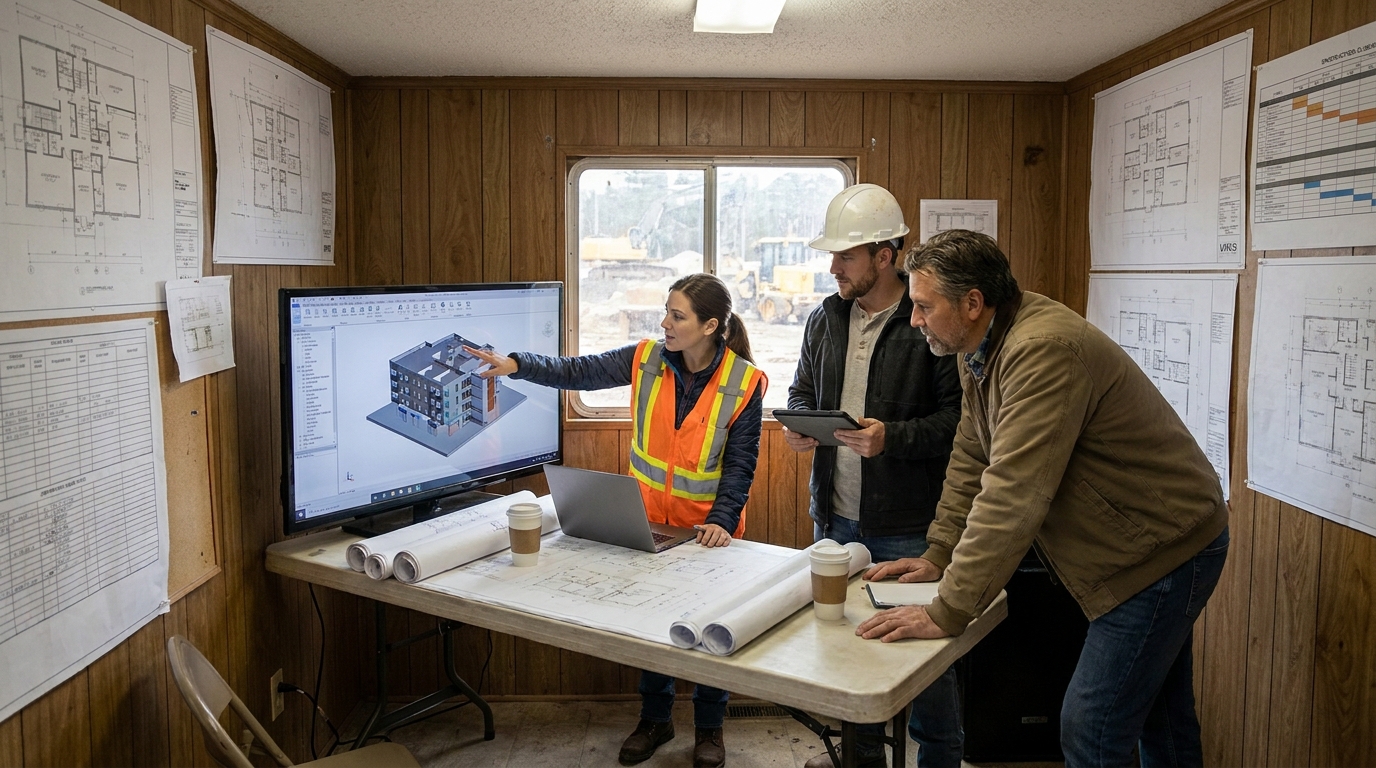
Design-build combines design and construction under a single contract. Instead of hiring the architect and contractor separately, the owner hires one design-build entity that takes responsibility for both. FHWA and DBIA both point to this model’s practical advantages, especially around speed, coordination, and single-point responsibility.
Single-point responsibility is one of those phrases that sounds like contract language until you see it play out on a job. In a design-build setup, the owner does not have to sort out whether a field issue came from the plans or from installation. The design-builder is responsible for delivering the full package. That can reduce claims tied to handoff problems and close some of the gaps that show up in more separated delivery systems.
Speed is another major reason design-build has grown. FHWA notes that design-build can reduce delivery time because it removes a separate construction procurement step and allows more overlap between design and construction. In practical terms, this means site work, early packages, procurement of long-lead items, and portions of construction can move forward while the design of later components is still being finalized. For the right project, that can save months.
This is one reason design-build has moved firmly into the mainstream. DBIA has reported that design-build represented a large share of U.S. design and construction dollar volume in 2021, showing that it is not a niche method anymore. Owners across commercial, institutional, industrial, and infrastructure sectors use it because it can align responsibility, support collaboration, and shorten schedules when managed properly.
Still, design-build is not magic. It is not automatically cheaper, and it is not automatically better. The owner gives up some of the direct separation between design advocacy and construction execution. That means the owner must be very clear about performance requirements, quality expectations, and scope. If the owner’s goals are vague, a design-build team may optimize the project in ways that meet the contract but not the owner’s unstated expectations.
Selection is also different. Many design-build procurements use best-value procurement rather than lowest-price-only bidding. That means owners evaluate qualifications, technical approach, team experience, schedule strategy, and price together. For owners used to low-bid tendering, this can require a mindset shift. Best value does not mean ignoring price. It means price is judged alongside the ability to deliver what the project actually needs.
Where design-build works well
Design-build often fits projects with schedule pressure, significant coordination needs, or owners who want one contract and one accountable entity. It can work very well for warehouses, multifamily buildings, manufacturing facilities, commercial interiors, public works with compressed timelines, and custom residential work where the owner values speed and integrated problem solving.
It is also useful where early contractor involvement can improve the design itself. Material availability, prefabrication opportunities, sequencing, and trade coordination can all be addressed earlier when the builder is part of the same delivery team. That does not remove all risk, but it changes where the risk sits and how early the team can respond.
Construction management at risk: early contractor input with separate design
Construction management at risk, often called CM at risk or CMAR, sits somewhere between traditional and fully integrated delivery. In this model, the owner hires a designer separately, but also brings on a construction manager during design to provide preconstruction services. Later, the construction manager becomes the builder and takes on construction risk, often under a guaranteed maximum price or GMP arrangement.
This method appeals to owners who want early pricing and constructability advice without giving up the separate designer relationship. The CM can review drawings as they develop, help package bid scopes, advise on logistics, and identify cost or schedule concerns before the documents are complete. For many complex projects, that early input is valuable because it grounds the design in actual market and field conditions.
The “at risk” part matters. AIA and AGC distinguish CM at risk from construction management as adviser because CM at risk is a delivery method in which the construction manager takes on building risk. That means the CM is not just coordinating the project for the owner. The CM ultimately becomes responsible for delivering the work, usually through direct contracts with trade contractors and with a pricing commitment built into the contract.
There are clear strengths here. Owners get early builder involvement, phased construction is easier, long-lead procurement can happen sooner, and there is still a separately retained design professional. Many healthcare, higher education, civic, and large commercial projects use CM at risk for exactly these reasons. It gives the owner more preconstruction insight than design-bid-build while preserving more separate design oversight than design-build.
The tradeoff is complexity. The owner still manages multiple contractual relationships, and the details of contingency, allowances, scope development, and GMP assumptions have to be understood carefully. A GMP can create a false sense of certainty if the scope is still evolving or if major exclusions are sitting outside the contract. In other words, a GMP is only as solid as the documents and assumptions behind it.
Why owners choose CM at risk
Owners often choose CM at risk when they want more control over the design process but still need contractor expertise early. It is a common fit for renovations in occupied facilities, technically complex buildings, projects with phased turnover requirements, and jobs where market conditions make pricing volatile. The model supports informed decisions before bids are locked in.
It also works for owners who have some sophistication and want active involvement. CM at risk is not a hands-off delivery method. The owner still needs to understand the structure, review packages, track scope changes, and stay engaged as the GMP is developed. When used well, that effort pays off. When used casually, misunderstandings can build under the surface and show up later as disputes over what the GMP really included.
Construction management as adviser or agent: management support, not full delivery risk
Construction management as adviser, sometimes called CM as agent, is often misunderstood. It is not the same as CM at risk. In this setup, the construction manager acts as a professional adviser to the owner. The CM helps with scheduling, estimating, coordination, procurement planning, and construction oversight, but does not usually take the same direct construction risk as a CM at risk builder.
This means the owner may hold separate contracts with trade contractors or with the general contractor, depending on the structure. The construction manager advises and manages, but the risk profile is different. AIA and AGC make this distinction clearly because people often use the phrase construction manager loosely, even though the legal and commercial role can vary significantly.
The advantage of this model is owner control. The owner can have a knowledgeable professional helping manage the project while retaining flexibility over contracts and procurement packages. It can work well when the owner has enough resources and sophistication to manage a more active role and wants transparency into costs, trade selection, and sequencing.
The disadvantage is that the owner retains more exposure. Because the construction manager is not taking on the same level of delivery risk, the owner may still be closer to disputes between designers, trades, and suppliers. This method can perform well, but only when the owner understands that hiring a CM adviser does not transfer the same responsibilities as hiring a design-builder or CM at risk contractor.
Integrated project delivery: high collaboration for complex work
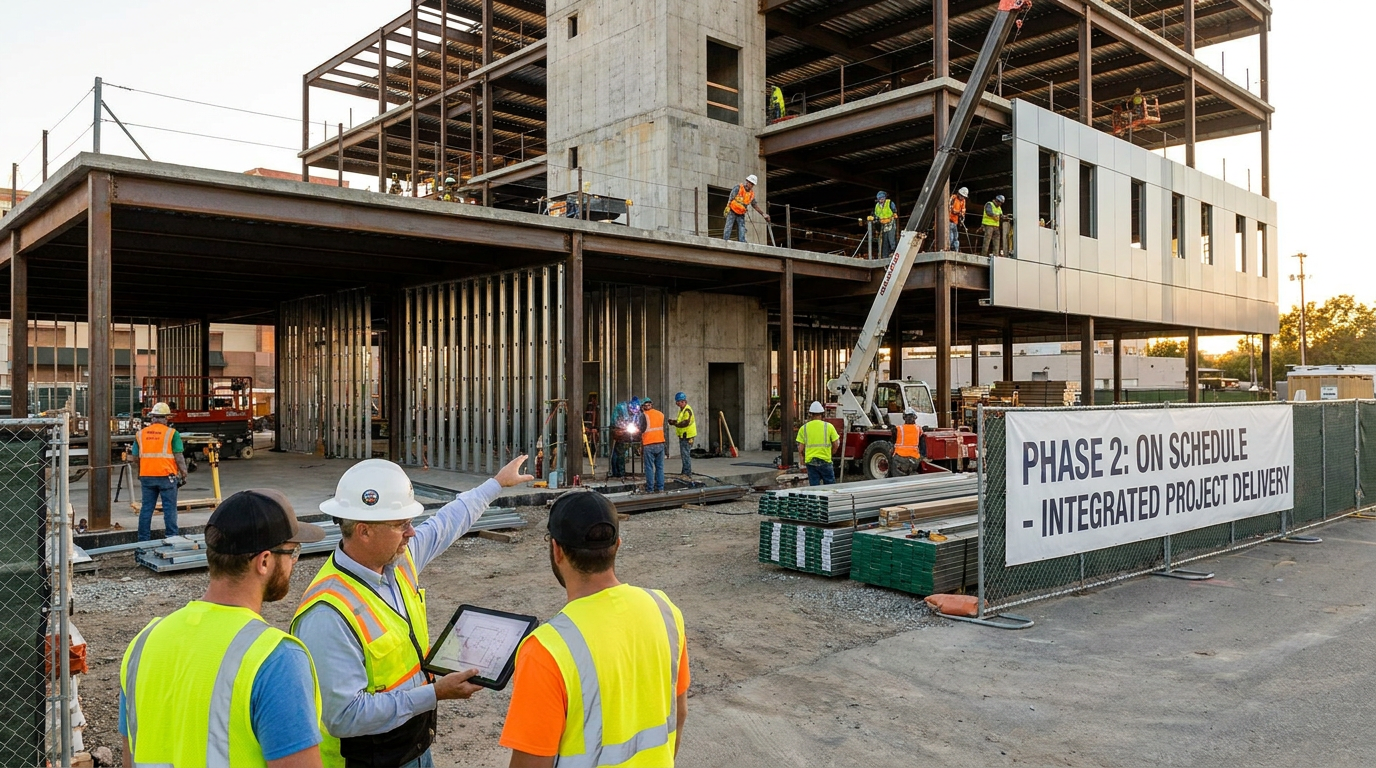
Integrated project delivery, or IPD, is a more collaborative model built around early alignment among key participants. AIA describes IPD as a method intended to optimize results, increase owner value, reduce waste, and maximize efficiency through all phases of design, fabrication, and construction. That is a strong claim, but on the right type of project, the logic is sound.
IPD typically brings the owner, architect, contractor, and often major trades into a more collaborative contractual structure from the start. Instead of protecting each silo and managing handoffs after the fact, the model tries to align incentives earlier. Cost, schedule, constructability, digital coordination, and fabrication strategy can be worked through as a team before traditional contract boundaries harden into disputes.
This makes IPD especially relevant for large, complex, highly coordinated projects such as hospitals, advanced laboratories, airport work, and technically demanding institutional buildings. It also aligns well with lean construction practices, prefabrication, BIM-driven coordination, and projects where reducing waste is a serious owner goal rather than a slogan.
That said, IPD is not simply design-build with better teamwork. It requires a high level of trust, transparent behavior, and a contract structure that supports shared decision making and aligned incentives. Not every owner is ready for that. Not every team is either. If the participants are not prepared to collaborate honestly and early, the model will not produce the benefits it promises.
For the right owner and project, though, IPD can be powerful. It addresses one of the oldest problems in construction, which is that projects are often fragmented even when the work itself requires integration. IPD tries to solve that problem at the contract and team level, not just through good intentions in meetings.
Comparing procurement methods by what owners actually care about
Most owners do not choose a procurement model because they like contract theory. They choose it because they care about four practical outcomes: cost certainty, schedule, quality, and risk. That is the right way to compare methods.
Design-bid-build can offer strong price competition once documents are complete, but schedule is usually slower because the process is sequential. Quality depends heavily on the completeness of the design documents and on the contractor’s execution. The owner carries the burden of coordinating between designer and builder if disputes arise.
Design-build can shorten the schedule and improve coordination because one entity is responsible for both design and construction. It often reduces claim exposure tied to design-construction handoffs. Cost certainty can also come earlier, but only if owner requirements are clear and the procurement process is well structured. Otherwise, the owner may get a fast project that still misses some expectations.
CM at risk gives the owner early construction input and often earlier pricing insight than traditional delivery. It can be strong on schedule because the team can phase packages and start certain work before every detail is complete. Cost certainty improves as the design develops toward the GMP, but the owner must understand what sits inside and outside that number. Quality is supported by the separate designer relationship and by the builder’s early constructability input.
CM as adviser gives the owner flexibility and detailed management support, but it also leaves more risk with the owner. It can work well for sophisticated owners who want visibility and control. For inexperienced owners, it can create more complexity than they expected.
IPD is strongest where collaboration itself is a major project need. On complex jobs, it can reduce waste, improve coordination, and align the team around outcomes rather than individual contract positions. But it requires maturity, trust, and real owner commitment. It is not the easiest method to implement, even when it is the right one.
Best value versus lowest bid
One of the most common misconceptions in procurement is that the cheapest price is always the best buying decision. In some cases, a low bid is exactly what the owner needs, particularly when the scope is clear, the market is competitive, and the procurement rules require formal low-bid awarding. But that is not the same thing as saying lowest price always produces the best project result.
Best-value procurement looks at price alongside qualifications, experience, technical approach, schedule plan, team structure, and quality control. This approach is especially common in design-build and in more complex procurement environments where performance matters as much as cost. A contractor or design-builder with a slightly higher fee but a stronger team and clearer plan may save far more money in avoided delays, rework, and claims.
That does not mean owners should become casual about price. It means price should be understood in context. A low number based on weak assumptions, unrealistic staffing, or incomplete scope is not a bargain. It is usually just tomorrow’s change order.
Practical rule: A low bid tells you what a team is willing to charge for the work as defined. It does not always tell you what the project will really cost by the time it is complete.
Common mistakes owners make when choosing a procurement method
The first mistake is waiting too long. Owners sometimes move deep into design and only then start thinking about delivery. By that point, certain advantages of design-build, CM at risk, or IPD may already be lost because the builder was not involved early enough to influence key decisions. Procurement should be discussed near the start of the project, not near the end of design.
The second mistake is choosing based on habit instead of fit. Some organizations use the same procurement model every time because it is familiar, not because it is right. That can work on repetitive projects, but it can also create mismatches. A method that performs well for simple renovations may not suit a fast-tracked technical facility.
The third mistake is confusing procurement with risk elimination. Every procurement method allocates risk. None of them erase it. Design-build shifts risk differently than design-bid-build. CM at risk structures it differently again. Good procurement is about deliberate allocation, not wishful thinking.
The fourth mistake is misunderstanding owner capacity. Some methods require more owner involvement, more timely decisions, and more contract administration. If the owner lacks internal experience, that should influence the procurement choice. A method that looks efficient on paper can become chaotic if the owner cannot support it properly.
How homeowners should think about procurement methods
Homeowners do not usually use the same terminology as institutional owners, but the same principles apply. If a homeowner is planning a simple renovation with a well-defined design and wants to compare several contractor prices, a traditional design then bid process may be perfectly reasonable. In that case, the value comes from clarity and competition.
If the project is a custom home, a major addition, or a renovation where speed and coordination matter, design-build often makes more sense. It can bring the design and construction conversation together earlier, which is useful when budget, layout, material selection, and scheduling all need to stay aligned. It can also reduce the common residential problem where the designer and builder point at each other once field conditions are exposed.
For larger private residential projects, a CM at risk style approach can also be useful if the owner wants a separate architect but also wants preconstruction input from a builder. That is especially true when the project involves phased work, occupied conditions, or site constraints. The key is not the label itself. The key is understanding who is responsible for what and when price commitments actually become reliable.
Homeowners should also be realistic about their own role. If you want to make every design decision personally, review competing quotes, and maintain direct influence over the design team, a more traditional structure may fit. If you want one team to carry more coordination responsibility and help move decisions faster, a more integrated approach is often better.
How public and institutional owners should think about procurement methods
Public and institutional owners operate under added constraints. Transparency, fairness, statutory compliance, and procurement policy often shape what methods are available. In Canada and the United States, public guidance repeatedly emphasizes that process matters, not just outcome. That means the best theoretical delivery method may not be legally or procedurally available in the same way it would be on a private job.
Even within those constraints, procurement choice remains strategic. Owners need to assess project complexity, schedule drivers, market conditions, internal staffing, and risk tolerance. For example, a highly regulated low-bid environment may still allow some form of prequalification, two-stage procurement, best-value evaluation, or alternative delivery for certain project types. The answer depends on the governing framework.
Institutional owners should also think about repeatability. A university, hospital system, school board, or municipality can benefit from standardizing decision criteria for procurement selection. That does not mean always using the same method. It means consistently asking the same practical questions so the chosen method reflects real project needs rather than internal politics or inherited habits.
A practical framework for choosing the right method
If you are trying to select a procurement method, start with the project rather than the contract form. Ask whether the scope is clear, whether the schedule is fixed, whether the owner has in-house experience, whether early contractor input would improve the design, and whether strong collaboration is essential. Those answers usually narrow the options quickly.
-
Use design-bid-build when the scope can be well defined before bidding, schedule pressure is moderate, and competitive low-bid procurement is a priority.
-
Use design-build when speed, coordination, and single-point responsibility matter, and when the owner can clearly state performance goals and expectations.
-
Use CM at risk when the owner wants early contractor involvement, phased execution, and a separate designer relationship, while still transferring construction risk later in the process.
-
Use CM as adviser or agent when the owner wants professional management support and transparency, and has the experience to retain more direct control and risk.
-
Use integrated project delivery when the project is complex enough to justify deep collaboration, shared alignment, and a team capable of working transparently from the start.
That framework is not perfect, but it is grounded in how projects actually behave. The main thing is to make the choice intentionally and early. Once design advances, funding locks in, or procurement rules are triggered, flexibility disappears fast.
Procurement trends shaping current construction practice
Several procurement trends are worth paying attention to. First, design-build continues to gain market share across North America. Owners are drawn to its speed, integrated accountability, and ability to reduce some of the friction between design and construction. The growth is not just a market preference. It reflects real pressure for faster delivery and better coordination.
Second, early contractor involvement is becoming more common even outside formal design-build structures. Owners increasingly want constructability reviews, preconstruction pricing, value engineering, and logistics planning before documents are complete. That is a response to labor shortages, material lead times, and more demanding project schedules.
Third, collaborative delivery models and digital coordination workflows are becoming more important. IPD, lean methods, model-based coordination, and prefabrication all work better when the procurement approach allows key participants to engage early. Procurement is beginning to reflect how modern projects are actually designed and assembled rather than how they were organized decades ago.
Finally, public owners are paying closer attention to transparency, risk allocation, and delivery-method fit. As projects become more complex and more expensive, there is less tolerance for default choices that are easy to administer but poorly aligned with project realities.
Final thoughts
Procurement methods are not just administrative pathways to hire a contractor. They are the operating system of a construction project. They determine how information flows, how risk is shared, how quickly the team can act, and how much friction gets built into the job before work even starts.
Traditional design-bid-build still has an important place, especially where scope is clear and transparency or low-bid competition is central. Design-build offers speed and single-point responsibility when coordination and schedule matter most. Construction management at risk gives owners early contractor input while preserving a separate design relationship. Construction management as adviser supports owners who want control and professional oversight without transferring the same level of construction risk. Integrated project delivery pushes collaboration further for complex projects that truly benefit from aligned incentives and early team integration.
The best choice depends on the project in front of you, not on trends alone and not on habit. Good owners and good project teams understand that procurement should match scope, complexity, schedule, budget priorities, and governance capacity. Get that decision right early, and the rest of the job has a much better foundation. Get it wrong, and the project may spend the next year trying to overcome a structure that never fit in the first place.
That is the practical truth behind construction procurement. It is not paperwork. It is strategy. And in construction, strategy shows up in concrete, steel, dollars, and time.



No Comment! Be the first one.