



Cities are entering a new transportation conversation, but the most important shift is not the vehicle itself. It is the possibility of redesigning urban systems around access, efficiency, safety, and land value in ways that better align transportation with housing, infrastructure, and long term growth. When people hear the phrase autonomous mobility cities, many still imagine streets filled with self driving private cars. In practice, the more important urban question is how automation can be integrated into a broader model of city building that supports transit, improves accessibility, and creates room for more complete communities.
Table Of Content
- What Is an Autonomous Mobility City?
- Why Cities Are Paying Attention Now
- The Land Use Opportunity: Reclaiming Urban Space
- Autonomous Mobility and Housing Strategy
- The Strongest Model: Mobility Hubs and Complete Communities
- Accessibility Must Be a Core Design Principle
- Sustainability Is a Policy Outcome, Not a Guaranteed Feature
- Street Design Still Matters, Perhaps More Than Ever
- The Governance Challenge Facing Canadian Cities
- Misconceptions That Still Distort the Debate
- A Strategic Vision for the Autonomous Mobility City
- Conclusion: The Urban Future Will Be Decided by Design, Not Hype
- Key Takeaways for Urban Leaders and Developers
This is especially relevant in Canada and across North America, where growth pressures, housing shortages, infrastructure constraints, and climate objectives are all converging. Urban regions need to move more people with less friction while also making space for new homes, more resilient public realm, and stronger local economic performance. Autonomous mobility has the potential to contribute to that future, but only if it is governed strategically. If automation is treated simply as a faster version of the old car dependent model, it may intensify congestion, sprawl, and inequality rather than solve them.
The rise of autonomous mobility cities should therefore be understood as a land use and governance challenge more than a technology story. The central issue is not whether the vehicles can move without a driver. The central issue is whether cities can use automation to create better streets, more housing opportunity, stronger transit connections, safer public space, and more inclusive access for the people who rely on urban systems every day. That is where the real urban future will be decided.
Transport Canada has already signaled that connected and automated vehicle technologies may bring important economic, social, and safety benefits, while also requiring active oversight, testing guidance, and evolving regulation. Canada’s Safety Framework for Connected and Automated Vehicles 2.0 reflects a safety based policy direction that supports testing, research, and deployment on public roads. At the same time, the federal consultation on a proposed UN global technical regulation for automated driving systems makes one point very clear: the standards are still being shaped. In other words, cities cannot assume a finished technology is arriving to solve urban problems on its own. They have to plan for uncertainty and guide the market toward public goals.
The opportunity is substantial. Brookings has argued that autonomous vehicles could reduce the need for parking lots, gas stations, and some street space, potentially freeing land for housing, parks, and redevelopment. NACTO has made a similar case, but with an important warning. Automation only improves safety, sustainability, and equity if cities intentionally prioritize walking, biking, rolling, transit, and curb management rather than letting autonomous systems reinforce car centric design. That distinction is critical for planners, developers, and policy makers because the future value of autonomous mobility depends far more on how cities organize land and streets than on the novelty of the vehicles themselves.
Autonomous mobility will matter most where it helps cities use land better, connect people more efficiently, and expand access to opportunity rather than simply automate the status quo.
What Is an Autonomous Mobility City?
An autonomous mobility city is an urban system that integrates automated vehicles, connected infrastructure, shared transportation services, and data driven management into the fabric of city planning. It does not refer only to private self driving cars. It includes automated shuttles, robotaxis, delivery automation, connected traffic signals, dynamic curb systems, and mobility hubs that link local travel to higher capacity transit. The defining feature is not the presence of advanced vehicles alone. It is the coordinated relationship between mobility technology, land use, public policy, and urban design.
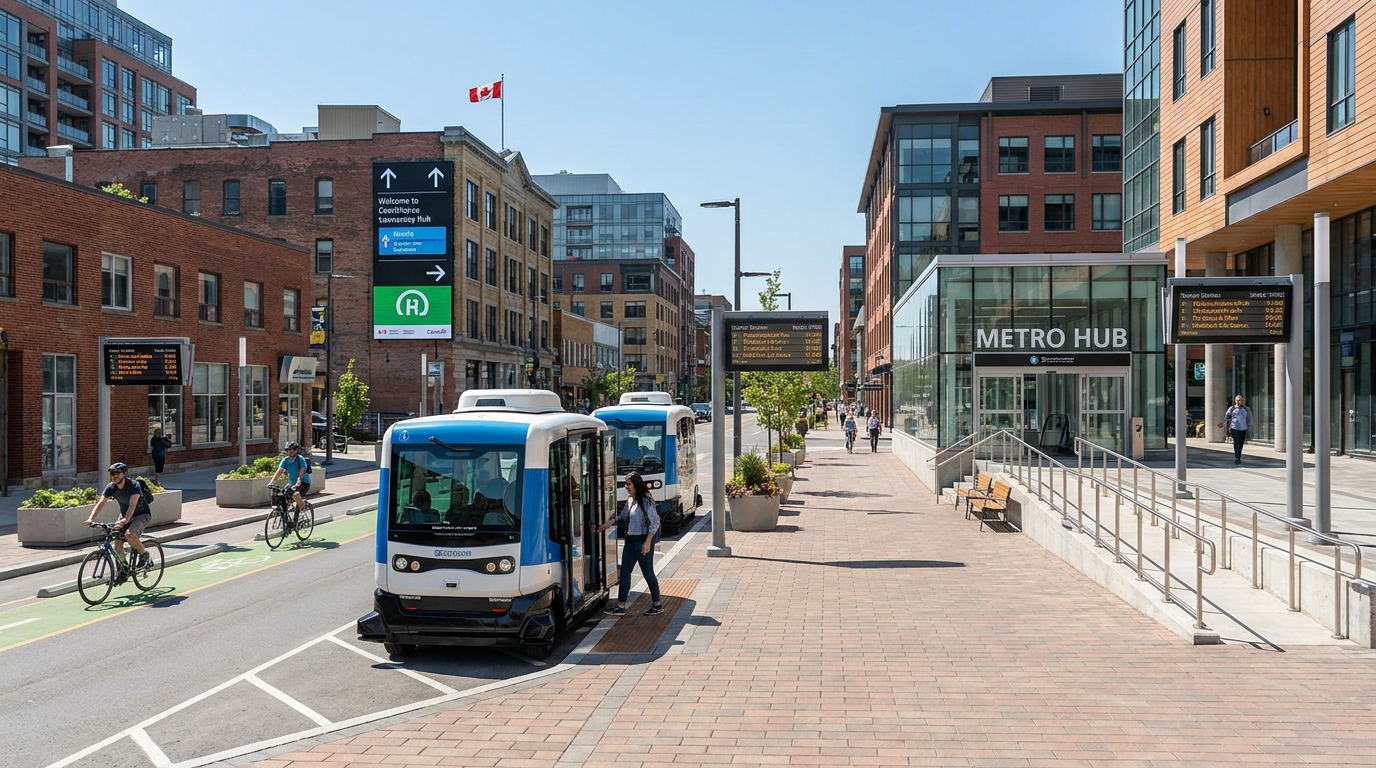
In a well planned autonomous mobility city, transportation becomes more responsive to where people live, work, shop, and access services. A mobility hub near a transit station might connect autonomous neighborhood shuttles, bike share, micro mobility, and pickup zones into a single location that supports denser housing nearby. Smart signal systems might improve traffic flow for buses and emergency vehicles while also making intersections safer for pedestrians. Curb space might be priced and managed in real time to support deliveries, drop offs, and accessible loading rather than unmanaged stopping that disrupts the street.
What matters here is the shift from vehicle ownership to network performance. Cities that adopt automation strategically will focus less on how many autonomous vehicles exist and more on what outcomes those systems produce. Do they reduce travel friction for seniors and people with disabilities? Do they support compact growth? Do they reduce the amount of land tied up in storage for idle vehicles? Do they make public transit work better by solving first mile and last mile connections? These are the benchmarks that separate a meaningful autonomous mobility city from a city that merely has new technology moving through old patterns.
There is also an important distinction between advanced driver assistance and true automation. Transport Canada explicitly states that active driving assistance is not an automated driving system and that the driver must remain actively involved. This distinction matters because public expectations often run ahead of reality. Many people assume autonomous mobility is already here at scale, when in fact full deployment remains limited and heavily dependent on evolving regulation, testing environments, and operational constraints. For planners and developers, that means the transition period may be long, uneven, and defined by hybrid systems rather than a sudden shift.
Why Cities Are Paying Attention Now
The timing is not accidental. Urban planning is under pressure from several directions at once. Cities need more housing supply, more efficient infrastructure investment, better accessibility for aging populations, and lower emissions from transportation systems. At the same time, digital tools now make it possible to manage traffic signals, curb space, fleet operations, and travel data in ways that were far less practical a decade ago. Autonomous mobility has entered this moment because it appears to offer a new layer of flexibility inside an already urgent planning environment.
Road safety is also a major part of the conversation. According to the World Health Organization’s 2023 road safety reporting, approximately 1.19 million people die globally each year in road traffic incidents. That scale of harm explains why safer automation remains an important public objective. If automated systems can eventually reduce human error and improve operational consistency, they may deliver real safety gains. But cities should avoid simplistic assumptions. Safety improvements will depend on vehicle performance, street design, operational oversight, and the degree to which automated systems are integrated with vulnerable road user protection.
Another reason cities are paying attention is the growing realization that the curb has become one of the most contested pieces of urban infrastructure. Deliveries, ride hailing, transit stops, active transportation, accessible loading, and private vehicles all compete for the same limited edge space. As automation expands into passenger movement and logistics, curb demand will only intensify. This is why North American planning discourse has shifted from asking whether autonomous vehicles will arrive to asking how cities should govern them. The curb, not the dashboard, may be where autonomous mobility most visibly reshapes urban operations.
Canada’s current policy posture reflects that broader transition. The federal government is moving from conceptual discussion toward more concrete regulatory alignment and consultation. That does not mean widespread urban autonomy is imminent. It means the planning window is open now. Municipalities, transit agencies, and development stakeholders have an opportunity to define how autonomous mobility supports public goals before market habits become entrenched and difficult to reverse.
The Land Use Opportunity: Reclaiming Urban Space
From a development standpoint, the biggest opportunity may be the land that cities could recover and repurpose. A significant amount of urban land is dedicated to storing vehicles, fueling them, moving them inefficiently, or accommodating oversized road designs shaped by conventional traffic patterns. If autonomous mobility increases vehicle sharing, reduces parking demand, and allows better coordination of trips, that land can be repositioned toward higher value urban uses. This is where the conversation moves from transportation technology into real estate strategy and city building.
Brookings has highlighted the possibility that autonomous vehicle adoption could reduce the need for parking lots, gas stations, and some street space. In urban regions where land values are high and housing shortages are acute, that is not a marginal issue. It is a strategic opening. Surface parking lots near transit stations, oversized parking structures in mixed use districts, and underutilized commercial parcels could all become candidates for housing, community amenities, employment space, or public realm improvements. The economic case strengthens further when cities align zoning, servicing, and mobility investment around those redevelopment opportunities.
The implications for development feasibility are significant. Parking minimums have long added cost, consumed buildable area, and constrained design flexibility. If cities gain confidence in shared autonomous services, better transit integration, and mobility hub access, they may be able to reduce or remove some parking requirements in targeted areas. That can improve project economics, support smaller unit formats, and increase the number of homes that fit on serviced land. It can also create more active, street oriented building frontages instead of blank garage structures that weaken the public realm.
There is a deeper planning logic here as well. Land in cities should perform at its highest and best public value over time. In many growing urban areas, using scarce central land for low intensity vehicle storage is increasingly difficult to justify when housing demand, public space needs, and infrastructure costs are all rising. Autonomous mobility cities offer a pathway to revisit those tradeoffs. But again, this benefit is not automatic. It depends on whether cities govern automation in ways that reduce parking demand and vehicle storage rather than simply making private car use more convenient.
Autonomous Mobility and Housing Strategy
Housing is where the autonomous mobility debate becomes especially important and also especially misunderstood. Some observers assume that if people can travel more comfortably in autonomous vehicles, they will simply move farther away and commute longer distances. There is some logic to that idea. Reduced driving stress could change tolerance for distance, which in turn could influence where some households are willing to live. But this is not the same as solving affordability, and it is not necessarily the most beneficial outcome for cities or regions.
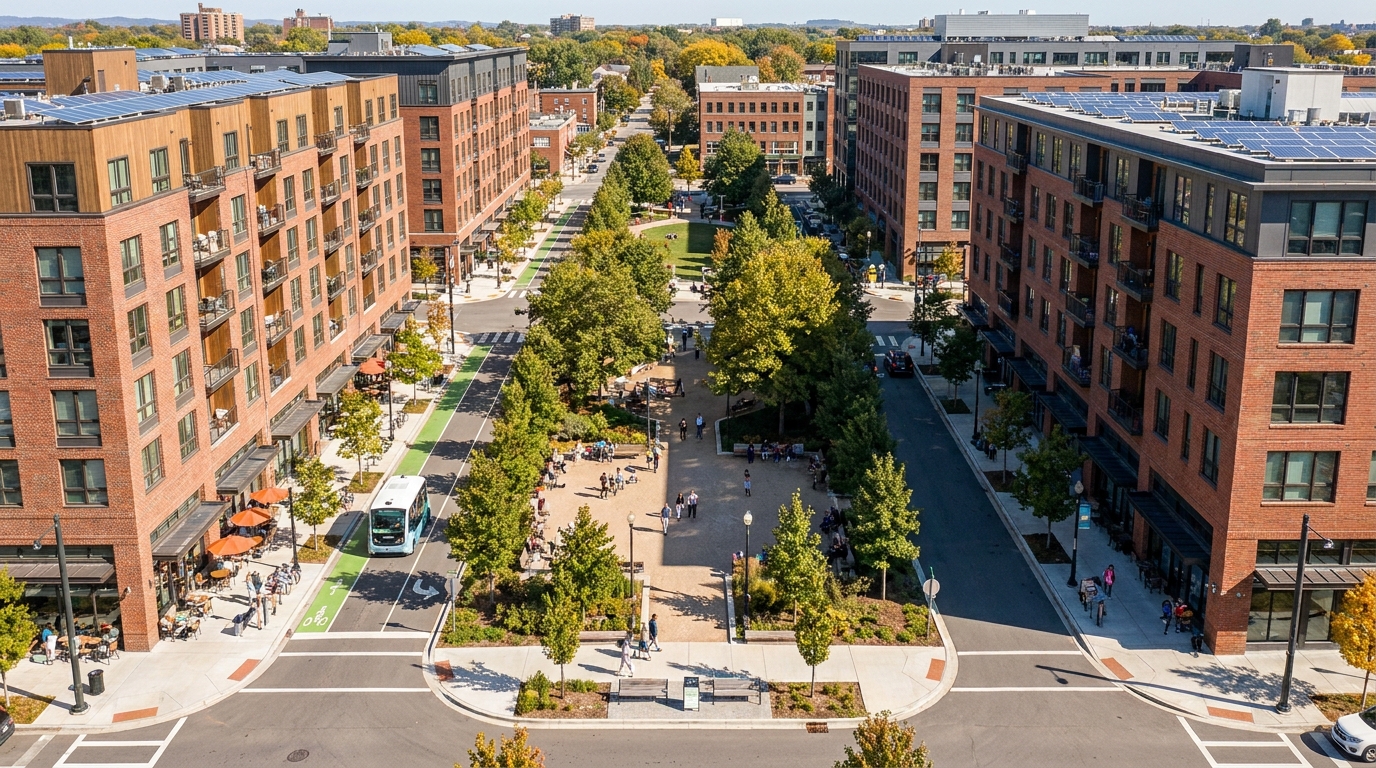
Canada’s housing policy direction offers a more grounded framework. Federal housing materials increasingly identify transit oriented development as a key tool for expanding supply and improving affordability. Programs such as the Housing Accelerator Fund encourage densification and transit supportive growth. That suggests the most plausible and strategically sound autonomous mobility model is not one based on endless low density expansion. It is one based on compact, mixed use, transit anchored communities where automated mobility complements high capacity transit and broadens local access.
This matters because transportation and housing are deeply linked in household economics. A home that is technically cheaper but requires high transportation costs and long daily travel times may not improve affordability in real terms. By contrast, a denser community connected to reliable transit, local services, and flexible automated feeder systems can reduce the total burden of living. For municipalities trying to manage growth, that model also uses infrastructure more efficiently and supports more complete neighborhoods.
Autonomous mobility can strengthen housing strategy when it serves as connective tissue rather than a substitute for urban form. For example, automated shuttles can improve access between lower density edges and major transit stations. Shared autonomous services can support mobility for residents in new infill developments where parking supply is limited. Delivery automation can reduce some friction in mixed use districts where loading is difficult. But the city still needs the underlying ingredients of good urbanism: density in the right places, walkability, public amenities, active transportation, and transit capacity.
There is also a risk that poorly governed automation could undermine housing goals. If autonomous mobility makes long distance travel easier without pricing or land use guardrails, it may encourage leapfrog growth and increase pressure for greenfield expansion. That can raise infrastructure costs, consume more land, and weaken the market signal for infill and transit oriented development. The lesson for policy makers is straightforward. Autonomous mobility should be integrated into housing strategy through deliberate planning tools, not treated as a neutral convenience that will somehow deliver positive urban outcomes on its own.
The Strongest Model: Mobility Hubs and Complete Communities
One of the most promising development models is the mobility hub embedded within a complete community. In this approach, higher density housing, local retail, community services, bike infrastructure, and public transit are concentrated around nodes where multiple transportation options connect seamlessly. Autonomous shuttles or on demand services can serve nearby neighborhoods and improve first mile and last mile travel, while the transit spine handles higher capacity movement across the region. This creates a layered mobility system that is more resilient and less land intensive than a city built around private car dependence.
For developers, this model improves clarity. It ties project location, public investment, and mobility service planning together in a way that can support both market absorption and long term value. For residents, it improves convenience without requiring car ownership as the default condition of access. For cities, it helps align growth with existing infrastructure and broader climate objectives. In strategic terms, that is a stronger proposition than allowing autonomous technology to disperse demand across ever larger urban footprints.
Accessibility Must Be a Core Design Principle
Accessibility is one of the most compelling promises of autonomous mobility and one of the most important tests of whether cities are designing responsibly. For older adults, people with disabilities, and residents who cannot drive, better automated transportation could expand independence and improve access to healthcare, employment, education, and social life. This is particularly relevant in aging societies where more residents want to remain active in their communities without relying on private family support for every trip.
Transport Canada and U.S. transportation authorities have both recognized automation as a potential accessibility enhancer. However, the promise remains conditional. Many current systems are not fully automated. Some services may rely on smartphone access, digital literacy, app based payment, or interfaces that exclude people with sensory, cognitive, or mobility challenges. If cities do not design around these realities, autonomous mobility may end up serving already advantaged users first while leaving others behind.
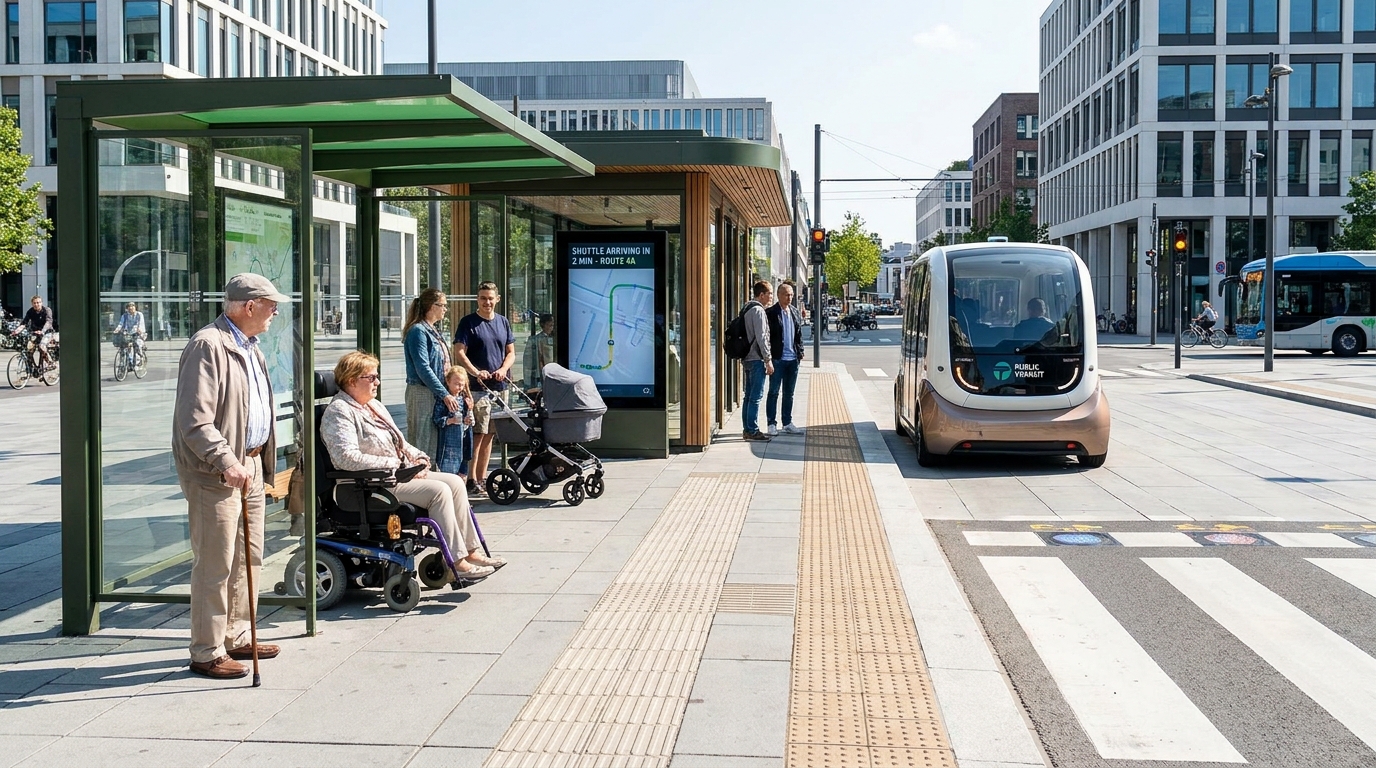
NACTO and ITDP both emphasize that inclusive access must be treated as a design objective from the beginning. That means accessible vehicles, accessible boarding areas, safe street crossings, tactile guidance, sheltered waiting spaces, multilingual and non digital information options, and payment systems that do not depend entirely on credit cards or smartphones. It also means service geography matters. A highly automated service concentrated only in affluent or high demand districts does not meet the standard of equitable urban mobility.
For city leaders, this is not a minor operational detail. Accessibility is central to how land use value is distributed across a region. When mobility systems are inclusive, more people can participate in economic and civic life, and more neighborhoods can function as places of opportunity. When systems are exclusionary, urban inequality deepens. In that sense, autonomous mobility should be evaluated not only by technical capability but also by who it serves, how reliably it serves them, and whether it strengthens dignity and independence in everyday travel.
Sustainability Is a Policy Outcome, Not a Guaranteed Feature
One of the biggest misconceptions about autonomous mobility is that it automatically reduces congestion and emissions. In reality, sustainability outcomes depend heavily on how systems are governed. If autonomous vehicles are mostly privately owned, travel empty between trips, encourage longer commutes, and increase total vehicle kilometres traveled, the net result could be more congestion and more emissions. Convenience alone does not equal sustainability.
On the other hand, if autonomous mobility is shared, electrified, priced effectively, and integrated with public transit, it could improve street efficiency and support lower emission travel. This is why many planning authorities focus on road pricing, mobility hubs, curb management, and transit integration rather than private adoption alone. The environmental performance of automation is shaped by policy architecture. Cities that want sustainable outcomes need to set the rules accordingly.
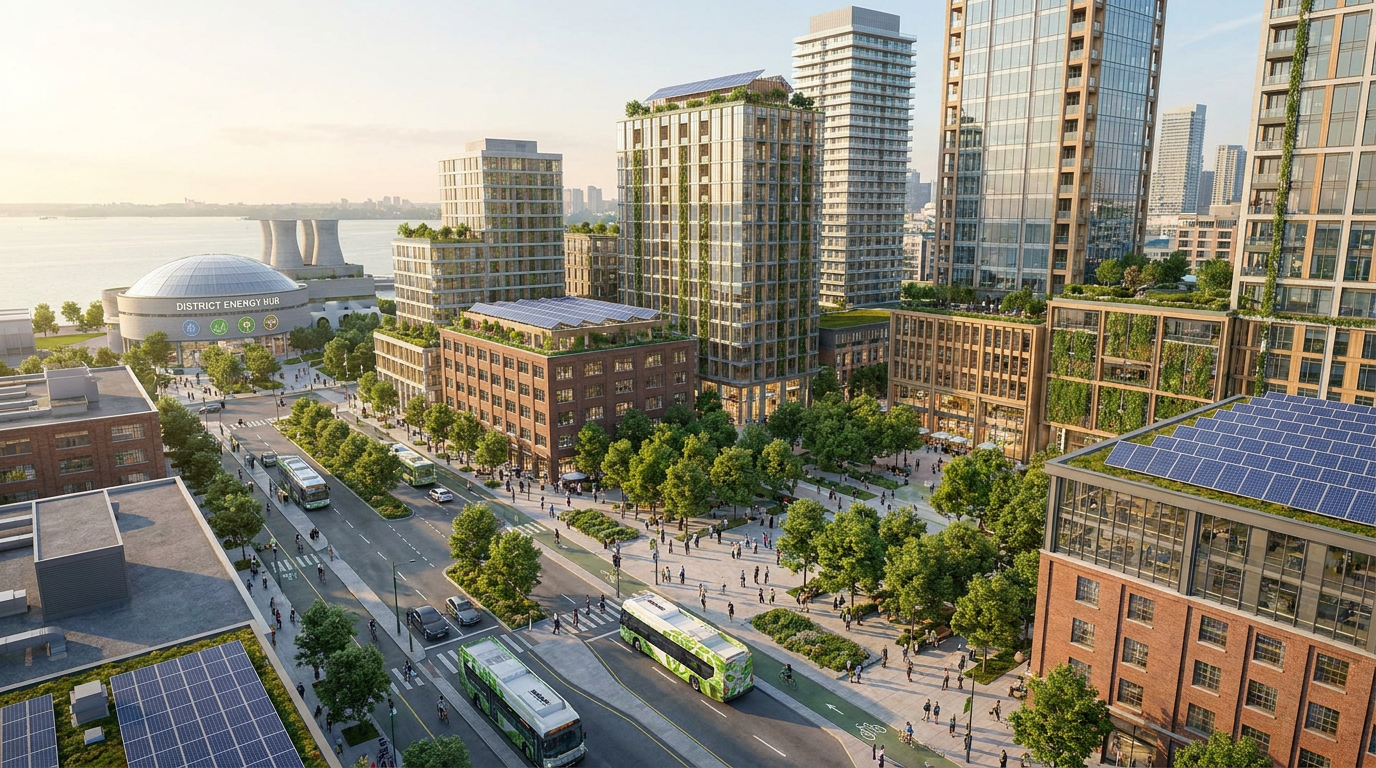
There is also a spatial dimension to sustainability that is often overlooked. Compact urban form generally reduces travel distances, supports walking and cycling, and lowers per capita infrastructure demands. If autonomous mobility supports transit oriented intensification, reclaimed parking land, and mixed use redevelopment, it can align with those sustainability advantages. If it encourages more dispersed urban growth, the opposite may occur. In strategic planning terms, land use and transportation cannot be separated here. The emissions profile of autonomous mobility is tied directly to the urban form it helps create.
Electrification will be an essential companion strategy. Autonomous systems that run on fossil fuel fleets will not meet the climate needs of future cities. But electrification by itself is also not enough. Even electric vehicles consume road space, create congestion, and shape land use decisions. The most resilient model is one where automation, electrification, and modal integration work together inside a framework that still values transit, walking, and cycling as core urban systems.
Street Design Still Matters, Perhaps More Than Ever
A common misconception is that if vehicles can drive themselves, street design becomes less important. In practice, the opposite is likely true. Automation increases the need for well managed lane allocation, curb space design, pickup and drop off organization, loading strategy, signal timing, and clear operating environments. Cities that fail to update street management may find that autonomous services create new conflicts rather than solving old ones.
NACTO has been particularly clear on this point. Autonomous vehicles should be integrated into streets in ways that prioritize people who are walking, biking, rolling, and using transit. Streets are public spaces before they are technology corridors. If automation is allowed to dominate without public design discipline, cities risk giving up valuable street capacity to low occupancy movement and chaotic curb activity. That outcome would reduce, not increase, the quality and efficiency of urban life.
The curb deserves special attention. In autonomous mobility cities, the curb becomes the interface between digital networks and physical space. It is where passengers board, deliveries arrive, accessible loading occurs, and public safety can either be strengthened or compromised. Dynamic curb management, designated loading zones, geofenced operations, and clear enforcement will become increasingly important. These may sound like operational details, but they have large implications for traffic flow, sidewalk safety, and commercial viability.
Connected signals and vehicle to everything communication may also improve network performance, especially in corridors where transit priority and freight coordination matter. Yet these systems should support broader public objectives rather than simply maximizing vehicle throughput. A successful autonomous mobility city will still be one where children can cross the street safely, where seniors can navigate without fear, and where the public realm remains legible and welcoming.
The Governance Challenge Facing Canadian Cities
The next phase of autonomous mobility will be defined by governance choices. Canada’s regulatory activity shows that automated driving standards are still evolving, and that is an important reminder for municipal decision makers. Cities should not wait passively for a mature technology package to arrive. They should be establishing planning principles now, especially around pilot design, curb regulation, data sharing, accessibility requirements, public transit coordination, and land use alignment.
The strongest municipal posture is neither blind enthusiasm nor defensive resistance. It is strategic selectivity. Cities should identify where automation can solve meaningful problems and where it may create new risks. A low speed autonomous shuttle connecting a transit station to a hospital district is a very different planning proposition from unrestricted robotaxi circulation across an already congested downtown. Governance needs to distinguish between these use cases and evaluate them according to public value, not marketing narratives.
Data governance is another crucial issue. Autonomous and connected systems generate enormous amounts of operational information that can help cities understand travel demand, curb activity, and street performance. But without strong rules, that data may remain fragmented, proprietary, or insufficient for public planning purposes. Municipalities need frameworks that protect privacy while also ensuring that public authorities can use mobility data to guide infrastructure, enforcement, and service planning.
Cybersecurity and testing oversight also remain central. Transport Canada’s materials consistently show attention to safety, cybersecurity, and staged deployment as prerequisites for broader implementation. This caution is appropriate. Cities depend on trust, reliability, and operational resilience. Any mobility technology that becomes deeply embedded in urban systems must meet those standards before scaling. In that sense, prudent governance is not an obstacle to innovation. It is the condition that makes durable innovation possible.
Misconceptions That Still Distort the Debate
The autonomous mobility discussion is often weakened by a few recurring myths. Clearing them up helps bring the topic back to practical planning. First, autonomous vehicles are not already fully deployed at scale in Canadian cities. Many systems available to consumers are driver assistance features, not full automated driving systems. This is an important legal, operational, and public education distinction.
Second, autonomous mobility will not automatically reduce congestion. If empty repositioning trips rise and private autonomous travel becomes easier, total vehicle travel may grow. Third, equity will not improve on its own. Inclusive access requires intentional design, affordable service models, and coverage beyond the most profitable corridors. Fourth, autonomous services are unlikely to replace the need for high capacity transit in major urban regions. Rail and bus rapid transit still move people at scales that smaller vehicles cannot match efficiently.
Fifth, automation does not eliminate the importance of urban design. It may increase it. Street hierarchy, curb rules, loading design, mobility hub location, and land use coordination all become more important as systems grow more complex. For city builders, these are familiar tools. The difference is that they now need to be applied in a mobility environment where software, operations, and physical design interact continuously.
A Strategic Vision for the Autonomous Mobility City
If autonomous mobility is going to improve urban life, the winning model will not be a city dominated by self driving private cars. It will be a city that uses automation selectively and strategically to support broader goals. Those goals include more housing in well connected locations, stronger transit systems, safer streets, better accessibility, more efficient goods movement, and the recovery of land now consumed by low value transportation uses.
The most effective autonomous mobility cities will likely share several characteristics. They will concentrate growth around transit and mobility hubs. They will reclaim parking and road space where better urban uses are possible. They will manage curbs as core infrastructure rather than leftover edge space. They will build accessibility into every deployment standard. They will price and regulate mobility to avoid induced traffic and low value circulation. And they will treat data, safety, and public accountability as non negotiable parts of the system.
From a development and planning perspective, this is a profound shift. It reframes mobility from a background service into a strategic lever for land economics and urban form. It also places a premium on coordination. Transportation agencies, planning departments, developers, housing authorities, accessibility advocates, and technology providers will need to work from a shared framework if autonomous mobility is to produce coherent urban outcomes. The cities that do this well will not just adopt new vehicles. They will build more adaptive, inclusive, and valuable urban systems.
Conclusion: The Urban Future Will Be Decided by Design, Not Hype
The rise of autonomous mobility cities is real, but its significance has less to do with spectacle and more to do with structure. The core question is not whether self driving technology exists. It is whether cities can harness automation to solve real urban problems without repeating the mistakes of car dependent planning. That requires discipline, clear public objectives, and a willingness to govern mobility as part of a larger housing and land use strategy.
For Canada, the moment is especially important. Regulatory standards are still forming. Housing affordability remains a national priority. Transit oriented development is increasingly central to supply strategy. Accessibility expectations are rising. Climate goals remain urgent. These forces create a narrow but meaningful window to shape autonomous mobility before it hardens into a pattern that works against city building rather than for it.
The best autonomous mobility city will not be the one with the most advanced vehicles. It will be the one that uses technology to expand access, reclaim land for better uses, strengthen complete communities, and make growth more sustainable over the long term. That is the strategic horizon worth pursuing. Urban success in the age of autonomy will be determined not by automation alone, but by the quality of the civic vision surrounding it.
Key Takeaways for Urban Leaders and Developers
- Autonomous mobility cities are a planning model, not just a vehicle trend. The real opportunity lies in integrating automation with land use, transit, and housing strategy.
- Parking and street reallocation may unlock major redevelopment value. Reduced demand for vehicle storage could free land for housing, parks, and mixed use growth.
- Transit oriented development remains essential. The strongest model is compact, mixed use growth where automated mobility complements higher capacity transit.
- Accessibility must be designed from the beginning. Inclusive vehicles, curb design, payment systems, and service geography are necessary for equitable outcomes.
- Sustainability depends on policy. Shared fleets, electrification, road pricing, and curb management are more important than private AV adoption alone.
- Governance will determine success. Regulation, testing, data sharing, street design, and public accountability will shape whether autonomous mobility improves cities or complicates them.


No Comment! Be the first one.