



The family room has quietly become one of the hardest working spaces in the home. It is where people gather after long days, where guests naturally settle in, where children spread out school projects, and where weekends often end with a movie and a blanket. In many homes, it also needs to absorb tasks that once belonged to separate rooms, from reading and remote work to gaming, crafting, and casual dining. That shift is not simply a passing design trend. It reflects the way people are living now, with more emphasis on flexibility, comfort, and making every square foot count.
Table Of Content
- Why Multi-Purpose Family Rooms Matter More Than Ever
- Start With the Lifestyle, Not the Furniture
- Create Gentle Zones Within One Room
- Easy Ways to Define Zones Without Closing the Room
- Choose Furniture That Can Adapt With You
- Layered Lighting Changes Everything
- Hidden Storage Is What Keeps the Room Beautiful
- Design a Media Experience That Does Not Dominate the Room
- Make Space for Work, Homework, and Quiet Focus
- Choose Materials That Can Handle Real Life Gracefully
- Design for Entertaining Without Losing Everyday Comfort
- Support Multigenerational Living and Changing Needs
- Common Mistakes to Avoid in a Multi-Purpose Family Room
- A Simple Planning Framework for Your Own Room
- The Beauty of a Room That Grows With You
Across North America, this change is easy to understand. The National Association of Home Builders reported that the average size of a new home in the United States declined to 2,411 square feet in 2023, the smallest average in 13 years, while buyers were often seeking homes around 2,070 square feet. At the same time, builders have noted growing interest in flex spaces and multiple-purpose rooms that can adapt as routines change. In Canada, multigenerational living continues to grow in importance, and policy changes such as the multigenerational home renovation tax credit introduced in 2023 reflect that reality. When more people, more ages, and more activities share a home, the family room becomes a meaningful place to design with extra care.
A multi-purpose family room is a single space designed to support several everyday functions — entertaining, movie nights, homework, remote work, and quiet reading — without feeling crowded or improvised. It is not a room that does everything poorly; it is one that does several things gracefully because it has been planned with intention. The most effective versions rely on a handful of tools working together: gentle zoning to separate activities, flexible and modular furniture, layered lighting that shifts from bright to restful, and concealed storage that keeps daily clutter out of sight. The goal is to balance ease and atmosphere so the room can host conversation one evening, support homework the next afternoon, and still feel restful during a quiet solo hour with a book. When the design is thoughtful, practicality does not take away from style. In fact, it often makes the room feel calmer, warmer, and more complete.
This article explores how to shape a family room that can evolve with your lifestyle while remaining polished and inviting. From zoning and furniture choices to lighting, storage, acoustics, and family-friendly finishes, these ideas are designed to help you create a room that truly supports daily life. Whether your home is compact, generous, newly built, or slowly being updated, a multi-purpose family room can become one of the most rewarding spaces to improve.
A multi-purpose family room works best when it feels intentional, not temporary. The secret is not squeezing in more functions. It is giving each function a natural place within a cohesive room.
Why Multi-Purpose Family Rooms Matter More Than Ever
Many households are asking more from fewer rooms. Affordability pressures, right-sizing decisions, and smaller new-home footprints have encouraged people to think more creatively about the spaces they already have. Rather than dedicating one room purely to formal entertaining and another solely to media, families are choosing layouts that feel useful every single day. This is one reason builders continue to anticipate more transition spaces and flex rooms in future housing plans. People want rooms that can shift with real life instead of standing still for special occasions.
There is also a strong emotional reason behind this movement. A family room is not just a practical zone. It is often the heart of the home, where everyday memories happen without much ceremony. Because it serves so many moments, it deserves a design that supports both energy and rest. A well-composed family room can feel lively when friends visit and deeply comforting when the house becomes quiet again.
In Canada, the rise of multigenerational households adds another layer of relevance. A room may need to accommodate grandparents, teenagers, young children, and working adults within the same day. Seating comfort, ease of movement, technology access, and lighting flexibility become much more important in that context. Instead of designing a room around a single ideal use, it makes sense to create a shared environment that welcomes different ages and changing routines.
There is a common misconception that multi-purpose design inevitably creates visual clutter. In reality, clutter usually comes from a lack of structure, not from having multiple functions. With clear zones, concealed storage, durable materials, and a consistent visual palette, a room can be incredibly versatile while still feeling serene. That is what makes this approach so attractive. It respects the messiness of real life without forcing the room to look messy.
Start With the Lifestyle, Not the Furniture
The most successful family rooms begin with observation. Before buying anything new, it helps to look honestly at how the room is already being used. Some families primarily need a media room that can occasionally host visitors. Others need a conversation space by day and a kid-friendly play and homework area by afternoon. Some households need an easy place for older relatives to sit comfortably, while others need a room that can support remote work in short bursts. The room should follow your habits, not a showroom fantasy.
A simple way to begin is to list the top five activities the room must support each week. You might include watching television, talking with guests, supervising homework, reading, game nights, or storing blankets and tech accessories. Once you see the room as a collection of lived moments, planning becomes more intuitive. You are no longer trying to decorate a generic family room. You are creating a setting for the rhythms of your home.
This approach also helps with decision making. If movie nights matter more than formal entertaining, then comfort and screen visibility should take priority over delicate accent furniture. If the room often hosts family gatherings, then extra movable seating and table surfaces may deserve more attention than a large coffee table. When every choice serves a clear purpose, the room feels harmonious rather than overfilled.
It is worth remembering that the best multi-functional spaces usually evolve in layers. You do not need a full renovation to make a room more adaptable. Furniture placement, better storage, improved lighting, and a stronger sense of zoning can dramatically change how the room works. Small, thoughtful adjustments often create the biggest feeling of relief.
Create Gentle Zones Within One Room
Zoning is the foundation of any multi-purpose family room. This does not mean building walls or creating rigid separations. Instead, it means giving each activity a sense of place so the room feels organized and intuitive. Even in an open layout, people naturally relax more when the arrangement quietly signals where to sit, where to work, where to play, and where to watch something together.
One of the easiest ways to establish zones is with furniture orientation. A sectional can define the media area, while a pair of accent chairs near a lamp can form a smaller reading or conversation corner. A slim console behind the sofa can subtly separate lounging from a nearby work or homework station. Rugs also help anchor different uses while softening acoustics at the same time. These choices guide movement without making the room feel chopped up.
Partial separation can be especially helpful in homes that are fully open concept. There is a tendency to assume open layouts are automatically the most flexible, but that is not always true. Some households benefit from a little visual definition and acoustic control. A low bookcase, a swiveling chair arrangement, or a wall of cabinetry can create just enough structure to make the room calmer and more useful.
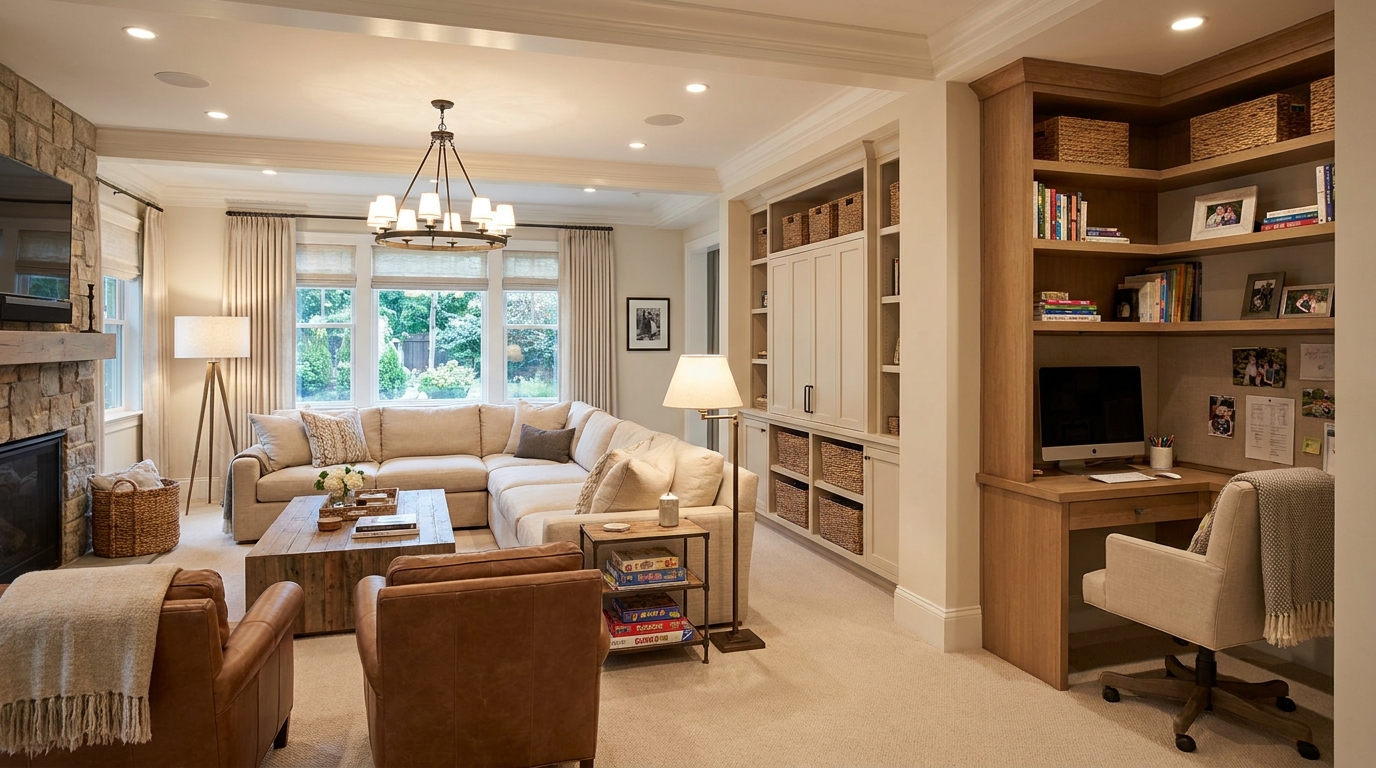
If your room must support several ages, zoning also helps each person feel considered. Children may need a low storage area and a surface for projects, while adults may want a corner that feels a little more composed for coffee or conversation. The point is not to isolate family members. It is to reduce friction so different activities can happen near each other more comfortably. That balance creates a room that feels generous in spirit, even when space is limited.
Easy Ways to Define Zones Without Closing the Room
- Use a rug to anchor the main seating area and visually separate it from a work or play nook.
- Place a sofa or sectional with its back to an adjacent function to create a natural boundary.
- Add a narrow console, storage bench, or bookcase between zones for subtle separation and extra utility.
- Vary lighting so each area has its own mood and purpose, such as brighter task lighting for homework and softer lamps for lounging.
- Choose furniture with flexible movement, including nesting tables, swivel chairs, and ottomans that can shift as needed.
Choose Furniture That Can Adapt With You
In a multi-purpose family room, furniture should do more than fill the floor plan. It should support movement, comfort, and change. This is why modular pieces are so valuable. A sectional that can be reconfigured, ottomans that act as seating or table surfaces, and nesting tables that come out only when needed all make the room feel more responsive. Flexibility is not about making everything mobile all the time. It is about giving the room options without creating stress.
Comfort should remain the guiding principle. Because the family room is a place of daily use, seating needs to feel inviting for more than a few minutes. Deep sofas, chairs with proper back support, and upholstered pieces in durable performance fabrics tend to wear beautifully in real homes. If the room serves both hosting and movie nights, balance tailored lines with softer details. A polished silhouette can still feel relaxed when the fabric, scale, and accessories are right.
Scale matters just as much as style. Oversized furniture can make a room feel trapped, while pieces that are too small may leave it visually scattered. Try to preserve easy circulation so people can move naturally, especially if children or older adults use the room often. In multigenerational spaces, accessible seating heights and supportive arms can make a noticeable difference in comfort without affecting the overall look.
It is also wise to think beyond the main sofa. A family room often becomes more functional when seating is varied. Swivel chairs can face the television or rotate toward conversation. Poufs and stools can be pulled in during gatherings and tucked away later. A storage bench by the wall or under a window can offer a flexible perch while keeping throws, board games, or seasonal items contained. These are the pieces that quietly make a room easier to live in.
Layered Lighting Changes Everything
Lighting is one of the most overlooked tools in a multi-purpose family room, yet it has enormous influence over both function and mood. A single overhead fixture rarely supports the many ways this room is used. Family rooms need light that can become brighter for reading, projects, and tidying, then softer for conversation and movie nights. Layered lighting gives you that range while making the room feel more intimate and finished.
The strongest approach combines ambient, task, and accent lighting. Ambient light creates the overall glow of the room, often through ceiling fixtures, recessed lights, or a central decorative fitting. Task lighting supports activities such as reading and homework through table lamps, floor lamps, or adjustable sconces. Accent lighting adds atmosphere by highlighting shelves, artwork, or cabinetry. When these layers work together, the room can move from practical to cozy with very little effort.
Dimmers are especially useful in a family room because they let one space support very different energy levels. During a gathering, a room may benefit from a brighter, more social setting. Later in the evening, softer pools of light feel more restful and flattering. If you use the room for media, avoiding overly harsh glare becomes important too. Lamps placed thoughtfully around the perimeter of the room often create a more welcoming effect than relying only on bright light overhead.
There is also something emotionally reassuring about a room with layered light. It feels cared for, not simply illuminated. In a space that serves both busy and peaceful moments, that softness matters. Good lighting helps the room hold all those moods gracefully.
Hidden Storage Is What Keeps the Room Beautiful
A multi-purpose family room can only stay calm if storage is integrated thoughtfully. This does not mean adding bulky cabinets everywhere. It means understanding what tends to accumulate in the room and giving those items a home. Blankets, remotes, chargers, toys, games, books, headphones, and craft supplies all have a way of drifting into view. When storage feels easy to use, the room is much simpler to reset at the end of the day.
Built-ins are especially helpful because they make storage feel architectural rather than added on. A media wall with closed lower cabinets and a few open shelves can hide practical clutter while still allowing room for display. Window seats with lift-up storage, benches with concealed compartments, and custom cabinetry around a television can all support a cleaner visual experience. The room immediately feels more intentional when utility is tucked into the design itself.
If built-ins are not possible, freestanding solutions can still look polished. Consider a coffee table with drawers, woven baskets that suit the palette of the room, or a handsome credenza that stores games and tech accessories. Lidded boxes on shelves can corral small items that often create visual noise. Even a dedicated charging drawer can improve the atmosphere by reducing cable clutter and keeping devices from overtaking every surface.
Statistics Canada has noted that many households live in homes needing minor or major repairs, which is a useful reminder that renovation planning should stay practical. Storage upgrades do not always need to be elaborate or expensive to improve daily life. Sometimes the smartest investment is simply choosing pieces that work a little harder and organizing the room around what your household truly uses.
Design a Media Experience That Does Not Dominate the Room
For many families, the television remains an important part of the room. Movie nights, sports, gaming, and streaming all shape how the family room is used. Still, a media setup does not have to overpower everything else. The most elegant rooms treat the screen as one feature among many, allowing the space to feel attractive and balanced even when the television is off.
A well-designed media wall can make this much easier. Closed cabinetry beneath the television hides electronics, controllers, and cables, while shelves or millwork around it give the wall more visual presence. Framing the screen with texture, paint, paneling, or stone can help it feel integrated rather than floating awkwardly. If the room often transitions from socializing to screen time, swivel chairs and movable ottomans can support both arrangements effortlessly.
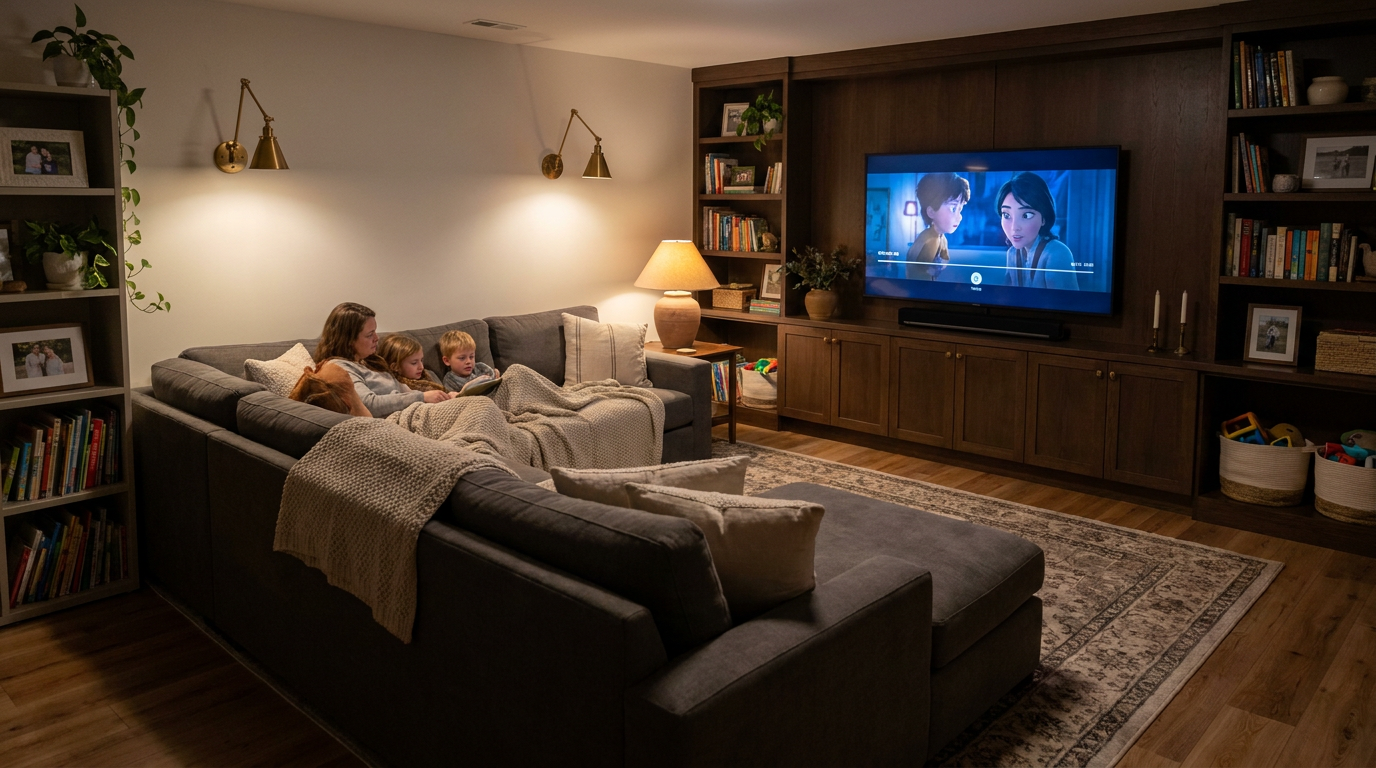
Acoustics deserve attention too. Hard surfaces can make media rooms feel echoey and tiring, especially in open-plan homes. Upholstered furniture, curtains, rugs, and even bookshelves help absorb sound and make the room more comfortable for both watching and conversation. If your household includes people who like different noise levels, acoustic softness becomes one of the quiet luxuries of the space.
Technology can also be integrated gently. Smart lighting scenes, discreet speakers, charging stations, and thoughtful cord management all make the room more enjoyable without making it feel clinical. The goal is not to create a showroom of gadgets. It is to make entertainment feel easy and calm so the room remains welcoming for every other purpose too.
Make Space for Work, Homework, and Quiet Focus
One reason multi-purpose family rooms matter so much today is that they often absorb light work and study tasks. Even if your home has a separate office, family life frequently spills into shared spaces. Parents supervise homework while answering emails. Teenagers revise notes near the action of the household. Someone reads, journals, or pays bills in the same room where others unwind. Planning for these moments makes the room far more useful.
This does not require turning the family room into a full office. Often, a compact writing desk, a floating shelf work station, or a console that can double as a laptop perch is enough. Task lighting should be brighter in this zone, and nearby outlets or a charging drawer make it easier to use. Choosing a chair that looks refined but still supports posture helps the area blend into the room instead of feeling improvised.
Noise and visual distractions are often the biggest challenge. Positioning a work or homework station slightly off to the side rather than directly facing the television can improve focus. A bookcase, screen, or plant grouping can create a gentle buffer without cutting the room apart. If the room must shift quickly between work and relaxation, baskets or drawers for papers and supplies let everything disappear at the end of the day.
There is something deeply satisfying about a room that allows for togetherness without forcing everyone into the exact same activity. That is one of the true gifts of a multi-purpose family room. It lets each person remain close while still having room for their own rhythm.
Choose Materials That Can Handle Real Life Gracefully
Practicality and beauty are not opposites. In fact, the most successful family rooms often rely on materials that are both durable and inviting. Performance fabrics, washable slipcovers, forgiving textures, and resilient rugs help the room stay attractive under everyday use. This is especially important if the room hosts children, pets, frequent guests, or multiple generations.
When choosing upholstery, look for fabrics with softness and texture rather than anything that feels overly precious. Boucle, woven blends, and performance linen looks can all bring warmth while standing up to regular life. Leather can be beautiful in some family rooms, especially when it has a relaxed finish that develops character over time. The key is to choose materials you will not feel anxious about using.
Color palettes also influence how practical a room feels. Mid-tone neutrals, warm woods, earthy hues, and layered textiles create depth while disguising wear better than very stark schemes. That does not mean the room must be beige or safe. It simply means the backdrop should support comfort and longevity. Accent color can come through pillows, art, or occasional seating that can evolve more easily over time.
Flooring and rugs deserve careful thought too. A durable area rug can soften sound, define a zone, and make the room feel finished, but it should be suitable for how the room is used. Low-pile, indoor-outdoor, or easy-clean options are often wise in heavily used family spaces. A room feels much more luxurious when you can live in it freely.
Design for Entertaining Without Losing Everyday Comfort
Entertaining in the family room should feel natural, not formal or strained. Most guests respond best to spaces that feel relaxed, welcoming, and easy to move through. This is where flexible seating, thoughtful table surfaces, and a little circulation space make all the difference. You want the room to hold conversation comfortably while still serving the household beautifully when no one is visiting.
A conversational layout often works better than arranging every seat toward the television. Even if the screen is part of the room, try balancing it with chairs or a secondary seating angle that encourages face-to-face connection. Drinks tables scattered throughout the room feel more gracious than relying on one crowded coffee table. If you often host, nesting side tables or small movable stools can be very helpful and easy to tuck away later.
Storage once again supports the experience. Having a place to quickly hide extra toys, chargers, or paperwork before company arrives can instantly shift the atmosphere. A cabinet that stores serving pieces, extra coasters, or throws for chilly evenings makes hospitality feel effortless. Good entertaining design is rarely about extravagance. More often, it is about removing little points of friction.
Styling matters here too, but in a restrained way. A few large accessories, layered textiles, and living elements such as branches or a plant can make the room feel complete without crowding surfaces. The family room should still feel like home, just a slightly more polished version of itself.
Support Multigenerational Living and Changing Needs
As multigenerational living becomes more common, family rooms are increasingly asked to serve people with different comfort levels, mobility needs, and routines. This does not mean the room has to feel clinical or obviously adapted. It simply means thinking with a little more generosity about access, seating, and usability. A beautiful room is one that welcomes everyone who lives in it.
Supportive chairs with arms, a clear path for movement, and side tables within easy reach can make the room more comfortable for older adults. Lighting should be warm but sufficient, especially for reading or moving safely in the evening. If hearing differences are part of the household, softer acoustics and manageable background noise can improve the experience for everyone. Thoughtful design often benefits all ages at once.
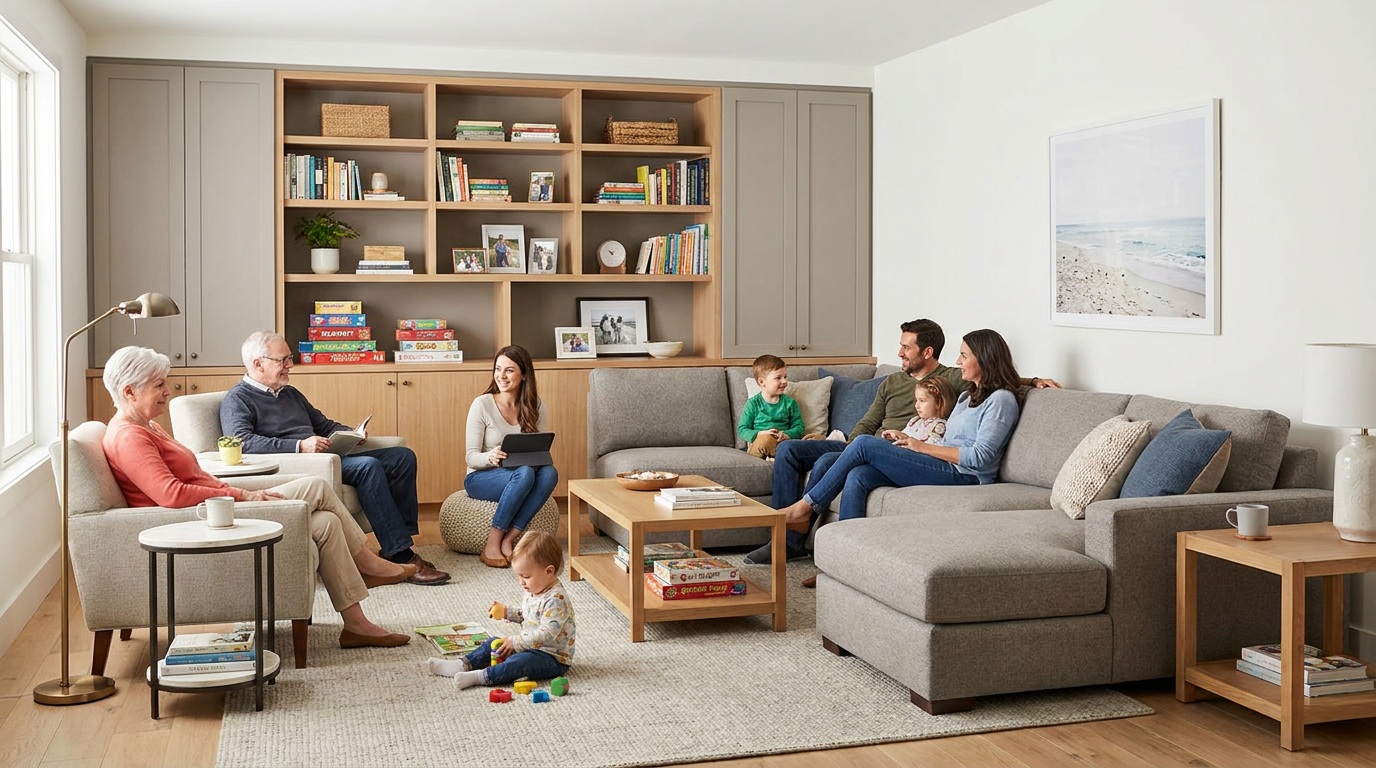
The Government of Canada introduced the multigenerational home renovation tax credit in 2023 to support the creation of secondary suites for seniors or adults with disabilities. While that specific measure applies to broader renovation work, it reflects a larger truth about housing today. More families are designing homes that can adapt over time. The family room is an ideal place to begin because it is already a shared social space with emotional importance.
Designing for changing needs is not about predicting every future detail. It is about choosing a layout and furnishings that can flex. A room that supports young children today may host aging parents tomorrow. A homework corner may later become a reading nook or hobby station. The more gracefully the room can evolve, the more valuable it becomes.
Common Mistakes to Avoid in a Multi-Purpose Family Room
One of the most common mistakes is trying to fit too many large pieces into one room. In a desire to accommodate every possible activity, people sometimes overfurnish the space and reduce its flexibility. A room needs breathing room to change moods and functions. Choose fewer, better pieces that can work harder instead of filling every corner.
Another frequent problem is relying on one harsh overhead light for every activity. This makes the room feel flat and limits how comfortably it can shift from work to relaxation. The absence of proper storage is another issue that quickly undermines a beautiful design. Without places to hide daily clutter, even the most attractive room starts to feel chaotic.
Some homeowners also assume that multi-purpose means visually mixed or inconsistent. In truth, cohesion is what allows multiple uses to feel elegant. Repeating materials, colors, and finishes across the room creates calm. A desk area, media wall, and lounging zone should feel related, even if they serve different purposes.
Finally, do not assume an open layout is always the ideal answer. Some rooms function better with a little separation, especially when media, work, and conversation need to happen at the same time. Flexibility is not about maximum openness. It is about creating a room that genuinely supports the people who use it.
A Simple Planning Framework for Your Own Room
If you are ready to rethink your family room, it helps to follow a simple sequence. First, define the room’s primary and secondary uses based on your actual week. Second, map where each activity should happen and how people move through the space. Third, evaluate what stays, what needs replacing, and what could become more useful with a different layout. Fourth, improve lighting and storage before adding decorative details. These practical steps create the structure that style can then build on.
It can also help to ask a few grounding questions as you plan. Where do people naturally gather now, and why. What tends to pile up in the room most often. Which moments feel cramped, noisy, or inconvenient. Where could a lamp, basket, swivel chair, or narrow storage piece solve a daily frustration. Design feels much less overwhelming when it begins with these very human observations.
- Identify the top activities the room must support every week.
- Divide the room into gentle zones based on those activities.
- Prioritize comfortable, flexible furniture with the right scale.
- Add layered lighting for media, conversation, reading, and work.
- Integrate concealed storage to protect the calm of the room.
- Choose durable, warm materials that welcome everyday living.
- Refine with art, textiles, and accessories that tie everything together.
This process is not about perfection. It is about making the room feel easier to live in and more reflective of your household. Even one or two well-chosen changes can shift the atmosphere dramatically.
The Beauty of a Room That Grows With You
A multi-purpose family room is ultimately about more than efficiency. It is about creating a space that supports the many versions of home life, from celebration and connection to rest and routine. When a room can hold all of that with ease, it begins to feel deeply comforting. It becomes less about decoration alone and more about emotional usefulness.
That is why these rooms matter so much now. As homes become more personalized, more flexible, and in many cases more compact, people are looking for spaces that can evolve without losing their sense of warmth. Builders are responding with more flex spaces, homeowners are investing in practical upgrades, and families are recognizing that comfort and adaptability are part of modern luxury. A room that truly works for your life is a beautiful thing.
If your family room currently feels overused, underplanned, or slightly pulled in too many directions, there is good news. You do not need to strip away personality or rebuild the entire space to make it better. With thoughtful zoning, supportive furniture, layered lighting, integrated storage, and a clear understanding of how your household lives, the room can become calmer, prettier, and far more versatile.
The best family rooms are not rigidly designed for one perfect moment. They are designed for real life, which means they can welcome guests, hold movie nights, support quiet work, and offer comfort at the end of an ordinary day. When your family room does all of that beautifully, it is not just multi-purpose. It is truly meaningful.


No Comment! Be the first one.