



Urban development used to treat telecommunications as a secondary utility. Roads were laid out, water and sewer systems were designed, power service was coordinated, and only later did connectivity enter the conversation. That model no longer reflects how cities actually function. In today’s economy, telecommunications infrastructure is not a finishing touch on development. It is a foundational system that supports housing, employment, education, healthcare, transit, emergency operations, municipal services, and day to day quality of life.
Table Of Content
- Telecommunications Is Now Core Urban Infrastructure
- Why Connectivity Influences Land Value and Development Feasibility
- Fiber, Wireless, and the Myth of Interchangeability
- Telecom as a Driver of Economic Growth and Community Development
- The Policy and Regulatory Context Matters More Than Ever
- Planning Telecom Early in the Development Process
- Key elements to consider during early stage telecom planning include
- Smart Cities Depend on Strong Telecommunications Foundations
- Resilience, Redundancy, and Critical Infrastructure Security
- Digital Equity and Affordability Cannot Be Ignored
- Best Practices for Integrating Telecommunications Into Urban Redevelopment
- A practical redevelopment framework often includes
- What Stakeholders Should Do Next
- Conclusion: The City of the Future Runs on More Than Concrete and Steel
For planners, developers, municipalities, and infrastructure stakeholders, this shift has major implications. A district that lacks sufficient fiber capacity, building access pathways, mobile coverage, redundant routing, and well managed rights of way is not simply less convenient. It is less competitive, less resilient, and often less capable of supporting the density and economic intensity envisioned in modern planning policy. As cities across Canada and North America push for more housing, transit oriented development, employment growth, and climate resilience, telecommunications infrastructure has become part of the strategic backbone that makes those ambitions realistic.
The policy context reinforces that reality. The U.S. Cybersecurity and Infrastructure Security Agency, or CISA, identifies communications systems as essential to virtually every societal function and as a dependency for other infrastructure sectors including energy, transportation, water, emergency services, information technology, and financial services. In Canada, the CRTC has framed high quality connectivity as central to full participation in social and economic life. Those are not abstract statements. They reflect the fact that urban systems now rely on digital networks as deeply as they rely on roads, substations, and water mains.
The numbers show major progress, but they also show why strategy still matters. The CRTC reported that 93.8 percent of Canadian households had access to fixed broadband internet access services in 2023 to 2024, while 99.5 percent had access to the latest generally deployed mobile wireless technology. Canada’s universal service objective is for 100 percent of households to have access to fixed broadband at 50/10 Mbps with unlimited data by December 2031. Recent reporting also indicates that approximately 72 percent of Canadian households have access to fiber at home and nearly 90 percent have access to gigabit speed service. Yet rural, remote, and First Nations reserve communities remain below national averages, and even in urban markets, coverage does not automatically mean affordability, adoption, or service quality.
The central lesson for urban development is clear. Telecommunications must be integrated early, not added late. The most successful growth areas treat connectivity as an enabling layer of land use, infrastructure coordination, economic development, and public service planning. That approach creates stronger projects and more capable cities.
Telecommunications Is Now Core Urban Infrastructure
There is a practical reason telecommunications has moved from the margins of planning into the center of development strategy. Nearly every major urban function now depends on stable, high capacity, low latency connectivity. Residential communities need reliable broadband to support remote work, education, entertainment, building management systems, and household access to services. Commercial districts need connectivity for transactions, logistics, cloud operations, tenant attraction, and competitive productivity. Municipal governments depend on networks for digital service delivery, traffic coordination, asset monitoring, public communication, and internal operations.
This dependency becomes even more important as cities intensify. Higher density does not just increase the number of users connected to a network. It increases the complexity of services that must run across that network. A mixed use district with mid rise and high rise housing, schools, clinics, ground floor retail, public Wi Fi, intelligent transportation systems, and digitally managed buildings generates a very different demand profile than a low density suburban environment. Capacity planning, redundancy, in building infrastructure, and fiber backhaul matter much more in these settings because the urban form itself raises expectations for service continuity and performance.
In strategic terms, telecommunications infrastructure should now be understood as a multiplier. It does not simply serve growth after the fact. It expands the economic value, service capability, and long term viability of development itself. A well connected district is more attractive to employers, more functional for residents, and more adaptable to future technologies. A poorly coordinated district, by contrast, may face retrofits, delays, tenant dissatisfaction, limited smart building integration, and weaker competitiveness over time.
This is why the conversation about urban infrastructure can no longer isolate telecom from other systems. The old distinction between physical infrastructure and digital infrastructure is becoming less useful. In practice, the two are converging. Transit systems run on data. Utility operations rely on communications links. Emergency management depends on resilient networks. Commercial real estate performance increasingly reflects digital readiness. Housing quality now includes connectivity as a baseline expectation rather than a premium add on.
In a modern city, connectivity is not just a service delivered to buildings. It is a strategic layer that helps buildings, districts, and public systems function as intended.
Why Connectivity Influences Land Value and Development Feasibility
From a land development perspective, telecommunications infrastructure affects both market positioning and project feasibility. In residential projects, reliable high speed connectivity is essential to attracting buyers and tenants who expect seamless work from home capability, streaming, digital education, telehealth access, and smart home functions. In office and employment projects, network quality can affect leasing outcomes because firms increasingly evaluate connectivity in the same conversation as power reliability, transit access, and floorplate efficiency.
There is also a cost side to the equation. If telecommunications is coordinated early, developers can align conduit placement, utility rooms, in building pathways, rooftop access, and service entries with site servicing and structural planning. If it is left too late, teams often face redesign, construction conflicts, fragmented provider negotiations, and expensive retrofits. The difference between these two approaches is not just technical. It affects project timelines, capital costs, and long term operating flexibility.
At the district scale, connectivity also influences investment attraction. Employers choosing locations for offices, industrial operations, life sciences facilities, educational uses, or data intensive commerce look for areas where robust communications infrastructure already exists or can be delivered without friction. The same is true for innovation districts and mixed use employment corridors. Fiber availability, carrier presence, building access rules, and small cell deployment conditions can all shape whether a precinct is perceived as future ready.
For municipalities trying to unlock redevelopment, this creates a direct planning issue. Zoning may permit density, but density alone does not create a high performing urban environment. If the infrastructure systems that support that density are weak or poorly coordinated, the district will struggle to meet its economic and social potential. Telecommunications belongs in the same early conversation as roads, stormwater, power servicing, transit integration, and community infrastructure.
Fiber, Wireless, and the Myth of Interchangeability
One of the most persistent misconceptions in urban development is the belief that wireless can replace fiber. This misunderstanding often emerges when project teams see strong mobile coverage and assume that physical broadband infrastructure has become less important. In reality, advanced wireless networks depend heavily on fiber backhaul and dense physical support systems. Mobile performance is only as strong as the network architecture beneath it.
Fiber remains the core long term asset for capacity, reliability, and upgrade potential. It supports fiber to the premises connections for homes and businesses, connects commercial buildings and institutions, links data traffic from wireless sites, and provides the bandwidth needed for modern urban uses. As digital demand rises, especially in high density areas, fiber’s importance increases rather than declines. It is the scalable layer that allows cities to support future applications without constantly rebuilding the network foundation.
Wireless networks are critical, but they solve a different problem. They provide mobility, flexible access, and last mile convenience for users on the move. In dense cities, 5G and future wireless systems may also support specific operational uses, from connected transportation to sensors and advanced public realm technologies. But these systems still require small cells, distributed antenna systems, pole access, power, and reliable transport connections. They are not detached from the physical city. They are deeply embedded in it.
For planners and developers, the strategic takeaway is simple. Fiber and wireless are complementary, not competing substitutes. The strongest urban environments are those that plan for both. That means ensuring sufficient conduit, backhaul, rooftop and street furniture access, building pathways, and policy frameworks that allow mobile densification without unnecessary delay or visual disorder.

Telecom as a Driver of Economic Growth and Community Development
Telecommunications infrastructure is often discussed in technical language, but its impact is fundamentally economic and social. Robust networks expand access to jobs, support entrepreneurship, improve educational opportunity, and enable businesses to operate with greater flexibility. In practical terms, they help determine whether communities can participate fully in the digital economy or remain constrained by weak service, high costs, or unreliable connections.
For local economies, the benefits are broad. High quality connectivity supports remote and hybrid work, which has changed how households choose where to live and how businesses think about space. It enables small businesses to reach broader markets, allows professional services firms to operate from urban and suburban nodes with equal sophistication, and strengthens the attractiveness of mixed use environments where people can live, work, and access services in the same district. This is especially relevant for redevelopment areas seeking to transition from older industrial or underused commercial patterns into more diverse urban economies.
Community growth is equally tied to connectivity. Telehealth can reduce travel barriers and expand access to care. Online learning can support students across age groups. Digital public services can make municipal engagement more efficient and accessible. Social connections, cultural participation, and civic inclusion are increasingly shaped by internet access and network reliability. When connectivity is weak, the burden falls hardest on households already facing other barriers.
This is why telecommunications cannot be framed only as a convenience for consumers. It is an input into opportunity. It affects whether residents can compete for jobs, whether students can complete assignments effectively, whether seniors can access remote care, and whether local organizations can deliver services efficiently. A city that overlooks telecom planning is not just limiting technical performance. It is constraining its own human and economic development capacity.
The Policy and Regulatory Context Matters More Than Ever
Urban development does not happen in a vacuum, and neither does telecommunications deployment. Regulatory decisions about wholesale access, competition, building access, rights of way, and wireless siting have direct implications for how quickly and affordably networks can be built. In Canada, the CRTC has recently focused on simplifying aspects of 5G deployment and updating wholesale access policy, reflecting the increasing link between telecom regulation and network buildout.
For urban stakeholders, this means telecom policy is no longer a distant sector issue. It has practical effects on redevelopment outcomes. If access to poles, conduit, rooftops, or municipal corridors is cumbersome, deployment slows. If building access frameworks are weak, competition can suffer and residents or businesses may face fewer service options. If small cell approvals are not coordinated with local planning, cities can experience unnecessary delays in network densification even where demand is growing quickly.
At the same time, competition and affordability remain central concerns. Strong infrastructure matters, but the public value of that infrastructure depends in part on whether households and businesses can actually use it at reasonable cost. Availability statistics tell only part of the story. Communities can appear well served on paper while still experiencing adoption gaps due to pricing, digital literacy barriers, or uneven service quality. Strategic urban planning therefore has to consider both physical deployment and equitable access.
Municipalities, developers, and network providers all benefit when regulatory and planning frameworks are aligned. Clear permitting processes, reasonable access rules, coordinated capital planning, and transparent technical standards can reduce friction and improve outcomes. In rapidly growing urban regions, this alignment is becoming a prerequisite for efficient infrastructure delivery rather than an administrative bonus.
Planning Telecom Early in the Development Process
The strongest development strategies recognize that telecommunications should be addressed at concept stage, not after approvals are mostly complete. Early planning allows project teams to map expected capacity needs, identify provider requirements, coordinate utility corridors, reserve physical space for equipment and pathways, and assess how the development will connect into surrounding networks. This reduces uncertainty and helps ensure the project can support both initial occupancy and future demand growth.
Early integration is especially important in large master planned communities, transit oriented developments, industrial campuses, institutional expansions, and major urban infill sites. These projects often involve phased delivery, multiple buildings, significant public realm investment, and long time horizons. If telecom planning is deferred, each later phase can become more expensive and less efficient. If it is embedded from the start, developers can create shared backbone infrastructure, common conduit systems, coordinated equipment spaces, and scalable service models that improve long term performance.
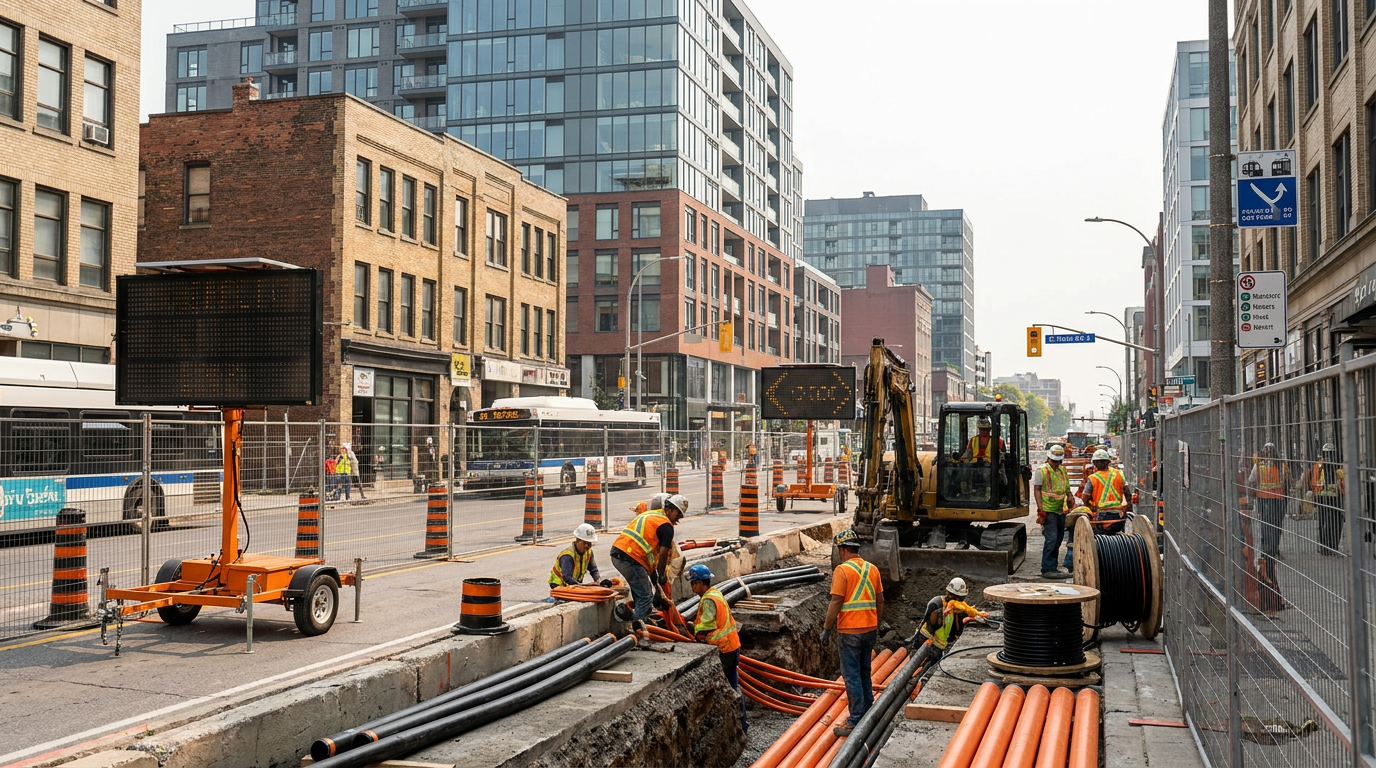
There is also a public works dimension. Cities that coordinate telecom with road reconstruction, utility upgrades, and streetscape projects can avoid repeated excavation and reduce overall disruption. This is where dig once strategies become valuable. When municipalities install or require conduit during planned civil works, they create future capacity at a far lower cost than retrofitting later. Over time, this approach improves network readiness across redevelopment corridors and growth areas.
Developers should also think beyond the minimum service requirement at occupancy. A building that technically receives service today may still underperform tomorrow if risers, pathways, equipment rooms, and connection points are undersized. Future proofing does not mean overbuilding endlessly. It means designing with realistic expectations about rising bandwidth demand, smart building systems, operational data needs, and tenant expectations over the life of the asset.
Key elements to consider during early stage telecom planning include:
- Fiber access points and routing into the site
- Shared or dedicated underground conduit systems
- In building pathways, risers, and telecom rooms
- Rooftop, façade, or pole access for wireless equipment where appropriate
- Power supply and backup considerations for critical communications assets
- Redundant routing for resilience and service continuity
- Coordination with roads, utilities, streetscape, and public realm design
- Carrier access, competition, and building service arrangements
Smart Cities Depend on Strong Telecommunications Foundations
Smart city discussions often focus on applications such as adaptive traffic signals, connected sensors, public safety systems, environmental monitoring, smart lighting, and digital service platforms. Those tools can be valuable, but they only work at scale when underlying networks are robust. Without sufficient bandwidth, low latency where required, dependable power, and secure system integration, smart city ambitions remain fragmented pilots rather than operational infrastructure.
This matters because many municipalities are moving beyond experimentation. Traffic operations, parking systems, transit information, building energy optimization, and utility monitoring are increasingly expected to function in real time. As those systems expand, cities need telecommunications infrastructure that can support a growing number of connected devices, reliable data transmission, and consistent performance under stress. In practical terms, smart city functionality is less about gadgets and more about disciplined network design.
For redevelopment districts, this opens an important opportunity. If telecommunications infrastructure is planned as part of early area servicing, districts can be designed to support future smart applications without piecemeal retrofits. Public realm infrastructure, lighting standards, street furniture, mobility hubs, and utility corridors can all be designed with connectivity in mind. This allows the district to evolve over time as technologies mature and public priorities change.
The most strategic approach is to avoid technology chasing and focus instead on durable enablers. Fiber pathways, accessible pole infrastructure, edge equipment locations, secure integration standards, and scalable governance frameworks offer far more long term value than isolated technology purchases. Cities that understand this distinction are better positioned to turn digital systems into meaningful urban performance gains.
Resilience, Redundancy, and Critical Infrastructure Security
One of the most important reasons telecommunications belongs at the center of infrastructure planning is resilience. CISA emphasizes that communications systems support other critical sectors including energy, transportation, water, emergency services, information technology, and finance. In urban settings, this means that a telecom disruption can cascade through multiple systems at once. The issue is not merely whether residents lose internet service. It is whether essential operations across the city can continue under stress.
Resilience starts with physical design. Redundant routes, diverse entry points, protected equipment locations, backup power strategies, and coordinated maintenance access all improve the ability of a network to withstand disruptions. Undergrounding can reduce exposure in some contexts, though it must be designed carefully in relation to flood risk, maintenance requirements, and other underground constraints. Above ground infrastructure may offer easier access in some situations but can be more exposed to weather or collision risks. The right answer depends on local conditions, but the principle is universal: resilience must be designed, not assumed.
Cybersecurity is also part of the equation. As communications networks connect more public systems, buildings, sensors, and operational technologies, the attack surface grows. Secure design, vendor oversight, access controls, network segmentation, and emergency response planning are increasingly relevant not just to telecom operators but to municipalities, institutional property owners, and developers of digitally integrated projects. A connected city without adequate cyber resilience is simply a more vulnerable city.
For urban leaders, resilience planning should treat telecom similarly to other essential systems. It requires risk assessment, interdependency mapping, contingency planning, and long term investment discipline. The goal is not perfection. The goal is to reduce the likelihood that a single point of failure in communications will compromise broader urban operations.
Digital Equity and Affordability Cannot Be Ignored
Another common misconception is that broadband availability equals universal access. In reality, households may live in areas with nominal coverage and still face barriers related to pricing, device access, service quality, building conditions, or digital literacy. This is why digital equity must remain part of the development and infrastructure conversation. A connected city on paper can still be divided in practice.
Canada has made notable progress in expanding connectivity, and the CRTC’s tracking of availability, adoption, and pricing trends reflects growing attention to the full picture. Still, coverage gaps persist in rural, remote, and First Nations reserve communities, and affordability remains a meaningful issue in many places. Urban areas are not exempt. Lower income households in major cities may still struggle to maintain adequate service even where networks are physically present.
From a planning standpoint, digital equity matters because modern urban life increasingly assumes connectivity. Employment applications, government services, education platforms, medical appointments, banking, and community communication all rely on digital access. If redevelopment produces new housing and mixed use districts without considering equitable connectivity outcomes, it can reinforce exclusion rather than reduce it.
Developers, municipalities, providers, and institutions each have a role to play. Building design can support competition and easier provider access. Public policy can encourage affordability programs and improved service options. Community facilities can provide digital access points and support. The broader objective should be to ensure that telecommunications infrastructure expands not just coverage maps, but meaningful participation in urban life.

Best Practices for Integrating Telecommunications Into Urban Redevelopment
As redevelopment intensifies across Canadian and North American cities, a set of practical best practices is beginning to define stronger outcomes. The first is to establish telecommunications as a required workstream in land development planning. That means including network considerations in due diligence, infrastructure studies, servicing strategies, and interdepartmental coordination from the outset. Projects should know early how they will connect, what constraints exist, and what future capacity might be needed.
The second is to align telecommunications with other infrastructure cycles. Coordinating with roadworks, utility trenching, streetscape projects, and public realm improvements allows cities and developers to install conduit, reserve pathways, and reduce duplication. The long term benefits are substantial because network expansion becomes easier, cheaper, and less disruptive over time.
The third is to plan for flexibility and competition within buildings and districts. This includes adequate risers, telecom rooms, accessible pathways, clear demarcation points, and practical service access conditions. Buildings that are physically difficult to serve can reduce consumer choice and complicate future upgrades. By contrast, infrastructure that supports multiple providers and evolving technologies tends to perform better over the life of the asset.
The fourth is to prioritize resilience. Redundancy, power continuity, secure equipment placement, and interdependency planning should all be considered standard elements of major projects, especially those involving hospitals, campuses, employment hubs, transit stations, or high density communities. The final best practice is to connect technical planning back to public outcomes. The point of telecommunications infrastructure is not simply faster speeds. It is stronger communities, better services, improved competitiveness, and a more adaptable city.
A practical redevelopment framework often includes:
- Assess existing network conditions and provider presence early in site analysis.
- Coordinate conduit, utility corridors, and civil works through integrated servicing plans.
- Design buildings with scalable telecom rooms, risers, and in building access pathways.
- Plan for wireless densification through appropriate rooftop, pole, or street furniture strategies.
- Incorporate redundancy and resilience standards for critical projects and districts.
- Support affordability and competition through clear access arrangements where possible.
- Align municipal permitting and right of way processes with timely network deployment.
- Review cybersecurity and operational risk as part of broader infrastructure governance.
What Stakeholders Should Do Next
For municipalities, the priority is to move telecom out of the narrow technology file and into mainstream growth planning. Official plans, secondary plans, infrastructure strategies, corridor studies, and capital coordination processes should all recognize telecommunications as an enabling system for housing, employment, mobility, and public service delivery. Municipal rights of way, asset management, and dig once practices should be reviewed through that lens.
For developers and landowners, the next step is to treat connectivity as part of project fundamentals. Ask early questions about fiber access, carrier interest, pathway design, wireless requirements, equipment space, redundancy, and long term tenant expectations. These are no longer specialist issues to defer until late stage engineering. They affect value, timing, operating performance, and marketability.
For infrastructure providers and utilities, stronger collaboration with planning departments and development teams will become increasingly important. Shared trenching, coordinated corridor management, and transparent technical standards can improve delivery for everyone. In high growth areas, this kind of cooperation is essential to avoiding repeated disruption and fragmented infrastructure outcomes.
For public institutions and community advocates, the focus should include digital equity and resilience. Expanding connectivity must go hand in hand with attention to affordability, inclusion, and service continuity. A well connected city is not defined only by fast infrastructure in premium districts. It is defined by whether residents across income levels and neighbourhoods can depend on that infrastructure in ways that improve everyday life.
Conclusion: The City of the Future Runs on More Than Concrete and Steel
Urban development has entered a period where physical growth and digital capability can no longer be planned separately. Telecommunications infrastructure sits at the intersection of housing delivery, economic competitiveness, smart city functionality, emergency preparedness, and social inclusion. It shapes how districts perform, how public systems respond, and how residents participate in modern urban life.
The progress in connectivity across Canada is real and significant. Fixed broadband access, mobile coverage, fiber expansion, and gigabit availability have all improved substantially. Yet the remaining challenges show why strategic planning matters. Coverage gaps persist in some communities. Affordability and adoption remain uneven. Wireless expansion still depends on physical infrastructure and policy coordination. Resilience and cybersecurity are increasingly central as more systems rely on communications networks.
The future of city building will depend on treating telecommunications with the seriousness it now deserves. That means integrating it early into land use decisions, infrastructure programs, redevelopment frameworks, and public investment strategies. It means recognizing fiber, small cells, conduit, building access, and rights of way management as core parts of urban capacity. Most of all, it means understanding that connectivity is not just about technology. It is about whether a city can support opportunity, reliability, and growth over the long term.
In the decades ahead, the most successful urban regions will be those that see telecommunications for what it has become: a foundational system of city building, as essential to modern development as transportation, energy, and water.



No Comment! Be the first one.