


Transforming Your Outdoor Space: The Art of Pool Landscapes
A beautiful pool may be the visual heart of an outdoor space, but it is the landscape around it that gives the setting its atmosphere, proportion, and emotional depth. The most memorable pool landscapes do not compete with the water. They frame it. They create an experience that begins before you reach the edge, guiding movement through texture, light, shade, and carefully measured views. In the best designs, the pool feels inseparable from the garden and the architecture, as though each element was conceived together rather than added in stages.
Table Of Content
- Why Pool Landscapes Matter More Than Many Homeowners Realize
- The Elegance of Restraint in Pool Design
- Designing Around Function First
- Circulation, Access, and Daily Ease
- Material Choices That Create a Sophisticated Pool Landscape
- Texture, Warmth, and Balance
- Planting Around Pools: Less Clutter, More Atmosphere
- What Makes a Good Poolside Plant
- Water-Wise Luxury: Sustainability Without Sacrificing Beauty
- Privacy Without Heaviness
- Lighting the Pool Landscape as an Evening Experience
- How to Avoid the Most Common Pool Landscaping Mistakes
- A Design Framework for a Timeless Pool Landscape
- Practical Principles to Guide the Final Design
- Conclusion: Framing Water With Grace
Pool landscaping is the design of everything surrounding a swimming pool — plantings, hardscape, lighting, drainage, and required safety barriers — so that the water, the deck, and the garden read as one composition rather than separate additions. Done well, it balances four essentials: safe, code-compliant enclosure and circulation; durable, low-glare materials that stay comfortable underfoot; a restrained, water-wise plant palette suited to the local climate; and layered lighting that extends the space into evening. The strongest pool landscapes are edited rather than elaborate, using a limited number of materials and plant forms repeated with intention so the water remains the visual focus. In regions across Canada and the northern United States, this integrated approach also needs to hold up through changing seasons, since a pool area is visible from the house long after the water is closed for the year.
This is where the true art of pool landscapes begins. Function and beauty are not opposing goals. They are partners. A practical layout that respects safety, drainage, maintenance, and circulation can also be deeply elegant. In fact, sophistication often comes from exactly this balance. A clean path to the water, a code-compliant enclosure that feels integrated, a planting scheme that softens edges without dropping endless debris into the pool, and materials chosen for both durability and visual harmony all contribute to an outdoor retreat that feels serene rather than overworked.
Across Canada and North America, this approach is becoming more relevant. Homeowners are paying closer attention to water use, regional planting conditions, and municipal rules for pool enclosures. At the same time, design preferences are moving toward restraint, with cleaner lines, edited plant palettes, and stronger architectural structure. The result is a quieter kind of luxury. Instead of filling every corner with colour or ornament, today’s most refined pool landscapes allow space, repetition, and material honesty to do the work.
When you think of pool landscaping as outdoor architecture rather than simple decoration, every decision becomes more meaningful. The shape of the pool, the width of the deck, the texture under bare feet, the shadow cast by a screen, the way evening lighting catches the movement of grasses, and the privacy offered by layered boundaries all affect the mood. The goal is not abundance for its own sake. The goal is an outdoor room that feels calm, intentional, and beautifully resolved.
Why Pool Landscapes Matter More Than Many Homeowners Realize
It is easy to think of landscaping as the final layer that comes after the pool is installed. In practice, it should be considered from the beginning. The surrounding landscape affects how the pool is approached, how large or small it feels, how much maintenance it requires, and how safely it functions. It also determines whether the outdoor space feels coherent. A pool placed into a yard without an integrated landscape often appears isolated, as if it belongs to a different project altogether.
The visual role of landscaping is obvious, but its practical role is just as important. Plant placement can preserve sightlines from the house, helping adults maintain better supervision. Hardscape can manage splash zones and reduce muddy transitions. Grading and drainage can prevent water from pooling where it should not. Privacy elements can shield the area without closing it in. Once these functional layers are in place, the artistic qualities become even more effective because they are supported by good planning.
This integrated thinking is especially valuable in climates where outdoor spaces must work across changing seasons. In many parts of Canada and the northern United States, a pool landscape should look composed not only in peak summer but also in spring and autumn, and ideally even in winter when the water is closed. That means structure matters. Evergreens, hardscape rhythm, walls, screens, lighting, and simple, strong planting forms allow the landscape to remain attractive even when flowering perennials are dormant.
The most successful pool landscapes are often those that feel edited. They know what to leave out. Rather than layering too many plant species, materials, and decorative gestures, they choose a small number of elements and repeat them thoughtfully. This repetition creates calm. It also supports maintenance, which is one of the most underestimated aspects of poolside design. Around water, every planting choice and every paving decision will be tested by moisture, foot traffic, splash, sunlight, and seasonal change.
The Elegance of Restraint in Pool Design
Luxury is often mistaken for abundance, yet truly refined outdoor spaces usually reveal the opposite. A sophisticated pool landscape tends to rely on restraint. Clean edges, a limited material palette, controlled views, and a measured selection of plants can create a setting that feels both elevated and restful. This matters because the pool itself is already a strong visual element. When the surrounding landscape is too busy, the entire composition loses clarity.
Restraint does not mean starkness. It means clarity of intention. A row of compact evergreen forms can be more powerful than a mixed hedge of unrelated shrubs. A few generous planting beds with repeated grasses, groundcovers, and one or two accent specimens can feel more luxurious than a patchwork of many species. Large-format pavers, natural stone coping, and carefully considered joints often communicate calm more effectively than overly intricate patterns.
This principle also aligns with current water-wise and low-maintenance thinking. Extension guidance across North America consistently supports the use of the right plant in the right place, improved soils, mulch, and efficient irrigation to reduce unnecessary water use. Around pools, restraint becomes even more sensible because overly dense planting can increase leaf litter, create excessive shade, complicate circulation, and visually shrink the space. A simple design is not a compromise. It is often the highest expression of confidence.
Luxury through simplicity is one of the defining ideas in contemporary pool landscaping. The most elegant spaces frame the water, support function, and create atmosphere without overwhelming the eye.
If a yard is compact, restraint is even more important. A smaller pool area benefits from open sightlines and disciplined layering. Instead of crowding the perimeter with shrubs, consider a balance of paving, one architectural privacy element, and selective plant masses. The effect is more expansive and more serene. Space, when shaped with care, is one of the most luxurious materials available.
Designing Around Function First
Before selecting a single plant, it is wise to define how the space needs to work. Pool landscapes must support movement, safety, maintenance access, lounging, and service zones, all while preserving a graceful appearance. This means the circulation pattern deserves as much attention as the view. A path from the house to the pool should feel natural, direct, and slip-resistant. Areas for seating should be positioned where they do not interrupt access or crowd the water’s edge.
One of the most important practical distinctions in pool landscaping is the difference between privacy and safety. Plants can contribute to privacy, soften the perimeter, and create enclosure in a visual sense. They do not automatically satisfy legal safety requirements. In the United States, Consumer Product Safety Commission guidance continues to emphasize barriers, controlled access, and self-closing, self-latching gates as central elements in preventing child drownings around residential pools. In Canada, the rules vary significantly by province and municipality, and local permit and enclosure requirements must always be reviewed before finalizing a design.
This distinction matters because many homeowners assume a dense hedge can serve as a barrier. In some jurisdictions, that is simply not the case. British Columbia guidance has made clear that hedges or plants do not count as a fence or solid barrier, and cities such as Ottawa enforce pool enclosure rules for privately owned outdoor water features capable of retaining 600 millimetres or 24 inches of water depth or more, with permits required. A beautiful landscape should integrate these safety elements with elegance, not ignore them.
Good design can make code-aware features feel natural. A slim metal fence in a dark finish may visually recede while preserving sightlines. A gate can align with an architectural path. Screens and walls can be layered so that compliant barriers do not dominate the visual composition. The key is to think of enclosure as part of the design language from the start, rather than as an afterthought added to satisfy regulations.
Circulation, Access, and Daily Ease
A sophisticated pool landscape always considers the lived experience of the space. How do people move from indoors to outdoors? Where do wet feet travel? Is there a clear route to towels, seating, and shade? Is there enough deck space for maintenance and safe movement? These questions shape the final design as much as colour or planting style.
Deck widths are particularly important. If the paved perimeter is too narrow, the space feels cramped and maintenance becomes difficult. If it is too broad without relief, the area can feel harsh and exposed. A balanced approach combines enough hardscape for comfort and function with planted zones that soften the boundaries. This is where material selection and planting composition work together, each tempering the other.
Material Choices That Create a Sophisticated Pool Landscape
Materials do more than define style. They shape comfort, durability, maintenance, and visual temperature. Around a pool, surfaces must tolerate water, sun, cleaning, and heavy use while remaining pleasant underfoot. The most timeless pool landscapes often rely on a restrained palette of stone, porcelain, concrete, wood-look materials, gravel accents, and metal details, each selected for a specific purpose and repeated to create visual harmony.
Porcelain pavers have become especially popular for contemporary poolscapes because they offer crisp lines, durability, and a refined finish. Natural stone remains deeply appealing for its texture and tonal depth, especially in designs that lean toward a more organic or classic expression. Concrete can also be elegant when detailed well, particularly in minimalist settings where seamless planes and subtle joints are part of the aesthetic. The decision is not simply about style. It is about how the material will age, how it will feel in sunlight, and how it will relate to the house.
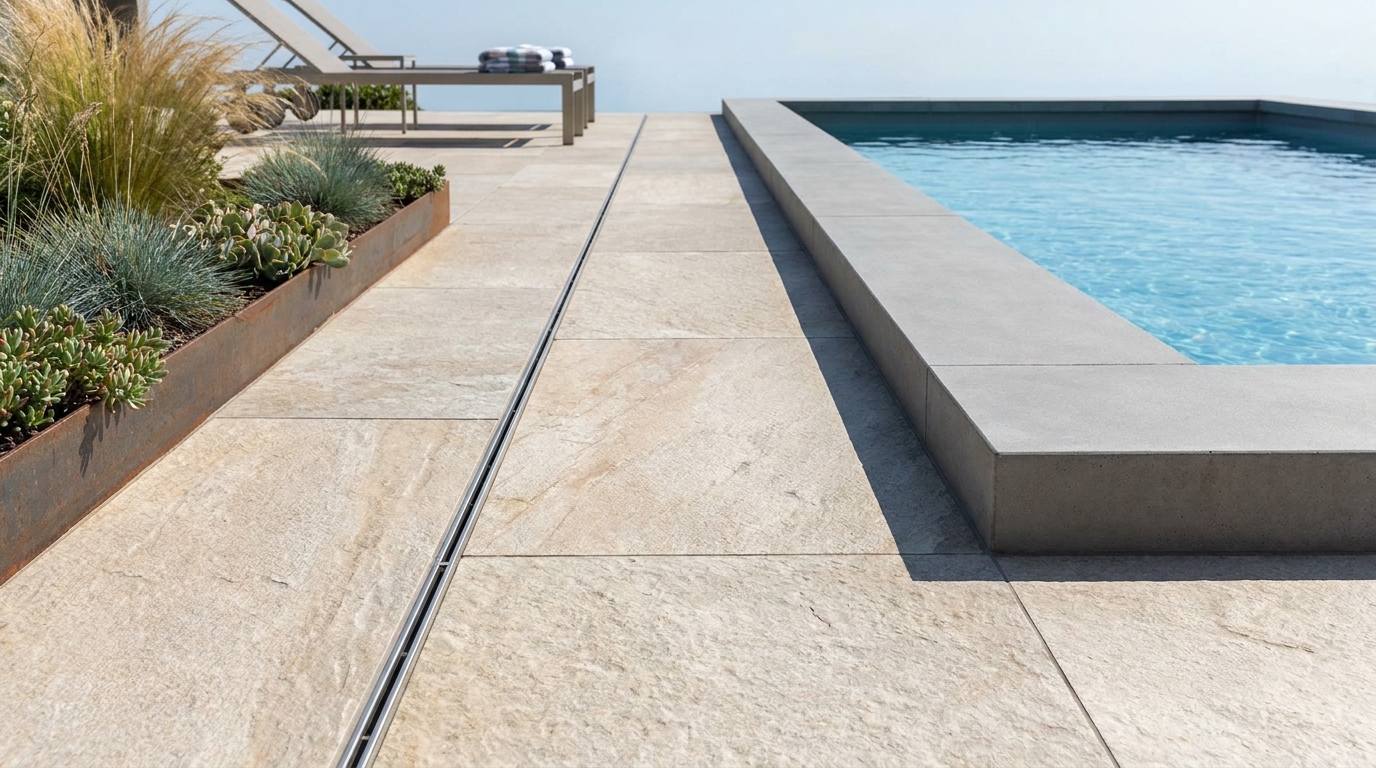
The coping around the pool deserves special attention because it acts as the immediate frame to the water. A thick stone edge can feel grounded and classical, while a thinner, more precise profile may suit a contemporary architectural vocabulary. The visual line of the coping affects how the water is perceived. In a refined landscape, this edge should feel intentional and proportionate. It is one of the quiet details that elevates the entire setting.
Drainage should also be integrated with care. Standing water on a deck is not only inconvenient but visually disruptive. Linear drains, subtle grading, and clean detailing allow practical performance to disappear into the design. This is often what makes a luxury outdoor space feel effortless. The eye sees beauty, while the infrastructure works discreetly beneath it.
Texture, Warmth, and Balance
Because a pool introduces a large plane of reflective blue or green, the surrounding materials should provide balance. Too many slick or highly polished surfaces can make the area feel cold. This is why designers often pair smooth water with more tactile elements such as flamed stone, matte porcelain, timber-look finishes, or softly brushed concrete. The dialogue between reflection and texture creates depth.
Colour selection matters just as much. Mid-toned neutrals usually offer the greatest flexibility and sophistication, especially when paired with greenery and architectural elements. Very light paving can feel brilliant and airy, but may create glare in bright sun. Very dark paving can feel dramatic, though it may absorb more heat. The most successful choice is usually one that harmonizes with the home’s exterior materials while supporting comfort and visual calm.
Planting Around Pools: Less Clutter, More Atmosphere
Planting should never feel like filler around a pool. It should act as a soft architectural layer that supports mood, privacy, and seasonal beauty while respecting maintenance realities. This is why restrained palettes are so effective. Repetition of a few plant forms creates a composed look and avoids the visual noise that often makes outdoor spaces feel busy. A mass of ornamental grasses, a line of clipped evergreens, or a broad drift of low groundcover can be more elegant than a collection of disconnected garden center favourites.
Extension guidance on xeriscaping and water-wise gardening repeatedly supports reducing turf where irrigation is difficult, improving soil quality, and choosing adapted or drought-tolerant species that suit the site. Around a pool, these ideas are especially useful. Splash, reflected heat, and the need for cleaner water all make highly fussy planting less desirable. Water-wise landscaping is not limited to desert climates. It is a broader approach to conservation and performance that can be adapted to many North American regions.
This matters because outdoor water use can be significant. Colorado State University Extension notes that as much as 50 percent of household water may be used for the yard and garden. In that context, a pool landscape that relies on efficient irrigation, mulch, healthy soil, and regionally appropriate planting is not only beautiful but responsible. It is also more likely to remain attractive over time because the plants are better matched to the conditions.
The pool should remain the focal point. Planting is there to soften geometry, create privacy, and bring life to the edges. If every border is crowded with flowering shrubs, large leaves, and fast-growing species, the result can feel restless. A better approach is to think in layers: low ground plane, mid-level softness, and a few structural anchors. This creates atmosphere without sacrificing order.
What Makes a Good Poolside Plant
A well-chosen poolside plant has several qualities. It should be adapted to the local climate, relatively clean in habit, and visually coherent with the overall design. Plants that drop excessive leaves, fruit, or petals into the water tend to create frustration. Species with aggressive roots or messy seasonal habits may also be poor candidates near paving or pool systems. While every region has its own best options, the principle is universal: beauty must coexist with practicality.
Native and adapted plants are especially valuable because they often require less water, fertilizer, and pesticide input once established. This supports both sustainability and ease of care. It also aligns with the quiet luxury many homeowners now seek. A landscape that looks composed without constant intervention is deeply appealing. Effortlessness, after all, is one of the signatures of good design.
Evergreen structure is often useful in northern climates because it preserves definition outside of peak growing months. Compact conifers, clipped broadleaf shrubs where climate allows, and strong grass forms can all contribute to a garden that remains elegant beyond summer. Seasonal flowers can certainly have a place, but they are usually most effective as accents rather than the main language of the design.
Water-Wise Luxury: Sustainability Without Sacrificing Beauty
There is a lingering misconception that water-wise landscaping must look dry, sparse, or overly rustic. In reality, the most elegant pool landscapes often depend on exactly the principles that water-wise design promotes. Healthy soil retains moisture more effectively. Mulch reduces evaporation and suppresses weeds. Efficient irrigation delivers water where it is needed rather than blanketing the whole yard. Adapted plants establish with less stress and often demand fewer chemical inputs over time. None of this diminishes beauty. It refines it.
Xeriscaping is best understood not as a visual style but as a strategy. It can be tailored to a modern urban backyard, a traditional suburban garden, or a more naturalistic property. Around a pool, it encourages discipline. It asks the designer to consider water use, plant performance, and maintenance burden alongside atmosphere. This leads naturally toward more enduring compositions with fewer wasted gestures.
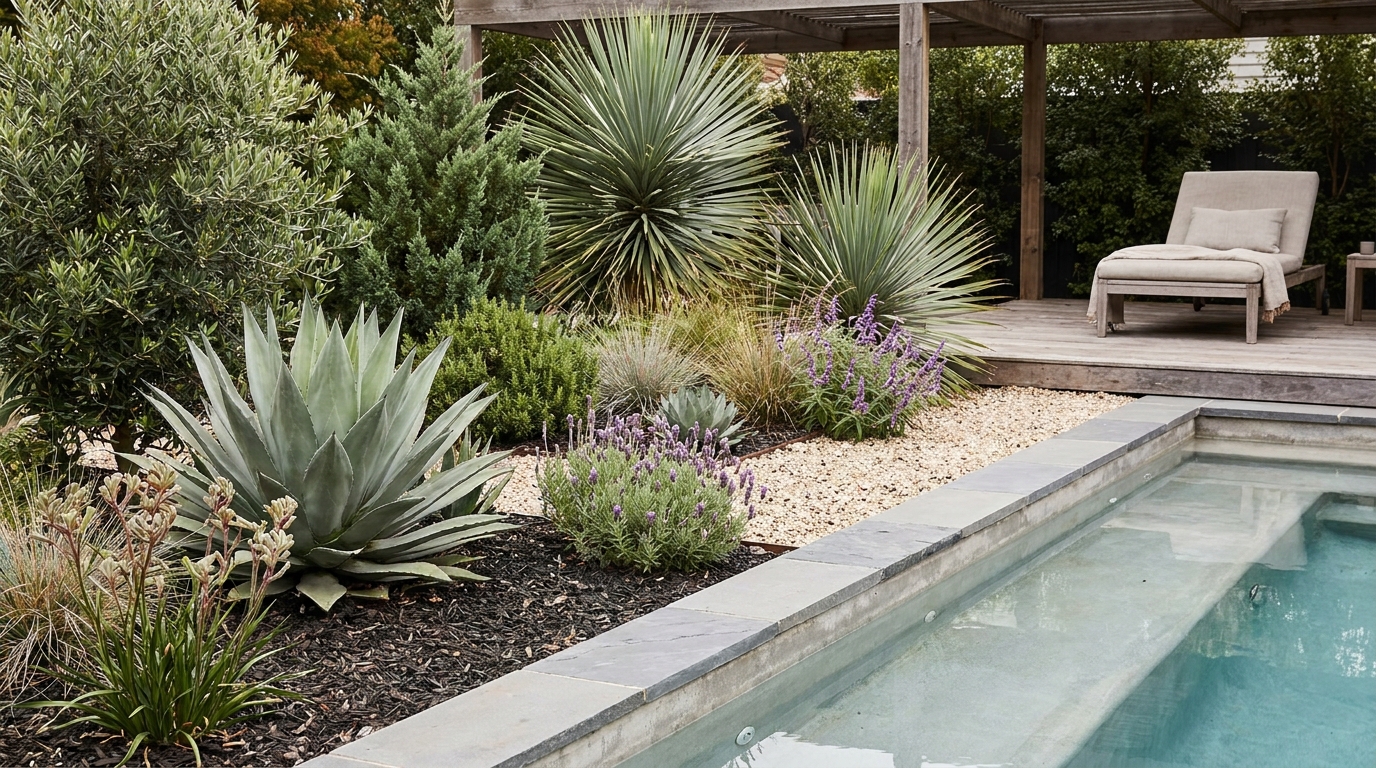
Mulch and gravel can play an important visual role here. When used with intention, they create contrast around plant masses and emphasize form. Fine gravel bands, stone mulch, or neatly edged bark areas can all make a pool landscape feel calmer and more resolved. They also reduce the amount of thirsty lawn and support better moisture retention around roots. Again, the effect is both practical and aesthetic.
Efficiency should extend to irrigation as well. Drip systems, hydrozoning, and thoughtful scheduling are far more refined than broad overhead watering. Around pool decks, where overspray can create slippery conditions or waste water, precise irrigation is particularly valuable. A sophisticated landscape is one that understands resources and uses them intelligently.
Privacy Without Heaviness
Privacy is one of the great desires in pool design, yet it is easy to pursue it too aggressively. Tall, dense hedges on every edge can make a yard feel closed, reduce air movement, increase debris, and cast heavy shade across the water. They can also create a maintenance burden that quickly undermines the sense of ease the landscape was meant to provide. A more elegant approach is to build privacy in layers.
Walls, screens, pergolas, trellises, fencing, and selective planting can all contribute to a sense of retreat. The beauty of this layered strategy is that it allows you to modulate openness and enclosure. A decorative screen may block a direct neighbouring view while still allowing light and air to pass through. A row of upright grasses can soften a fence line without becoming an impenetrable mass. A small tree, placed thoughtfully, can provide a canopy effect and visual relief without dropping constant debris into the pool.
It is important to remember that privacy elements are not always safety barriers, and safety barriers are not always adequate privacy screens. These are separate functions that may overlap visually, but they should be designed and evaluated independently. Once the required enclosure is established according to local regulations, the softer privacy layer can be composed with more freedom and artistry.
Lighting the Pool Landscape as an Evening Experience
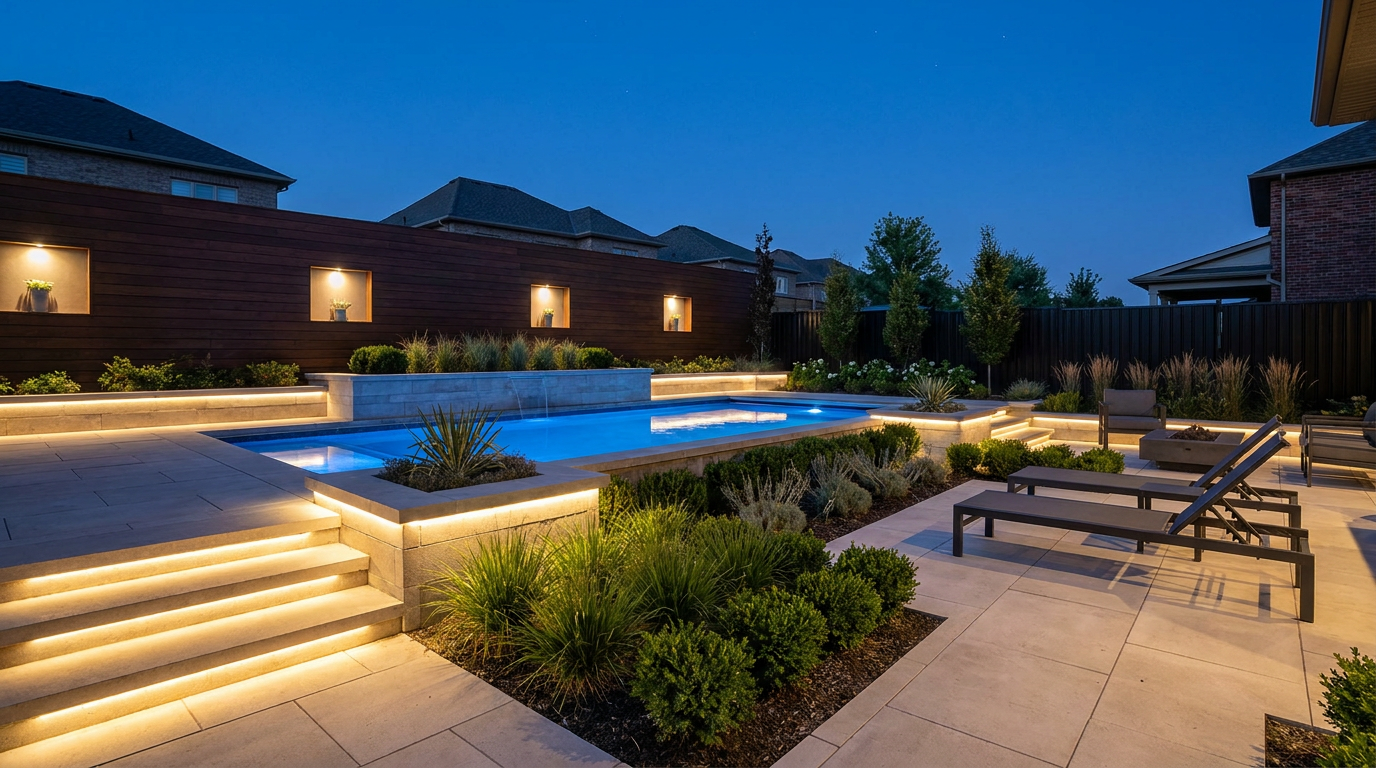
A pool landscape should not disappear after sunset. Evening is often when the space feels most atmospheric, and lighting is what allows it to shift from daytime recreation area to luminous outdoor retreat. The most sophisticated lighting schemes are subtle. They avoid harsh brightness and instead use layers of glow, shadow, and reflection to define the space with restraint.
Underwater lighting gives the pool its jewel-like quality at night, but the surrounding landscape must support that effect. Low path lights can guide movement safely. Soft uplighting can reveal the shape of specimen plants or small trees. Wall sconces, step lights, and integrated seat lighting can create depth without visual clutter. The goal is not to illuminate everything equally. It is to compose scenes.
Lighting is also a practical tool. It clarifies circulation, highlights transitions, and improves safety around edges and steps. When approached thoughtfully, these functional requirements become part of the atmosphere. A refined pool landscape at night should feel calm, flattering, and legible. It should invite lingering without feeling theatrical or overlit.
How to Avoid the Most Common Pool Landscaping Mistakes
Many pool landscapes fail not because the ideas were poor, but because the composition lacked discipline. One of the most common mistakes is overplanting. In an effort to make the space feel lush, homeowners sometimes crowd the pool with too many species, too many colours, and too much volume. The result can be more debris, more maintenance, and less visual calm. Restraint nearly always ages better.
Another common mistake is treating the landscape and the pool as separate projects. When the pool is designed first and the landscape is left to fill the leftover spaces, the final result often feels disconnected. Paths become awkward, seating areas feel forced, and planting beds appear accidental. Integration from the beginning leads to stronger proportion and better function.
Ignoring regulations is another serious error. Because pool enclosure requirements vary widely across Canadian municipalities and U.S. jurisdictions, assumptions can be costly. A hedge may look private but not satisfy code. A gate may need to self-close and self-latch. A permit may be required before a pool is filled. These are not details to resolve later. They should shape the plan from the outset.
Finally, many homeowners overlook maintenance. Plants that seem beautiful in the nursery can become frustrating when they shed heavily, outgrow their space, or demand constant irrigation and trimming. Materials that look attractive in a showroom may be slippery, glare-prone, or difficult to keep clean. The most elegant landscape is one that continues to perform beautifully after the first summer has passed.
A Design Framework for a Timeless Pool Landscape
For those beginning a project, it can help to think in a clear sequence. Start with the architecture of the space: the pool shape, deck geometry, circulation routes, safety enclosure, drainage, and seating zones. Next, define the material language so that paving, coping, screens, walls, and accents feel related. Then develop the planting strategy, keeping the palette limited and the forms intentional. Finally, add lighting and finishing details to shape the atmosphere.
This framework reinforces the idea that artistry is not separate from function. It grows out of it. A beautiful screen line emerges because privacy and proportion were considered together. A planting bed feels restful because it was chosen to soften an edge rather than fill empty space. Lighting feels magical because it is layered onto a layout that already makes sense in daylight.
Timelessness comes from coherence. A pool landscape does not need to chase every trend to feel current. In fact, the most enduring outdoor spaces tend to rely on classic principles: strong geometry, measured repetition, regionally appropriate planting, durable materials, and a clear hierarchy of focus. The water should remain the central visual element, with the landscape acting as its frame, its companion, and its quiet enhancement.
Practical Principles to Guide the Final Design
If you want your pool landscape to feel both luxurious and livable, certain principles are worth keeping in mind from the start. These ideas are especially useful for homeowners in Canada and North America, where climate variation, water considerations, and municipal regulations can shape the outcome significantly.
-
Prioritize integration. The pool, hardscape, planting, lighting, and enclosure should feel like one composition rather than separate layers added over time. This creates stronger visual harmony and better daily function.
-
Use a restrained palette. Repeating a few materials and plant forms almost always produces a more sophisticated result than mixing too many colours, textures, and species.
-
Design for water wisdom. Adapted plants, improved soil, mulch, and efficient irrigation support beauty with lower resource use and easier maintenance.
-
Respect safety codes. Softscape can enhance privacy, but it does not replace code-compliant barriers where they are required. Always check local regulations before finalizing the design.
-
Think beyond summer. Structure, evergreen rhythm, and material quality help the landscape remain attractive through multiple seasons, especially in northern climates.
-
Let the pool remain the focal point. Landscaping should frame the water, not overwhelm it. Space, light, and proportion are part of the beauty.
Conclusion: Framing Water With Grace
The art of pool landscapes lies in editing. It lies in knowing that a serene outdoor retreat is not created by adding more, but by choosing with care. A sophisticated pool area balances safety with softness, structure with planting, sunlight with shade, and luxury with ease. It respects the realities of climate, water use, and maintenance while still feeling aspirational and deeply personal.
When the design is successful, the experience is immediate. The eye rests. The water gleams. The path feels natural underfoot. Planting softens the edges without noise. Privacy is present without heaviness. In daylight, the space feels composed and open. In the evening, it glows. Nothing is accidental, yet nothing feels forced.
That is the enduring elegance of a well-designed pool landscape. It turns a backyard amenity into an atmosphere. It transforms a pool from an isolated feature into the center of a complete outdoor composition. And in doing so, it creates not only a place to swim, but a place to linger, to gather, and to feel at home in beauty.



No Comment! Be the first one.