



Cities across North America are under pressure from several directions at once. Housing demand continues to rise, infrastructure costs are escalating, climate targets are becoming more urgent, and many urban regions are still struggling with the long shadow of sprawl. In that context, transit-oriented development, often shortened to TOD, has moved from planning jargon into the center of serious conversations about how communities should grow. It is no longer viewed as a niche design concept for a handful of downtown sites. It is increasingly understood as a practical framework for building more resilient, productive, and sustainable cities.
Table Of Content
- What transit-oriented development really means
- How TOD helps cities push back against urban sprawl
- Why transit-oriented development strengthens local economies
- The sustainability case for TOD is practical, not theoretical
- Housing supply, affordability, and the transit connection
- Community engagement and the human scale of TOD
- The risks of TOD and why equity must be built in from the start
- What effective TOD implementation looks like in practice
- Common misconceptions that hold TOD back
- Why the momentum behind TOD is growing now
- A blueprint for future cities
Transit-oriented development (TOD) is an urban planning approach that concentrates housing, jobs, retail, and public amenities within a comfortable walk of a high-quality transit station or corridor, reducing a household’s dependence on a private vehicle for daily life. Rather than letting cities expand outward in a pattern that locks people into long commutes and car ownership, TOD directs growth inward, toward land that is already served by transit infrastructure. The approach rests on a simple premise: when homes, workplaces, shops, and services sit close enough together near frequent transit, walking, cycling, and transit use become realistic default choices rather than fallback options. Done well, a transit station stops being just a place to board a train or bus and becomes the anchor of a complete, walkable neighborhood. The goal is not density for its own sake, but walkable districts where daily needs are reachable without a car, and where transit investment translates into mixed-use growth rather than isolated towers surrounded by parking lots.
This matters because transportation and land use are inseparable. A city can spend billions on transit infrastructure, but if the surrounding land remains underused, disconnected, or dominated by parking, much of that investment underperforms. On the other hand, when station areas are planned for density, mixed use, walkability, and public life, transit becomes more useful and the neighborhood becomes more valuable to residents, businesses, and the broader region. That is the strategic promise of TOD: it helps cities get more out of the infrastructure they already have while shaping future growth in a more efficient way.
Federal guidance in the United States defines TOD as development near transit stations that mixes housing, employment, shopping, and transportation choices. Canadian housing research similarly frames it as a way to connect transit investment with housing supply, affordability, and neighborhood livability. These definitions point to something larger than a real estate format. TOD is a city-building approach. It is about the structure of urban opportunity, the economics of land, and the long-term performance of neighborhoods.
As urban regions confront sprawl, affordability pressures, and environmental risk, transit-oriented development offers a blueprint with unusual breadth. It can reduce car dependency, improve access to public transportation, support local businesses, lower emissions, and help direct growth toward places that are already served by infrastructure. But it is not automatic. The best TOD is intentional, inclusive, and supported by policy. Without that, station-area growth can become exclusive, expensive, and disconnected from community needs. Understanding the concept means understanding both its promise and its limits.
Transit-oriented development works best when it is treated not as a building type, but as a long-term urban strategy that connects mobility, housing, economic development, and sustainability.
What transit-oriented development really means
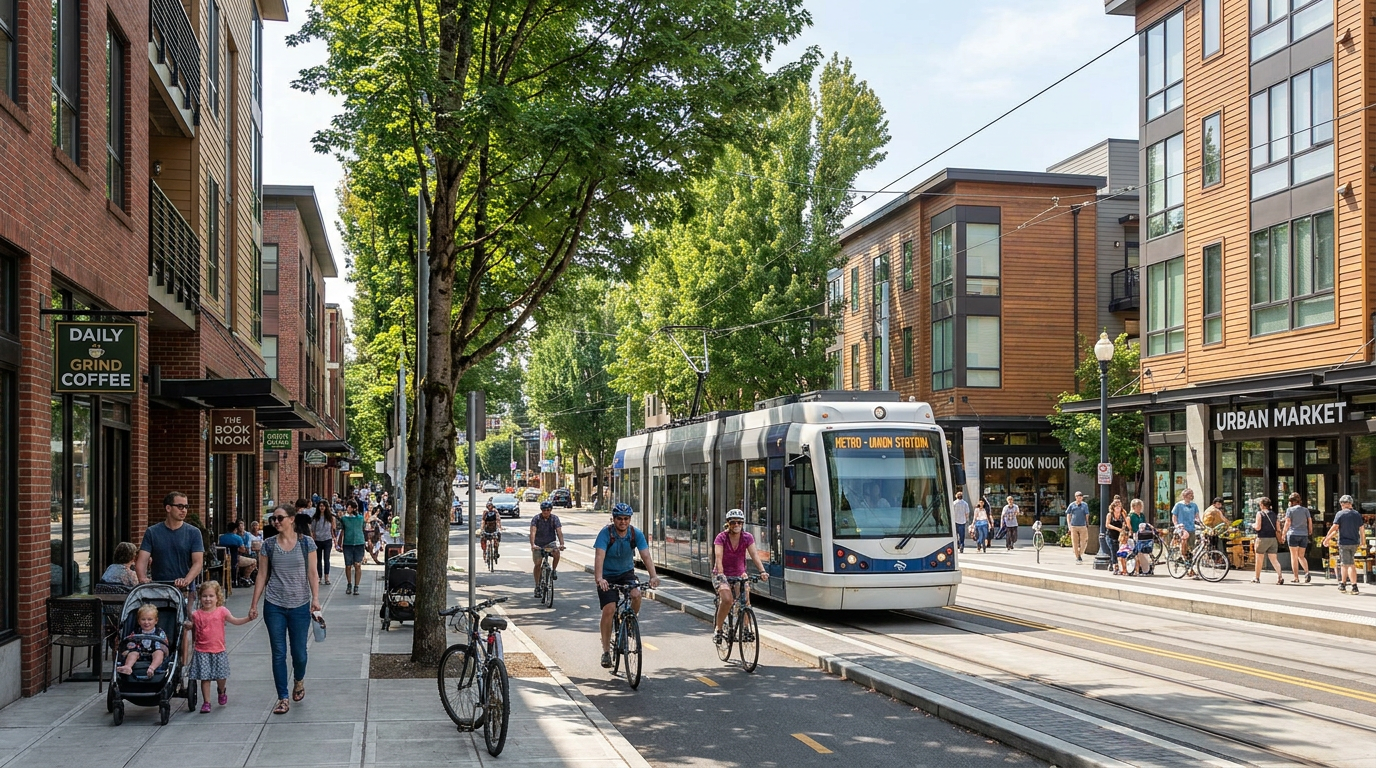
Transit-oriented development is often misunderstood as simply building taller buildings beside a rail station. That narrow interpretation misses the point. TOD is not defined by height alone, and it is certainly not limited to luxury towers near subway lines. In practice, it can include a wide range of built forms, from mid-rise mixed-use blocks and apartment buildings to office space, townhouses, community facilities, and gentler infill. What makes it transit-oriented is the way these elements are organized around access, proximity, and everyday convenience.
A successful TOD area typically includes several basic ingredients. It has reliable transit service, whether that means subway, light rail, commuter rail, bus rapid transit, or a frequent bus network. It provides a mix of uses so people can live, work, shop, and access services within the same district. It supports walking and cycling through connected streets, short blocks, safe crossings, and attractive public space. It also manages parking carefully, since excessive parking can undermine density, raise costs, and weaken the walkable form that TOD depends on.
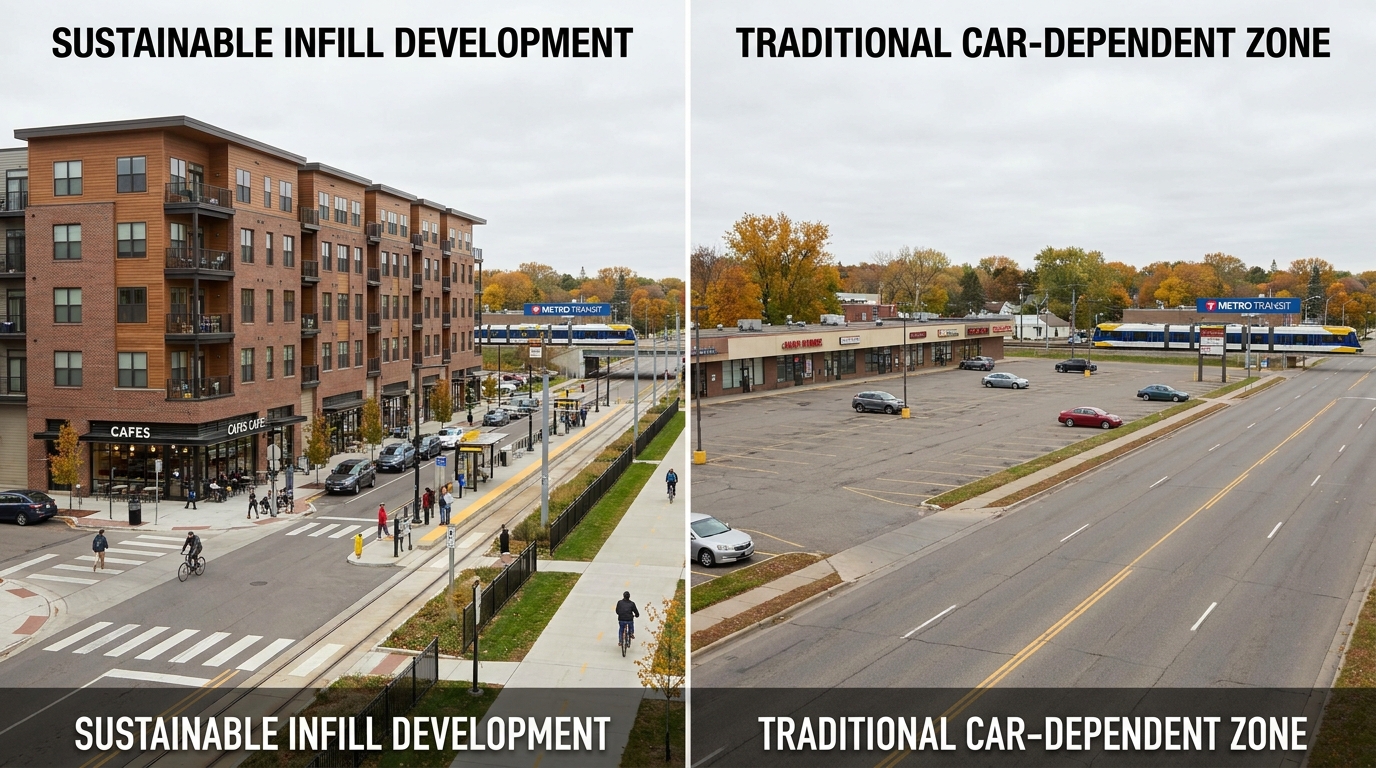
What distinguishes TOD from conventional suburban development is that it is designed around people and access rather than around vehicle storage and road capacity. In many auto-oriented places, land near major transport infrastructure is consumed by surface parking, drive-through uses, and single-purpose buildings. Those patterns create distance between destinations and make walking uncomfortable or impractical. TOD reverses that logic. It treats station areas as high-value urban places where accessibility should be translated into housing, commerce, civic life, and public benefit.
It is also important to note that TOD is not only for major downtowns or legacy rail cities. Many suburban municipalities and emerging urban nodes can support TOD if they have strong transit service and supportive planning. The model can work around bus rapid transit stations, regional rail stops, suburban transit hubs, and even major bus corridors where service is frequent and reliable. The key is not whether the mode is glamorous. The key is whether the transportation system is good enough to support a more compact, connected pattern of growth.
How TOD helps cities push back against urban sprawl
Urban sprawl has shaped North American growth for decades. It spread housing, employment, retail, and services across increasingly large areas, often separated by wide roads and connected primarily by private vehicles. While this pattern accommodated growth, it also created heavy infrastructure demands, longer commutes, environmental costs, and a persistent mismatch between where people live and how they move. Transit-oriented development offers a direct alternative by steering growth into compact, transit-served locations.
The environmental agencies and planning bodies that support smart growth have consistently pointed to compact development as a way to reduce vehicle miles traveled. When homes, jobs, and services are concentrated near transit, more trips can be made on foot, by bike, or on transit. EPA guidance notes that residents in transit-oriented developments are two to five times more likely to use transit for commuting and non-work trips than others in the same region. That is a significant behavioral shift, and it matters because transportation remains one of the largest sources of urban emissions.
Sprawl is not just a geographic condition. It is also a fiscal and operational challenge. Every outward extension of roads, pipes, utilities, and public services creates long-term obligations for municipalities and taxpayers. Compact growth around stations can improve the return on existing infrastructure because it channels demand into places where transit service and public investment are already present. From a strategic planning perspective, this is one of TOD’s strongest arguments. It allows cities to grow more efficiently by using land and infrastructure more intensively rather than constantly extending them outward.
There is also a land conservation dimension. When urban growth is dispersed, it places pressure on greenfield land at the metropolitan edge. That can consume agricultural lands, natural systems, and future ecological buffers. By encouraging infill and station-area redevelopment, TOD can reduce the need to convert as much undeveloped land into low-density urban form. It does not eliminate growth pressure entirely, but it does provide a framework for absorbing more of that growth within established urban boundaries.
For policymakers, the anti-sprawl case for TOD is especially compelling because it links transportation spending with urban form. A transit line on its own does not guarantee compact growth. But transit combined with zoning reform, public realm improvements, housing strategy, and coordinated infrastructure planning can meaningfully alter development patterns. That is where TOD becomes more than an aspiration. It becomes a blueprint for changing the physical trajectory of metropolitan growth.
Why transit-oriented development strengthens local economies
One of the most underappreciated strengths of TOD is its economic logic. Compact, transit-rich neighborhoods put more people within walking distance of shops, services, and workplaces. That concentration of activity creates a stronger customer base for local businesses and a more efficient labor market for employers. According to ITDP, compact neighborhoods are more likely to sustain local business activity because higher density generates more demand for nearby services and facilities. In simple terms, more people nearby means more daily economic activity on the ground.
That activity benefits more than just major commercial tenants. Well-planned station areas can support independent retailers, cafés, service businesses, childcare providers, health services, and neighborhood-scale employers. The walkable urban form of TOD creates repeat foot traffic, and that consistency is often more valuable to local businesses than sporadic car-based visits. A district where residents pass storefronts on the way to transit each morning and evening has a different economic rhythm from a corridor dominated by parking lots and drive-by traffic.
TOD can also improve access to jobs for people who cannot drive, prefer not to drive, or face high transportation costs. Better transit access expands the effective reach of the labor market, which can help both workers and employers. For households, this may mean more employment options without the expense of car ownership. For businesses, it can mean access to a larger pool of workers. In regions where labor shortages and mobility barriers coexist, this is not a minor benefit. It is a regional competitiveness issue.
Household affordability is closely connected to this economic value. The price of housing matters, but so does the cost of getting to work, school, groceries, and healthcare. Metro Vancouver’s work on housing and transportation cost burden underscores that location near transit can materially affect combined affordability. A household paying slightly more in rent or mortgage in a transit-rich area may still come out ahead if it can avoid the costs of multiple vehicles, long commutes, and high fuel spending. This is one reason location efficiency is becoming a more important lens in urban policy.
From a municipal perspective, TOD can also support stronger tax bases and more productive land use. Large parcels near stations often carry significant public investment value, yet many remain underdeveloped relative to their accessibility. Redeveloping those areas with mixed-use projects can increase assessment, intensify economic activity, and improve utilization of transit assets. The goal should not be density for its own sake. The goal is value creation through better urban performance.
The sustainability case for TOD is practical, not theoretical
Transit-oriented development is often discussed in the language of climate action, and for good reason. More compact, transit-served urban form is associated with lower vehicle miles traveled, which can reduce greenhouse-gas emissions, air pollution, and congestion. EPA guidance continues to frame transit, infill, and land-use change as practical emission-reduction strategies. The significance of TOD is that it addresses emissions through the structure of daily life. It changes the conditions that shape travel behavior rather than relying only on individual choices.
That practical effect extends beyond carbon. A neighborhood designed around walking, cycling, and transit tends to produce health benefits through more active transportation and less exposure to vehicle emissions. Public space quality also improves when streets are designed as places rather than merely as traffic corridors. Sidewalks, trees, plazas, and safer crossings become part of the transportation system because they support first-mile and last-mile access. In this way, TOD contributes to a healthier public realm while improving mobility.
Infrastructure efficiency is another major sustainability advantage. Low-density expansion requires more road space, more parking, and more extensive utility networks per resident than compact infill does. Dense growth near transit generally requires less per-capita road and parking capacity than dispersed suburban development. That means less land consumed by vehicle storage and more land available for housing, employment, parks, and public amenities. In an era of constrained public budgets and rising construction costs, that efficiency has real strategic value.
There is also a resilience argument. Cities that provide multiple transportation options are less vulnerable to fuel price shocks, traffic disruptions, and household mobility stress. A resident who can walk to groceries, take transit to work, and cycle to school has more flexibility than someone whose daily life depends entirely on car travel. TOD does not eliminate all transportation challenges, but it broadens choice and reduces fragility in the urban system. That is part of what makes it a future-oriented model.
Importantly, TOD should not be treated as a standalone climate solution. It performs best when paired with reliable transit service, safe active transportation infrastructure, parking management, and supportive land-use policy. If the train is infrequent, the sidewalks are poor, and the zoning limits mixed-use growth, the full sustainability benefits will not materialize. The lesson is simple: urban form and transportation need to be planned together.
Housing supply, affordability, and the transit connection
In Canada and many U.S. regions, the conversation about TOD has become inseparable from housing supply. Areas around major transit investments are often among the most logical places to add new homes because they offer existing mobility access, public infrastructure, and strong market demand. Yet these same locations can be difficult places to deliver affordability. That tension is now central to contemporary TOD policy.
Canadian Mortgage and Housing Corporation research has highlighted that the cost of land is the biggest obstacle to including affordable housing in new transit-oriented developments. This is a crucial point. Public investment in transit increases accessibility, and accessibility tends to increase land value. If planning systems do not capture or guide some of that value toward public goals, the result can be high-end development that meets market demand without meeting broader housing needs. In other words, transit can raise opportunity, but it can also raise exclusion unless policy keeps pace.
This is why inclusive TOD requires more than permitting density. It requires tools such as affordable housing requirements, partnerships with non-profit housing providers, public land strategies, value capture mechanisms, and development frameworks that address project feasibility early. It also requires realistic attention to development charges, financing, and timing. A station-area plan may look strong on paper, but if the financial structure does not work, the housing outcome will not arrive as intended. Feasibility is not a secondary issue in TOD. It is one of the central determinants of whether planning goals become real homes.
There is also a broader affordability issue tied to transportation costs. Households located far from jobs and services may access cheaper housing, but they often absorb those savings through higher car ownership, fuel, insurance, and commute expenses. Research on housing and transportation cost burden shows why location matters. A home cannot be assessed only by its price tag. It has to be understood within the full cost of everyday life. TOD supports this broader view by reducing the transportation burden that many households quietly carry.
For cities trying to respond to housing shortages, this suggests a clear strategic priority. Areas near high-quality transit should be among the most prepared places for new housing growth. That means as-of-right permissions where appropriate, coordinated infrastructure upgrades, predictable approval pathways, and public policies that preserve affordability. Without these measures, cities risk spending heavily on transit while still limiting the housing supply that should naturally cluster around it.
Community engagement and the human scale of TOD
Transit-oriented development succeeds when it feels like a neighborhood rather than a planning diagram. That requires attention to the human scale. People do not experience a district as floor space ratio or density metrics. They experience it through sidewalks, storefronts, shade, safety, noise, public spaces, and the ease of moving from one destination to another. A station area can be technically dense and still feel disconnected if its streets are hostile or its public spaces are weak. Good TOD therefore combines strategic land use with strong urban design.
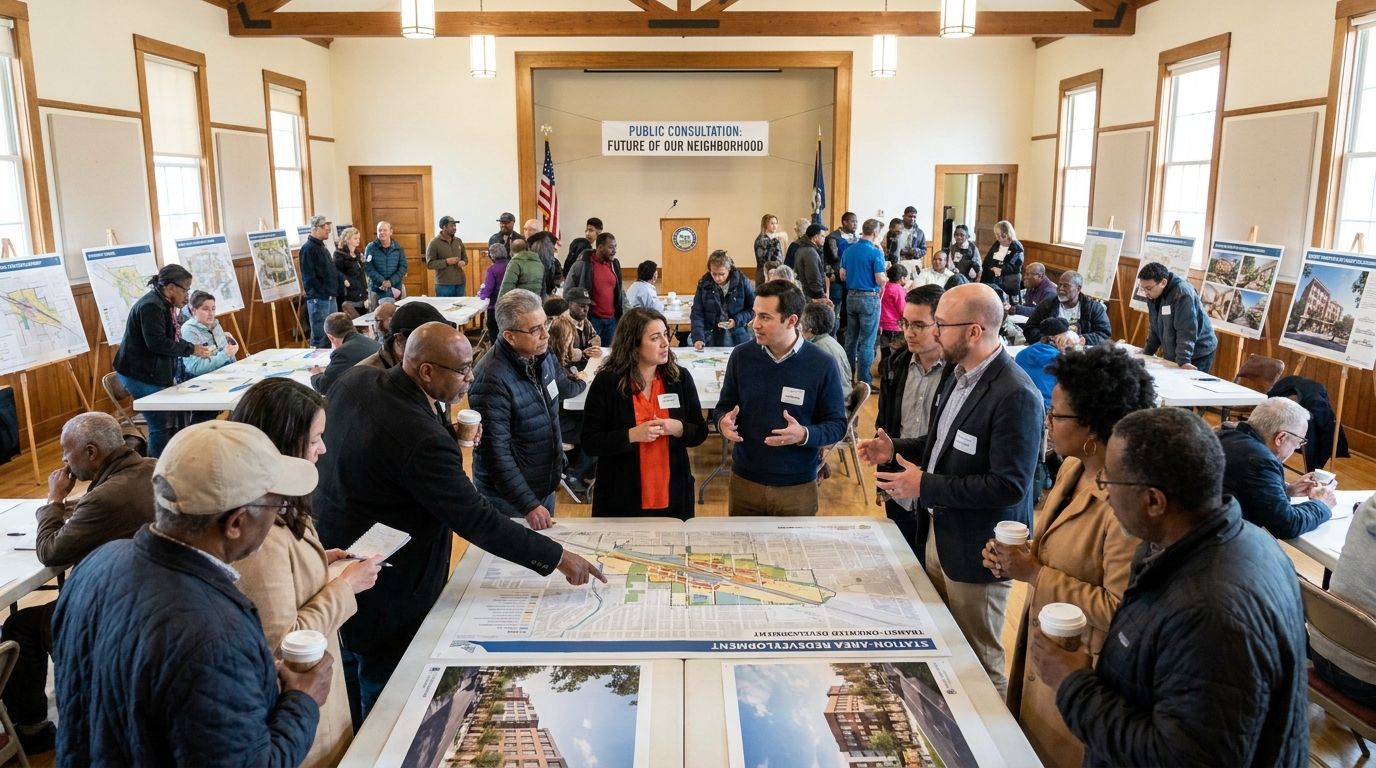
Community engagement is essential to that process. Local residents often understand mobility gaps, public realm challenges, and neighborhood needs better than anyone. They know where crossings feel unsafe, where services are missing, and where development pressure is already affecting affordability. Engaging that knowledge early can improve outcomes and build legitimacy. It also helps shift TOD away from a top-down growth narrative and toward a more grounded discussion about livability and access.
At its best, TOD can strengthen community life by making neighborhoods more connected and socially active. Public plazas near stations can become gathering spaces. Mixed-use streets can support daily encounters between residents, workers, students, and visitors. Better transit access can widen participation in urban life for seniors, young people, and households without cars. These are not cosmetic benefits. They affect social inclusion, local identity, and the overall quality of urban experience.
That said, engagement has to be honest about trade-offs. Growth near transit can raise concerns about shadowing, traffic changes, school capacity, construction disruption, and neighborhood change. Those concerns should not be dismissed, but they should be addressed within the larger reality that cities must grow somewhere. The strategic question is not whether growth happens. It is whether growth happens in places that support accessibility, sustainability, and public value. Station areas are often among the most logical answers.
The risks of TOD and why equity must be built in from the start
No serious discussion of transit-oriented development is complete without addressing equity. Transit investment can raise land values, attract new capital, and change neighborhood demographics. Those shifts may generate economic activity, but they can also displace lower-income residents, small businesses, and community-serving uses if no protective policies are in place. This is one of the most important realities in station-area planning. Accessibility is valuable, and value without governance can produce exclusion.
That is why equitable TOD has become such a central theme in both U.S. and Canadian discussions. The objective is not merely to build near transit, but to create inclusive, walkable, transit-rich neighborhoods that preserve affordability and share the gains from public investment. This can involve anti-displacement strategies, tenant protections, deeply affordable housing, small-business supports, and community benefits agreements. The right policy mix will vary by jurisdiction, but the principle is consistent: public transit investment should produce public value for existing and future residents.
Equity also has a spatial dimension. Some regions have expanded housing near transit significantly, while others still have large disparities in access and performance. Urban Institute research shows that there are now millions more homes near transit than in prior decades, but outcomes vary widely by region. That means TOD is not simply a concept to be celebrated. It is a field of implementation where governance, market conditions, and local regulation shape who benefits and who does not.
Another common mistake is assuming that density alone solves inclusion. If all new station-area housing arrives at luxury price points, the social benefits of access remain unevenly distributed. Likewise, if a neighborhood gains transit and upscale retail but loses community-serving businesses and long-term residents, the development may be efficient on paper yet weaker in social terms. Strong TOD policy therefore needs to align growth with affordability, retention, and local economic continuity.
In strategic terms, the best TOD plans recognize that public infrastructure creates private value. The policy challenge is to capture enough of that value to fund housing, public space, and social outcomes without undermining project viability. That balance is difficult, but it is the core work of contemporary urban development. The future of TOD will depend less on whether the concept is appealing and more on whether cities can structure inclusive implementation.
What effective TOD implementation looks like in practice
If transit-oriented development is to deliver on its promise, implementation has to be disciplined. The first requirement is strong transit service. Frequent, reliable, and legible transit is what makes a station area truly transit-oriented. A rail line or bus corridor with poor service will not generate the same behavioral and development outcomes. Land use intensity should follow actual accessibility, not just the presence of tracks or a bus stop on a map.
The second requirement is supportive land-use policy. This includes zoning that permits mixed-use development, meaningful residential density, active ground floors where appropriate, and reduced minimum parking requirements. In many regions, legacy zoning still undercuts TOD by limiting housing types, separating uses, or requiring more parking than the market and mobility context justify. Reforming those rules is often one of the most powerful steps a municipality can take.
The third requirement is integrated infrastructure planning. Sidewalks, cycling links, parks, schools, utilities, and station access improvements all shape whether a district functions well. TOD is not simply about putting more buildings beside transit. It is about creating complete neighborhoods that can absorb growth with quality. That requires capital coordination across agencies and a realistic phasing strategy that matches public investment with private development timing.
The fourth requirement is financial realism. Public agencies, transit authorities, municipalities, and developers need a shared understanding of land value, development charges, construction costs, and affordable housing economics. Recent Canadian discussions have increasingly focused on development charges and infrastructure financing because these variables strongly influence whether station-area projects pencil out. Ambitious plans without feasible delivery mechanisms often result in delay rather than transformation.
The fifth requirement is continuity of governance. Transit-oriented development unfolds over years, often decades. It can involve multiple landowners, changing political leadership, evolving markets, and overlapping agencies. Cities that succeed with TOD tend to establish clear station-area visions, predictable rules, and long-term partnerships rather than relying on one-off approvals. In that sense, TOD is as much an institutional challenge as it is a design challenge.
Common misconceptions that hold TOD back
Several misconceptions continue to distort public discussion. The first is that TOD only means very tall towers. In reality, many successful transit-oriented neighborhoods are built from mid-rise forms, mixed-use blocks, and moderate density that still supports transit effectively. The second is that TOD is only relevant around subway or commuter rail stations. In many places, bus rapid transit, frequent buses, and multimodal hubs can support strong TOD outcomes if service quality is high.
The third misconception is that building near transit automatically creates affordability. It does not. Proximity to transit often increases land values, which can make affordability harder without targeted policy. The fourth misconception is that TOD by itself is a climate fix. It is an important part of the solution, but it works best alongside active transportation investments, good service, parking management, and thoughtful urban design. Recognizing these realities helps move TOD from slogan to strategy.
Why the momentum behind TOD is growing now
The urgency behind TOD is increasing because several policy pressures are converging. Housing shortages are forcing cities to look harder at where new supply can realistically be added. At the same time, governments are under pressure to justify major transit investments with stronger ridership, better land use outcomes, and broader economic benefits. Climate commitments are adding another layer, pushing regions to reduce auto dependence and support more efficient development patterns. TOD sits at the intersection of all three.
Federal policy momentum reflects this shift. The U.S. Federal Transit Administration has continued support for TOD planning through its Pilot Program for Transit-Oriented Development, including FY2026 funding. That signals that station-area planning is still seen as a national implementation priority, not a temporary planning trend. In Canada, CMHC research and policy discussion continue to connect TOD with housing supply, affordability, and the economics of development near transit. The conversation is clearly moving from theory toward delivery.
Research tools are also improving. More institutions are now tracking where TOD is occurring, how much housing is being added near transit, and whether regions are converting accessibility into meaningful urban growth. This matters because it enables a more evidence-based conversation. Rather than speaking about TOD as an abstract good, cities can compare performance, identify barriers, and refine policy according to measurable outcomes.
For developers, investors, and planners, this growing focus means station areas will remain among the most strategic urban geographies of the coming decades. They sit where public infrastructure, land value, regulatory change, and housing demand converge. The question is no longer whether TOD matters. The question is how effectively regions can use it to shape growth that is productive, inclusive, and environmentally responsible.
A blueprint for future cities
Transit-oriented development matters because it responds to the central challenge of modern urban growth: how to accommodate more people and more activity without repeating the high-cost, high-emission, low-efficiency patterns of sprawl. It does this by aligning land use with mobility, by turning transit investment into neighborhood structure, and by building places where daily life can function with less dependence on private cars. That is not a cosmetic shift. It is a structural one.
The strongest case for TOD is that it delivers across multiple objectives at once. It can reduce driving, support climate goals, use infrastructure more efficiently, strengthen local businesses, and improve access to jobs and services. It can also support housing supply in some of the most accessible parts of a region. In a planning environment where public resources are limited and urban pressures are intensifying, that kind of multi-benefit framework is especially valuable.
But the future of TOD will depend on whether cities approach it with enough seriousness. Building near transit is not enough. The work requires inclusive housing policy, anti-displacement measures, walkable design, strong public transit service, and feasible economic frameworks. It requires municipalities and agencies to think beyond individual projects and toward station-area ecosystems that evolve over time. That is where strategic planning matters most.
Future cities will be shaped by the choices made around transit corridors and stations. Those places can become isolated nodes with expensive housing and underperforming public space, or they can become complete neighborhoods that expand opportunity while reducing environmental strain. The difference lies in policy, design, governance, and long-term vision. Transit-oriented development is not a cure-all, but it is one of the clearest blueprints available for building cities that are more connected, more sustainable, and more economically resilient.
For urban leaders, the path forward is increasingly clear. If the goal is to curb sprawl, support local economies, improve affordability, and meet sustainability commitments, then growth should be directed toward the places best equipped to carry it. In most metropolitan regions, those places are around transit. The task now is to ensure that the next generation of development does not simply cluster near stations, but creates lasting public value around them.



No Comment! Be the first one.