



There is something deeply comforting about a home that supports a child’s natural curiosity. It does not need to be large, perfectly styled, or filled with expensive educational products. What matters most is that children feel invited to read, draw, ask questions, imagine, and spend time with the people who care for them. A thoughtful home learning environment can quietly shape daily habits in ways that feel warm and sustainable rather than rigid or school-like.
Table Of Content
- Why educational spaces at home matter
- Start with a family-centered mindset, not a classroom model
- How to choose the right educational zones in your home
- Create a reading nook that feels irresistible
- Simple elements that make a reading nook work
- Design an art corner that celebrates process, not perfection
- Build a maker shelf for curiosity, invention, and STEM thinking
- Set up a homework zone that supports focus without isolation
- Make room for pretend play and storytelling
- Use organization to support independence and calm
- Reflect your family’s culture, language, and values
- Create routines that bring the spaces to life
- Examples of gentle daily rhythms
- Educational spaces in small homes and shared rooms
- What to avoid when creating learning-rich spaces
- The heart of an educational home is connection
For many families, the idea of creating educational spaces at home can sound intimidating at first. Parents may picture an entire playroom makeover, custom storage, or a miniature classroom lined with charts and desks. In reality, the most meaningful learning spaces are often the simplest ones. A corner by the window with books, a small table for crayons and paper, a basket of building materials, or a calm spot for homework can make a lasting difference when they are used regularly and with intention.
Research strongly supports this gentler, more practical approach. UNICEF describes an optimal home environment as one that is safe, well organized, and filled with opportunities to play, explore, and access developmentally appropriate books and toys. NAEYC also reminds families that literacy starts long before formal reading instruction and grows through everyday conversations, shared routines, storytelling, drawing, pretend play, and responsive time together. In other words, educational design at home is not really about performance. It is about creating a setting where learning can happen naturally throughout the day.
This matters even more in a time when many families are trying to balance school demands, busy routines, and digital overload. Statistics Canada has identified reading or looking at books for enjoyment in early childhood as an indicator strongly associated with early literacy and school readiness. At the same time, Canadian public health guidance has warned that too much screen time can displace sleep, play, and family interaction. A home with inviting, low-distraction learning zones gives children an appealing alternative to passive entertainment and helps families build calmer rhythms around attention, creativity, and connection.
The good news is that a learning-rich home does not require perfection. It does not need to resemble a catalog or fit a single educational philosophy. The best educational spaces are personal, flexible, easy to maintain, and grounded in real family life. They support reading, creativity, self-regulation, and independent play while still feeling like home.
The most powerful educational space in a home is not the one with the most products. It is the one that invites children to engage, explore, and return to it again and again.
In this guide, we will look at how families can transform different areas of the home into thoughtful spaces for learning and creativity. From reading nooks and art corners to maker shelves, homework zones, and screen-conscious routines, the goal is to create rooms and rhythms that help children thrive in a way that feels beautiful, practical, and emotionally supportive.
Why educational spaces at home matter
A child’s home is their first learning environment, and in many ways it remains their most influential one. Before children can read independently or complete school assignments on their own, they are already learning from the way home life is arranged. They notice whether books are easy to reach, whether drawing materials are welcomed or hidden away, whether adults make time for conversation, and whether there are moments of calm in the day. These everyday cues send a powerful message about what is valued.
Statistics Canada’s focus on reading for enjoyment reflects something many parents instinctively understand. Children build early literacy not only through formal instruction but through repeated exposure to language, books, and pleasurable routines around stories. When a home makes reading visible and comforting, children are more likely to associate books with belonging rather than obligation. This emotional association matters because it shapes long-term motivation.
The same is true for creativity. NAEYC emphasizes that open-ended art and making experiences help children build language, vocabulary, fine motor skills, confidence, and self-regulation. When children can create without worrying about producing a perfect result, they learn to persist, make decisions, and express ideas. An art corner is not just a place to keep markers. It can become a space where a child develops patience, focus, and a sense of capability.
Educational spaces at home also support family well-being more broadly. When children know where to go for quiet reading, imaginative play, or homework, the home often feels less chaotic. Materials are easier to find, transitions become smoother, and parents can support routines without repeating constant instructions. Instead of a general sense that children should be “doing something educational,” there are clear, inviting options built into the flow of home life.
There is also an important equity and accessibility dimension to this conversation. UNICEF estimates that many children globally do not receive enough responsive interaction or stimulation at home, and that millions of young children lack even basic playthings. While those figures are global, they underscore a simple truth that applies everywhere. Access to books, creative tools, and safe opportunities for exploration can have a meaningful effect, even in a small apartment or a shared family room. Educational value is not created by square footage. It is created by thoughtful use of what is available.
Start with a family-centered mindset, not a classroom model
One of the most common misconceptions is that educational home spaces should look like school. Families may assume they need desks in rows, alphabet posters on every wall, or a highly structured routine that mimics a classroom schedule. For most households, this approach is not only unnecessary but often less effective. Home should feel supportive and stimulating, yes, but it should still feel emotionally restful and personal.
A better starting point is to think about how your family actually lives. Where do your children naturally curl up when they are tired? Where does mess feel manageable? Which part of the home gets beautiful morning light? Is there a quiet place near an adult work area where homework support can happen without isolation? Good educational design grows out of these real patterns. It works with the rhythms of family life rather than fighting them.
Flexibility matters because children’s needs change quickly. A preschooler may need floor space, baskets, and sturdy board books, while an older child may want a small writing desk, task lighting, and materials for projects. If you build zones that can evolve over time, the home remains useful without requiring frequent overhauls. A low shelf can hold picture books one year and chapter books the next. An art table can later become a science and homework station.
It also helps to focus less on decorating a concept and more on supporting behavior. Instead of asking how to make a room look educational, ask what you want to happen there. Do you want your child to read independently for a few minutes after school? Do you want a place where siblings can draw while dinner is prepared? Do you want a calm, common-area homework spot that keeps devices visible and distractions lower? Once the purpose is clear, the design becomes much easier.
This family-centered mindset is especially useful for parents who feel pressure from social media. A beautifully photographed playroom can be lovely inspiration, but it is not a requirement for good learning. The most effective spaces are often slightly imperfect and deeply lived in. They reflect the child’s interests, the family’s culture, and the reality of daily routines.
How to choose the right educational zones in your home
Most families do not need one large dedicated room for learning. In fact, smaller zones spread throughout the home often work better because they match different moods and activities. A reading nook can live in a bedroom or family room. An art station may fit beside the kitchen where cleanup is easy. A maker basket can slide onto a low shelf in the dining area. A homework zone might belong in a common area where a parent is nearby.
Before setting anything up, walk through your home and notice where children already gravitate. Children often reveal the best design solutions through their habits. If they constantly bring books to a sunny hallway corner, that may be the natural place for a reading nook. If they like drawing at the kitchen table, perhaps what they really need is better storage and easier access to supplies rather than a separate room.
As you identify possible zones, think about four qualities: comfort, visibility, organization, and safety. Comfort encourages children to stay longer and engage more deeply. Visibility helps adults notice when materials need refreshing and allows younger children to feel supported. Organization makes it easier for children to use materials independently and put them away. Safety remains foundational, especially when setting up shelves, lighting, scissors, cords, or small objects.
Health Canada’s home safety perspective is a valuable reminder to view the home from a child’s level. What looks harmless from adult height may feel cluttered, unstable, or tempting in a risky way to a young child. A successful educational space should feel accessible but not hazardous. Low shelves need to be stable, materials should be age appropriate, and pathways should remain clear enough for children to move confidently.
If space is limited, think in layers rather than rooms. A single corner can serve reading in the morning, art in the afternoon, and homework in the evening if materials are stored thoughtfully. Bins, trays, rolling carts, and baskets are especially useful because they allow the environment to adapt without becoming visually overwhelming.
Create a reading nook that feels irresistible
If there is one educational space that nearly every home can benefit from, it is a reading nook. Reading corners matter because they turn books from background objects into part of the child’s daily landscape. When reading feels cozy and available, children are more likely to reach for books independently and more likely to welcome shared reading as part of family life.
A good reading nook does not need much. In most homes, a soft rug, a few cushions, gentle light, and easy-to-reach books are enough to create an inviting effect. The key is access. Books should be visible rather than packed away in deep bins where covers disappear. Forward-facing book ledges or low baskets can be especially appealing for younger children because they make choices easier and more visual.
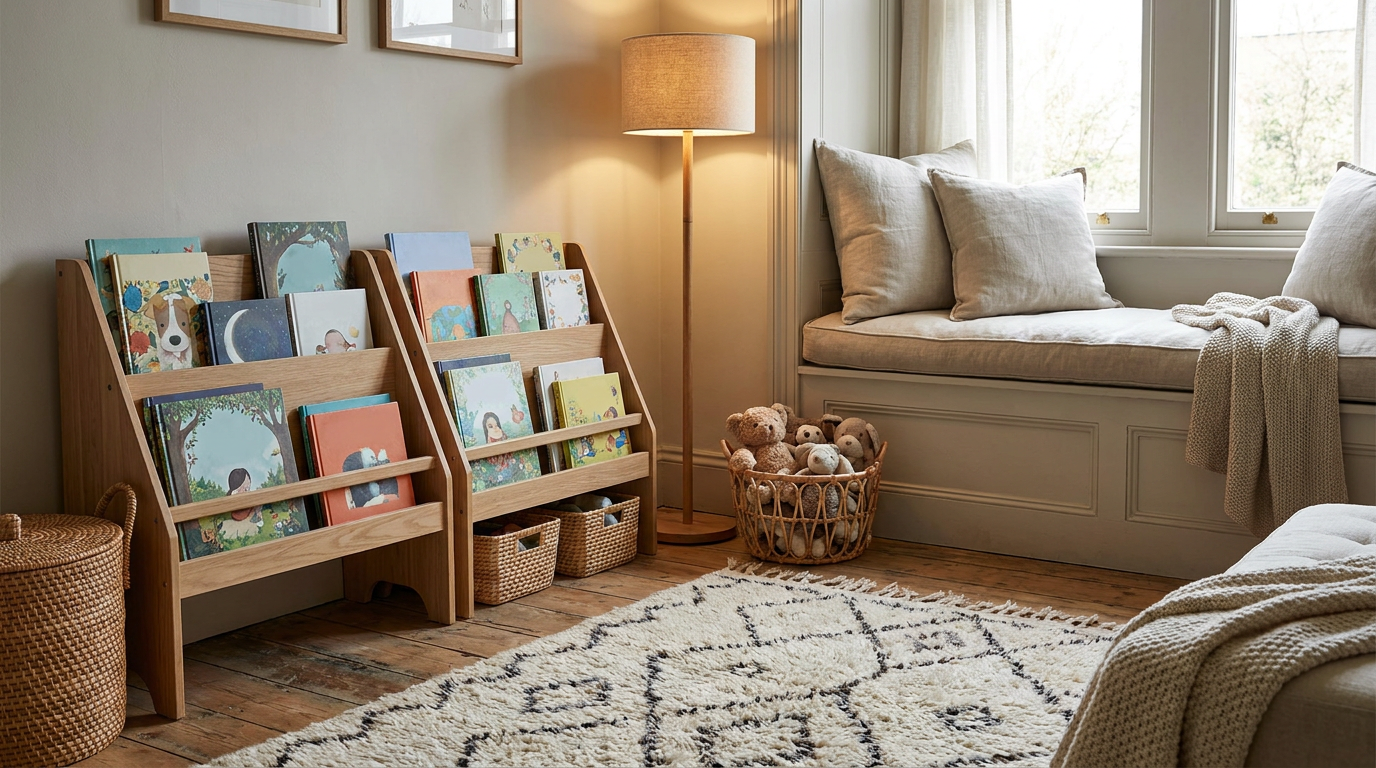
Consider atmosphere as much as storage. A reading nook should feel slower and softer than the rest of the room. Natural light is wonderful during the day, while a small lamp can make evening reading feel special. A child-sized chair can work, but floor cushions, beanbags, or a padded bench often feel more relaxed and easier for shared reading. Many children love a sense of enclosure, so placing the nook in a corner, beneath a canopy, or beside a window can make it more comforting.
The content of the bookshelf matters too. NAEYC recommends including books in the home language as well as English, along with stories that reflect a child’s culture, family, and everyday life. This is more than a representation issue. It helps children feel seen and helps literacy grow through familiar language and meaningful context. A strong home library can include picture books, poetry, simple nonfiction, seasonal titles, and a few favorites that are read over and over again.
It is also wise to rotate rather than overload. Too many books at once can feel visually busy and make it harder for children to choose. A smaller, curated selection tends to invite more attention. You can keep extra books stored nearby and swap them out every few weeks based on interests, seasons, or topics children are exploring at school.
To make the reading nook part of family routine, anchor it to daily habits. Morning stories, after-school quiet time, bedtime reading, and weekend library resets all help this space stay active rather than decorative. Statistics Canada’s attention to reading for enjoyment is a helpful reminder that what counts most is not just having books in the home, but spending real time with them.
Simple elements that make a reading nook work
- Accessible book storage that lets children see covers and make choices independently
- Comfortable seating such as pillows, a beanbag, or a small upholstered chair
- Soft lighting that makes the area feel calm and welcoming
- A small basket for bookmarks, stuffed animals, or favorite read-alouds
- A thoughtful mix of books including bilingual, multicultural, and age-appropriate choices
Design an art corner that celebrates process, not perfection
Creative expression deserves its own place in the home, even if that place is modest. An art corner gives children permission to experiment, make decisions, and communicate through color, texture, and movement. It also reduces the friction that often keeps creativity from happening. When paper, crayons, glue, tape, and recycled materials are easy to reach, children can begin creating without an adult having to set everything up from scratch each time.
NAEYC’s guidance on makerspaces and open-ended art is especially helpful here. Rather than focusing on crafts with one fixed outcome, families can offer loose materials that invite invention. Cardboard, paper towel rolls, magazines, child-safe scissors, paint, markers, tape, string, and scraps of paper all support richer learning than highly controlled projects that are mostly about copying directions. In a home setting, this can be wonderfully liberating.
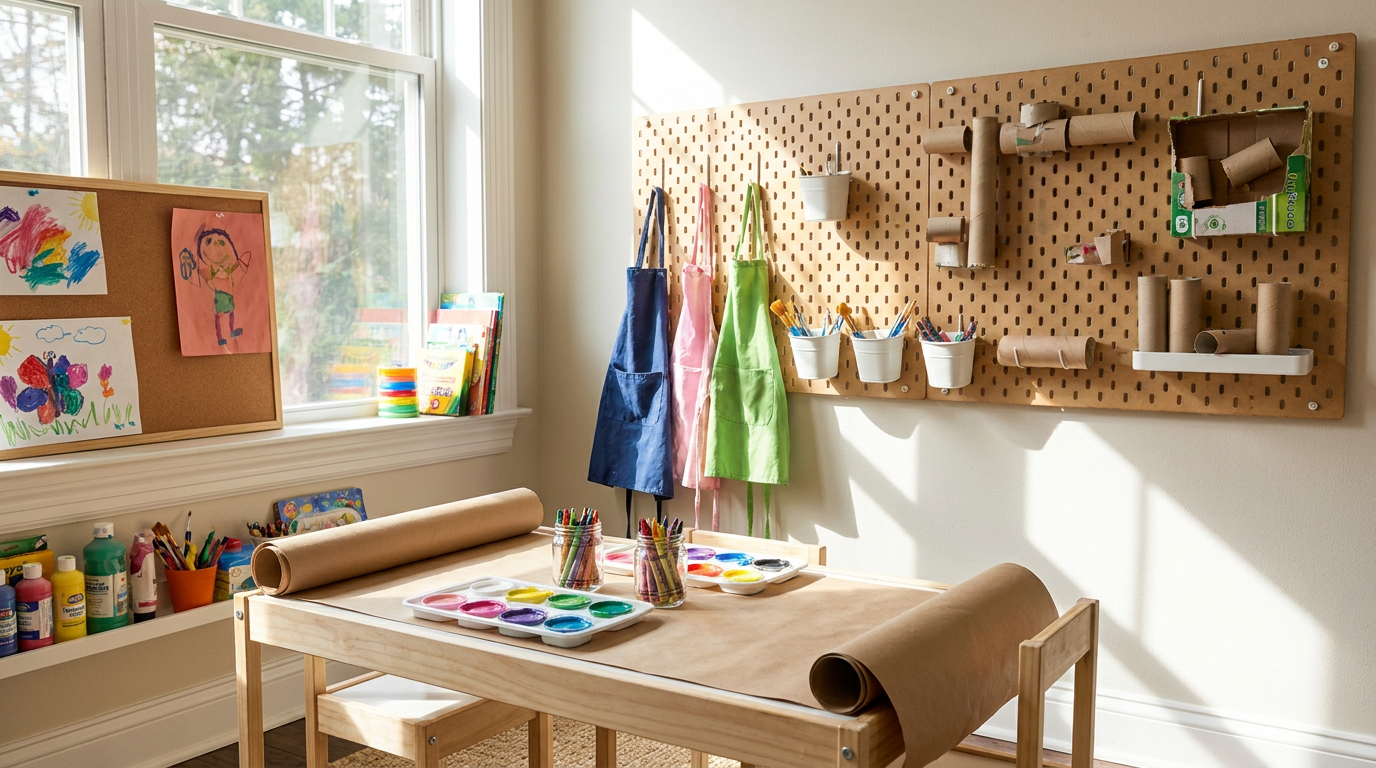
An art corner works best when cleanup has been considered from the beginning. Place it near washable surfaces if possible, or use a wipeable mat beneath the table. Store supplies in open containers with clear categories so children know what belongs where. A few jars for crayons and pencils, trays for paper, and a lidded bin for collage materials can go a long way. When children can help maintain the space, it becomes easier to use regularly.
Display also matters, but it does not need to be elaborate. A simple clip rail, cork strip, or magnetic board allows children to see their work honored without overwhelming the room. Rotating pieces keeps the area fresh and communicates that the process of making is worth noticing. This is particularly helpful for children who are still building confidence and benefit from seeing their efforts treated with care.
Parents sometimes worry that art spaces will become chaotic or too messy to manage. The solution is usually not to remove the activity but to simplify the setup. Limit the number of supplies available at one time, choose washable materials, and create easy routines for starting and ending a session. With the right systems, an art corner can become one of the calmest and most satisfying parts of the home.
It is worth remembering that process-based art supports more than creativity. It can also help children regulate emotions, expand vocabulary, practice grip strength, develop patience, and feel the pleasure of focused attention. In a family home, that combination of expression and calm is incredibly valuable.
Build a maker shelf for curiosity, invention, and STEM thinking
Not every child is drawn first to drawing or reading. Some children want to build, test, take apart, invent, and solve. For them, a simple maker shelf can become the most magnetic educational zone in the house. This does not require a dedicated workshop or expensive kits. In fact, NAEYC specifically encourages families to use household materials because open-ended resources often inspire more imaginative problem-solving than polished products do.
A maker shelf can include cardboard, masking tape, string, paper cups, craft sticks, recyclables, magnets, measuring tools, child-safe scissors, rulers, and blank paper for planning. Older children may enjoy adding simple circuitry kits, building sets, or age-appropriate STEM tools, but the heart of the space is experimentation. It should feel like a place where trying things out is welcome.
To keep the shelf useful, organize by category rather than by project. Children are more likely to start independent making when they can see what is available and combine materials in their own way. Transparent bins and labels can help, especially for early readers. If the visual effect starts to feel cluttered, place some materials inside a cabinet and rotate them seasonally.
One of the loveliest things about a maker zone is that it naturally invites conversation. A child building a bridge from cardboard or a marble run from tubes is practicing planning, language, and persistence at the same time. Adults do not need to take over the activity. Often the most supportive role is simply to observe, ask open questions, and help children describe what they notice or want to try next.
In smaller homes, a maker shelf can be mobile. A rolling cart or a lidded box stored under a bench may be all you need. The important thing is that making materials are not so difficult to access that they are forgotten. Educational spaces work best when they remove barriers between a child’s idea and the chance to explore it.
Set up a homework zone that supports focus without isolation
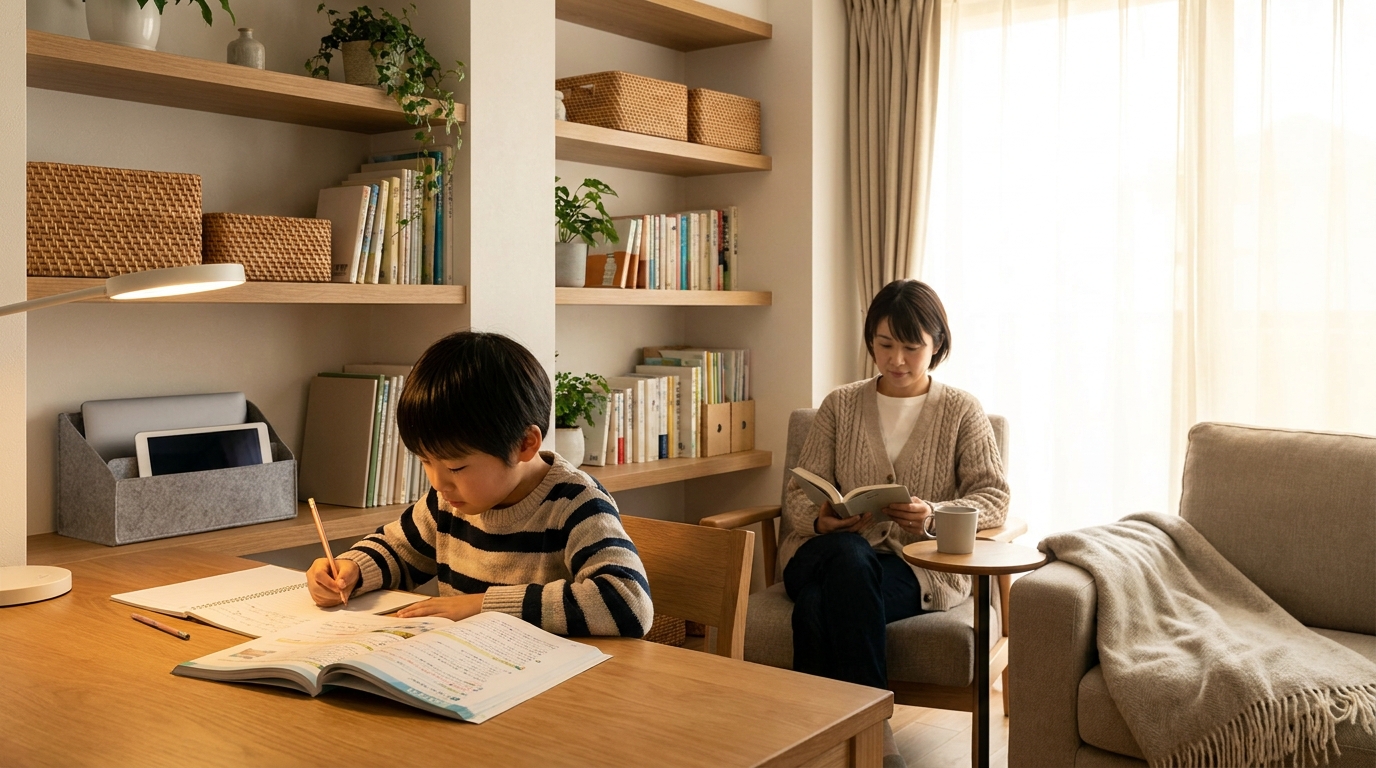
As children grow, they benefit from a home area that supports concentration, writing, project work, and school routines. The most effective homework zones are often located in common areas rather than behind closed bedroom doors, especially for younger elementary-aged children. This arrangement allows adults to be nearby for support while still encouraging independence and a sense of responsibility.
A good homework zone is calm, uncluttered, and stocked with basic supplies. Pens, pencils, paper, scissors, headphones for school-related listening if needed, and a small task light can prevent constant interruptions. If the space doubles as a dining table or family workspace, a caddy or portable bin makes it easier to set up quickly and put away at the end of the day.
Given current concerns around screen time, this is also an ideal place to think carefully about digital boundaries. Statistics Canada reported that in 2024 nearly half of Canadian children and youth aged 3 to 17 met recreational screen-time guidelines, while more than half exceeded them. Families cannot eliminate screens entirely, nor should they feel they must, but it is increasingly important to create visible distinctions between necessary digital tasks and default recreational scrolling or gaming.
One practical strategy is to keep devices in common areas and build schoolwork routines around intentional use. When a child finishes online homework or research, the device has a clear resting place rather than remaining constantly within reach. This simple design choice can help preserve sleep, reduce distraction, and support healthier self-regulation. For younger children, Canadian public health guidance recommending less than one hour of routine screen time per day for ages 2 to 5 adds even more urgency to creating appealing offline spaces.
The emotional feel of the homework zone matters just as much as the supplies. Avoid making it overly stark or punitive. A plant, warm lamp, clock, and a nearby shelf of reference books can make the area feel composed and welcoming. Children are more likely to settle into focused work when the space feels supportive rather than heavily supervised.
Make room for pretend play and storytelling
Educational spaces are not only about visible academic skills. Pretend play is one of the richest forms of early learning because it strengthens language, sequencing, social understanding, emotional expression, and problem-solving. A simple dramatic play corner can support all of these areas while also giving children a joyful way to process the world around them.
This space does not need a themed playhouse or elaborate furniture. A few open-ended props often work better than highly specific toys. Scarves, baskets, dolls, toy food, notebooks, dress-up pieces, small blankets, cardboard boxes, and play kitchen items can become countless scenarios depending on the day. One week the area may be a veterinary clinic, and the next it may become a bakery, a spaceship, or a library.
Storytelling can be woven into this zone in gentle ways. Keep a basket of puppets, blank booklets, or simple character cards nearby. Children often move naturally from pretend play into drawing maps, making signs, inventing menus, or dictating stories. This is exactly the kind of home literacy environment that early childhood experts emphasize. Language grows when children use it with purpose, imagination, and responsive adults nearby.
If several children share a home, pretend-play zones can also support negotiation and empathy. Children practice taking turns, assigning roles, and adjusting ideas together. Of course, conflict can appear too, but even those moments offer learning opportunities when adults help children find words, solve problems, and reset.
Because pretend play can spread quickly, containment helps. A rug, low shelf, or basket of rotating props can define the area without making it feel constrained. The goal is not to stop imagination from spilling into the rest of the house. It is simply to give it a welcoming home base.
Use organization to support independence and calm
Organization is often treated as a finishing touch, but in educational spaces it is central to success. When children can see, reach, and return materials independently, they gain agency. The home feels calmer because activities begin more easily and cleanup feels more possible. Good organization is not about perfection. It is about making the environment understandable to a child.
Low shelves, open baskets, trays, and clear categories tend to work best. Younger children benefit from visual simplicity, so it is wise to avoid overcrowding each zone. Fewer choices often lead to deeper engagement. Older children may be able to manage drawers and more detailed systems, especially if they help design them.
Think about your storage as part of the educational experience. Labels build print awareness, sorting builds logic, and cleanup builds responsibility. These small routines contribute to executive function over time, helping children learn planning, attention, and follow-through. In that sense, an organized shelf is not separate from learning. It is one of the ways learning becomes more possible.
Rotating materials is one of the easiest ways to keep educational spaces fresh without spending more money. Instead of presenting everything all at once, place some books, puzzles, and creative tools in storage and swap them every few weeks. This reduces visual clutter and renews interest. Children often engage more deeply with familiar materials when they return after a short break.
Do not overlook the emotional tone of organization either. Baskets made from natural materials, gentle colors, and well-defined surfaces can make children feel calmer. A room does not need to be minimal to feel peaceful, but it should allow the eye and body to settle. Learning is easier in environments that feel cared for.
Reflect your family’s culture, language, and values
One of the most meaningful ways to enrich a child’s learning environment is to make sure it reflects who they are. Educational spaces feel stronger when children can see their family life, language, and cultural identity inside them. This may be through bilingual books, music, family photos, folktales, objects tied to heritage, or art materials that connect to traditions and celebrations.
NAEYC’s recommendation to include books in both the home language and English is especially important for multilingual families. Language is deeply tied to attachment, memory, and confidence. When children hear and see their home language valued in everyday spaces, literacy becomes more inclusive and emotionally grounded. It also allows grandparents and extended family members to participate more fully in reading and storytelling routines.
Values can be reflected in subtler ways too. A family that cares about nature may keep field guides and collected leaves near the art station. A family that loves cooking may place recipe cards, measuring tools, and child-safe kitchen tasks within reach. A music-loving family may create a basket of simple instruments and lyric books in the living room. Educational space is most powerful when it honors the real shape of family life.
This identity-affirming approach also helps children understand that learning is not confined to school subjects. It lives in stories, traditions, practical tasks, celebrations, and relationships. That broader definition feels healthier and more sustainable than treating education as something separate from the heart of home.
Create routines that bring the spaces to life
Even the most beautiful learning corner will not matter much if it is never used. What turns spaces into educational supports is routine. Children thrive when they can predict certain moments in the day that belong to reading, making, quiet focus, or imaginative play. These routines do not need to be strict, but they do need to be repeated often enough to become familiar.
Start by attaching spaces to natural transitions. A reading nook might come alive after breakfast or before bed. The art corner may open while a parent prepares dinner. The homework zone may be used after a snack and a short outdoor break. When educational spaces are tied to existing rhythms, children are less likely to resist them because they feel like part of family life rather than an extra demand.
Responsive interaction is part of this too. UNICEF’s research points to the importance of stimulation and caregiver engagement in the home environment. This does not mean parents need to be constantly directing activities. It means being present enough to notice, talk, listen, and occasionally join in. A short conversation about a drawing, a shared laugh during pretend play, or ten minutes of reading aloud can be more valuable than a room full of untouched materials.
Families may also find it helpful to create screen-free windows during the day. This is not about making technology the enemy. It is about protecting time for sleep, conversation, books, play, and focused thinking. When children know that certain hours naturally invite offline activity, they often transition more smoothly than adults expect, especially if the environment offers appealing alternatives.
Examples of gentle daily rhythms
- Morning reset: open curtains, return books and supplies to their places, and place one inviting activity on the table.
- After-school decompression: snack, quiet reading, and then homework or maker time depending on the child’s energy.
- Late afternoon creativity: art corner or pretend play while dinner is prepared.
- Evening wind-down: tidy together, choose tomorrow’s books, and end with a family read-aloud.
Educational spaces in small homes and shared rooms
Many families assume their home is simply too small for dedicated learning areas, but small-space homes often become the most thoughtful because every corner is used with care. A narrow hallway can hold wall-mounted book ledges. The end of a sofa can become a reading basket zone. A rolling cart can transform the kitchen into an art studio for an hour and disappear after dinner. Shared bedrooms can still include individual bins or low shelves that give each child a sense of ownership.
The secret in small spaces is to prioritize function over volume. Choose a few core activities that matter most right now, such as reading, creating, and homework, and design around those. Avoid overfilling the home with too many toys or supplies in the hope of covering every possible interest. Children generally use spaces more deeply when the environment is edited and easy to understand.
Vertical storage can also help tremendously. Hooks, pegboards, shelves above a child-height work surface, and slim wall organizers allow materials to stay accessible without taking over the floor. Foldable furniture is useful too, especially for art and project work. If a table can collapse or a tray can slide under a bed, the room remains flexible for the rest of the day.
Shared family rooms benefit from visual boundaries. A rug, lamp, or bookshelf can define a learning zone without construction or renovation. This subtle separation helps children recognize the purpose of an area and allows adults to preserve a cohesive, stylish home overall. Educational design does not need to feel childish in a disruptive way. It can be integrated beautifully into a calm, welcoming interior.
What to avoid when creating learning-rich spaces
Sometimes the most helpful design advice is knowing what not to do. One common mistake is overcomplicating the space from the start. When a learning area is packed with too many bins, labels, products, and visual stimuli, children can feel overwhelmed rather than inspired. Simplicity is often the more effective route.
Another issue is making spaces overly adult-controlled. If materials are too precious, too high up, or only available with permission, children may stop initiating learning on their own. Of course, some supplies need supervision, but the overall environment should still communicate trust and accessibility.
It is also wise to avoid judging educational value by visible output alone. A quiet half hour spent flipping through books, building with cardboard, or making a pretend restaurant menu may not produce something frame-worthy, but it can still represent rich learning. Process matters. So does emotional ease.
Finally, do not assume that adding more screens will automatically make a home more educational. While digital tools can absolutely support learning in specific ways, passive or excessive screen time can displace the conversation, play, sleep, and independent thinking that children need. The goal is balance, and the home environment can support that balance beautifully when offline spaces are compelling and well used.
The heart of an educational home is connection
At its best, an educational home is not defined by furniture or trends. It is defined by a feeling. It is the feeling that books belong in daily life, that questions are welcome, that materials can be touched and explored, that creativity is not reserved for special occasions, and that adults are available for conversation and encouragement. These things matter far more than perfection.
Creating educational spaces at home is ultimately an act of optimism. It says that children’s curiosity deserves room to grow and that small everyday choices can support that growth. A reading nook may nurture a lifelong love of stories. An art table may give a child a way to process big feelings. A maker basket may reveal confidence that no one had yet seen. A calm homework zone may reduce tension and help a child feel more capable.
Families do not need to do everything at once. Begin with one corner, one basket, one routine. Notice what your child returns to and what helps the home feel calmer and more connected. Let the space evolve alongside your family. The most enriching educational environments are rarely finished. They are living parts of the home, shaped by real use, affection, and attention over time.
When home supports literacy, creativity, and curiosity in this natural way, education stops feeling like a separate task that must be squeezed into the day. It becomes part of the atmosphere of family life. And that may be the most lasting gift a home can offer a child.



No Comment! Be the first one.