Dawes Road Approval Signals the Next Phase of Transit-Oriented Intensification in East Toronto
Toronto Council’s approval of a 39-storey residential tower at 6 Dawes Road is more than another high-rise decision near a rail corridor. It is a clear signal that the Danforth-Main-Dawes area is moving from incremental intensification into a full transit-oriented growth district, with all the pressure points that come with that shift: station capacity, public realm delivery, affordability expectations, and the political limits of density.
As reported by Beach Metro Community News, the approved Fitzrovia proposal includes 452 residential units, 69 vehicle parking spaces, 508 bicycle parking spaces, and a public park secured through an Ontario Land Tribunal settlement. The site sits just north of the rail tracks and Danforth GO station, within walking distance of Main Street subway station. From a development strategy perspective, this is exactly the type of location where Toronto’s planning framework is increasingly prepared to accept height, provided the project can be tied to transit access, reduced car dependence, and public benefit delivery.
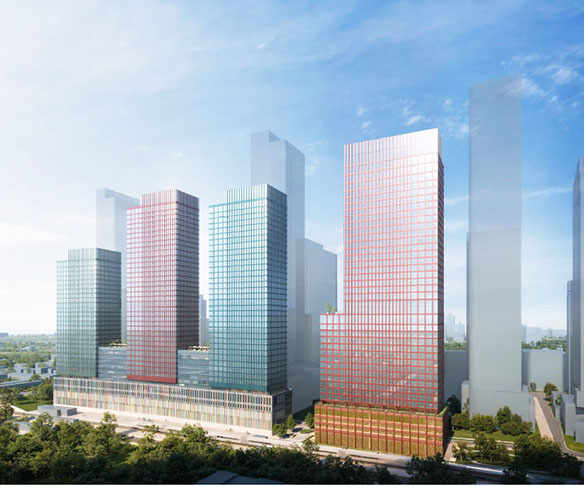
The important detail is not only the approved height. It is the path to that height. The broader master plan was previously resolved through an OLT settlement involving four towers at 29, 39, 37, and 17 storeys. Three towers are already under construction. The final component was later reintroduced at 56 storeys, triggering community pushback around transit crowding, services, and the absence of meaningful affordable housing. The project has now landed at 39 storeys, which tells the market something useful: Toronto may support substantial density near higher-order transit, but the ceiling is still negotiated through infrastructure confidence, political tolerance, and community benefit optics.
For developers, this reinforces a practical reality. Transit adjacency is no longer a simple entitlement argument. Being near GO and subway service strengthens the planning case, but it also raises expectations. Residents and councillors will ask whether station platforms, sidewalks, schools, parks, childcare, and local services can absorb the population increase. Agencies may not object formally, but the political conversation will still centre on whether growth is being matched by capacity.
Transit-oriented development succeeds when density, infrastructure, and public benefit move at the same speed.
The parking ratio is another signal. With 69 vehicle spaces for 452 units, the project reflects the city’s direction away from auto-oriented residential delivery in transit-rich areas. The 508 bicycle spaces are not decorative. They are part of the feasibility equation in a market where parking construction costs, mode-share policy, and buyer or renter expectations are shifting. For rental and multifamily developers in particular, reduced parking can improve project economics, but only where transit access is credible and daily amenities are close enough to support car-light living.
The affordability outcome is more complicated. The project reportedly moves from six to nine affordable units across the four-building plan, while earlier discussion referenced more than $7 million in Section 37 contributions. That reflects a long-standing tension in Toronto approvals: cash contributions and capital benefits can help secure public value, but they do not always translate into a visible level of affordable housing on-site. As inclusionary zoning, community benefit charges, and housing affordability politics continue to evolve, developers should assume that density requests will be judged not only on built form, but also on the clarity and credibility of the public return.
The Dawes approval should be read as a benchmark for emerging station-area redevelopment across the city. Land near transit remains highly valuable, but entitlement risk is now tied to a broader urban bargain. Height is achievable. Density is defensible. But the strongest projects will be those that arrive with a complete argument around mobility, servicing, public space, affordability, and neighbourhood capacity before the opposition defines the conversation.
Source: Beach Metro Community News