Douglas Cardinal and the Architecture of Moving Water
Some buildings sit on a site. Douglas Cardinal’s work seems to listen to one. His Canadian Museum of History, set beside the Ottawa River, is not a monument imposed on the landscape but a long, limestone gesture shaped by current, memory, and Indigenous knowledge. Its curves do not decorate the building. They are the building’s argument.
In a recent profile by Monocle, Cardinal describes the river not simply as scenery but as a force of orientation. Raised in Blackfoot First Nations territory in southern Alberta, and of Anishinaabe heritage, he learned early that nature was not a backdrop to human life. It was kin, sustenance, responsibility. “We do not have dominion over nature, we are nature,” he says. That belief has become the spatial grammar of his architecture.
The museum, originally opened in 1989 as the Canadian Museum of Civilization, is often described through its sweeping forms. Yet its real refinement lies in how those forms hold tension. The building is sculptural, but not static. It has the muscular softness of eroded stone, the layered movement of sediment, the quiet rhythm of water meeting shore. Limestone, chosen for its tactile and geological presence, gives the curves weight and permanence. It allows the museum to feel less like an object and more like a landscape condition.
Cardinal’s resistance to hard-edged modernism is central here. The 20th century gave cities many buildings of precision and authority, but also many that seemed indifferent to climate, culture, and human feeling. Cardinal’s organic architecture proposes another discipline. It is not looseness. It is not whimsy. It is architecture organized by flow, continuity, and respect for place.
The curve, in Cardinal’s hands, is not an aesthetic flourish. It is a way of refusing separation between building, body, land, and water.
There is a lesson here for interiors as much as architecture. A room, like a museum, can be composed through relationship rather than display. Materials can be chosen for how they age, how they absorb light, how they recall a landscape or a family history. A wall can guide movement rather than merely divide. A window can frame not just a view but a daily ritual of attention.
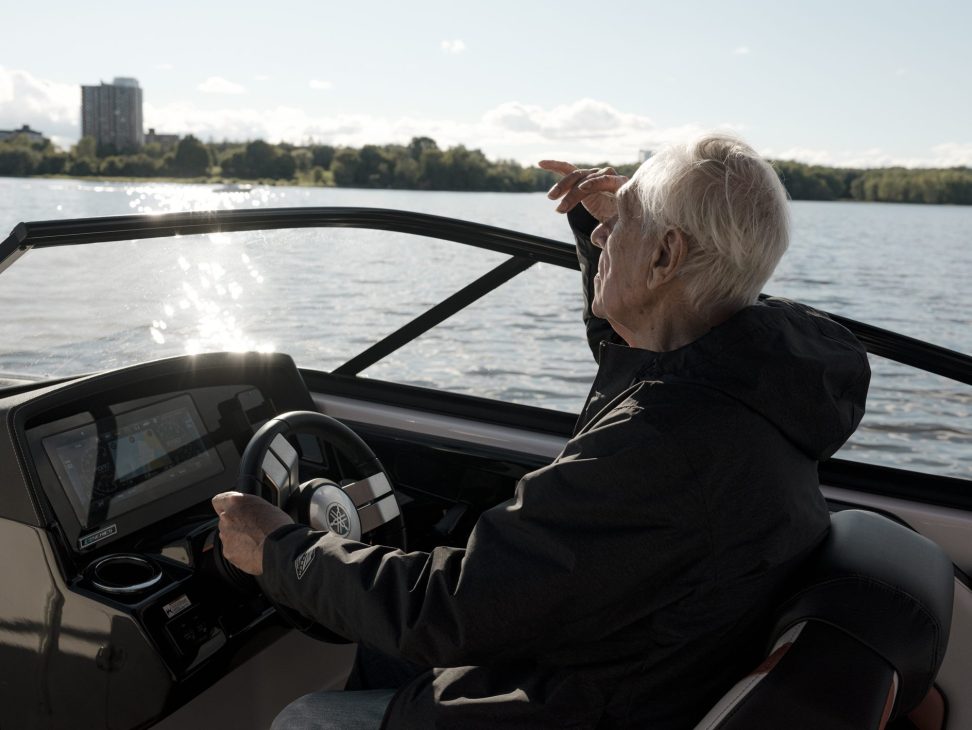
Cardinal’s continued time on the Ottawa River gives the story its most beautiful design detail. He understands the museum from the water, from motion, from the line of approach that reveals how architecture changes as one passes it. This is a more generous way to judge a building than the frontal photograph. It asks whether a structure can accompany a life, whether it can remain alive through weather, memory, and use.
For design-minded readers, Cardinal’s work is a reminder that beauty does not begin with surface. It begins with an ethic. The most enduring spaces are not those that dominate their surroundings, but those that understand where they are, what came before them, and how lightly, or how gracefully, they might belong.
Source: Monocle