


Canada’s Housing Pipeline Is Slowing Where Feasibility Matters Most
Canada’s housing starts are not collapsing, but they are losing momentum at the point where policy ambition meets project economics. CMHC’s June housing starts release shows the six-month trend down 2.8% to 248,123 units, while the monthly seasonally adjusted annual rate fell 6% from May. For developers, planners, and capital allocators, the signal is clear: approved density is not the same as buildable supply.
The deeper issue is not one month of weaker starts. It is the widening gap between what governments need the housing system to deliver and what the market can finance under current conditions. CMHC pointed to uncertainty, higher development costs, weaker demand, and more unsold homes as factors holding back construction. That combination directly affects land pricing, absorption assumptions, debt coverage, presale thresholds, and the timing of site launches.
Actual monthly starts in centres of 10,000 people or more were down 13% year-over-year, while the year-to-date total was down 1%. That relatively small year-to-date decline masks a more important planning concern: completions rose 8.4% month-over-month, while units with approved permits but not yet started fell 1.1%. The system is delivering projects already in motion, but the next wave is being filtered more aggressively by feasibility.
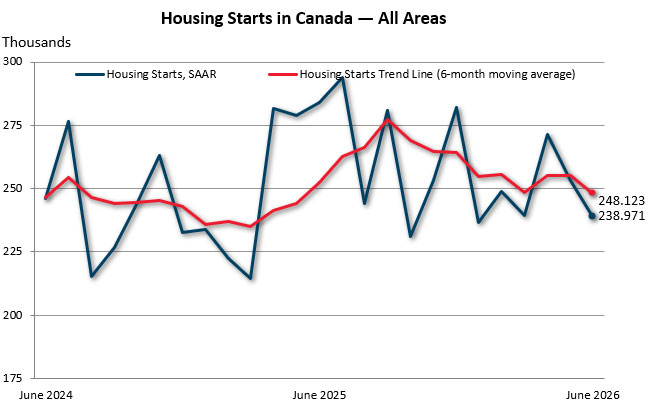
This matters because Canada’s housing strategy is increasingly dependent on multi-unit delivery. CMHC notes that the multi-unit segment can swing sharply from month to month, which is exactly why the six-month trend is important. Large apartment and condominium projects are highly sensitive to construction financing, municipal charges, approval timelines, servicing capacity, and buyer or renter depth. When even one of those inputs shifts, entire towers can move from shovel-ready to deferred.
The regional split is equally important. Among the three largest CMAs, Toronto recorded a 25% year-over-year increase in actual starts, driven by multi-unit activity. Montreal rose 10%, also supported by higher multi-unit starts. Vancouver fell 35% as both multi-unit and single-detached starts weakened. These are not just market statistics. They reflect different combinations of land cost, entitlement structure, investor confidence, construction pricing, and local demand elasticity.
The next housing constraint is not only zoning capacity. It is the ability to convert approved capacity into financed, serviced, absorbable construction.
For municipalities, the data should sharpen the focus on implementation. Upzoning and housing targets matter, but they do not solve the capital stack. If development charges, parkland requirements, delays, and infrastructure gaps remain unresolved, permit pipelines can look healthy while starts soften. A city can approve theoretical supply and still fail to produce occupied homes within the required window.
For landowners and developers, this is a pricing discipline moment. Sites underwritten on peak rents, fast absorption, low financing costs, or aggressive escalation assumptions need to be revisited. Projects with transit access, phased servicing, rental durability, institutional capital alignment, and flexible unit mix will remain better positioned. Sites dependent on speculative appreciation or thin condo demand will face tougher sequencing decisions.
The key watch points over the next two quarters are permit-to-start conversion, unsold inventory, municipal fee relief, construction lending appetite, and whether Toronto’s multi-unit strength proves durable or simply reflects projects already deep in the pipeline. Canada does not have a shortage of housing need. It has a shortage of projects that can clear today’s economics. That distinction will define land strategy through 2026.