



Emerging markets in real estate are often misunderstood. Many investors hear the phrase and immediately think of discounted pricing, speculative upside, or unfamiliar overseas jurisdictions. In practice, the most compelling emerging market opportunities today are often much closer to home. In Canada and across North America, they frequently appear in high-growth secondary metros, suburban corridors, and specialized asset classes where future demand may be stronger than current pricing suggests.
Table Of Content
- What Does an Emerging Market Mean in Real Estate Today?
- Why Emerging Markets Attract Real Estate Capital
- The Supply and Demand Mismatch That Drives Returns
- What Are the Most Important Indicators for Identifying Emerging Markets?
- Why Secondary Markets Deserve More Attention
- Emerging Themes Shaping Opportunity in 2025
- Rental Housing
- Value-Add and Repositioning
- Data Centers and Digital Infrastructure
- Logistics and Infrastructure-Led Industrial Growth
- The Risk Side of the Equation
- How to Underwrite Emerging Markets More Effectively
- Common Misconceptions Investors Should Avoid
- A Practical Framework for Investors in Canada and North America
- Looking Ahead: Where Opportunity Is Likely to Come From
- Final Takeaway
That distinction matters more in 2025 than it did during the broad upswing that defined much of the last cycle. Recent Canadian housing research has shown that rental construction played a major role in expanding new supply, while slower population growth and wider economic uncertainty have started to constrain demand in some segments. As a result, investors can no longer rely on broad national momentum alone. Returns are becoming more dependent on submarket selection, local fundamentals, and disciplined underwriting.
The opportunity is still real. Markets with demographic expansion, job growth, infrastructure investment, and constrained or misaligned housing stock can still deliver above-average rent growth and appreciation over time. But the pathway to those returns is narrower and more analytical. The best emerging real estate markets are not necessarily the cheapest or the fastest-rising. They are the ones where future fundamentals appear stronger than current expectations.
This article takes a comprehensive view of emerging markets through a real estate investment lens. It examines what defines an emerging market today, the indicators investors should monitor, the structural themes gaining traction, and the risks that can quickly erode returns if ignored. The goal is not to promote speculation. It is to frame emerging market investing as a disciplined tradeoff between compounding and complexity.
What Does an Emerging Market Mean in Real Estate Today?
In real estate, an emerging market is not simply a place that has not yet reached maturity. It is a market where multiple forces are beginning to align in a way that can support faster-than-average growth in rents, values, or development activity. Those forces typically include population inflows, household formation, employment expansion, infrastructure investment, improving transparency, and a supply base that is not yet fully equipped to meet rising demand.
For North American investors, this definition increasingly points toward secondary cities, suburban growth corridors, and specialized sectors rather than only international frontier economies. Some of the most interesting opportunities now sit in areas that are benefiting from migration and affordability advantages relative to major metros. Others are tied to structural themes such as digital infrastructure, industrial logistics, and rental housing, where demand is being driven by long-term economic shifts rather than short-term momentum.
The key is to avoid treating emerging as a synonym for undervalued. A market may be inexpensive because demand is weak, liquidity is limited, regulation is unstable, or oversupply is already evident. Price alone is not the thesis. The thesis comes from a measurable gap between current pricing and future fundamentals.
Core principle: An emerging real estate market is best defined not by low prices, but by improving fundamentals that the market has not yet fully priced in.
This is especially relevant in Canada. Recent market commentary has highlighted a growing regional divide, with some metros seeing stronger starts and relative resilience while others are flattening as supply catches up. That means investors need to move beyond citywide labels and assess neighbourhoods, corridors, and asset classes individually. In today’s cycle, emerging opportunity is increasingly hyper-local.
Why Emerging Markets Attract Real Estate Capital
The attraction is straightforward. When investors identify a market before demand becomes widely recognized, they can often acquire assets at lower entry pricing, achieve stronger rent growth, and benefit from cap rate compression if institutional capital follows later. This is the classic sequence behind outsized returns in real estate. Early positioning, if supported by real fundamentals, creates a margin of advantage.
There is also a portfolio construction argument. Mature gateway markets tend to offer liquidity, depth, and transparency, but they also tend to be more efficiently priced. Emerging markets can provide access to higher yield, stronger growth, and differentiated performance drivers. For investors willing to do more work on the ground, that can create an edge.
In 2025, that edge is increasingly linked to mispricing created by market transition. Higher interest rates, asset repricing, and changing demand patterns have created more uneven performance across property types and geographies. According to CBRE’s 2025 investor survey, interest in value-add opportunities remains strong, reflecting the market’s search for returns where active management and repositioning can unlock value. In other words, investors are not just looking for growth. They are looking for growth that is still investable.
That mindset fits emerging markets well. In many cases, the upside does not come from buying a flawless asset in a fully established district. It comes from identifying a location where transit, employment, tenant demand, or digital infrastructure is improving faster than current valuations imply. The challenge is making sure the thesis is grounded in durable data rather than narrative.
The Supply and Demand Mismatch That Drives Returns
The most reliable investment thesis in an emerging market is a mismatch between demand and supply. When job creation, migration, and household formation outpace the available stock of housing, industrial space, or specialized facilities, the market gains pricing power. That can support rent growth, lower vacancy, stronger tenant retention, and ultimately higher asset values.
However, that mismatch is becoming more nuanced. In Canada, CMHC reported that rental construction was a major driver of new housing supply in 2025, while also noting that slower population growth and economic uncertainty were starting to constrain demand in certain segments. CMHC’s housing outlook also suggested that in some markets, rental supply has been growing faster than demand, contributing to higher vacancy and slower rent growth.
For investors, this changes the playbook. It is no longer enough to assume rental housing is universally undersupplied in every market. Some major metros may be entering a period where new inventory tempers rent growth, while parts of the Prairies and select suburban corridors may remain more resilient because their demand dynamics are stronger relative to supply. This is why the best opportunities are increasingly found at the micro-market level.

Investors should think in terms of absorption, not just construction volume. A market can post strong development numbers and still remain healthy if tenant demand is absorbing that supply efficiently. The warning sign is not building activity itself. The warning sign is new completions materially outpacing occupancy gains for a sustained period. That is where vacancy tends to rise and rent growth tends to cool.
In practical terms, a promising emerging market often shows a very specific profile. Population and employment are rising. Household formation is increasing. Affordability relative to nearby major metros remains supportive. Vacancy is tight or trending downward in target subsegments. The development pipeline exists, but not at a level that appears likely to overwhelm demand. When those conditions align, future pricing power becomes easier to underwrite.
What Are the Most Important Indicators for Identifying Emerging Markets?
Investors often ask for a single metric that reveals the next growth market. There is no such metric. Emerging market selection is a process of triangulation, where several indicators reinforce one another. Strong population growth may look attractive, but without employment expansion and absorbable housing costs, it can prove temporary or fragile. The goal is to identify markets where demand is broad-based and durable.
The following indicators are among the most useful when evaluating a potential emerging real estate market:
- Population growth and migration patterns. Net in-migration matters because it reflects real household movement and rising housing demand.
- Household formation. Population gains only translate into housing demand when they create new households and occupied units.
- Employment growth and wage base. A market needs job creation, economic diversification, and income support to sustain rents and occupancy.
- Affordability relative to income. Markets with a cost advantage over major metros can capture migration and employer interest.
- Vacancy rates and rent growth. Tight vacancy paired with steady rent gains often signals effective demand.
- Absorption versus completions. This helps determine whether new supply is being digested or overwhelming the market.
- Infrastructure investment. Transit, highways, logistics access, and power capacity can significantly alter long-term demand.
- Local policy and zoning. Development feasibility and entitlement efficiency directly affect both supply and investor returns.
- Liquidity and exit depth. A market can look strong operationally but still carry elevated exit risk if buyer demand is thin.
No single data point should dominate the analysis. A market with strong migration but weak job growth may underperform. A city with strong rent growth but an extreme supply pipeline may cool quickly. An area with excellent fundamentals but poor liquidity can still be difficult to monetize at the wrong point in the cycle. Investors need to assess how the indicators interact, not just whether one looks impressive on its own.
This is where experience often separates conviction from excitement. Strong investing in emerging markets is less about finding the loudest story and more about building a coherent view from multiple datasets. If the demand base, affordability profile, policy environment, and infrastructure outlook all point in the same direction, the thesis becomes more investable.
Why Secondary Markets Deserve More Attention
Secondary markets have become a central part of the emerging market conversation because they often sit at the intersection of affordability, growth, and operational upside. As major metros become more expensive and supply heavy in certain subsegments, tenants and businesses increasingly look to nearby cities and corridors that offer lower occupancy costs and room for expansion. That movement can create sustained demand for residential, industrial, and mixed-use assets.
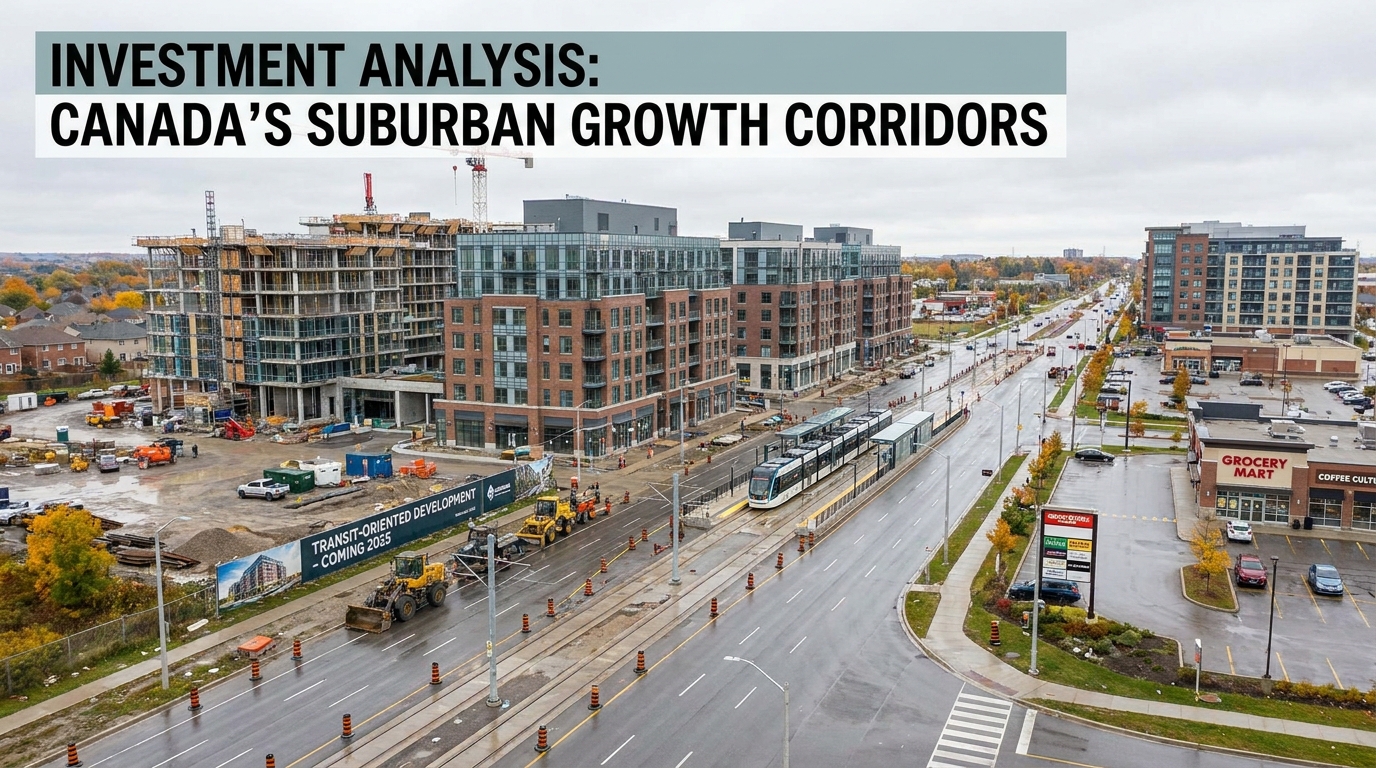
In Canada, this trend has been especially relevant where some large urban centers are seeing more rental supply come online while select secondary markets maintain tighter fundamentals. Parts of the Prairies and suburban growth corridors continue to attract attention because they offer relative affordability and, in some cases, stronger local balance between supply and demand. That does not make them automatically superior. It makes them worthy of closer, data-led attention.
Secondary markets also tend to offer wider entry cap rates than primary cities, which can improve going-in yield and provide more room to manage financing costs. In a higher-rate environment, that spread matters. If two markets offer similar long-term demand prospects but one provides better current income and less aggressive pricing, the risk-adjusted case may be stronger there.
Still, investors should not romanticize smaller markets. They can be less liquid, more concentrated economically, and more sensitive to a single employer, infrastructure delay, or policy shift. A secondary market can outperform, but it can also reverse faster if its growth story is too narrow. The investment case should always be built on resilience, not simply acceleration.
Emerging Themes Shaping Opportunity in 2025
Rental Housing
Rental housing remains one of the most important themes in North American real estate, but the story is becoming more selective. Demand for rental units is still supported by affordability pressures in ownership housing, demographic change, and urban migration patterns. Yet recent Canadian data suggests that stronger supply growth in some major markets is cooling rent growth and raising vacancy in specific segments.
That creates a split market. Investors may find less upside in heavily supplied submarkets where new completions are arriving faster than demand can absorb them. At the same time, markets with healthier affordability, more measured pipelines, and stronger household formation may still offer attractive rental fundamentals. The implication is clear. Rental investing remains compelling, but broad assumptions need to give way to submarket discipline.
Value-Add and Repositioning
Value-add strategies remain attractive because they align with the current repricing environment. Where acquisition pricing has adjusted but operating inefficiencies remain, investors can improve returns through renovation, lease-up, expense control, and better tenant targeting. This approach is particularly relevant in emerging markets because information gaps and operational inefficiencies are often more pronounced there than in fully institutionalized urban cores.
CBRE’s 2025 survey highlighted strong investor interest in value-add opportunities, underscoring the market’s willingness to take measured execution risk in exchange for better return potential. In practical terms, that means investors are increasingly looking for assets where local demand is real, but current management or positioning is failing to capture it fully. Emerging markets often contain those disconnects.
Data Centers and Digital Infrastructure
One of the strongest structural themes in real estate today is digital infrastructure. JLL’s 2025 outlook noted that data centers continue to face critical supply shortages in many markets, making them a standout thematic opportunity. Demand is being fueled by cloud computing, AI expansion, enterprise digitalization, and the increasing need for resilient data storage and processing capacity.
This is significant for emerging market investors because digital infrastructure does not thrive everywhere. It depends on power availability, fiber connectivity, land suitability, regulatory support, and access to end users. Markets that can provide these conditions may attract capital well before broad recognition catches up. In this sense, data center investing is a textbook example of how emerging opportunity can be driven by infrastructure readiness rather than headline population growth alone.

Logistics and Infrastructure-Led Industrial Growth
Industrial and logistics assets continue to benefit from long-term changes in distribution, e-commerce, and supply chain design. As companies prioritize speed, redundancy, and regional access, markets with strong transportation networks and lower operating costs may gain relative importance. The emergence of new industrial corridors often follows road, rail, and port upgrades, making infrastructure investment one of the clearest leading indicators in this asset class.
Power access is becoming just as critical as transportation. For both industrial users and digital infrastructure operators, utility capacity is now a competitive differentiator. Investors evaluating emerging markets should pay close attention to whether a city or corridor has the practical ability to support future industrial intensity. Without that capacity, demand may bypass the location regardless of its apparent affordability.
The Risk Side of the Equation
Emerging markets can outperform, but they can also expose investors to a broader set of risks than mature core markets. That is the tradeoff. Higher return potential is often compensation for greater uncertainty in financing, liquidity, policy, and execution. Ignoring those risks is the fastest way to convert a promising thesis into an underperforming investment.
Financing risk is especially important in the current environment. IMF research in 2025 noted that many emerging markets and developing economies are contending with high financing costs, significant refinancing needs, and weaker external flows. While not every North American secondary market fits that macro profile directly, the principle is highly relevant to real estate investing. Capital has become more selective, debt is more expensive, and refinancing assumptions require greater caution.
The IMF also warned that portfolio flows can be volatile and highly sensitive to changes in global risk conditions. For real estate investors, that matters because sentiment-driven capital can retreat quickly from higher-risk or lower-liquidity markets. A market that looks attractive during abundant capital conditions may suddenly face valuation pressure when financing tightens or risk appetite falls. That is why emerging market investing should always be paired with conservative leverage and clear exit planning.
Other risks deserve equal attention. Construction cost inflation can erode development margins. Policy changes can alter zoning economics, rent regulation, or foreign buyer demand. Liquidity can dry up exactly when investors need flexibility. In cross-border investments, currency swings can either amplify or erase returns. Operationally, local expertise gaps can lead to weak tenant selection, delayed execution, or incorrect pricing assumptions.
Risk management is not a defensive exercise. In emerging real estate markets, it is part of the return strategy because disciplined underwriting preserves the ability to hold, refinance, or exit when conditions change.
How to Underwrite Emerging Markets More Effectively
The best investors treat emerging markets as a scenario analysis exercise rather than a projection exercise. They do not assume the upside case is the base case. Instead, they test what happens if lease-up takes longer, rents flatten, cap rates widen, or refinancing becomes more expensive. That approach does not eliminate uncertainty, but it turns uncertainty into something measurable.
Start with revenue assumptions. Rent growth should be based on local supply-demand evidence, not national averages or marketing language. If the market is adding significant new rental inventory, a prudent model should reflect the possibility of slower rent growth and higher concessions. If a property’s upside depends entirely on aggressive pricing assumptions, the investment is likely too thin.
Next, examine debt structure carefully. Higher-rate cycles reward investors who enter with manageable leverage, long enough duration, and realistic refinancing plans. In emerging markets, the margin for error is smaller because liquidity and valuation support may not be as deep during a downturn. A strong deal should survive stress, not just excel in favorable conditions.
Exit strategy is equally important. Investors often focus intensely on acquisition and operations, then become vague about who will buy the asset later and under what conditions. In mature markets, exit depth may be taken for granted. In emerging markets, it should never be assumed. Buyers need to map likely exit pools early, whether they are local operators, regional investors, institutions, or user-buyers.
A disciplined underwriting framework often includes the following questions:
- Is the demand story supported by both migration and employment data?
- How does the local supply pipeline compare with current absorption?
- Is the market affordable enough to sustain future occupancy without excessive rent burden?
- What local policy or infrastructure changes could improve or damage the thesis?
- How would the investment perform under slower leasing, higher cap rates, or tighter credit?
- Is there enough liquidity in the market to support a realistic exit within the target hold period?
These questions may seem basic, but they are precisely where many emerging market deals either prove durable or unravel. Strong returns rarely come from optimism alone. They come from entering well, structuring well, and surviving volatility better than less disciplined capital.
Common Misconceptions Investors Should Avoid
One of the biggest misconceptions is that emerging markets are simply cheap markets. They are not. A low purchase price can reflect weak local demand, outdated stock, shrinking employment, or little investor depth. Cheap assets can stay cheap for years if there is no catalyst to improve income or valuation. Investors need to focus on trajectory, not just ticket price.
Another misconception is that high growth automatically produces high returns. It does not. Growth can attract too much supply, encourage overleveraging, or create unrealistic expectations that compress yields too far. If investors pay peak pricing for a market already flooded with optimism, the eventual returns may be disappointing even if the city continues to grow.
There is also a tendency to overvalue population growth while underweighting job creation, affordability, and policy conditions. Population inflows matter, but they are not enough on their own. If new residents are not supported by strong employment opportunities or if housing costs become unsustainable, occupancy and rent growth can become less durable than expected.
Finally, many investors treat a city as a single market. In reality, one city can contain both strong and weak submarkets at the same time. A downtown condo segment may be oversupplied while a suburban rental node remains constrained. An industrial corridor near major transport access may outperform even if office fundamentals elsewhere in the region are soft. Precision is essential.
A Practical Framework for Investors in Canada and North America
For investors focused on Canada and North America, the strongest emerging market strategy today is often built around selective exposure rather than broad bets. That means identifying cities and corridors with durable demographic and infrastructure tailwinds, then narrowing further into asset classes and submarkets where current pricing still leaves room for upside. The goal is not to chase the hottest headline. It is to uncover the places where fundamentals are strengthening ahead of consensus.
In residential, that may mean targeting secondary markets where affordability still supports migration and household formation, but where supply pipelines remain manageable. In industrial, it may mean corridors with transportation access and land economics that can support future logistics demand. In digital infrastructure, it may mean focusing on markets with power, fiber, and permitting conditions that create barriers to new supply.
There is also a strong case for staying flexible on strategy. Some markets may favor development if barriers to new supply remain high and long-term demand is evident. Others may favor value-add acquisitions where repricing has created a more attractive basis. Still others may be best approached through income-focused holdings where growth is moderate but downside protection is stronger.
The underlying theme is selectivity. Recent Canadian market research points to a more uneven environment in which national averages reveal less than they used to. Some regions are cooling as supply catches up. Others still show relative tightness and stronger long-term demand support. Investors who rely on broad narratives may miss that divergence. Investors who work market by market are more likely to capture it.
Looking Ahead: Where Opportunity Is Likely to Come From
Over the next several years, emerging real estate opportunities are likely to come from structural shifts rather than purely cyclical rebounds. Housing affordability pressures, migration toward lower-cost cities, digital infrastructure demand, logistics redesign, and infrastructure-led development will continue to shape the map. Markets positioned at the intersection of these themes may deliver the most attractive risk-adjusted returns.
That does not mean every growth corridor will outperform. Some previously hot markets are already normalizing as new supply enters and demand slows. Others may remain resilient precisely because they have not yet been flooded with speculative capital. This is why investors should watch for the point where improving fundamentals are visible in the data but not yet fully reflected in pricing. That is often where the most compelling entry window exists.
In practical terms, future winners are likely to share several traits. They will have credible employment and population drivers. They will retain enough affordability to support occupancy. They will benefit from infrastructure or power access that creates functional demand. And they will offer enough transparency and liquidity for investors to underwrite both growth and exit with confidence.
Emerging market investing, then, is not about predicting the next boom. It is about identifying where long-term utility, demand, and capital interest are converging before that convergence becomes obvious to everyone else.
Final Takeaway
Emerging markets remain one of the most compelling areas in real estate investment, but the definition has evolved. In 2025, the opportunity is less about broad speculative growth and more about disciplined identification of markets where future fundamentals may be stronger than current pricing implies. That often means looking beyond major city averages and focusing on secondary metros, suburban corridors, and specialized asset classes with durable demand drivers.
The rewards can be meaningful. Investors may access stronger rent growth, better yield, and earlier positioning ahead of institutional capital. But the risks are equally real, from financing pressure and volatile capital flows to local oversupply and limited exit depth. That is why emerging market investing should be approached with analytical rigor, conservative leverage, and a clear understanding of local supply-demand dynamics.
For investors willing to do that work, the landscape is still rich with possibility. The best opportunities are not simply where prices look low or headlines sound exciting. They are where data, infrastructure, demographics, and timing align in a way that creates durable value. In real estate, that is what turns complexity into compounding.



No Comment! Be the first one.