



The idea of a carbon-neutral city has moved from the margins of planning discourse into the center of urban strategy. It is no longer enough for cities to talk about sustainability in broad terms or rely on symbolic projects that look green but leave the core systems unchanged. A credible carbon-neutral city is one that systematically reduces emissions across the sectors that matter most, then balances any remaining emissions with verified reductions or removals. In practical terms, that means changing how a city builds, moves, heats, cools, powers, and grows.
Table Of Content
- What Is a Carbon-Neutral City, Really?
- Why Cities Matter So Much in the Climate Transition
- The Biggest Levers: Buildings and Transportation
- Deep Building Retrofits as Core Urban Infrastructure
- Mobility Beyond the Private Car
- Clean Energy, District Systems, and Smarter Infrastructure
- Waste, Materials, and the Circular City
- Nature-Based Solutions Are Valuable, but Not a Substitute
- Governance Is the Difference Between Vision and Delivery
- Why Community Engagement Is Not Optional
- Inspiring Examples: What Leading Cities Are Doing
- The Strategic Framework for Building a Carbon-Neutral City
- A Practical Urban Decarbonization Checklist
- The Opportunity Ahead
For most North American cities, the challenge is not a lack of technology. The tools already exist. Efficient buildings, deep retrofits, electric transit, cleaner grids, district energy, waste diversion, and smarter land use are all proven pathways. The real challenge is coordination. Carbon-neutral cities are created when land use planning, infrastructure investment, regulation, finance, and community trust work in the same direction over a long horizon.
This is why the conversation matters far beyond climate policy. Carbon-neutral urbanism is also about housing supply, public health, resilience, affordability, productivity, and long term land value. UN-Habitat has emphasized that cities are both major contributors to emissions and highly exposed to climate risks such as heatwaves, flooding, storms, and drought. That means the transition is not simply about reducing carbon on paper. It is about building places that can perform better economically and socially under real world pressure.
Canada offers an important policy backdrop for this transition. The federal climate framework targets a 40 to 45 percent reduction below 2005 emissions levels by 2030 and net-zero by 2050, while the Canadian Net-Zero Emissions Accountability Act requires transparency, accountability, and public participation. That framework matters because it signals that the path to lower emissions is not optional, and it also shows that governance and civic legitimacy are now part of the climate equation. Cities are where much of that national ambition is either delivered or delayed.
This guide focuses on the practical side of carbon-neutral cities. It explains what the term really means, where the biggest urban emissions reductions can be found, why holistic planning is essential, and how leading cities are translating ambition into implementation. More importantly, it makes the case that the most successful urban climate strategies are not built around a single headline innovation. They are built through layered decisions that shape how the city works every day.
The future city is not defined by one green technology. It is defined by whether all of its systems, from housing to transport to infrastructure, are aligned around lower emissions, resilience, and a better quality of urban life.
What Is a Carbon-Neutral City, Really?
A carbon-neutral city is an urban area that balances the greenhouse gases it emits with an equivalent amount of emissions reduced or removed, achieved primarily by cutting emissions at the source rather than relying on offsets. In practice, that means reducing energy use in buildings through deep retrofits and efficient new construction, shifting transportation away from car dependence through transit, walking, and cycling infrastructure, decarbonizing electricity and heating through clean energy and district energy systems, diverting waste through circular economy practices, and aligning land use so that homes, jobs, and services sit closer together. The strongest city strategies do not begin with tree planting or purchased offsets; they begin with these structural reductions in the sectors, especially buildings and transportation, that drive the largest share of urban emissions. Only after direct reductions are pursued do verified offsets or removals play a supporting role in closing any remaining gap toward full carbon neutrality.
That distinction is important because carbon neutrality is often misunderstood. A city cannot credibly claim to be carbon-neutral simply because it expands parkland or buys offsets while continuing to approve inefficient buildings, auto-dependent growth, and fossil-fuel intensive infrastructure. Nature-based solutions are valuable, especially for resilience and localized carbon benefits, but they are not substitutes for structural emissions reductions. The foundation of any serious pathway is direct decarbonization.
Definitions also matter. Some cities focus on territorial emissions, meaning emissions produced within their physical boundaries. Others consider broader consumption-based emissions, which include the carbon impacts embedded in imported goods, construction materials, and supply chains. There is no single accounting method used everywhere, so clarity is essential. A city may appear to perform well on territorial emissions while still driving high carbon impacts through what it consumes and builds.
That is why the most mature urban climate strategies are increasingly explicit about boundaries, timelines, and sector priorities. They identify what is being counted, where emissions are coming from, and how reductions will be achieved in stages. They also recognize that net-zero and carbon-neutral are related but not always identical in practice. Depending on the framework used, the role of offsets, removals, and sector-specific targets can differ. For the public, the key question is simpler: is the city reducing emissions where it matters most, and is it doing so in a way that is measurable and durable?
Why Cities Matter So Much in the Climate Transition
Cities concentrate people, buildings, infrastructure, commerce, and travel. That concentration creates emissions, but it also creates opportunity. A well planned urban area can reduce per capita energy use, shorten travel distances, improve transit viability, support efficient buildings, and lower infrastructure costs over time. Density on its own is not a climate strategy, but when paired with smart design and public investment, it becomes one of the strongest enablers of decarbonization.
Urban form has consequences that last for generations. Every subdivision, tower, transit corridor, industrial precinct, and civic facility shapes emissions far into the future. A low-density pattern that requires long vehicle trips and extensive utility networks is difficult and costly to retrofit later. By contrast, compact mixed-use development creates the conditions for cleaner transportation, more efficient service delivery, and lower operational energy demand. In that sense, land use is climate policy whether or not it is described that way.
There is also a resilience dimension that can no longer be separated from mitigation. UN-Habitat’s climate planning guidance emphasizes participatory planning and the mainstreaming of climate action into broader local policy. Its World Cities Report 2024 underscores that cities are exposed to escalating climate risks at the same time they are being asked to reduce emissions. Heat, flooding, infrastructure stress, and inequality are colliding in urban areas, which means future-ready planning must solve for multiple outcomes at once.
This is why carbon-neutral city building should be framed not only as an environmental project, but as a city-building agenda. Residents experience climate action through housing costs, transit options, local air quality, neighborhood safety, utility bills, and access to public space. If climate policy is disconnected from those everyday realities, implementation slows. If it improves daily life while also lowering emissions, public support strengthens.
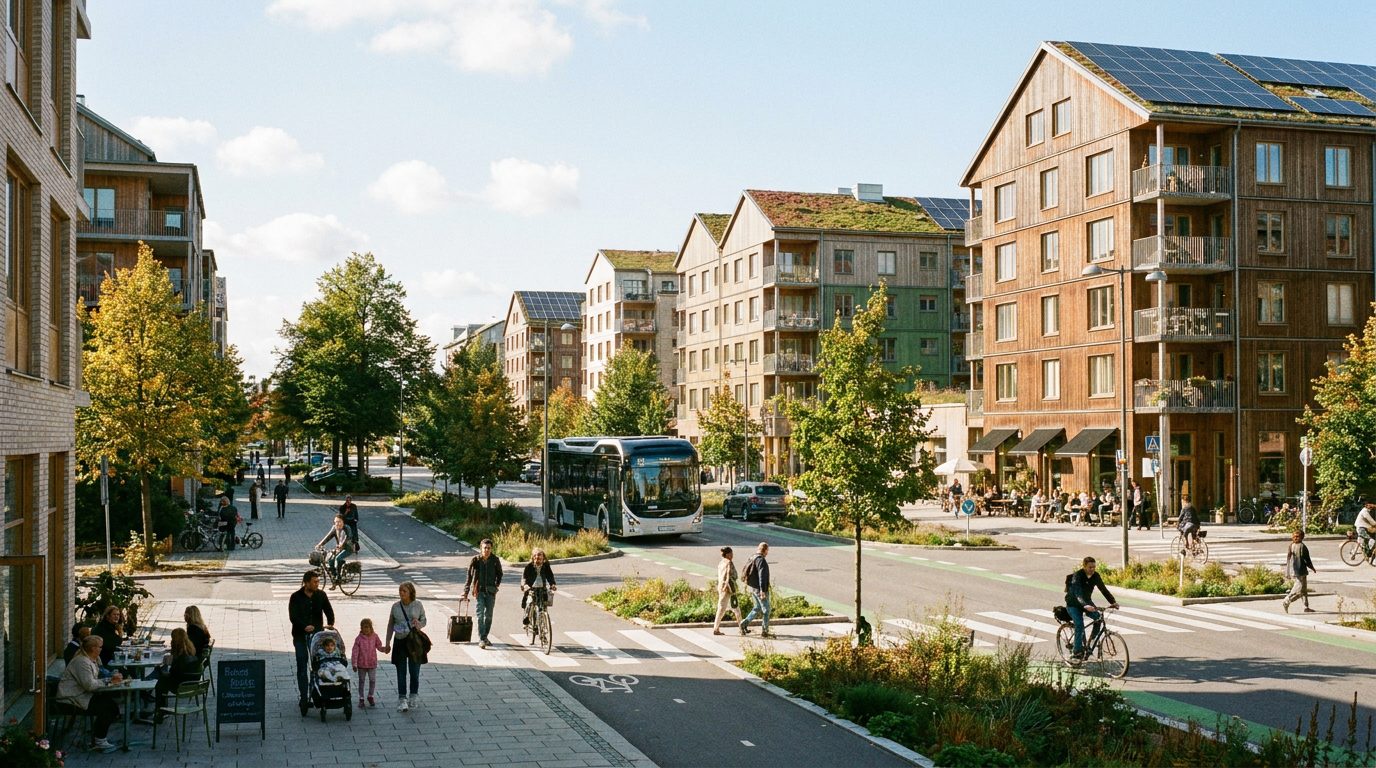
The Biggest Levers: Buildings and Transportation
If cities want the fastest and most credible route toward carbon neutrality, two sectors usually demand the greatest attention: buildings and transportation. Research summarized by C40 indicates that buildings account for over half of city emissions on average. That single fact should reshape how urban leaders prioritize action. It means the performance of homes, towers, offices, institutional buildings, and industrial facilities is not a technical side issue. It is central to the urban carbon balance.
Buildings matter for several reasons. First, they lock in long term energy demand through design choices that are expensive to reverse later. Second, heating systems in colder climates have historically depended on fossil fuels, making operational emissions a major challenge. Third, existing building stock is large, aging, and often inefficient, which means retrofit strategy matters just as much as new construction standards. A city that only builds green new projects while ignoring its older stock will miss the scale of reduction required.
Transportation is the second major lever because mobility is shaped by both technology and geography. Vehicle electrification is essential, but it is not enough on its own. If a city continues to expand in a way that forces long trips for work, school, retail, and daily services, transport emissions remain harder to control and infrastructure costs rise. Transit-oriented development, complete streets, walking, cycling, and mixed-use planning are what make low carbon mobility realistic at scale.
The interaction between these two sectors is where strategic planning becomes most powerful. Housing built near frequent transit can lower household emissions dramatically. Buildings with high efficiency standards and electric heating can take advantage of cleaner electricity as the grid decarbonizes. Public realm investments that support walking and biking can reduce congestion while improving health outcomes. The lesson is clear. Urban carbon strategy works best when the city is designed as an integrated system rather than as a collection of disconnected sustainability programs.
Deep Building Retrofits as Core Urban Infrastructure
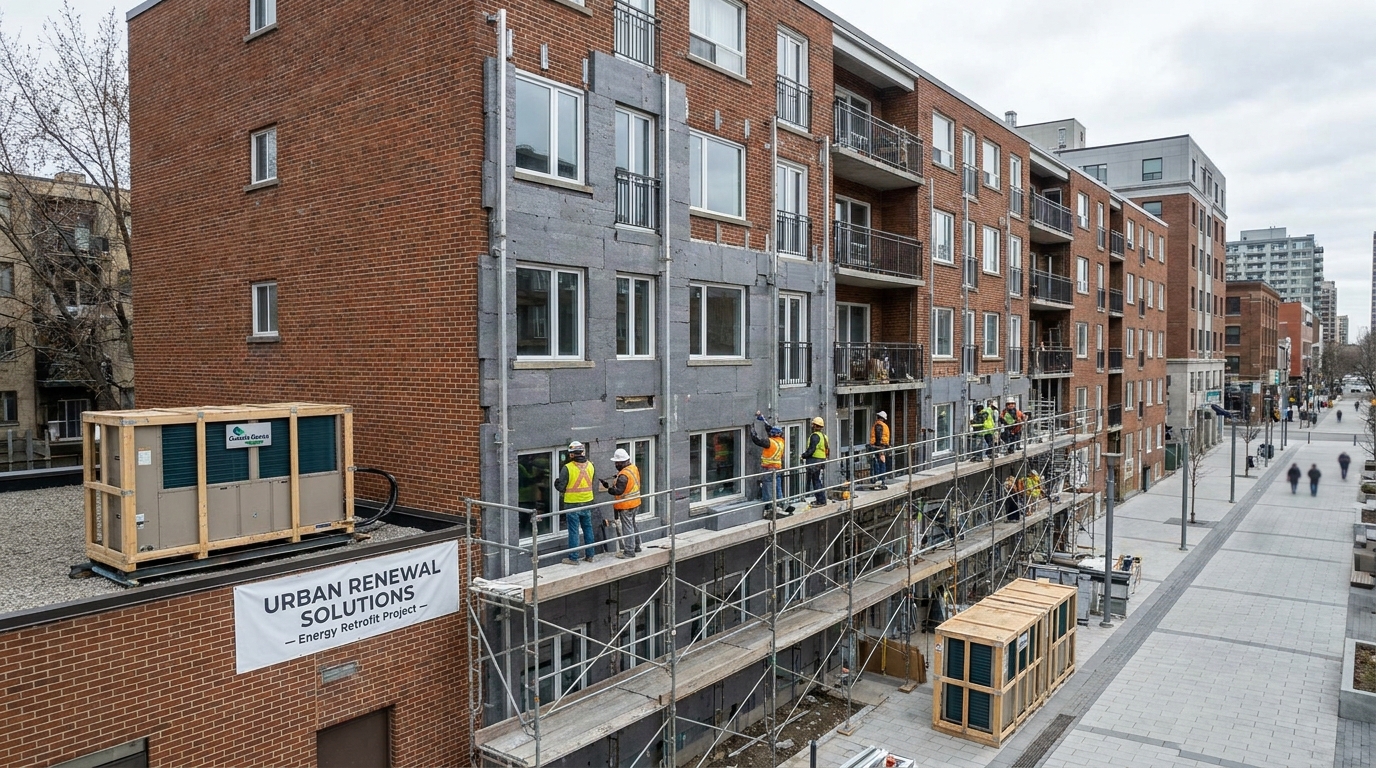
Retrofitting existing buildings is one of the hardest urban decarbonization tasks, but also one of the most important. New green buildings receive attention because they are visible and easier to brand as future-facing. Yet most of the buildings standing today will still be in use decades from now. If those assets remain inefficient, dependent on fossil-based heating, and vulnerable to heat or flooding, cities will struggle to meet their targets and residents will continue to face higher operating costs.
A serious retrofit agenda includes better insulation, high-performance windows, improved ventilation, smart controls, electrified heating such as heat pumps, and in some cases on-site renewable generation. It also requires financing mechanisms, workforce training, and standards that create predictability in the market. Owners need a reason to invest. Contractors need a pipeline of work. Utilities and regulators need alignment so that upgrades can happen efficiently across neighborhoods rather than only building by building.
From a city-building perspective, retrofits should be treated as productivity and resilience investments, not merely environmental expenses. Efficient buildings can reduce energy poverty, improve indoor comfort, and protect vulnerable residents during extreme temperatures. They also increase the long term performance of urban assets, which matters to both public agencies and private investors. The carbon benefit is significant, but so is the wider value case.
Mobility Beyond the Private Car
A carbon-neutral city does not eliminate cars entirely, but it does reduce dependence on them. That outcome is shaped by urban form as much as by mobility policy. When daily destinations are close together, streets are safe, and transit is reliable, more trips shift naturally to lower carbon modes. When growth is dispersed and basic services are separated by distance, even well intentioned residents are pulled back into high-emission travel patterns.
Practical solutions include protected cycling infrastructure, reliable bus networks, regional rail integration, transit priority lanes, fare coordination, and zoning that allows more housing near stations and corridors. Electrified buses and municipal fleets are also increasingly important because they combine emissions reductions with lower maintenance costs over time. The strongest city strategies do not treat transportation as a standalone engineering file. They connect it directly to land use, housing policy, and infrastructure sequencing.
This is one reason electric vehicles should be seen as part of the answer, not the whole answer. EVs reduce tailpipe emissions, especially where electricity is relatively clean, but they do not solve congestion, street safety, land consumption, or the cost of car-dependent urban expansion. A city that simply replaces every gasoline car with an electric one may cut emissions, but it will still carry many of the same structural inefficiencies. Carbon-neutral planning aims higher than fuel substitution alone.
Clean Energy, District Systems, and Smarter Infrastructure
Decarbonizing a city requires cleaner energy supply as well as lower demand. Efficient buildings and electrified transport are much more effective when the grid itself is moving toward low carbon generation. This is where municipal action intersects with regional utilities, provincial regulation, and national policy. Cities do not always control electricity production directly, but they can influence demand profiles, local energy systems, building performance, procurement, and infrastructure investment.
District energy is one of the most practical examples of system-wide urban decarbonization. Rather than heating and cooling each building independently, district systems can serve entire precincts through shared infrastructure, often with greater efficiency and lower emissions. These systems are especially relevant in dense mixed-use areas, institutional clusters, waterfront redevelopments, and large master planned communities. They also create a platform for future adaptation as cleaner energy sources become available.
Infrastructure planning should also account for the carbon implications of water systems, waste collection, municipal buildings, and fleet operations. Cities that are advancing from ambition to delivery are increasingly using building-performance standards, district energy policies, fleet electrification, and procurement rules to drive measurable change. These tools matter because they move climate action out of the realm of aspiration and into the mechanics of urban management.
There is a broader economic logic here. Cleaner infrastructure can lower long term operating costs, reduce exposure to volatile energy prices, and improve the attractiveness of urban investment districts. As decarbonization becomes more tied to competitiveness, investment, and disclosure, municipalities that modernize their systems early may be better positioned to attract capital and talent. Carbon-neutrality is not anti-growth. In many markets, it is becoming a condition for resilient growth.
Waste, Materials, and the Circular City
Waste is often treated as a secondary issue in climate strategy, but it plays a meaningful role in urban carbon performance. Landfill emissions, especially methane, can be significant. At the same time, the way cities handle materials affects emissions embedded in construction, demolition, packaging, food systems, and public procurement. A carbon-neutral city needs to think beyond disposal and toward circularity.
That means reducing waste generation, expanding reuse and repair systems, improving organics collection, capturing landfill gas where needed, and designing buildings and infrastructure with material efficiency in mind. It also means acknowledging that territorial emissions inventories may not fully capture the carbon intensity of imported materials such as steel, concrete, and manufactured goods. Cities that want to lead will increasingly need to consider consumption-based impacts as part of long term strategy.
Construction is especially important in growing cities where housing demand is high. We need more homes in many urban regions, but we also need to be smarter about embodied carbon in the process of building them. This is not an argument against growth. It is an argument for growth that is compact, efficient, infrastructure-aware, and material-conscious. Better planning can support both housing delivery and lower carbon outcomes if approvals, design standards, and infrastructure decisions are aligned.
Nature-Based Solutions Are Valuable, but Not a Substitute
Urban trees, wetlands, green roofs, permeable landscapes, and restored waterfront systems have an important role in the carbon-neutral city. They help manage stormwater, mitigate urban heat, improve biodiversity, and make neighborhoods more livable. They can also contribute modestly to carbon sequestration and help strengthen resilience as climate impacts intensify. In dense urban environments, those benefits are significant.
But it is important to avoid a common misconception. Carbon-neutral cities are not achieved by planting trees alone. A city that continues to permit inefficient sprawl, fossil-fueled buildings, and high-emission transportation cannot offset its way to credibility through landscaping. Nature-based solutions work best as part of a wider strategy that has already prioritized deep reductions in energy, mobility, and waste systems.
The stronger argument for urban greening is that it complements decarbonization while improving quality of life. Shaded streets can reduce heat stress. Parks and green corridors can support active mobility. Restored natural systems can reduce flood risk and protect infrastructure. In other words, nature-based solutions become most powerful when they are integrated into urban structure rather than added as decorative climate gestures.
Governance Is the Difference Between Vision and Delivery
One of the most persistent misconceptions in climate discourse is that this transition is mainly a technology problem. In reality, weak governance, fragmented authority, poor coordination, and low public trust often slow progress more than technical limitations do. Cities may know what to do, but knowing is not the same as implementing. Carbon-neutrality is achieved through policy sequencing, institutional alignment, stable funding, and public legitimacy.
That is why Canada’s climate planning framework is instructive. The national target of a 40 to 45 percent emissions reduction below 2005 levels by 2030, with net-zero by 2050, is paired with accountability and public participation requirements under the Canadian Net-Zero Emissions Accountability Act. Canada also submits an official greenhouse gas inventory annually to the UNFCCC, tracking emissions across major greenhouse gases back to 1990. This matters because it reinforces a culture of measurement and transparency rather than purely rhetorical ambition.
At the municipal level, governance means embedding climate goals into the systems that already shape urban outcomes. That includes official plans, zoning bylaws, building codes, capital budgets, transit plans, procurement rules, and asset management frameworks. If carbon-neutrality is isolated in a standalone strategy document, it often lacks the leverage needed to influence actual development patterns. If it is built into city operations and approvals, it starts to shape markets.
Implementation also depends on multilevel coordination. Cities cannot decarbonize alone. Utilities, provinces, states, federal governments, transit agencies, developers, community organizations, and Indigenous governments all affect the pace and success of urban transition. Strong governance recognizes this and creates a structure for collaboration rather than assuming municipal authority is sufficient on its own.
Why Community Engagement Is Not Optional
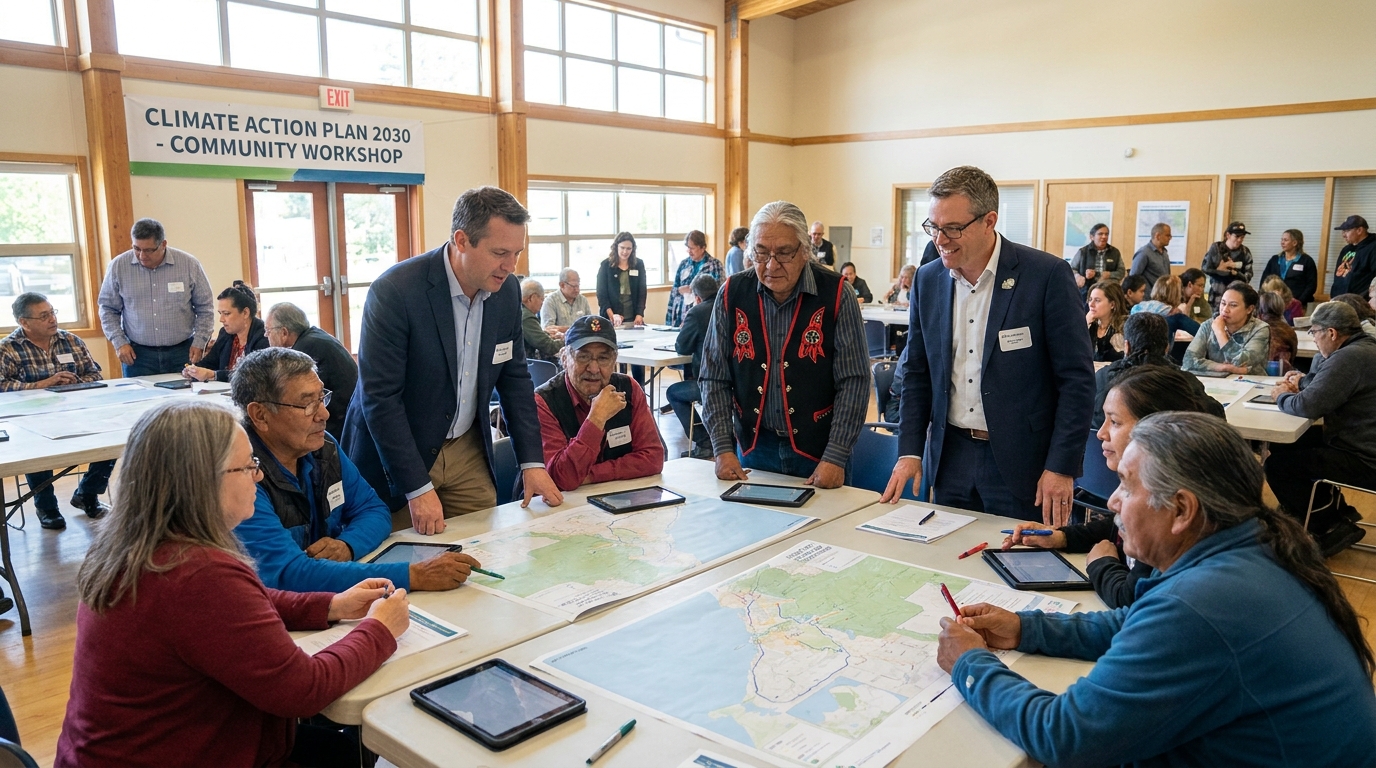
Community engagement is often described as a best practice, but in carbon-neutral city planning it is closer to a prerequisite. Plans that lack public trust tend to stall when implementation begins to affect cost, street space, development approvals, or neighborhood change. Plans built with communities, on the other hand, are more likely to reflect local priorities, identify practical barriers early, and gain the social durability needed to survive political turnover.
UN-Habitat’s climate planning guidance emphasizes participatory planning, and Canada has similarly highlighted public participation in national climate processes with input from provinces, territories, Indigenous Peoples, industry, and tens of thousands of Canadians. That is useful context because it shows decarbonization is not only about engineering solutions. It is about legitimacy, fairness, and decision-making quality. When communities understand the tradeoffs and benefits, implementation becomes more realistic.
Effective engagement also broadens the knowledge base of planning itself. Indigenous knowledge, local experience, resident priorities, and neighborhood-specific observations can improve how projects are designed and sequenced. This is especially important where climate action intersects with affordability, displacement risk, and service equity. A low carbon city that becomes less accessible or less inclusive will face resistance for good reason.
The practical lesson is that community engagement should happen early and continue through delivery. It should not be reduced to a late-stage consultation after the major decisions are already fixed. Carbon-neutral cities are built through public conversation as much as through technical modeling, because people ultimately decide whether policies can move from paper to place.
Inspiring Examples: What Leading Cities Are Doing
The encouraging news is that cities do not have to start from scratch. Across North America and beyond, practical examples show that urban decarbonization is already moving from target-setting to delivery. Networks such as C40 have helped accelerate peer learning by connecting cities around tools like net-zero carbon buildings, performance standards, and implementation frameworks. The value of these networks is not branding. It is the sharing of tested methods that can reduce the lag between ambition and action.
Vancouver is one of the clearest examples in the Canadian context. Its Renewable City Strategy has aimed for all of the city’s energy needs to come from renewable sources by 2050, with buildings and transportation identified as the main emissions sources. That focus is strategically sound because it targets the sectors where urban policy has the greatest leverage. Vancouver’s example shows that a city can set a long horizon while still concentrating near term action where the gains are largest.
C40’s Net Zero Carbon Buildings Accelerator includes 29 cities, among them Toronto, Vancouver, Montréal, Seattle, San Francisco, Washington, DC, and Los Angeles. The significance of this is not simply that these cities share a climate label. It is that they are working through the operational details of building decarbonization in very different regulatory and market contexts. That kind of cross-city learning is increasingly valuable as more municipalities move from broad targets to performance-driven policy.
There are also signs that urban climate policy is being reinforced at higher levels of governance. UN-Habitat reported that urban content now appears in most third-generation national climate commitments, with 80 percent of 142 NDC 3.0 submissions featuring well-developed urban content, up from 49 percent in the previous cycle. This trend matters because it suggests cities, housing, and multilevel governance are becoming more central to national climate strategy. In parallel, Canada’s 2025 progress reporting and the growth of the Net-Zero Challenge, which had 308 participating businesses and organizations as of October 2025, indicate stronger private sector engagement in decarbonization as well.
The Strategic Framework for Building a Carbon-Neutral City
If we step back from the examples and focus on what actually works, a practical framework begins to emerge. Carbon-neutral cities are built through layered actions rather than one-off breakthroughs. Clean electricity, efficient buildings, low carbon mobility, waste diversion, electrified fleets, district energy, and climate-smart land use all matter. The question is how to organize them into an urban strategy that is coherent, fundable, and durable.
First, cities need a clear emissions baseline and a transparent inventory framework. Without measurement, priorities become distorted and progress is difficult to verify. Second, they need to target high-impact sectors, especially buildings and transportation, with implementation tools rather than just aspirational language. Third, they need to connect mitigation with adaptation so that investments improve both emissions performance and urban resilience.
Fourth, they need to plan growth intelligently. In high-demand markets, housing supply and climate policy must be aligned rather than treated as competing agendas. More homes near transit, jobs, and services can support both affordability and lower emissions if infrastructure keeps pace. Fifth, they need financing and policy certainty. The private sector can contribute capital and innovation, but only when signals are stable enough to support long term investment. Sixth, they need community trust, because a strategy without social legitimacy is vulnerable at every stage of delivery.
These principles may sound straightforward, but they require discipline. Carbon-neutrality cannot be pursued as a branding exercise layered on top of conventional growth patterns. It has to influence the core logic of city building: where growth goes, how buildings perform, how people move, what infrastructure is funded, and how risks are managed.
A Practical Urban Decarbonization Checklist
-
Establish a clear emissions inventory with transparent boundaries, sector breakdowns, and interim milestones tied to public reporting.
-
Prioritize deep building retrofits, net-zero-ready new construction, and clean heating systems because buildings are often the largest urban emissions source.
-
Link land use and transportation by concentrating growth near transit, enabling mixed-use density, and improving walking, cycling, and bus reliability.
-
Expand clean energy and district systems where density and infrastructure conditions support them, especially in major redevelopment areas.
-
Reduce waste through circular economy strategies, organics diversion, material efficiency, and procurement standards that consider lifecycle emissions.
-
Integrate urban greening and resilience measures such as trees, flood protection, and heat mitigation as complements to direct emissions reduction.
-
Embed climate goals into everyday governance tools including zoning, capital planning, building standards, fleet procurement, and infrastructure management.
-
Engage communities early and continuously so that implementation reflects local knowledge, equity concerns, and public priorities.
The Opportunity Ahead
The transition to carbon-neutral cities is often described as daunting, and in many respects it is. It touches every major urban system and requires action over decades, not months. But from a development and planning perspective, it is also an opportunity to correct patterns that were already under strain. Many cities were facing housing shortages, congested roads, aging infrastructure, heat risk, and public health challenges before climate targets became central. A carbon-neutral framework does not create these issues. It offers a more coherent way to solve them together.
There is a long term land value dimension here as well. Places that can house growth efficiently, deliver reliable transit, modernize infrastructure, reduce operating costs, and remain resilient under climate stress will likely outperform places that cannot. Investors, residents, and employers are already paying closer attention to energy performance, climate exposure, and quality of life. Carbon-neutral urbanism is becoming part of the competitiveness conversation, not separate from it.
For policymakers, planners, developers, and communities, the central takeaway is simple. The future will not be built through isolated climate gestures. It will be built through integrated city-making. That means aligning housing, mobility, infrastructure, public participation, and environmental performance within one practical framework. It means understanding that carbon-neutrality is not the endpoint of urban transformation but a way of guiding it.
The best carbon-neutral cities will not only emit less. They will also be healthier, more efficient, more resilient, and more equitable places to live. They will have buildings that waste less energy, neighborhoods that support shorter trips, infrastructure that can handle future climate stress, and governance systems strong enough to turn complex goals into visible outcomes. That is the real promise of the carbon-neutral city. It is not just about reducing harm. It is about building better urban futures on purpose.
For cities willing to think holistically and act consistently, the path is already visible. Start with the biggest levers. Plan for growth and resilience together. Build trust through participation. Use regulation, investment, and design in concert. Learn from the cities that are already moving. The future city will not arrive by accident. It will be planned, financed, debated, improved, and built. And if we do it well, it will be cleaner, stronger, and more livable than the one we inherited.



No Comment! Be the first one.