AI Site Selection Is Moving From Store-Level Scoring to Portfolio-Level Forecasting
Commercial real estate site selection is becoming less about isolated address evaluation and more about continuous market simulation. GrowthFactor’s launch of Market Planning, reported by EIN Presswire, is a useful signal: retail expansion teams increasingly want AI systems that can compare sites, model trade areas, test cannibalization, and explain recommendations in language decision-makers can use.
The important shift is not simply that another property technology platform now uses AI. The more meaningful change is interface design. GrowthFactor is positioning the question as the starting point. Instead of asking users to move between demographic dashboards, traffic tools, competitor maps, spreadsheets, and forecasting models, the platform lets teams ask where to open next and then assembles the analysis across multiple datasets.
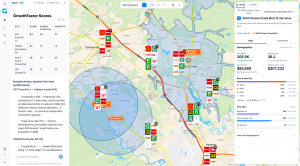
For KG Data readers, the property intelligence angle is clear. Multi-unit expansion has always depended on pattern recognition, but the pattern space has become too large for manual workflows alone. A new store decision can involve income bands, population density, psychographics, foot traffic, vehicle counts, zoning constraints, competitor proximity, co-tenancy, lease economics, and the brand’s own historical sales performance. The analytical advantage comes from connecting those signals rather than reviewing them separately.
GrowthFactor says its system draws from licensed demographic, psychographic, foot traffic, vehicle traffic, points-of-interest, zoning, and customer portfolio data. That combination matters because site selection models are only as strong as the relationship between external market context and internal operating history. A high-traffic site is not automatically a strong site. A dense trade area is not automatically aligned with the customer profile. The valuable model is the one that can compare candidate locations against the brand’s own proven demand signature.
The next competitive edge in retail real estate will come from modeling markets as systems, not ranking sites as isolated dots on a map.
The launch also points to a broader movement in property technology: agentic AI as an analytical operator. In this model, the software does not only display data. It selects tools, runs workflows, surfaces assumptions, and explains outputs. That creates faster planning cycles, but it also raises the standard for auditability. If an AI-generated site score influences a lease decision worth millions, the team needs to inspect the inputs, weights, assumptions, and confidence level behind that recommendation.
This is where the “visible steps” claim becomes commercially important. Real estate committees do not only need answers. They need defensible answers. A ranked candidate list has limited value if the reasoning cannot be reviewed by finance, operations, leadership, and local market specialists. The strongest AI tools in this category will be judged less by how fluent their chat interface feels and more by how well they expose the evidence trail.
Another notable signal is pricing. GrowthFactor Pro is being offered as a self-serve product at $200 per user per month. That puts advanced site analytics closer to individual operators, brokers, franchise teams, and smaller expansion groups that may not have had access to enterprise-grade planning tools. If the model performs reliably, this kind of pricing could widen the market for AI-assisted location intelligence beyond large national chains.
Readers should track three things next: whether revenue forecast ranges prove accurate across different categories, how platforms handle data provenance and bias, and whether AI planning tools reduce bad openings rather than merely speeding up approvals. Faster decisions are useful. Better capital allocation is the real test.
Source: EIN Presswire