



Property management has always been a balancing act between cost, reliability, resident comfort, and asset value. For decades, most buildings were maintained in one of two ways. Teams either reacted after something failed, or they followed fixed maintenance schedules that treated every asset the same regardless of its actual condition. That model is now changing. Predictive maintenance introduces an intelligence layer that helps owners and managers act before visible breakdowns occur, using data to estimate when equipment needs attention and where risks are building inside a property.
Table Of Content
- What Predictive Maintenance Actually Means in Property Management
- Why Traditional Maintenance Models Fall Short
- How Predictive Maintenance Works Inside Smart Properties
- What Data Sources Are Most Useful
- Real-World Applications Across Property Types
- HVAC and Climate Control
- Water Leaks and Plumbing Systems
- Elevators and Vertical Transportation
- Energy Systems and Electrical Equipment
- The Business Case: Cost, Asset Life, and Tenant Satisfaction
- How to Implement Predictive Maintenance Without Overcomplicating It
- A Practical Rollout Sequence
- Common Challenges and How Smart Teams Address Them
- The Role of AI in the Next Generation of Building Maintenance
- What the Future Means for Smart Properties
- Conclusion: From Scheduled Tasks to Intelligent Property Care
In the real estate sector, this shift matters because buildings are full of systems that quietly determine performance every day. Heating and cooling units, pumps, elevators, access controls, lighting networks, plumbing lines, boilers, water heaters, ventilation systems, and backup power assets all age differently under changing occupancy patterns and weather conditions. A static maintenance plan cannot fully account for that complexity. Predictive maintenance uses signals from sensors, work orders, utility data, building management systems, and historical performance records to identify patterns that point toward future failure. The result is a more proactive maintenance strategy that protects both operations and tenant experience.
For property owners, the appeal is practical rather than abstract. Fewer emergency repairs often mean lower labor costs, less equipment downtime, longer asset life, and more stable budget planning. For tenants, the value appears in less disruption, more comfort, faster issue resolution, and greater confidence in the building itself. In smart properties, where connected devices and automation platforms are already producing useful data, predictive maintenance becomes one of the clearest ways to turn digital infrastructure into measurable operating value.
This article explores how predictive maintenance works in real estate, where it delivers the strongest results, what implementation looks like in practice, and why its future impact on smart property management is likely to be substantial. The goal is not to present predictive maintenance as a futuristic concept. It is already a practical operating model. The real question for owners and managers is how to apply it in a way that fits the scale, budget, and priorities of their portfolio.
What Predictive Maintenance Actually Means in Property Management
Predictive maintenance is often confused with preventive maintenance, but the distinction is important. Preventive maintenance follows a calendar or usage schedule. A property team might service an air handling unit every three months or inspect a pump after a set number of operating hours. That approach is usually better than waiting for failure, but it still relies on assumptions. Some equipment may be serviced too early, while other assets may develop problems between scheduled visits. Predictive maintenance adds a more dynamic layer by asking what the equipment is telling us right now and what that data suggests will happen next.
At its core, predictive maintenance combines condition monitoring with analytics. Sensors and connected systems track variables such as temperature, vibration, pressure, humidity, current draw, run time, flow rates, and indoor air quality. Software compares these inputs with historical baselines and failure patterns. If an HVAC motor begins to vibrate beyond its normal range, or if a water pump starts drawing more power than expected for the same workload, the system can flag a potential issue before the unit stops working. Maintenance teams can then intervene at a more efficient moment, often before tenants feel any impact.
In smart property management, predictive maintenance also uses context. A chiller that appears to be under strain during a heat wave may not be failing. A fan unit that consistently behaves differently under similar conditions may be showing early signs of wear. That contextual view matters because building systems do not operate in isolation. Occupancy changes, weather patterns, tenant behavior, renovation work, and utility demand all shape how equipment performs. The better the data model understands those conditions, the more useful its predictions become.
This is why predictive maintenance should be seen as a decision support system rather than a simple alert tool. It helps property managers prioritize tasks based on risk, likely impact, cost of delay, and operational dependencies. Instead of treating every maintenance issue as equally urgent, teams gain a way to focus on the assets and anomalies that matter most.
Why Traditional Maintenance Models Fall Short
Reactive maintenance is expensive in obvious and hidden ways. The obvious costs include emergency labor, urgent parts procurement, after-hours contractor fees, and revenue loss when space cannot be fully used. The hidden costs are often larger. A failed HVAC unit can trigger resident complaints, increased churn risk, and reputational damage. An undetected water issue can spread into flooring, drywall, insulation, and mold remediation. Elevator outages can affect accessibility, service quality, and lease perception in premium buildings. By the time a problem becomes visible, the recovery path is usually more expensive than the original fix would have been.
Preventive maintenance improves on this by reducing some failures through routine care, but it remains inefficient in mixed portfolios. Buildings do not age uniformly. A newly renovated multifamily property with low occupancy stress does not need the same maintenance rhythm as an older office tower with heavy mechanical demand. Yet fixed schedules often produce blanket treatment. Equipment in good condition may be serviced too frequently, while hidden degradation still slips through. Over time, this creates avoidable cost without eliminating risk.
Another limitation is data fragmentation. Many property teams already have valuable information spread across separate systems such as building management software, maintenance logs, vendor records, utility invoices, and resident service tickets. In a traditional model, those signals are reviewed after the fact rather than connected in real time. Predictive maintenance closes part of that gap by integrating multiple data sources into a more continuous operating picture. The difference is not just speed. It is pattern recognition. A rise in maintenance complaints, energy spikes, and sensor anomalies may reveal a building issue that no single system would fully explain on its own.
For modern portfolios, especially those with smart building infrastructure, the old maintenance logic simply leaves too much value untapped. The technology stack is already capable of producing operational intelligence. Predictive maintenance is the process that converts that intelligence into action.
How Predictive Maintenance Works Inside Smart Properties
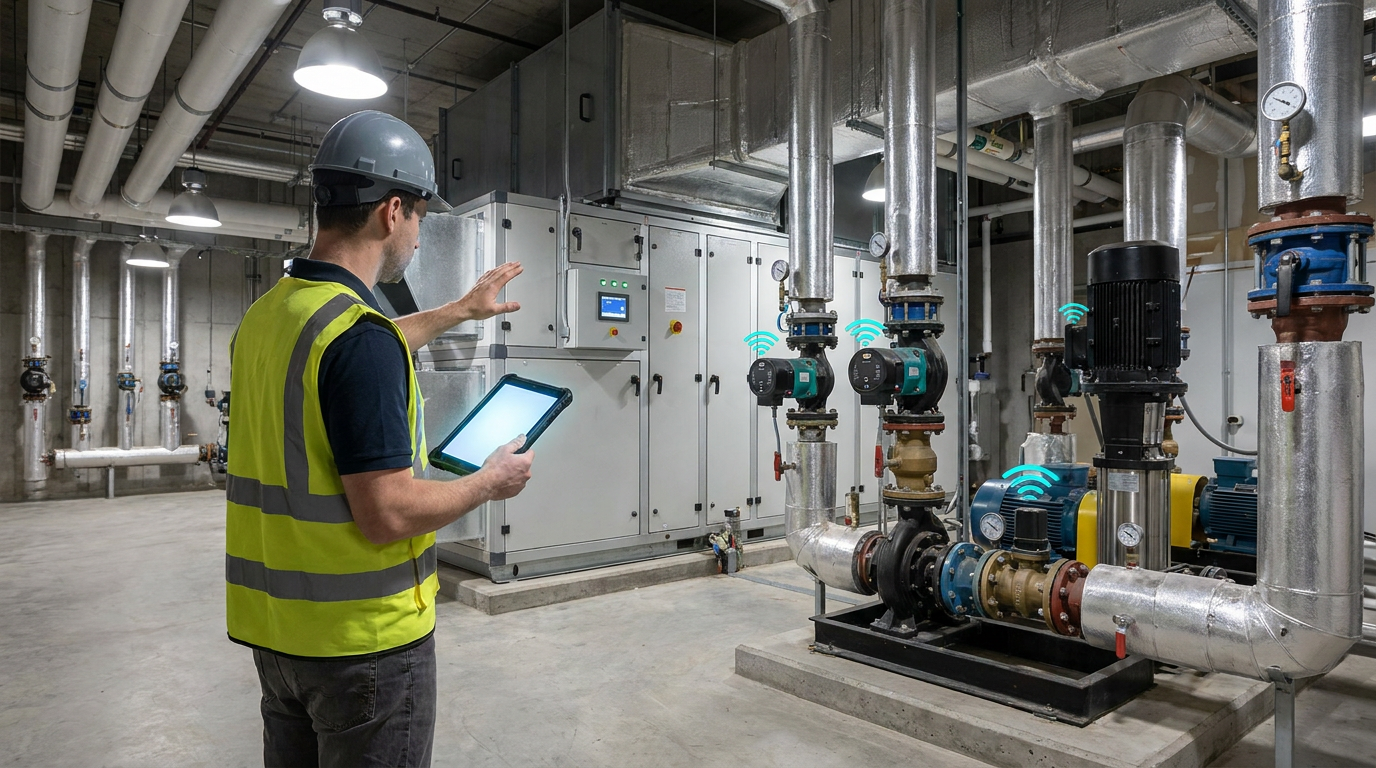
Most predictive maintenance programs follow a sequence that starts with data capture and ends with prioritized intervention. The first layer is instrumentation. Smart buildings use IoT sensors, embedded equipment controls, building automation systems, submeters, and connected field devices to monitor asset conditions. Some properties begin with native data from newer systems, while older assets may need retrofit sensors to measure vibration, temperature, leaks, energy draw, or runtime behavior.
The second layer is data aggregation. Information from separate devices needs to flow into a platform where it can be cleaned, standardized, and compared over time. This is often where many property organizations discover the real challenge. Data quality matters more than dashboard aesthetics. If naming conventions differ across buildings, if sensor intervals are inconsistent, or if work order logs are incomplete, the resulting predictions will be weaker. Strong implementation depends on creating a structured operational dataset that links assets, locations, maintenance history, and current performance signals.
The third layer is analytics. This may include threshold-based alerts, trend analysis, anomaly detection, and machine learning models trained on historical equipment behavior. In practical terms, analytics can answer questions such as these: Is this rooftop unit performing outside its seasonal baseline? Is this elevator showing a pattern that often precedes a service failure? Is this boiler cycling more often than expected for current occupancy and weather? These are not abstract technical exercises. They are operational prompts that help teams schedule the right work before disruption occurs.
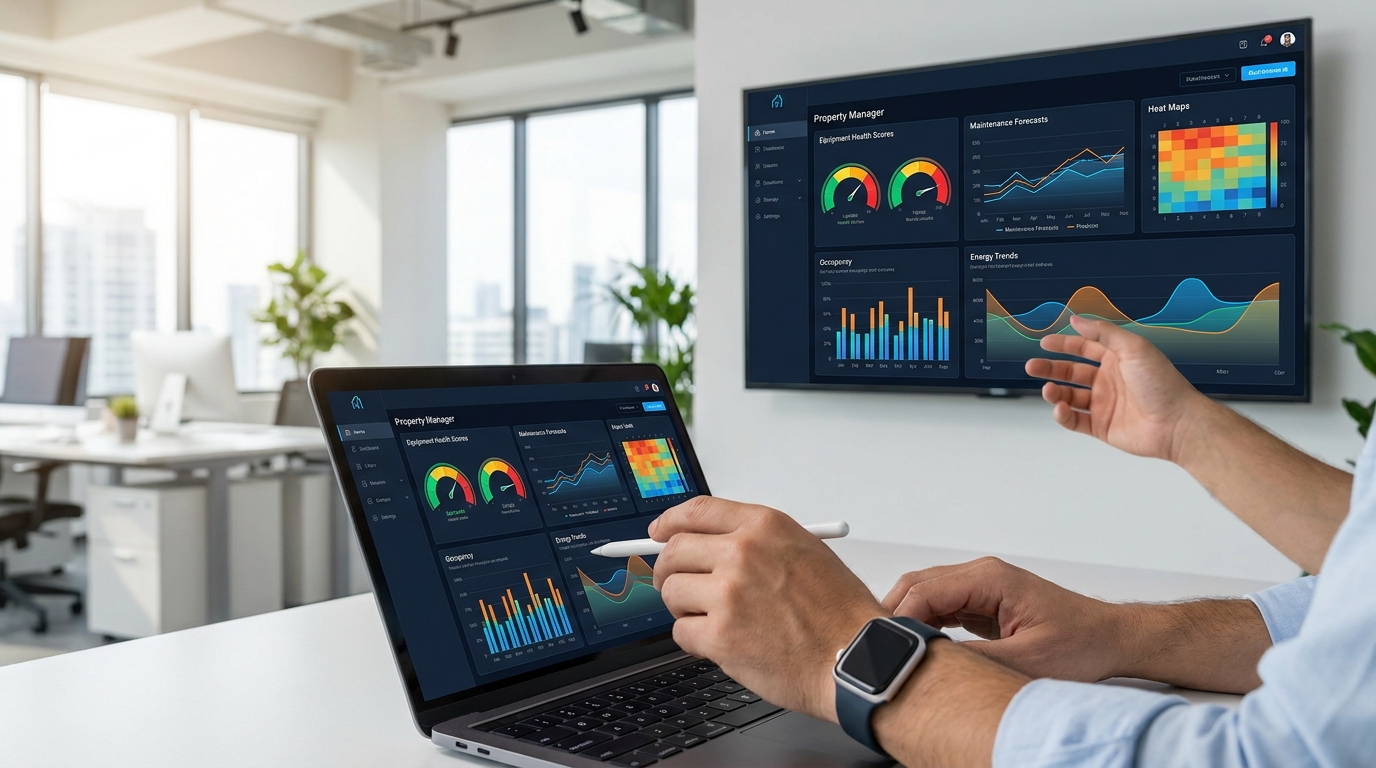
The final layer is workflow integration. A predictive signal becomes valuable only when it leads to useful action. That means alerts should connect directly to maintenance tickets, technician assignments, vendor workflows, inventory checks, and escalation rules. A property manager should not need to manually transfer a dashboard warning into another system just to begin the response process. The most effective smart properties treat predictive maintenance as part of daily operations rather than a separate analytics experiment.
What Data Sources Are Most Useful
The strongest predictive maintenance programs do not depend on a single source of truth. They blend multiple signals to improve confidence and reduce false positives. Common sources include building management systems, HVAC controls, elevator telemetry, leak detection devices, electrical monitoring, occupancy sensors, access control logs, indoor air quality sensors, and energy consumption data. Historical maintenance tickets also matter because they show not only what failed but how often, under what conditions, and at what cost.
Tenant and resident feedback can also be surprisingly useful when interpreted carefully. Repeated complaints about uneven cooling on one floor may indicate a balancing problem, airflow restriction, or an early equipment issue. In multifamily properties, requests related to hot water delays, humidity, odors, or recurring appliance malfunctions may reveal broader operational trends. Predictive maintenance becomes stronger when soft signals from people are paired with hard signals from devices.
External data adds another layer. Weather forecasts, local climate patterns, utility rates, and seasonal occupancy changes all influence equipment strain and maintenance risk. A system that understands when extreme heat is coming can help teams inspect vulnerable assets before the highest demand period begins. That is where predictive maintenance overlaps with resilience planning. It is not only about fixing assets before they fail. It is about preparing the building to perform reliably under changing conditions.
Real-World Applications Across Property Types
Predictive maintenance is highly adaptable because buildings may differ in use, but their core operating problems are often similar. Systems degrade, usage fluctuates, and failures rarely happen at convenient times. In smart property management, the practical question is where predictive methods create the clearest return. The answer usually depends on the assets that are most expensive to repair, most disruptive when unavailable, or most central to tenant experience.
In multifamily housing, HVAC performance, water systems, leak prevention, elevators, and access technology often sit at the top of the list. In office buildings, air quality, energy optimization, chillers, ventilation units, and vertical transportation may deserve greater focus. In mixed-use developments, managers may need to track how different occupancy cycles affect asset stress in retail, residential, and shared infrastructure areas. In every case, predictive maintenance works best when tied to a specific operational risk rather than implemented as a vague innovation initiative.
A useful way to understand the concept is to look at practical examples by system category. These examples reflect common conditions found across real estate portfolios and show how predictive maintenance changes decisions before visible disruption occurs.
HVAC and Climate Control
Heating, ventilation, and air conditioning systems are often the first place property teams see value because HVAC is both data-rich and central to occupant comfort. Sensors can track supply air temperature, return air conditions, vibration in fan motors, filter pressure drops, compressor cycling behavior, and energy use per operating hour. When analytics detect that a motor is overheating or a unit is consuming more energy than expected without delivering the same cooling output, the property team can inspect the system before a tenant notices reduced comfort.
Consider a mid-size apartment building during summer. Service requests for warm bedrooms begin to rise on one side of the building, but not enough to suggest a full equipment outage. Sensor data shows that one air handler is running longer than its peers under similar weather conditions, while energy draw is increasing and airflow is gradually declining. A predictive system would flag likely causes such as filter blockage, belt wear, or motor stress. Instead of waiting for a breakdown during peak demand, the manager schedules service proactively, avoiding a larger repair and reducing resident complaints.
In office properties, predictive HVAC maintenance also supports indoor air quality goals. Ventilation systems that drift out of balance can affect comfort, concentration, and employee satisfaction long before failure occurs. Monitoring CO2 levels, particulate matter, humidity, and ventilation runtime helps teams maintain healthier interior environments while reducing unnecessary service cycles.
Water Leaks and Plumbing Systems
Water is one of the most financially destructive risks in real estate because small issues can remain hidden until the damage spreads. Predictive maintenance improves this area through continuous leak detection, pressure monitoring, flow anomaly analysis, and moisture sensing in high-risk zones. Smart sensors placed near water heaters, risers, mechanical rooms, under sinks, and near appliance connections can detect unusual patterns before visible flooding occurs.
Imagine a residential tower where overnight water flow remains slightly elevated in one vertical section of the building, despite low occupancy movement. The increase is too small to trigger attention through billing alone, but a smart system recognizes the pattern as abnormal for that time window. Combined with moisture signals behind a maintenance wall, the platform recommends inspection. Technicians discover a slow leak at a valve connection that could have developed into significant structural and finish damage. The intervention takes hours rather than weeks of restoration.
Plumbing systems also benefit from predictive analysis of pump behavior, pressure irregularities, and hot water demand patterns. In older buildings, these signals can help identify stress points before they lead to outages, tenant dissatisfaction, or expensive emergency response. For owners, this is one of the strongest examples of predictive maintenance as risk reduction rather than just efficiency.
Elevators and Vertical Transportation
Elevators are highly visible assets because tenants and visitors feel their performance immediately. Delays, door issues, noise, and service interruptions affect both convenience and perception of building quality. Modern elevator systems generate detailed telemetry that can support predictive maintenance through motor temperature monitoring, door cycle analysis, brake behavior, vibration patterns, and fault log interpretation.
In a commercial high-rise, for example, one elevator may show a gradual increase in door reopening events during morning peak periods. On their own, these incidents seem minor. Over time, however, they often correlate with alignment wear, sensor issues, or component fatigue. A predictive system surfaces the trend before a full service shutdown occurs. The building team can coordinate maintenance during low-traffic periods, reducing disruption for occupants and limiting the reputational impact of repeated outages.
Vertical transportation is a useful case because it shows how predictive maintenance protects both operational continuity and user experience. The cost of failure is not only technical. It is experiential. Smart property management increasingly recognizes that those two dimensions are connected.
Energy Systems and Electrical Equipment
Electrical panels, generators, lighting controls, submeters, and backup power systems also benefit from predictive monitoring. Abnormal heat signatures, changes in current draw, unusual load behavior, and irregular runtime can indicate developing problems. In larger properties, this can help prevent outages, improve energy efficiency, and support compliance goals. Backup systems are especially important because they may appear healthy until the moment they are needed most.
Properties with solar integration, battery storage, electric vehicle charging, or demand response programs have even more reason to adopt predictive methods. These assets introduce new dependencies into building operations. Monitoring inverter performance, charger health, and storage behavior helps managers maintain reliability across a more complex energy ecosystem. As buildings become more electrified, predictive maintenance is likely to move from a useful option to a basic operational necessity.
The Business Case: Cost, Asset Life, and Tenant Satisfaction
Property owners rarely invest in technology simply because it sounds advanced. They invest when the operating case is credible. Predictive maintenance makes sense because it influences several financial and performance metrics at once. Emergency repairs decline, technician time is used more efficiently, and parts can be ordered with less urgency. Equipment often lasts longer because early intervention reduces the strain of prolonged hidden faults. Energy performance may also improve when inefficient operation is detected early rather than normalized over time.
Budgeting becomes more stable as well. Reactive maintenance tends to create uneven spending patterns, with costly spikes driven by failures that arrive at the worst possible time. Predictive maintenance does not eliminate uncertainty, but it improves planning. Managers can see where risk is accumulating and can phase maintenance activity in a more controlled way. This is particularly valuable for portfolio owners who need to allocate capital rationally across multiple assets.
Tenant satisfaction is another major advantage, though it is sometimes undervalued because it is less direct than maintenance savings. Residents and commercial tenants judge a property through lived reliability. They notice whether elevators work consistently, whether common areas stay comfortable, whether leaks are addressed before damage spreads, and whether recurring problems actually stop recurring. A building that quietly works well creates trust. Predictive maintenance supports that trust by reducing the gap between hidden equipment deterioration and visible service disruption.
In smart property management, the most valuable maintenance event is often the one tenants never experience because the issue was resolved before it became a problem.
There is also an asset value dimension. Well-maintained buildings with reliable systems, stronger performance records, and more efficient operations can be more attractive to investors, lenders, and institutional partners. As data maturity becomes part of property evaluation, the ability to show disciplined predictive maintenance may strengthen an owner’s position in due diligence and long-term strategy discussions.
How to Implement Predictive Maintenance Without Overcomplicating It
One reason some property teams hesitate is the assumption that predictive maintenance requires a fully digitized portfolio from day one. In reality, successful implementation often starts with a narrow focus. The best first step is usually to identify the most failure-prone, high-cost, or tenant-sensitive assets in the building. These could include chillers, boilers, water pumps, elevators, leak-prone plumbing zones, or ventilation units in critical common areas. Starting with a defined problem creates faster learning and clearer returns.
After asset selection, managers need a data inventory. This means asking what information already exists, where it lives, and how reliable it is. Some properties already have strong building automation data but weak work order history. Others have rich service logs but minimal live sensor coverage. The implementation plan should close the most important gaps first. Installing new sensors can be valuable, but often the earliest gains come from organizing data that the building already produces.
Platform choice matters, but workflow design matters more. A predictive tool should fit how the maintenance team actually works. If the software generates too many low-value alerts, staff will ignore it. If it lacks asset hierarchy, service history, or work order integration, the data may be interesting but not operationally useful. Managers should evaluate systems based on practical questions. Can we prioritize by risk level? Can we connect predictions to maintenance tasks? Can our technicians understand why the alert matters? Can we compare results across buildings?
Training is another critical step. Predictive maintenance changes decision habits. Teams must become comfortable interpreting condition-based signals and balancing them with field judgment. The goal is not to replace experienced technicians with software. It is to make their judgment more informed and more scalable. Properties that get this right usually build trust by showing technicians that the system helps them catch real issues earlier rather than adding administrative noise.
A Practical Rollout Sequence
For many owners and operators, a phased rollout is the most effective path. A clear sequence often includes the following steps:
- Select a pilot property or system where failures are costly and data availability is reasonable.
- Define success metrics such as reduced emergency calls, lower downtime, improved first-time fix rates, energy savings, or fewer tenant complaints.
- Connect and standardize data sources including sensors, building systems, and maintenance records.
- Configure alert thresholds and analytics models based on asset type, building conditions, and operational priorities.
- Integrate with maintenance workflows so predictions trigger inspections, work orders, and escalation rules.
- Review outcomes regularly and refine thresholds, workflows, and technician feedback loops.
- Scale gradually across the portfolio once the pilot demonstrates operational value.
This phased structure keeps the project grounded. It allows teams to build confidence through evidence rather than rolling out a broad technology initiative that lacks clear ownership. In practice, the most durable predictive maintenance programs are not the most ambitious at launch. They are the ones that align tightly with real operational decisions.

Common Challenges and How Smart Teams Address Them
Predictive maintenance is powerful, but it is not automatic. One common challenge is poor data quality. Missing maintenance logs, inconsistent equipment naming, disconnected sensors, and duplicate asset records can weaken the analytics layer quickly. Smart teams address this by treating data governance as part of operations, not as a one-time IT project. Clean asset inventories, standard naming conventions, and disciplined work order documentation make the predictive model much more useful over time.
Another challenge is alert fatigue. If the system flags too many anomalies without clear prioritization, teams may stop trusting it. This is why thresholds and models need tuning. The goal is not maximum sensitivity. It is actionable relevance. Managers should classify alerts by severity, confidence, and likely operational impact so technicians know what requires immediate response and what can be observed during routine rounds.
Legacy buildings can also create integration issues. Older equipment may not produce digital data natively, and replacement is not always realistic in the short term. However, retrofit sensors have improved enough that many older assets can still be monitored effectively. Wireless temperature, vibration, moisture, and electrical sensors often provide a useful starting point. The lesson here is that predictive maintenance does not require a perfect smart building. It requires enough reliable signal to support better timing and prioritization.
Internal adoption can be just as important as technical setup. If property leaders present predictive maintenance as a replacement for maintenance expertise, resistance is understandable. The better approach is to frame it as a force multiplier. Experienced technicians know the sounds, smells, and performance quirks of a building. Predictive systems add memory, pattern detection, and portfolio-wide visibility. Together, those capabilities are much stronger than either one alone.
The Role of AI in the Next Generation of Building Maintenance
Artificial intelligence is making predictive maintenance more capable by improving how systems detect anomalies, compare assets, and forecast failures. Earlier tools often relied on simple thresholds such as a temperature crossing a set limit. Newer systems can model normal behavior under different conditions and identify subtler deviations. This is especially useful in buildings because equipment performance is influenced by weather, occupancy, control logic, and time of day. AI helps distinguish between a temporary operational shift and an emerging maintenance issue.
Another important development is natural language analysis. Maintenance notes, vendor reports, inspection comments, and tenant complaints contain valuable information, but they are often unstructured. AI tools can extract recurring themes from these text sources and connect them to equipment data. For example, repeated comments about stale air in one wing of a property may align with rising fan energy use and declining airflow metrics. That combination creates a much stronger signal than any one input would on its own.
Portfolio benchmarking is also improving. AI can compare similar assets across buildings to identify outliers earlier. If one pump in a group of comparable properties is wearing faster than expected, the system can highlight the discrepancy even before on-site teams recognize the trend. For owners managing multiple buildings, this kind of cross-asset intelligence creates a strategic advantage. It shifts maintenance from isolated site management to networked performance management.
Looking ahead, predictive maintenance will likely blend with prescriptive maintenance. Instead of only forecasting failure, systems will increasingly recommend the best course of action based on cost, urgency, parts availability, technician capacity, and tenant impact. That progression matters because property operations are not just about knowing what may happen. They are about choosing the most efficient response in context.
What the Future Means for Smart Properties
The future impact of predictive maintenance in real estate is likely to be broad because it connects to several long-term trends at once. Buildings are becoming more connected, more electrified, more sustainability-focused, and more performance-measured. Occupants also expect reliability in the same way they expect digital convenience. As these pressures increase, maintenance can no longer remain a mostly reactive back-office function. It becomes part of the intelligence system that shapes operational quality and asset competitiveness.
In smart residential properties, predictive maintenance may become closely tied to resident experience platforms. A leak sensor, appliance monitor, or HVAC anomaly could trigger both a maintenance workflow and a communication workflow, keeping residents informed before they need to submit a complaint. In commercial real estate, predictive insights may connect to leasing strategy, energy management, ESG reporting, and workplace experience metrics. The maintenance function starts to influence more than repair outcomes. It becomes part of the property’s broader value proposition.
Insurance and compliance implications may also grow. As more buildings can document active monitoring and early intervention practices, insurers may view certain risks differently. Lenders and investors may also place greater value on properties with strong operational visibility and documented asset performance. Predictive maintenance is not only a maintenance story. It is increasingly part of how institutional real estate evaluates resilience and operational maturity.
There is also a social dimension. Better maintenance means safer living conditions, more stable indoor comfort, fewer severe disruptions, and more responsible stewardship of housing assets. In a sector where deferred maintenance can damage both value and trust, predictive methods offer a practical path toward more accountable property care.
Conclusion: From Scheduled Tasks to Intelligent Property Care
Predictive maintenance transforms smart property management because it changes the timing and quality of maintenance decisions. Instead of relying mainly on fixed schedules or waiting for visible failure, property teams can act on evidence from sensors, historical patterns, and operational context. That shift improves cost control, strengthens tenant satisfaction, protects equipment life, and helps buildings perform more reliably in everyday use.
The strongest implementations are not necessarily the most complex. They begin with clear priorities, focused asset selection, reliable data, and workflows that connect predictive insight to field action. For owners and managers, the opportunity is to make maintenance less reactive, less fragmented, and more strategic. In a market where smart property performance increasingly shapes both resident experience and asset value, that is a meaningful operational advantage.
Predictive maintenance is best understood as practical intelligence for the built environment. It helps buildings tell us what they need before minor problems become expensive failures. For the future of smart properties, that may be one of the most important shifts in management strategy. Better data does not just help us understand buildings. It helps us care for them with greater precision, consistency, and foresight.



No Comment! Be the first one.