



Water infrastructure rarely dominates public conversation until something goes wrong. A boil water advisory, a flooded intersection, a development delay caused by capacity limits, or a drought restriction can suddenly make clear what planners, developers, and municipalities already know: a city is only as resilient as the systems that move, treat, store, and protect its water. In a period defined by population growth, climate uncertainty, and aging assets, resilient water systems have moved from the background of urban planning to the center of it.
Table Of Content
- Why resilient water systems now sit at the center of urban development
- The end of siloed planning
- What a resilient urban water system actually includes
- Climate adaptation is now a basic design requirement
- How climate-ready design changes urban projects
- Housing growth and water capacity are now inseparable
- The role of digital systems, data, and asset intelligence
- Why water reuse and efficiency are moving into the mainstream
- Equity, national resilience, and the full settlement system
- What municipalities and development leaders should prioritize next
- Common misconceptions that still hold cities back
- Conclusion: resilient water systems are city-building systems
That shift is not theoretical. Across Canada and North America, governments are increasingly treating water, wastewater, and stormwater infrastructure as essential platforms for housing supply, public health, and long-term economic growth. Federal materials in Canada explicitly connect these systems to community expansion and reliable service delivery, while recent funding programs reinforce the reality that utility capacity now shapes whether cities can intensify, greenfield areas can proceed, and existing neighbourhoods can absorb new residents. This is an important strategic change because it reframes water infrastructure as a city-building issue rather than a narrow technical service.
At the same time, municipalities are under pressure from multiple directions. They must replace pipes and facilities built for a different era, respond to more intense rainfall and changing watershed conditions, and stretch capital budgets across competing priorities. The United States Environmental Protection Agency estimates that $472.6 billion is needed over 20 years for drinking water infrastructure alone, including $312.6 billion for distribution and transmission pipelines. While Canadian numbers differ by municipality and region, the scale of deferred investment and future need is broadly similar enough to offer a useful benchmark. The core message is simple: future-ready urban development depends on water systems that are not only larger, but smarter, more integrated, and more adaptable.
This is where resilience becomes the right framework. A resilient water system is not defined by one asset class or one funding stream. It is a coordinated urban system that can deliver safe drinking water, manage wastewater, absorb storm events, reduce leakage, protect watersheds, support new housing, and respond to disruption without failure. It has to work in periods of abundance and in periods of stress. It has to function across old urban cores, fast-growing suburbs, peri-urban edges, and underserved communities. Most of all, it has to be planned with a long-term view.
Future-ready cities will not separate land use from water capacity. They will treat resilient water systems as foundational infrastructure for housing, public health, and economic growth.
Why resilient water systems now sit at the center of urban development
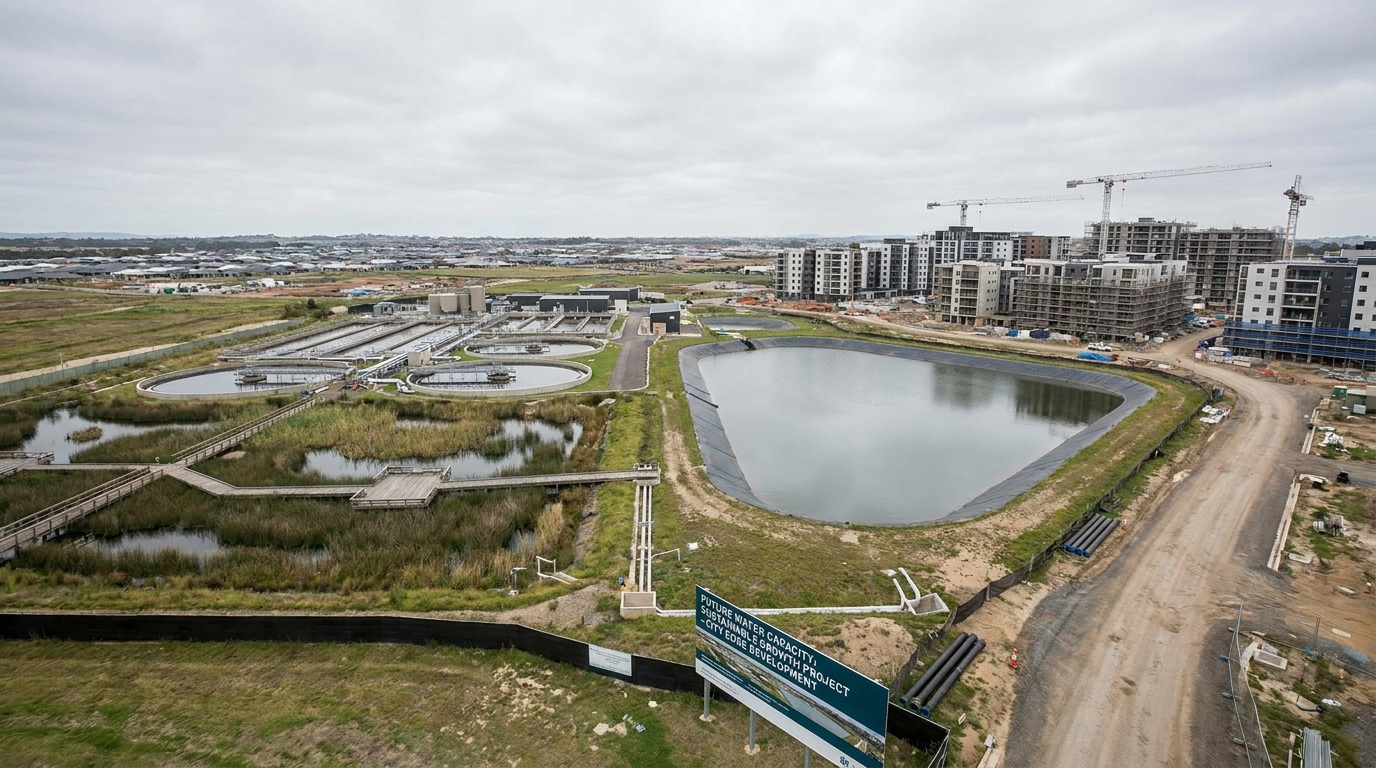
The first reason is growth. Cities across Canada continue to face substantial pressure to add housing, intensify around transit, and open new areas for development. Yet no matter how strong the policy case for more homes may be, projects cannot move forward if the underlying water and wastewater networks lack capacity. Water servicing constraints are increasingly becoming a hidden ceiling on growth. In practical terms, that means the path to more housing is tied directly to treatment upgrades, trunk mains, pumping systems, storage, and stormwater infrastructure.
The second reason is asset age. Much of the infrastructure under North American cities was built decades ago and is reaching the end of its service life. Buried pipes are easy to defer because they are invisible to most residents, but deferral carries long-term cost. Leaks increase non-revenue water loss, breaks disrupt service, infiltration can burden wastewater systems, and undersized networks limit intensification. The challenge for urban leaders is not simply replacing old assets as they fail. It is replacing them in a way that reflects the city that is emerging, not the city that existed when those systems were first installed.
The third reason is climate risk. Canadian freshwater science has made clear that warming temperatures, smaller snowpacks, earlier melt, and changing precipitation patterns can produce very different kinds of pressure across regions. Some areas will face more severe drought conditions. Others will experience more intense rainfall and flood events. Many will face both, depending on season and watershed. This matters because conventional water planning often assumed a relatively stable climate baseline. That assumption no longer holds, and resilient design now requires a broader and more dynamic understanding of hydrology.
The fourth reason is governance. Canada has strengthened the national conversation on water through investments, freshwater coordination, and the creation of the Canada Water Agency, which was backed by $85.1 million over five years plus $21 million ongoing. At the same time, federal housing and infrastructure programs increasingly link growth objectives to utility readiness. That trend is strategically important because it encourages cities, utilities, and development stakeholders to plan together rather than in sequence. When those systems align early, projects move more efficiently and public money is used more effectively.
The end of siloed planning
One of the most important changes in modern infrastructure strategy is the move away from siloed planning. For decades, cities often treated drinking water, wastewater, stormwater, transportation, parks, and land use as separate disciplines with separate timelines. That structure can work in a stable environment with incremental change, but it struggles when a city is growing quickly and facing climate volatility. A pipe replacement project may miss an opportunity to coordinate with road reconstruction. A new subdivision may be approved without enough watershed context. A flood mitigation strategy may proceed without considering future land use intensity.
Integrated urban water management responds to this problem by treating the full water cycle as part of one planning system. In this model, source water protection, treatment, distribution, wastewater collection, stormwater retention, reuse, and receiving-water health are analyzed together. The objective is not just technical performance. It is also urban performance. The question becomes how water systems can support a city that is denser, more climate-resilient, more efficient, and more liveable.
This integrated approach is also more realistic financially. Municipalities cannot rebuild every piece of infrastructure at once, so they need a framework that helps them prioritize investments with the broadest long-term return. A stormwater retrofit that also improves public realm quality, reduces flood claims, and protects downstream infrastructure may offer more value than a single-purpose intervention. A treatment plant upgrade aligned with growth phasing may unlock housing while reducing lifecycle risk. Integrated planning allows cities to see these compounding benefits clearly.
It also improves decision quality. When planners, engineers, housing teams, environmental specialists, and finance departments work from a shared growth and resilience model, tradeoffs become visible earlier. That creates better sequencing, stronger business cases, and more credible public communication. In other words, integration is not just a technical ideal. It is a governance strategy for building cities more intelligently.
What a resilient urban water system actually includes
There is a common misconception that resilience can be achieved by replacing old pipes alone. Pipe renewal is essential, but it is only one layer of the system. In reality, resilient urban water infrastructure combines engineered assets, natural systems, data, policy, and land-use coordination. The strength of the model comes from how these pieces work together.
At the drinking water level, resilience includes source water protection, treatment redundancy, storage, distribution reliability, and leakage reduction. Safe supply depends not only on treatment plants but also on healthy watersheds, flexible conveyance networks, and enough storage to absorb peaks, emergencies, and service interruptions. As cities grow, redundancy becomes especially important because highly optimized systems with no backup capacity can be efficient in normal conditions but fragile during disruption.
At the wastewater level, resilience means maintaining collection systems, reducing inflow and infiltration, modernizing treatment processes, and planning for higher service demand. Wastewater infrastructure is often overlooked in development discussions, but it is just as important as drinking water capacity. Treatment limits can become hard constraints on expansion, and failure to invest can result in environmental non-compliance, service risk, and escalating costs later.
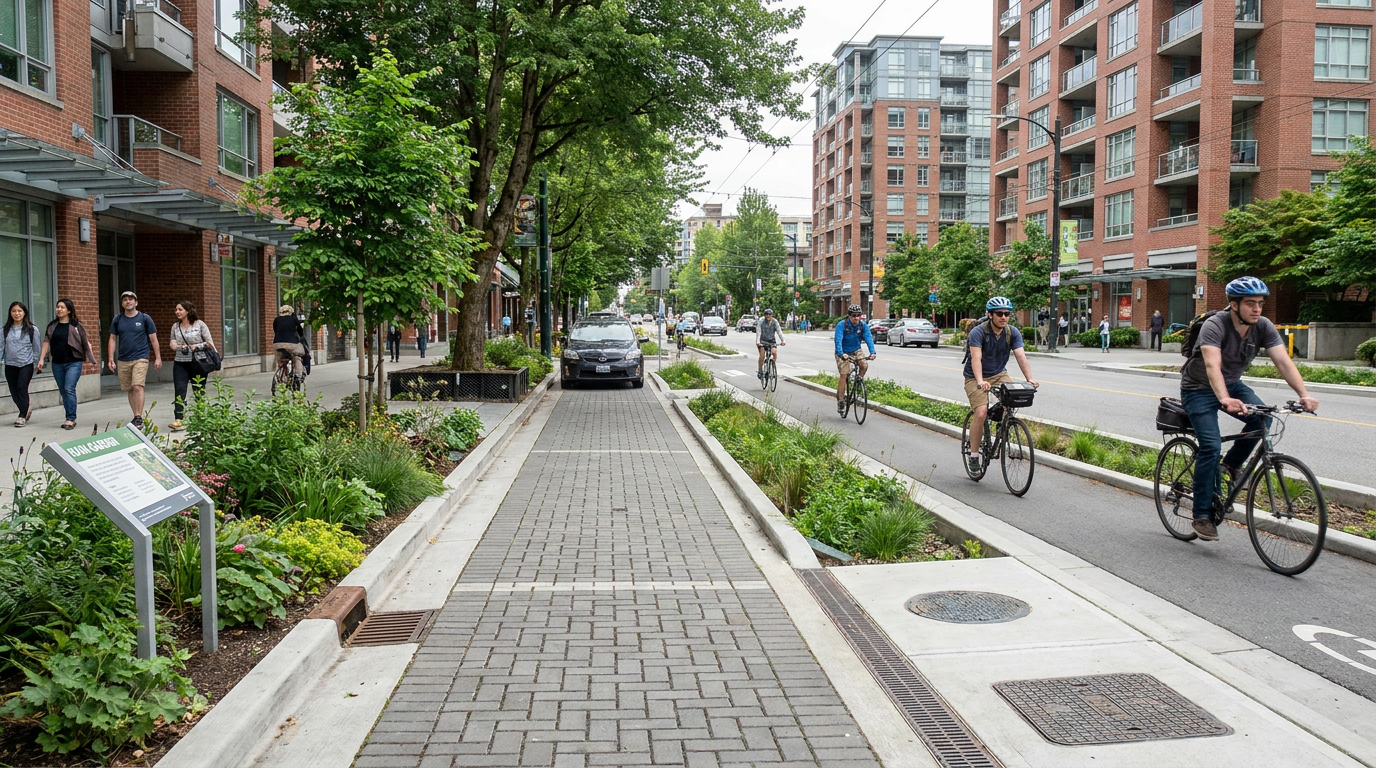
At the stormwater level, resilience has become far more sophisticated than traditional drainage alone. Instead of moving runoff away as quickly as possible, leading practice increasingly focuses on managing water where it falls, slowing flows, improving infiltration, reducing pollution, and protecting downstream systems. This is where low-impact development, retention and detention systems, permeable surfaces, urban tree canopy, wetlands, and bioswales come into play. These measures are especially effective when embedded into street design, parks planning, and site plan approvals from the outset.
Digital capability is another major component. Smart monitoring, leak detection, GIS-based asset management, predictive maintenance, and real-time controls can significantly improve system performance. They help utilities detect failures earlier, prioritize capital spending better, and respond more effectively during storms or supply stress. In a future-ready city, digital water systems are not a luxury feature. They are part of how municipalities extend asset life and use limited capital more strategically.
To understand the full picture, it helps to think about resilient systems across several linked dimensions:
- Capacity, which determines whether a city can safely support existing residents and planned growth.
- Reliability, which reflects how consistently water services perform under normal conditions.
- Adaptability, which measures how well systems handle drought, flood, contamination risk, or demand shifts.
- Environmental performance, which includes watershed health, receiving-water quality, and ecological protection.
- Financial sustainability, which shapes whether infrastructure can be maintained, renewed, and expanded over time.
Climate adaptation is now a basic design requirement
For many years, resilience was treated as an added consideration. Today it is a baseline requirement. Climate conditions are changing the assumptions that underlie water planning, from reservoir yield estimates to storm sewer sizing to floodplain risk. Municipalities that continue to design around historical averages will expose themselves to higher operational and financial risk over time.
In the Canadian context, climate adaptation has to account for both too much water and too little water. More intense rainfall can overwhelm conventional drainage networks, flood roads and basements, erode channels, and damage public infrastructure. Reduced snowpack and altered runoff timing can also affect supply availability, particularly in systems dependent on seasonal recharge and snowmelt-fed watersheds. That dual condition is why resilience cannot be limited to flood mitigation alone. Drought planning, conservation strategy, storage flexibility, and reuse all belong in the same conversation.
Nature-based solutions have gained importance precisely because they address several of these pressures at once. Wetlands restoration, urban greening, and distributed stormwater landscapes can reduce runoff volumes, improve water quality, buffer heat, and support biodiversity. International Water Association materials reflect a growing emphasis on these hybrid approaches because they strengthen climate resilience without relying solely on hard infrastructure expansion. The key point, however, is balance. Green infrastructure is not a complete substitute for gray infrastructure. The strongest urban systems combine both.
That hybrid logic is worth emphasizing because it corrects another common misconception. Cities do not have to choose between pipes and parks, between treatment plants and wetlands, or between concrete channels and natural systems. In most cases, the strategic answer is coordinated layering. Gray infrastructure delivers essential conveyance, treatment, and storage. Green infrastructure reduces pressure on those systems, improves urban conditions, and adds resilience where single-purpose engineering can fall short. The city that performs best in the future will likely be the one that uses both most intelligently.
How climate-ready design changes urban projects
Climate-informed planning changes project design at every scale. At the regional level, it affects watershed protection, source water strategy, and long-term supply modelling. At the community level, it shapes secondary plans, growth boundaries, servicing phasing, and open space systems. At the site level, it influences grading, infiltration design, landscape strategy, and building-level water efficiency measures. In each case, resilience improves when water is considered early rather than after land-use decisions have already hardened.
It also changes standards of care. Municipalities increasingly need asset management systems that account for lifecycle risk under changing climate conditions rather than simply standard depreciation schedules. An undersized culvert or vulnerable pumping station may have seemed manageable in the past, but more frequent severe weather can quickly change its risk profile. When that analysis is done properly, investment priority becomes clearer and emergency response becomes more predictable.

Housing growth and water capacity are now inseparable
One of the most significant policy shifts in recent years is the explicit connection between housing delivery and infrastructure readiness. This is especially visible in Canada, where federal policy has increasingly recognized that drinking water, wastewater, and stormwater systems are essential to support housing growth and economic development. The Housing Infrastructure Fund, including a $1 billion direct delivery stream for key municipal services, reflects an increasingly pragmatic understanding of how homes actually get built.
From an urban strategy perspective, this is exactly the right framing. Housing targets are meaningful only if the enabling infrastructure exists. A municipality can approve intensification in principle, but if treatment plants are at capacity, trunk mains are constrained, or stormwater outlets are overburdened, approvals will slow or projects will become financially difficult. Utility planning therefore becomes a central component of growth management. It is not downstream from housing policy. It is part of housing policy.
This relationship also affects land economics. Serviced land carries a different development value than land with major capacity uncertainty. Where cities invest proactively in water infrastructure, they create more certainty for development timelines and more predictability for capital planning. Where infrastructure lags, housing supply can be constrained even in markets with high demand. That has implications not only for affordability but also for employment, municipal revenue, and regional competitiveness.
Strong municipalities are starting to treat this more strategically. Rather than reacting to project-by-project servicing requests, they are using growth forecasts, asset condition data, and watershed analysis to guide infrastructure sequencing. This allows them to identify where upgrades can unlock the most housing, where intensification can be supported efficiently, and where growth should be staged until capacity is improved. Over time, that kind of alignment creates better urban form and lower infrastructure risk.
The role of digital systems, data, and asset intelligence
Resilience depends on physical infrastructure, but it also depends on information. Many water systems still operate with incomplete visibility into leakage, pressure zones, condition risk, or storm response performance. That makes capital planning more reactive than it should be. In a tighter fiscal environment, cities need better data not simply for efficiency, but for confidence. If a municipality knows where failure risk is concentrated, where water loss is highest, or where demand is changing fastest, it can direct scarce funding more productively.
Digital water tools now make that possible at a much deeper level. Utilities can use remote sensors, acoustic leak detection, SCADA integration, smart meters, hydraulic models, and GIS-linked asset databases to create more dynamic operating systems. During storm events, real-time controls can optimize storage and flow routing. During drought periods, demand tracking can support targeted conservation measures. During renewal planning, predictive analysis can help sequence replacements before a break or service disruption occurs.
These tools also matter from a governance perspective because they improve transparency. Better dashboards and reporting can help councils, regulators, and the public understand why certain investments are urgent and how performance is changing over time. That is increasingly important when utilities are asking for rate adjustments or defending long-term capital plans. Strong data turns resilience from an abstract goal into a measurable management practice.
There is also a broader development benefit. As municipalities improve digital visibility, they can provide developers with clearer servicing information and more reliable long-range infrastructure forecasts. This reduces uncertainty, supports better phasing decisions, and helps integrate private investment into public infrastructure timing. In fast-growing regions, that improvement in coordination can have meaningful effects on project delivery.
Why water reuse and efficiency are moving into the mainstream
Across North America, drought resilience research and policy are bringing water reuse and efficiency closer to the mainstream of urban planning. This shift is not limited to arid regions. Even water-rich jurisdictions are recognizing that conservation, demand management, and reuse can provide strategic flexibility as climate patterns become less predictable and treatment costs rise. Resilience is not only about producing more supply. It is also about using available water more intelligently.
Urban water efficiency begins with fundamentals such as leak reduction, metering, fixture standards, and public education. These measures can significantly reduce demand growth at a relatively low cost compared with major supply expansion. For municipalities facing tight capital budgets, conserving existing capacity can be one of the most cost-effective forms of infrastructure strategy. Every litre not lost to leakage or unnecessary use is capacity that can support households, industry, or environmental flows.
Reuse adds another layer. Depending on regulation and local conditions, reclaimed water can be used for irrigation, industrial processes, or other non-potable applications, reducing pressure on treated drinking water supplies. Over time, a circular water economy approach may become more common in large growth areas where water stress, energy costs, and development pressure intersect. The strategic value is not just environmental. It is operational. Reuse diversifies the system and creates more options under stress.
For developers and planners, this trend opens the door to more sophisticated district-scale design. Large master-planned communities, institutional campuses, and employment zones may be able to incorporate shared systems, advanced stormwater retention, and reclaimed water opportunities where economics and regulation align. That kind of innovation will not fit every site, but it will become increasingly relevant in places where capacity constraints are shaping urban growth decisions.
Equity, national resilience, and the full settlement system
Any serious discussion of resilient water systems in Canada must include the broader settlement system beyond major metropolitan areas. National resilience is not achieved if only the largest cities modernize while smaller municipalities, northern communities, peri-urban areas, and First Nations continue to face significant infrastructure gaps. Water security is a public health issue, a development issue, and a justice issue all at once.
Federal reporting has highlighted ongoing work to improve drinking water and wastewater systems in First Nations communities, yet it also shows that substantial performance gaps remain. One reported figure notes that 67.4 percent of wastewater systems in First Nations communities produced treated effluent meeting regulated requirements in 2023 to 2024. That statistic matters because it reminds policymakers and urban leaders that resilience must be understood at a national scale. A country cannot claim future-ready water infrastructure while serious service disparities persist.
This point is relevant to urban development because metropolitan growth does not happen in isolation. Regional systems are connected through supply chains, labour markets, environmental systems, and migration patterns. Investment standards established in one part of the country influence expectations in others. A resilient national framework therefore requires more than big-city upgrades. It requires coordinated support for communities with different geographies, governance structures, and infrastructure baselines.
From a strategic perspective, equity and resilience should not be treated as competing priorities. In fact, they reinforce one another. The more inclusive and reliable the overall water system becomes across the country, the stronger the economic and environmental foundation for long-term growth. Cities benefit when the broader settlement network is healthier, more dependable, and less exposed to chronic infrastructure shortfalls.
What municipalities and development leaders should prioritize next
The next phase of resilient water planning will require discipline, not just ambition. There is no shortage of concepts in the market, but cities need clear frameworks that connect infrastructure spending to measurable development and resilience outcomes. The most effective organizations will likely be those that move from isolated projects to multi-decade implementation strategies grounded in land use, watershed conditions, asset risk, and financial realism.
Several priorities stand out. The first is stronger alignment between growth planning and utility capital planning. Municipalities should know where housing and employment growth are intended to go, what servicing limitations exist, and which investments can unlock the greatest long-term benefit. The second is climate-informed asset management, including better modelling of flood, drought, and lifecycle risk. The third is wider use of hybrid systems that combine gray capacity with green performance. The fourth is expanded use of digital monitoring and data-driven operations. The fifth is proactive demand management through efficiency and, where viable, reuse.
These priorities can be translated into a practical implementation agenda:
- Map growth against water capacity so that intensification and expansion decisions are linked to realistic servicing plans.
- Upgrade critical aging assets with a focus on high-risk pipelines, treatment bottlenecks, storage constraints, and vulnerable pump stations.
- Embed stormwater resilience into urban design through low-impact development standards, retention features, permeable surfaces, and naturalized systems.
- Invest in digital visibility using sensors, leak detection, predictive maintenance tools, and integrated asset data.
- Use watershed-scale planning to coordinate development with hydrologic realities and source water protection.
- Expand conservation and reuse strategies where they can extend capacity and reduce long-term system stress.
- Build governance capacity so planners, utilities, finance teams, and development stakeholders make decisions from a shared framework.
None of these priorities are simple, but they are more achievable when approached as part of one strategic agenda rather than a set of disconnected initiatives. This is especially true in regions trying to reconcile growth targets with fiscal constraints. The goal is not perfection in one capital cycle. The goal is directional clarity and disciplined progress over time.
Common misconceptions that still hold cities back
Despite growing awareness, several misconceptions continue to weaken infrastructure decision-making. The first is the idea that water resilience can be solved by pipe replacement alone. Pipe renewal is fundamental, but resilience also requires watershed planning, stormwater design, storage strategy, digital monitoring, reuse, and emergency preparedness. Cities that focus on only one layer of the system often leave major risks unresolved.
The second misconception is that green infrastructure can replace all conventional infrastructure. It cannot. Bioswales, wetlands, and permeable surfaces are powerful tools, but they work best as part of a hybrid network that also includes treatment plants, trunk systems, reservoirs, and engineered storage. Framing the issue as green versus gray creates false choices and weaker outcomes.
The third misconception is that climate adaptation is mainly a concern for coastal or flood-prone cities. In reality, Canadian science points to a broader landscape of risk that includes drought, altered snowmelt patterns, intense rainfall, and watershed stress in many regions. Every municipality should be asking how changing hydrology affects supply reliability, stormwater performance, and infrastructure exposure.
The fourth misconception is that water infrastructure is only a utility issue. Federal policy direction increasingly rejects that view, and for good reason. Water capacity influences housing starts, business investment, neighbourhood health, emergency resilience, and long-term municipal finances. Once this is understood, water strategy becomes one of the most consequential elements of urban development planning.
Conclusion: resilient water systems are city-building systems
Resilient water infrastructure should be understood for what it truly is: a foundational city-building system. It supports housing production, protects public health, enables economic growth, reduces climate risk, and shapes the long-term feasibility of urban expansion. In a period of rapid change, it is not enough to maintain yesterday’s networks. Cities need systems designed for tomorrow’s pressures and opportunities.
The good news is that the strategic direction is becoming clearer. Federal funding and policy are increasingly aligned with the need to modernize water, wastewater, and stormwater systems. Nature-based solutions are gaining legitimacy alongside conventional engineering. Digital monitoring is making asset decisions more intelligent. And the connection between infrastructure readiness and housing delivery is now much more explicit than it was even a few years ago.
The challenge now is execution. Municipalities, utilities, planners, and development leaders have to move beyond siloed thinking and build integrated frameworks that connect land use, climate adaptation, finance, and water management. The regions that do this well will not only reduce risk. They will be better positioned to grow, to attract investment, and to deliver the kind of urban future that is both resilient and liveable.
In the end, water is not just a service network under the ground. It is a strategic determinant of how cities function above it. If urban Canada and its North American peers want to build future-ready communities, resilient water systems must be planned as essential infrastructure for the next generation of development.



No Comment! Be the first one.