



Land entitlement is one of the most important and least understood phases of real estate development. To the public, a project often appears to begin when construction fencing goes up or when excavation starts. In reality, the most consequential work frequently happens much earlier, through a layered process of policy review, municipal approvals, technical studies, agency input, and strategic negotiation. Before a site can become housing, commercial space, or a mixed-use community, the developer must establish that the intended use is legally permitted, physically supportable, and politically approvable.
Table Of Content
- What Land Entitlement Really Means
- Why Entitlement Matters for Land Value, Feasibility, and Housing Supply
- The Legal and Planning Framework Behind Entitlement
- Step 1: Start with Rigorous Due Diligence
- Core questions to answer in due diligence
- Step 2: Determine the Required Approval Path
- Step 3: Engage the Municipality Early
- Step 4: Prepare the Application Package and Supporting Studies
- Step 5: Navigate Public Consultation and Agency Review
- Step 6: Secure Core Planning Approvals
- Step 7: Move Through Site Plan Control and Detailed Design Review
- Step 8: Satisfy Conditions, Clear Remaining Approvals, and Advance to Building Permit
- The Biggest Risks in Land Entitlement
- Best Practices for Faster, Stronger Entitlement Outcomes
- Case Study Patterns: What Successful Entitlement Looks Like
- How Entitlement Is Changing
- Final Thoughts
That is the essence of land entitlement. It is the process of securing the rights to develop land in a particular way under the applicable planning framework. In Ontario, which offers a strong reference point for North American land use systems, entitlement typically moves through a hierarchy shaped by the Planning Act, provincial policy, municipal official plans, zoning bylaws, subdivision or consent approvals, site plan control, and ultimately building permits. Each step carries implications for schedule, cost, density, design, and land value.
From a strategic standpoint, entitlement is not just a legal checkpoint. It is a value creation exercise and a risk management discipline. A parcel that is restricted to low-intensity use may be worth dramatically more if it can be approved for residential intensification, mixed-use density, or a subdivision supported by services and infrastructure. At the same time, delays in approvals can erode feasibility through carrying costs, redesign expenses, consultant fees, financing pressures, and market timing risk. In a market facing ongoing housing supply challenges, entitlement sits at the center of how quickly cities can grow and how efficiently land can be put to productive use.
This guide explains the land entitlement process step by step, using Ontario as a representative example while keeping the lessons broadly applicable across North America. It also highlights common misconceptions, practical risks, and best practices drawn from real development patterns. For developers, landowners, planners, and anyone interested in city building, mastering entitlement is essential to understanding how land moves from possibility to permission.
Key insight: Entitlement is where urban vision meets legal reality. The sites that create long-term value are not simply well located. They are well aligned with policy, infrastructure, and a credible path to approval.
What Land Entitlement Really Means
Land entitlement refers to the set of approvals and permissions required before land can be developed for a particular use. These approvals determine whether a proposed project complies with the policy and regulatory framework that governs land use. In practical terms, entitlement answers several foundational questions. Is the use allowed on the site. Is the density acceptable. Can the land be serviced. Does the proposal fit the official plan. Will it require a rezoning, subdivision, site plan approval, or additional environmental review.
One of the biggest misconceptions is that entitlement is the same as a building permit. It is not. A building permit generally comes later and confirms that the detailed construction drawings meet building code and technical standards. Entitlement comes earlier and addresses whether the proposed development is allowed in principle and under what planning conditions. A project can own land for years and still be unable to build if it has not secured the necessary entitlement approvals.
Another common misunderstanding is that private ownership creates automatic freedom to develop. In reality, ownership is only one component of development rights. Municipal zoning, official plan designations, servicing constraints, environmental features, heritage restrictions, transportation impacts, and public consultation all influence what can happen on a site. This is why land entitlement should be viewed as both a legal process and a strategic one. It bridges what a landowner hopes to do and what the broader planning system will permit.
Why Entitlement Matters for Land Value, Feasibility, and Housing Supply
The reason entitlement matters so much is simple. It changes the economic potential of land. A site valued based on its current use may become significantly more valuable if approved for higher density residential, mixed-use redevelopment, industrial expansion, or a serviced subdivision. In that sense, entitlement is often the mechanism that converts raw land value into development land value. The market does not only price location. It prices certainty, timing, and approved use.
For developers, that makes entitlement central to feasibility. Project economics depend on what can actually be built, how long approvals will take, what conditions may be attached, and how much carrying cost the site can absorb during review. A strong location alone does not guarantee a viable project if the entitlement path is weak, contested, or misaligned with policy. Conversely, a less obvious site may become highly attractive if it sits within a supportive growth area, near transit, with servicing capacity and a realistic planning strategy.
Entitlement also matters at the city scale. Recent Canadian research, including work referenced by CMHC, has reinforced that land use regulation has a material effect on housing affordability and supply. If approvals are slow, fragmented, or uncertain, housing takes longer to reach the market and costs rise across the system. That is one reason governments have begun emphasizing streamlined approval processes, e-permitting, one-window review systems, and reforms that support faster delivery of housing and mixed-use growth.

In practical terms, entitlement shapes whether cities can achieve strategic goals such as complete communities, transit-oriented development, intensification, infrastructure efficiency, and a broader range of housing options. It is not an administrative afterthought. It is one of the core levers through which urban growth is managed.
The Legal and Planning Framework Behind Entitlement
Every jurisdiction has its own rules, but the structure of entitlement is broadly similar across North America. The land must be legally permitted for the intended use, physically capable of supporting development, and acceptable within the local political and planning context. In Ontario, the Planning Act is the central provincial statute that governs how land uses may be controlled. It provides the framework for zoning bylaws, minor variances, plans of subdivision, land severances, and the broader process of planning review and approval.
Municipal official plans then establish long-range land use policy. They set the vision for where growth should occur, how intensification should be managed, what areas are designated for employment or residential use, and how infrastructure, transit, and community services should support development. Zoning bylaws translate that higher-level policy into parcel-specific permissions by regulating use, height, setbacks, density, parking, and related development standards.
This hierarchy matters because entitlement applications are reviewed not as isolated proposals but in relation to the full planning framework. A developer who wants to intensify a site cannot focus only on the parcel boundary. The application must be justified through consistency with provincial policy, conformity with municipal planning direction, and compatibility with surrounding context. Where a proposal does not fit current policy or zoning, additional approvals are required to create the rights needed to proceed.
Step 1: Start with Rigorous Due Diligence
The entitlement process should begin long before an application is filed. The first phase is due diligence, and this is where many future problems can either be identified early or ignored until they become costly. Proper due diligence evaluates the site not only from a legal standpoint but also from a technical, financial, and political perspective. The goal is to understand the true approval pathway before major capital is committed.
At a minimum, due diligence should confirm the existing official plan designation and zoning, the surrounding land use context, title issues, easements, access conditions, servicing capacity, environmental constraints, natural heritage features, flood risk, grading challenges, noise sources, transportation implications, and whether the land is subject to site plan control or subdivision requirements. If the site is in a built-up urban area, additional review may be needed for heritage status, shadowing concerns, compatibility, or urban design expectations. If the site is greenfield land, issues like servicing extension, stormwater management, road connections, and subdivision phasing become especially important.
This stage is also where the development concept should be tested against reality. Too many projects begin with an aspirational massing exercise rather than a grounded planning strategy. An effective entitlement approach starts with a realistic development pro forma tied to what the policy environment and infrastructure can reasonably support. It is better to refine expectations early than to spend months advancing a proposal that was never likely to gain approval.
Core questions to answer in due diligence
- What uses are currently permitted on the site under the zoning bylaw?
- Does the official plan support the proposed density, form, and land use?
- Will the project require an official plan amendment, zoning bylaw amendment, minor variance, consent, or plan of subdivision?
- Is there sufficient water, wastewater, stormwater, and transportation capacity to support development?
- Are there environmental, heritage, access, or title issues that could delay or prevent approval?
- What are the most likely sources of public concern or agency comment?
When due diligence is done well, it does more than prevent surprises. It shapes the entire business plan, including acquisition structure, conditional periods, consultant scope, scheduling assumptions, and financing strategy.
Step 2: Determine the Required Approval Path
Once due diligence is complete, the next step is identifying the exact approvals required. This is where entitlement becomes highly local. Two sites that appear similar on the surface may have very different approval paths depending on existing zoning, lot configuration, policy designation, servicing context, and municipal review procedures. In Ontario, to change land use or create new lots, applicants must submit a planning application and obtain approval from the appropriate decision maker, who reviews the proposal against the Planning Act, provincial policy, local official plans, and other applicable rules.
If the proposed use fits the official plan but not the zoning bylaw, the developer may need a zoning bylaw amendment. If the official plan itself does not support the use or density, an official plan amendment may also be required. If the deviation is limited and minor in nature, a minor variance may be appropriate instead of a full rezoning. If the project involves creating new lots, rights of way, or blocks for development, a consent or plan of subdivision may be necessary. If the use is permitted and the lot configuration is already acceptable, the project may move toward site plan control and then building permits.
Choosing the correct path is a strategic decision. Filing the wrong application, or filing too early without enough technical support, can add months of delay. Developers who approach entitlement effectively do not ask only what is technically possible. They ask what sequence is most defensible, what evidence will be required, and what package gives the municipality the greatest confidence in the proposal.
Step 3: Engage the Municipality Early
Before formal submission, early engagement with municipal planning staff is often one of the most valuable steps in the entitlement process. This can happen through pre-application consultation, informal staff meetings, or more structured scoping sessions where the municipality outlines expectations for studies, drawing packages, design issues, and approval sequence. Early dialogue does not guarantee support, but it can dramatically improve the quality of an application and reduce preventable friction.
Municipalities are not only regulators. They are also stewards of long-term growth, infrastructure planning, community character, and public accountability. When a developer demonstrates that the proposal has been designed with local priorities in mind, the conversation becomes more constructive. For example, if the project helps advance housing supply, transit-supportive density, complete communities, or underused land revitalization, those benefits should be clearly articulated from the outset.
At this stage, strong teams often test alternatives. They may review a preferred concept and a fallback concept, compare unit counts against servicing limits, or assess whether public realm improvements could strengthen the planning case. Early engagement is not about asking for permission informally. It is about understanding the decision environment and refining the proposal so that the formal process starts from a stronger position.
Step 4: Prepare the Application Package and Supporting Studies
Most entitlement applications rise or fall on the quality of their supporting material. Municipal reviewers, agencies, and the public need enough evidence to assess whether the project is appropriate. That means an application package typically includes planning rationale, concept plans, survey information, civil engineering drawings, transportation review, servicing analysis, stormwater reports, environmental studies, urban design submissions, landscape concepts, and other technical material depending on the site.
The specific requirements vary by project type. A downtown infill site may need detailed shadow, wind, streetscape, and transportation analysis. A suburban subdivision may require more extensive work on grading, servicing, natural heritage, and road network integration. A severance application may be simpler, but even small projects can be delayed if basic information is incomplete or inconsistent. The central principle is that entitlement is evidence driven. Approvals depend on showing that the project can function on the ground and fit within the policy framework.
Good applications also tell a coherent story. The planning rationale should connect the proposal to provincial policy, the official plan, infrastructure strategy, compatibility, and local needs such as housing supply or employment growth. Technical reports should support, not contradict, that narrative. One of the most common mistakes in entitlement is treating the submission as a set of isolated consultant documents rather than an integrated approval strategy.
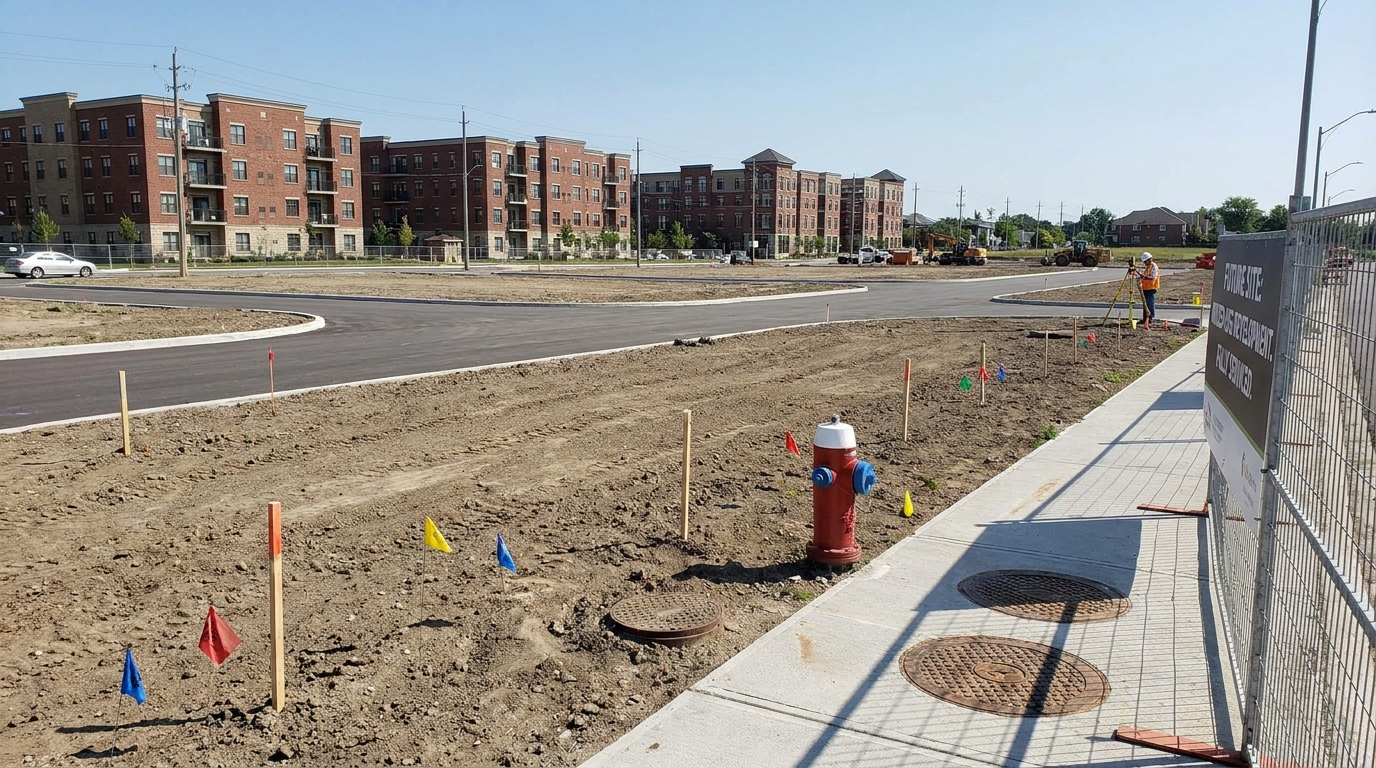
Step 5: Navigate Public Consultation and Agency Review
After submission, the project enters formal review. This typically includes circulation to internal departments and external agencies, along with some level of public consultation. This stage is often underestimated by inexperienced applicants because it introduces the widest range of perspectives and potential delay points. Engineering, transportation, parks, urban design, conservation authorities, school boards, utility providers, and other bodies may all comment depending on the proposal.
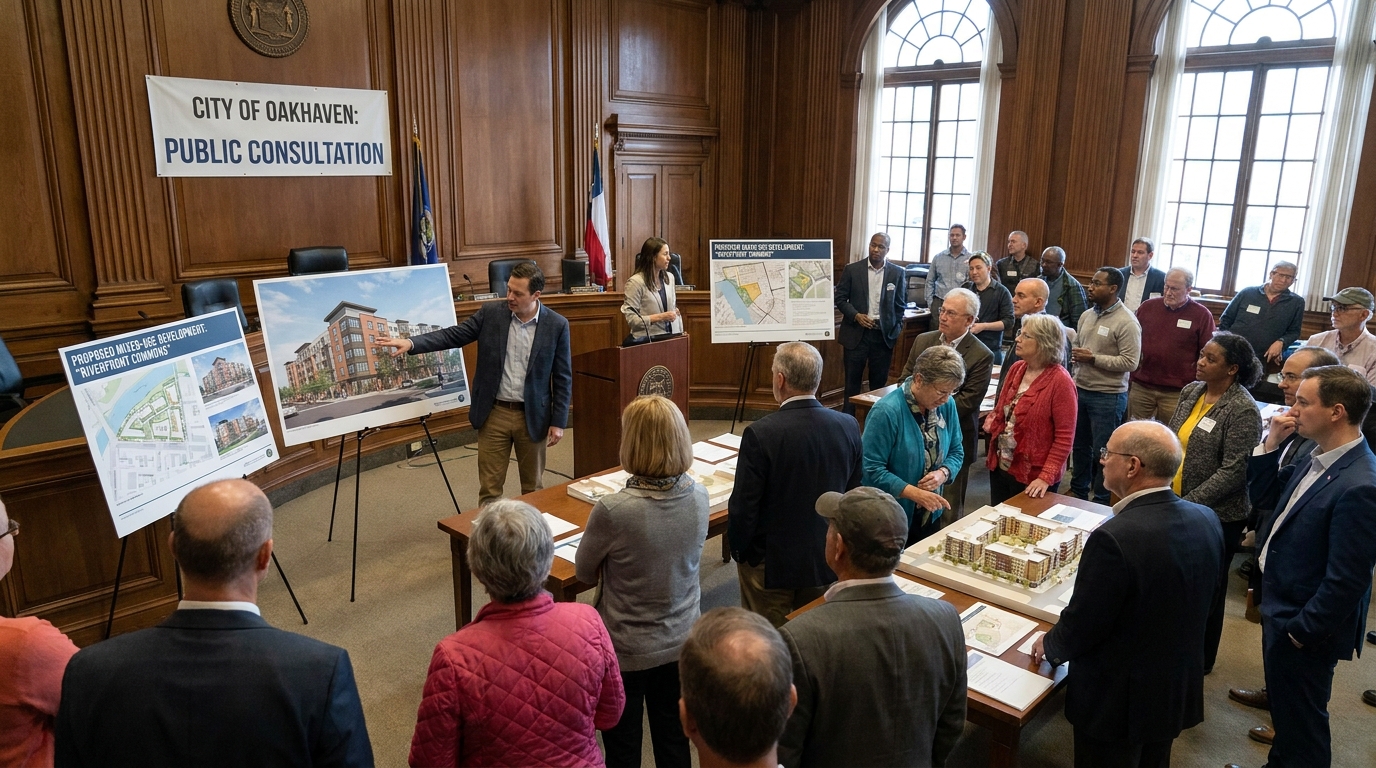
Public consultation is especially important. Even when a project aligns with policy, nearby residents may raise concerns about height, traffic, parking, shadow, servicing, school capacity, privacy, or neighbourhood character. The correct response is not to dismiss those concerns or assume they are merely oppositional. Effective entitlement strategy treats consultation as part of risk management. Some comments may identify real design weaknesses. Others may require clearer communication about what the policy framework already anticipates for the area.
Developers who handle this stage well tend to be transparent, responsive, and disciplined. They explain what the project is, why the site is appropriate, what technical work has been done, and how the proposal contributes to broader municipal goals. Not every objection can be resolved, but many can be mitigated through design changes, clearer servicing explanations, public realm improvements, or better transition to adjacent uses.
Step 6: Secure Core Planning Approvals
The heart of entitlement is obtaining the approvals that establish development rights. Depending on the project, that may include an official plan amendment, zoning bylaw amendment, minor variance, consent, or plan of subdivision. These approvals each serve a different purpose, and understanding the distinction is critical.
An official plan amendment is generally required when the proposal seeks a land use, density, or policy framework not currently supported by the municipality’s long-range planning document. Because the official plan expresses the city’s broader vision, these applications often involve more substantial policy justification. A zoning bylaw amendment translates that policy into specific permissions on the site, such as use, height, setbacks, parking, and built form standards.
A minor variance is intended for modest relief from zoning provisions where the proposal remains compatible and meets statutory tests. A consent, often referred to as land severance, is used to divide land, create easements, or establish rights of way in situations that do not require a full subdivision. A plan of subdivision is used for more complex land division, especially where roads, blocks, services, or multiple lots are being created. Ontario guidance emphasizes that subdivision approval exists to confirm that land is suitable for its proposed use and conforms to official plans, zoning, and provincial policy.
The strategic issue is that these approvals are not just forms. They are the legal architecture of the project. They define what can be built, how lots are configured, what conditions must be satisfied, and in what sequence later approvals can occur. Any weakness here can ripple through the rest of the development process.
Step 7: Move Through Site Plan Control and Detailed Design Review
Once the major land use permissions are in place, many projects proceed into site plan control. This step focuses on the detailed design and functional layout of the development. It reviews matters such as building placement, access, circulation, landscaping, grading, drainage, servicing interfaces, loading, lighting, and compatibility with nearby properties. Site plan control is often where broad planning approval becomes buildable site design.
Developers sometimes underestimate this phase because they assume the major planning battle has already been won. In reality, site plan can still have significant schedule implications. Technical comments may require design revisions, utility coordination, stormwater adjustments, accessibility improvements, or changes to loading and fire access. In urban projects, streetscape treatment, active frontage, bicycle facilities, and public realm quality may receive close scrutiny.
What matters most is continuity between the entitlement concept and the detailed design package. If the submitted site plan materially departs from what was approved through rezoning or other planning permissions, new issues can emerge. Strong execution requires carrying the planning logic through to engineering, architecture, landscape, and servicing design so that the approval path remains consistent.
Step 8: Satisfy Conditions, Clear Remaining Approvals, and Advance to Building Permit
Even after planning approvals are granted, the project may still have conditions to satisfy before it is fully development ready. These can include final engineering drawings, legal agreements, servicing arrangements, easements, road widenings, parkland matters, environmental clearances, utility coordination, or financial securities. In subdivision projects, conditions can be extensive and may involve multiple agencies. This is why entitlement should never be confused with a single yes or no event. It is a staged process in which permissions are progressively secured.
Building permits come after this entitlement foundation has been established. They assess compliance with building code and construction requirements, not whether the land use was appropriate in planning terms. A common misconception is that a rezoning means construction can begin immediately. In many cases, downstream approvals such as site plan, environmental approvals, subdivision conditions, and building permits are still required. Some zoning-order frameworks may establish land use permissions more quickly, but they generally do not eliminate all later approvals.
At this point, the sites that perform best are the ones where entitlement was planned as an integrated sequence from the beginning. Those projects move into permit and construction with fewer redesigns, fewer legal surprises, and more confidence in cost and timing.
The Biggest Risks in Land Entitlement
Entitlement risk is often the largest source of schedule uncertainty in development. It is also one of the most expensive risks because land carrying costs continue while approvals are pending. Financing can become more difficult, market conditions can shift, construction pricing can rise, and municipal policy can evolve during delay periods. The difference between a twelve-month approval path and a thirty-month one can determine whether a project remains feasible at all.
The major risks usually fall into a few categories. Policy risk arises when the proposal is not well aligned with the official plan, provincial policy, or local growth objectives. Technical risk arises when servicing, transportation, environmental, or design issues are not adequately resolved. Political risk arises when public opposition becomes intense or when council support is uncertain. Process risk arises when applications are incomplete, consultant materials conflict, or agency comments are not managed proactively. Legal risk can emerge through appeals, conditions disputes, or title complications.
Ontario’s system includes appeal mechanisms through the Ontario Land Tribunal, which can affect timelines significantly when disputes arise. Appeals are part of the planning framework and should not be viewed simply as exceptional events. In some markets, they are a foreseeable component of entitlement risk. That is why sophisticated developers underwrite entitlement as a phased risk management exercise rather than assuming a straight line from submission to approval.
Best Practices for Faster, Stronger Entitlement Outcomes
The projects that secure approvals efficiently usually share a common discipline. They begin with facts, align with policy, and respect the full complexity of the process. Speed does matter, but speed without preparation often creates rework. The goal is not merely a fast application. The goal is a credible application that can withstand scrutiny and move with fewer interruptions.
- Start with realistic assumptions. Base land pricing and project feasibility on an evidence-based entitlement path, not optimistic zoning scenarios.
- Match the concept to the planning framework. Projects that support local goals such as housing supply, transit-supportive density, and complete communities are easier to defend.
- Invest in early technical review. Servicing, access, environmental, and infrastructure issues should be understood before the formal process begins.
- Build a coordinated consultant team. Planning, engineering, architecture, legal, transportation, and environmental work should tell one consistent story.
- Engage early and communicate clearly. Productive municipal dialogue and transparent public consultation often reduce avoidable conflict.
- Underwrite schedule risk honestly. Carrying costs, redesign cycles, appeal exposure, and condition clearance must be reflected in the pro forma.
In today’s environment, another best practice is understanding where streamlining tools exist. Ontario’s Community Planning Permit System, for example, can combine zoning, site plan, and minor variance processes into a single approval stream in designated areas. This does not remove the need for good planning or technical review, but it reflects a broader shift toward more efficient entitlement models where municipalities are prepared to implement them.
Case Study Patterns: What Successful Entitlement Looks Like
While every project is unique, successful entitlement tends to follow a few repeatable patterns. One common pattern is the transit-oriented infill site where existing policy already supports intensification, but zoning has not caught up. In these situations, a well-prepared rezoning application that demonstrates transit support, public realm quality, compatibility, and infrastructure capacity can unlock meaningful value. The strategic insight is that policy support alone is not enough. The entitlement win comes from translating that support into a detailed, defensible application.
Another pattern is the underused suburban or edge-of-city parcel that appears attractive because of size but carries major servicing and subdivision complexity. The projects that succeed here are usually those that treat infrastructure and phasing as central to entitlement, not secondary engineering details. Roads, stormwater, utility coordination, and lot creation strategy are what determine whether the land can actually move to market. In these cases, subdivision approval is the crucial bridge between concept and executable development.
A third pattern is the mixed-use redevelopment site in an area facing housing pressure and municipal growth targets. Here, entitlement success often depends on showing how the project advances broader public objectives. If the application clearly supports housing supply, complete communities, walkability, and efficient land use, it is better positioned than a proposal framed purely in private development terms. This is where strategic city building and project feasibility come together. The most successful proponents understand that good entitlement is not about asking for an exception in isolation. It is about presenting a project as part of the municipality’s long-term growth solution.
How Entitlement Is Changing
Land entitlement is evolving in response to affordability pressures, infrastructure constraints, and the urgency of adding housing more quickly. Across Canada and North America, governments are under pressure to improve approval speed while still protecting public interest. That has led to greater interest in e-permitting, one-window review processes, standardized application requirements, and more proactive alignment between growth policy and implementation tools.
There is also growing attention on transit-oriented development, infill intensification, and complete communities that reduce dependence on sprawl while making better use of infrastructure. In this context, entitlement has become even more important. It is no longer enough to know the rules. Developers and planners must understand how those rules are being reshaped by supply goals, climate considerations, transportation investment, and changing municipal priorities.
The broad lesson is that entitlement remains highly local, but the strategic forces around it are becoming more visible and more consequential. Housing shortages, public infrastructure costs, and urban competitiveness all depend in part on how effectively land use approvals are managed. The ability to navigate entitlement is therefore not only a project skill. It is a core urban growth capability.
Final Thoughts
Understanding land entitlement is essential for anyone serious about development. It is where legal rights, planning policy, infrastructure realities, market feasibility, and public interest intersect. The process can be complex, slow, and occasionally contentious, but it is also where the long-term value of land is most meaningfully shaped. A site becomes truly development ready not when it is purchased, and not when a building permit is issued, but when the entitlement path has been thoughtfully secured.
For developers, the most important discipline is to treat entitlement as a structured sequence of risk decisions rather than a single application. That means doing deep due diligence, choosing the right approval path, aligning with policy, engaging municipalities early, and building a coherent case through strong technical work. For cities, the challenge is to maintain public accountability while reducing unnecessary friction in a system that directly affects housing supply, affordability, and growth quality.
At its best, entitlement is not a barrier to development. It is the framework that ensures growth happens in the right places, with the right infrastructure, and in a way that creates lasting value for both private investment and the broader community. In an era defined by housing demand and urban change, mastering entitlement is not optional. It is foundational to successful development.


No Comment! Be the first one.