



Islamic financing has moved from a specialist conversation into a broader investment discussion, particularly in real estate where the underlying asset is tangible, income producing, and easier to structure around ownership rather than pure debt. For many readers, the subject first appears through the idea of an interest-free home purchase. That description is too narrow. Islamic finance is not simply conventional lending with different terminology. It is a legal and ethical framework that governs how capital is deployed, how profit is earned, how risk is shared, and how financial activity connects to real economic value.
Table Of Content
- Why Islamic Financing Matters in Real Estate
- The Core Principles of Islamic Finance
- Riba: The Prohibition of Interest
- Gharar: The Avoidance of Excessive Uncertainty
- Maysir: The Prohibition of Gambling-Like Speculation
- Linkage to Real Economic Activity
- Islamic Financing Is Not Just “Interest-Free Lending”
- Common Islamic Real Estate Financing Structures
- Murabaha: Cost-Plus Sale
- Ijara: Leasing Structure
- Diminishing Musharaka: Shared Ownership with Gradual Buyout
- Istisna’a: Construction and Development Finance
- How Returns Are Generated in Islamic Real Estate Finance
- Why Islamic Financing Appeals to Ethical and Faith-Based Investors
- Islamic Financing in Canada and North America
- Risk Management and Governance in Islamic Real Estate Investing
- Common Misconceptions Investors Should Avoid
- How to Evaluate an Islamic Real Estate Financing Product
- Strategic Use Cases for Investors
- The Bigger Picture: Growth, Standardization, and Market Maturity
- Conclusion
- Frequently Asked Questions About Islamic Financing and Real Estate
- Is Islamic financing cheaper than a conventional mortgage?
- Can non Muslims use Islamic real estate financing?
- What is the most common Islamic structure for buying a home?
- Does Sharia-compliant mean lower risk?
- Why is real estate so important in Islamic finance?
In real estate, that distinction matters. Property is one of the clearest examples of an asset that can support Sharia-compliant structures because the financing can be linked to a home, a rental building, a development project, or a co-ownership arrangement. Rather than generating returns through interest on money alone, Islamic financing typically relies on asset ownership, trade, leasing, partnership, or services. The economic outcome may at times resemble a conventional mortgage payment in monthly cash flow, but the contract mechanics, title arrangements, and profit treatment can be materially different.
This makes Islamic financing relevant well beyond a narrow religious audience. Muslim investors and homebuyers often pursue it for faith alignment, but non Muslim investors also look at it through the lens of ethical finance, asset-backed discipline, and alternatives to conventional debt models. In markets such as Canada and the United States, where affordability pressures and household debt remain central concerns, interest in alternative ownership structures has grown. Availability is still uneven, product design is highly jurisdiction specific, and legal execution requires care, but the strategic appeal is increasingly clear.
This article explains the principles behind Islamic financing, the most common real estate structures, the practical differences from conventional lending, and the advantages and constraints investors should understand before using it in a wealth-building strategy. The goal is not to present Islamic finance as a universal solution, but to offer a clear investment briefing on how it works, where it fits, and what disciplined decision making looks like in practice.
Key idea: Islamic financing is built around ethical rules, real assets, and shared responsibility. It is not free financing, and it is not automatically lower risk. Its value lies in how profit, ownership, and accountability are structured.
Why Islamic Financing Matters in Real Estate
Real estate sits naturally within Islamic finance because it is tied to physical ownership, measurable value, and identifiable use. A home can be lived in, a commercial property can generate rent, and a development project can create productive housing or business space. This connection to real activity is central to the framework. Islamic legal and ethical principles require financial transactions to avoid detached speculation and to maintain a credible link between money and genuine economic purpose.
That connection helps explain why Islamic finance often appeals during periods of financial stress or public concern over debt. In Canada, financial stability discussions continue to focus on housing affordability, mortgage debt, and correction risk. When conventional borrowing becomes more expensive or more heavily scrutinized, alternative models receive more attention. Islamic structures may offer buyers and investors another route into ownership or project participation, especially when they prefer co-investment, lease-to-own, or trade-based arrangements over a standard interest-bearing loan.
At the same time, real estate concentration can create risk. International analysis has noted that some Islamic financial institutions have significant exposure to property and construction, which can increase vulnerability during real estate downturns. This is an important reminder for investors. The fact that a transaction is Sharia-compliant does not make it immune to valuation pressure, liquidity stress, tenant risk, construction overruns, or macroeconomic weakness. Strong structuring and prudent underwriting remain essential.
The Core Principles of Islamic Finance
To understand Islamic real estate financing, investors need to start with the governing principles. Three concepts appear repeatedly in both scholarship and market practice: riba, gharar, and maysir. Each of these shapes contract design and sets limits on what a compliant financial product can do.
Riba: The Prohibition of Interest
Riba is commonly explained as the prohibition of interest, but the practical lesson for investors is broader. The system seeks to prevent money from generating a predetermined return simply by being lent as money. In conventional finance, the lender advances funds and earns interest over time regardless of whether the underlying asset performs well. In Islamic finance, that return must instead arise through an asset sale, lease payment, partnership profit, or another permissible activity linked to value creation.
For real estate, this means the financier may buy and resell a property at a disclosed markup, acquire the property and lease it to the occupant, or enter a co-ownership arrangement where the buyer gradually purchases the financier’s share. The provider still earns a return. The difference is how that return is legally and ethically justified. Profit is attached to trade, use of an asset, or ownership participation rather than to an interest charge on a loan balance.
Gharar: The Avoidance of Excessive Uncertainty
Gharar refers to excessive uncertainty or ambiguity in a contract. In investment terms, this pushes parties toward clarity in pricing, ownership, obligations, and delivery. A compliant real estate agreement should clearly define what is being bought, leased, or jointly owned, how payments are calculated, which party bears which risks, and what happens if there is damage, delay, or default. Vague contractual exposure is discouraged because it invites unfairness and dispute.
This principle is one reason Islamic products can appear documentation heavy. If the transaction depends on asset transfers and legal relationships rather than a simple lender-borrower formula, the paperwork has to reflect that complexity. For investors, this is not a weakness but a reminder that precision is part of the discipline. Clear contracts reduce mispricing and improve enforceability.
Maysir: The Prohibition of Gambling-Like Speculation
Maysir prohibits gambling-like speculation and transactions driven by pure chance rather than productive activity. In real estate, the practical application is a preference for investment grounded in use, income, construction, or ownership rather than highly speculative structures detached from the asset itself. Investors can still pursue opportunity and profit, but the framework discourages arrangements that resemble betting more than investing.
For property markets, this has a stabilizing logic. Real estate already contains enough uncertainty through vacancy, rates, location shifts, and construction cost swings. Islamic finance does not remove those risks, but it attempts to ensure that participants face them through a transparent and economically meaningful relationship to the asset.
Linkage to Real Economic Activity
A final principle ties the entire framework together. Islamic financing must be connected to real economic activity and ethical standards. This is why real estate is such a prominent use case. A home, warehouse, apartment building, or development site is not abstract. It exists, it serves a need, and it can support returns based on occupancy, rent, or resale. The financier’s involvement is anchored in something tangible, not in purely synthetic financial engineering.
For investors, this principle often enhances discipline. Because transactions revolve around identifiable assets and documented rights, there is less room for hidden leverage or unclear value creation. That does not guarantee superior performance, but it can improve visibility into where returns come from.
Islamic Financing Is Not Just “Interest-Free Lending”
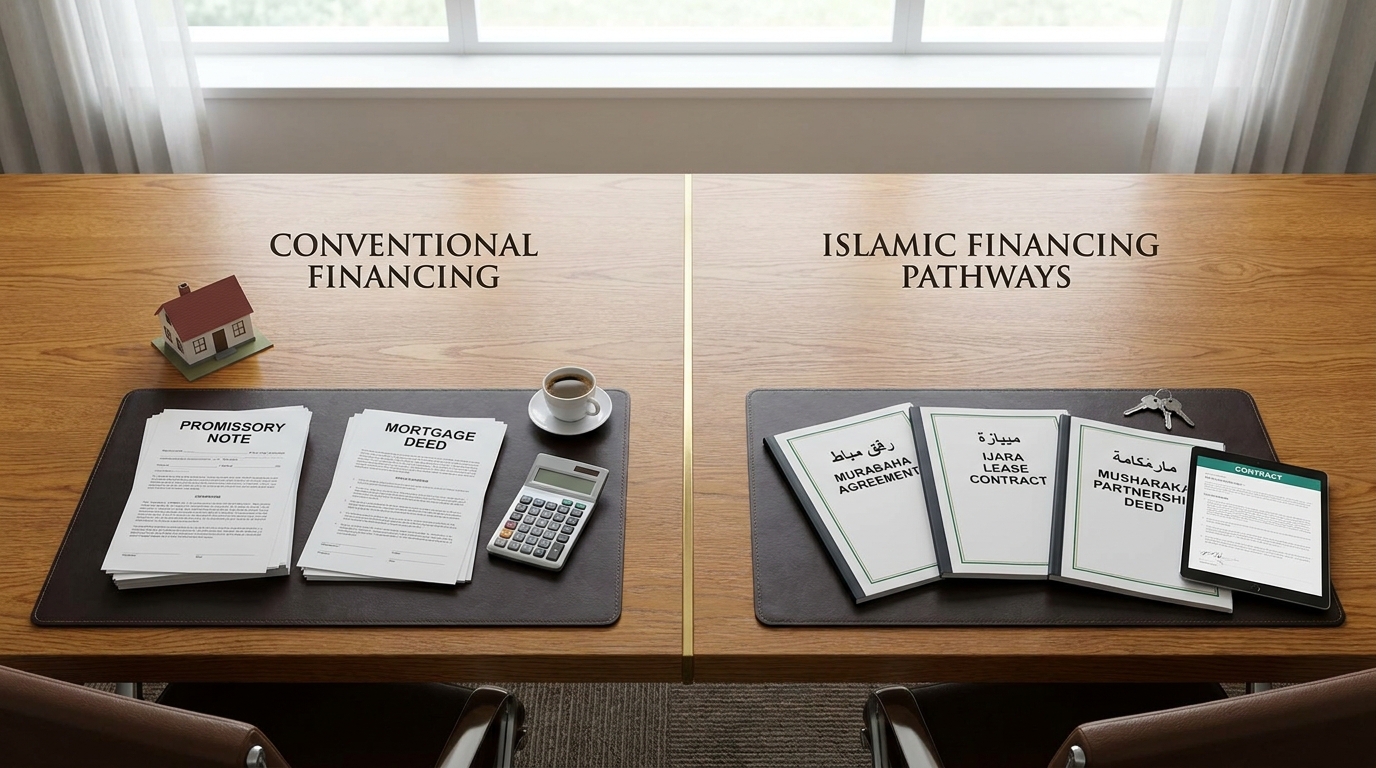
One of the most common misconceptions is that Islamic financing is simply a conventional mortgage with the interest label removed. That is inaccurate. In a conventional mortgage, the bank lends money to the buyer, the buyer acquires the property, and the borrower repays principal plus interest. In Islamic finance, the provider may buy the property first, lease it, resell it at a markup, or share ownership with the client. The return to the provider is structured through those legal relationships rather than through interest on a loan.
This distinction matters in several areas. Legal title may be handled differently. Maintenance obligations may differ depending on whether the structure is a lease or co-ownership model. Early repayment treatment can vary. Default procedures can also differ because the provider’s position may be tied to ownership rights instead of only secured lending rights. In many cases, a Sharia board or qualified scholar reviews the product to determine whether the structure aligns with recognized standards.
For the user, monthly cash flow may still feel familiar. There may be a regular payment, a long term schedule, and an ultimate transfer into full ownership. But economically similar does not mean legally identical. Anyone evaluating a product should examine the actual contract, tax treatment, title registration, insurance requirements, and dispute procedures rather than relying on simplified marketing language.
Common Islamic Real Estate Financing Structures
Several structures are widely used in property transactions. Each serves a distinct purpose and each allocates ownership, risk, and profit differently. Understanding these structures is essential for comparing opportunities and assessing suitability.
Murabaha: Cost-Plus Sale
Murabaha is one of the best known Islamic financing structures. In a real estate context, the financier purchases the property and then sells it to the client at a disclosed markup, with payment often made over time. The key point is that the provider earns profit through a sale transaction rather than interest on a loan. The purchase price, markup, and payment terms are set out clearly at the beginning.
This structure can be straightforward and easy to explain, which is one reason it has been widely used in Islamic finance. From the buyer’s perspective, the certainty of the final price can be attractive, especially if market rates are volatile. The tradeoff is that the financing cost is embedded in the sale price, so buyers should still evaluate affordability, flexibility, and legal execution carefully. A murabaha arrangement is not a discount product. It is a different contractual path to a similar economic objective.
Murabaha is often better suited to transactions where the property and pricing are clearly established from the outset. It is less naturally aligned with long term shared ownership than diminishing musharaka, but it can be effective when simplicity and payment certainty are the priority.
Ijara: Leasing Structure
Ijara is a lease-based model. In a typical property arrangement, the financier acquires the asset and leases it to the client in return for periodic rental payments. Depending on the structure, the client may later purchase the property at the end of the lease term or gradually acquire ownership alongside the lease arrangement. Because the return is tied to rent for use of the asset, the provider’s earnings arise from permissible leasing activity.
Ijara works well in real estate because leasing is already a familiar commercial concept. The important issue is how responsibilities are divided. In a true lease arrangement, certain ownership risks and obligations remain with the owner, while the occupier bears obligations associated with use. The contract has to define these points precisely so that the structure remains both legally workable and Sharia-compliant.
For investors, ijara can also apply beyond owner occupied housing. It may be relevant for income-producing commercial assets where rental economics are central to the investment thesis. That said, tax and accounting treatment can vary significantly by jurisdiction, so local advice is essential.
Diminishing Musharaka: Shared Ownership with Gradual Buyout
Diminishing musharaka is often seen as one of the most intuitive structures for home financing because it combines co-ownership with a gradual transfer of the financier’s share. In a common form, the financier and client buy the property together. The client then pays rent for the financier’s share while also making periodic purchases of that share over time. As the client acquires more ownership, the financier’s share declines and the rental component typically falls accordingly.
This model stands out because it visibly reflects risk sharing and ownership transition. It also resonates with people who want a structure that feels meaningfully different from a pure debt relationship. In practical terms, diminishing musharaka can resemble a lease-to-own arrangement, but the legal details matter greatly. Title, maintenance, insurance, default rights, and buyout formulas must all be clearly drafted.
For many households, this model is appealing because it offers a transparent path from partnership to full ownership. For investors, it also demonstrates how Islamic finance can align monthly payments with a progressive equity-building process rather than only debt amortization.

Istisna’a: Construction and Development Finance
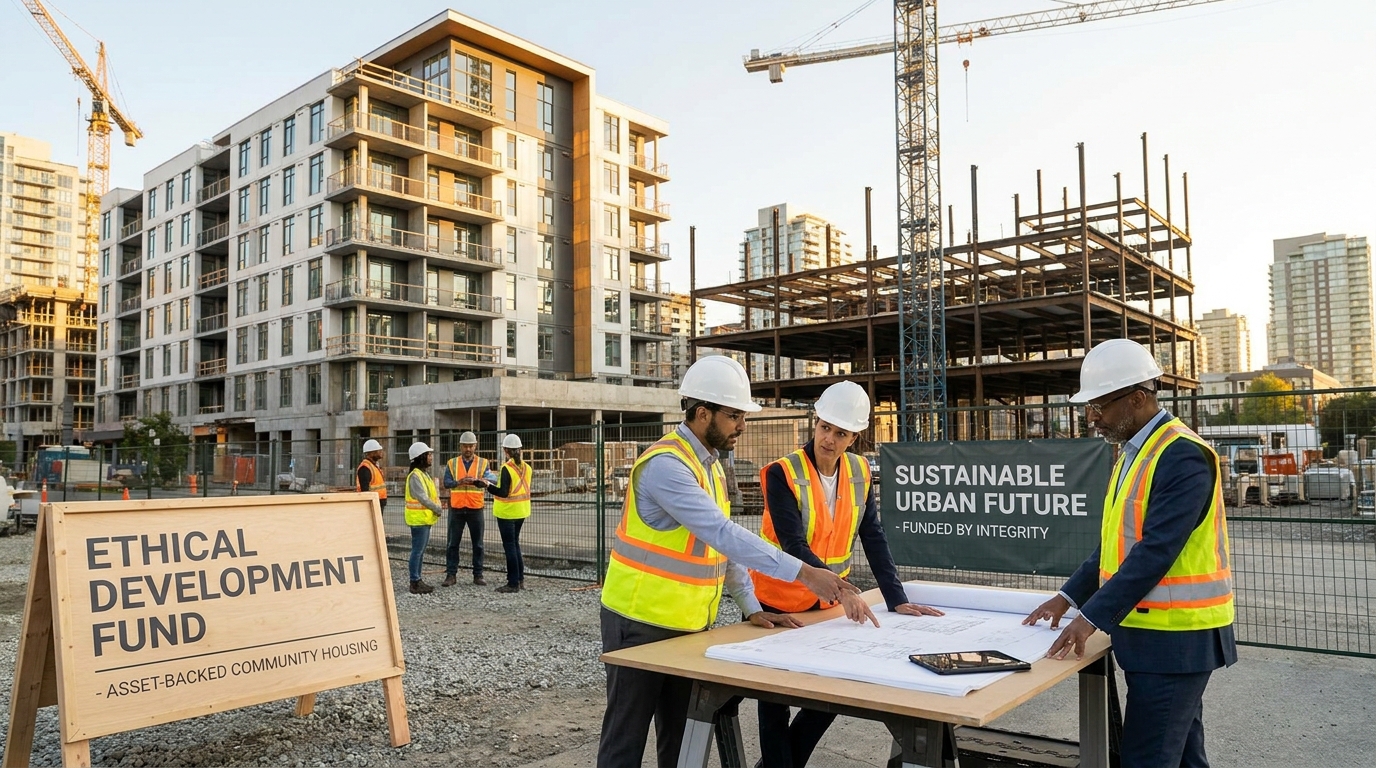
Istisna’a is commonly used for construction or development finance, where an asset is commissioned to be built rather than purchased in finished form. In this arrangement, the financier helps facilitate funding for the construction of a specified asset under agreed terms. This is particularly relevant in development projects, custom builds, or infrastructure-related property activity.
For real estate investors, istisna’a is important because it extends Islamic finance beyond completed home purchases into the development cycle itself. That opens the door to ethical participation in housing supply, mixed use assets, or community projects. The risk profile, however, is different from financing an existing stabilized property. Construction delay, cost inflation, contractor performance, and completion risk all need disciplined management.
Used well, istisna’a shows the productive side of Islamic finance. Capital is directly supporting the creation of a real asset, not merely the transfer of a financial claim. That aligns closely with the broader principle of linking finance to genuine economic output.
How Returns Are Generated in Islamic Real Estate Finance
Investors evaluating Islamic finance need to focus on how returns are actually produced. In conventional lending, interest compensates the lender for time, credit risk, and opportunity cost. In Islamic finance, returns arise through permissible economic activities. That may include markup on a sale, rent on a leased asset, profit from partnership participation, or fees for services structured within compliant boundaries.
This matters because the source of return affects both legal treatment and investment behavior. If a financier owns an asset, even temporarily, the financier may bear certain risks associated with that ownership. If the arrangement is a partnership, profit and risk cannot be allocated in a way that eliminates substance while keeping only appearance. In other words, the contract form should reflect the commercial reality.
For property investors, the discipline is useful. It forces clearer thinking about whether income comes from rent, appreciation, trade margin, or development gain. That transparency can improve underwriting and reduce reliance on vague assumptions. It also means the investor should pay close attention to whether a product is truly asset-backed in a robust sense or merely asset-based in a looser form where the link to the asset is more formal than economic.
Why Islamic Financing Appeals to Ethical and Faith-Based Investors
The first and most obvious reason is faith alignment. Muslim investors and households who seek to avoid riba often view Islamic finance as the legitimate route into homeownership and real estate investment. This is not a minor preference. For many, it is the determining factor in whether they participate at all. A compliant structure can turn ownership from a moral compromise into an acceptable long term plan.
But the appeal does not stop there. A growing number of investors are attracted to the ethical dimensions of the model. The emphasis on asset linkage, contractual clarity, reduced speculation, and shared responsibility fits neatly into broader conversations around responsible capital. Some investors see it as a practical extension of ethical investing and halal investing, especially when combined with screening for property use and tenant activity.
Islamic finance also carries a financial inclusion dimension. International research has pointed to its potential role in widening access to finance, supporting smaller enterprises, and funding productive sectors. In high cost housing markets, alternative ownership and financing structures can be valuable for households who want options outside the traditional mortgage channel. This does not mean Islamic finance solves affordability on its own, but it does broaden the menu of viable structures.
Islamic Financing in Canada and North America
In Canada and North America, Islamic financing remains a niche but expanding segment. Demand is being driven by population growth in Muslim communities, stronger awareness of ethical finance, and sustained concern over housing access and debt burdens. The challenge is that supply has not developed evenly. Product availability varies by lender, province, legal framework, and scale of local demand. Consumers often have fewer choices than they would in conventional mortgage markets.
That uneven availability matters because real estate finance is intensely local. A Sharia-compliant structure must still fit mortgage law, tax rules, securities rules where relevant, consumer protection standards, and title registration procedures. A model that works efficiently in one jurisdiction may require adaptation in another. This is one reason product design can differ substantially across providers even when they use the same broad Islamic contract label.
Canadian readers should also view this landscape through the wider financial stability lens. Household mortgage debt remains a core issue in national policy discussions, and housing market correction risk continues to shape regulator and central bank attention. In that environment, alternative models need to be judged on substance, not novelty. If a structure improves clarity, aligns with client values, and supports sustainable ownership, it adds value. If it merely replicates leverage in a more complicated wrapper, the benefit is less compelling.
Risk Management and Governance in Islamic Real Estate Investing
One of the more important developments in recent years has been greater regulatory and supervisory attention to Islamic finance. As the global sector has expanded, governance, stability, reporting standards, and prudential oversight have become more central. The Islamic Financial Services Board reported that Islamic banking accounted for over 70 percent of Islamic financial services industry assets in 2024, which underscores both the scale of the sector and the importance of disciplined oversight.
For real estate investors, governance is not a theoretical topic. Sharia compliance depends not only on contract labels, but also on review, monitoring, and credible supervision. Many providers rely on Sharia boards or qualified scholars to review structures and documentation. Investors should understand who performed that review, what standard was applied, and whether the product has ongoing governance rather than a one time approval.
Risk management should be approached with the same seriousness as in any other property strategy. Real estate exposure can become concentrated. Lease income can weaken. Construction timelines can slip. A co-ownership structure can become operationally difficult if documentation is weak. Liquidity may be lower than in conventional banking channels, particularly in smaller markets. The ethical framework does not erase execution risk. It simply imposes a different discipline on how transactions should be formed.
Common Misconceptions Investors Should Avoid
A sophisticated understanding of Islamic finance requires moving past a few persistent misconceptions. The first is that Sharia-compliant means zero cost. It does not. Providers still need to earn profit, rent, or fees through permissible means. Buyers should compare total economic cost, not just labels.
The second misconception is that all Islamic financing products are the same. They are not. Scholar interpretation, local law, tax constraints, provider capability, and underwriting standards can all influence structure. Two products both described as diminishing musharaka may differ meaningfully in ownership mechanics and risk allocation.
The third misconception is that compliance automatically means lower risk or better returns. In reality, a poorly structured asset-backed transaction can be riskier than a well underwritten conventional loan. Concentration in real estate and construction remains a known issue for some Islamic institutions. Investors still need diversification, due diligence, and conservative assumptions.
The fourth misconception is that Islamic finance is only relevant to Muslims. Faith compliance is a major driver, but asset-based and ethical features attract a broader audience. In a market where many investors are rethinking leverage, transparency, and responsible capital, the appeal is wider than many assume.
How to Evaluate an Islamic Real Estate Financing Product
If you are considering Islamic financing for a home purchase or investment property, begin with the contract rather than the marketing summary. Ask which structure is being used, whether it is murabaha, ijara, diminishing musharaka, or another format, and request a clear explanation of ownership at each stage. Determine who holds title, who bears maintenance obligations, how payments are divided between rent and equity acquisition where relevant, and what happens if you exit early.
Next, compare the full economic outcome. Look at total cost over the expected holding period, not only monthly payments. Consider fees, legal charges, transfer taxes where applicable, insurance requirements, and any purchase undertakings or final buyout provisions. A structure can be ethically aligned and still be more expensive than a conventional alternative, so the decision should combine values and economics rather than assume one overrides the other.
It is also wise to assess governance credibility. Ask whether a Sharia board or scholar reviewed the product and whether the review is documented. Consider the operational strength of the provider, especially if you are entering a long term arrangement. In niche markets, provider quality can matter even more than headline pricing.
Finally, review the underlying asset with normal investment discipline. A compliant financing structure does not make a weak property strong. Location, rental demand, build quality, liquidity, and local market fundamentals remain decisive. Stephen Adler’s view on real estate is simple: structure matters, but asset quality matters more. Financing can enhance a sound deal, not rescue a poor one.
Strategic Use Cases for Investors
Islamic financing can fit several real estate strategies. For owner occupiers, it may provide a path to homeownership that aligns with religious commitments while preserving the familiar discipline of long term monthly payments. For buy and hold investors, lease and co-ownership structures can support income property acquisitions where asset-backed discipline is a priority. For developers, istisna’a and partnership-oriented structures may provide a framework for ethically structured project finance.
There is also a strategic branding angle for funds and operators. As global Islamic financial services continue to expand, well governed real estate platforms that understand compliance, reporting, and transparency may find access to a broader investor base. That is particularly relevant in sectors with visible social utility such as housing, logistics, healthcare property, and community-oriented mixed use development.
The strongest use cases tend to share a few characteristics. The underlying asset is clear and productive. The legal framework is robust. The provider has real structuring competence. The investor values not only cost efficiency, but also governance, ethics, and contract integrity. When those conditions are present, Islamic financing can be more than a niche accommodation. It can be a serious capital framework.
The Bigger Picture: Growth, Standardization, and Market Maturity
Islamic finance is growing globally, but growth alone is not the most important story. The more significant trend is institutional maturity. Regulators, standard setters, and market participants are paying closer attention to governance, standardization, prudential treatment, and reporting quality. That should help improve transparency and confidence over time, though product differences across jurisdictions will likely remain.
For real estate, this maturation could be especially meaningful. Property is one of the most practical channels for translating Islamic finance principles into visible ownership outcomes. Better standardization may improve cross-border acceptance, reduce confusion for consumers, and strengthen investor trust. It may also support broader product innovation in areas such as co-ownership platforms, development finance, and income-producing assets.
Still, maturity should not be confused with simplicity. Islamic real estate finance will continue to require careful legal design, credible Sharia governance, and disciplined risk control. Investors who approach it seriously, rather than as a marketing novelty, are best positioned to benefit.
Conclusion
Islamic financing offers a distinct framework for real estate investment, one built on ethical constraints, real asset linkage, and a more visible relationship between profit and ownership. Its core principles prohibit riba, avoid excessive uncertainty and speculation, and require financial activity to connect with productive economic use. In practice, that leads to structures such as murabaha, ijara, diminishing musharaka, and istisna’a, each with its own implications for ownership, payments, and risk.
For Muslim investors, the appeal is often rooted in faith compliance. For others, the attraction lies in ethical investing, asset-backed discipline, and alternative pathways into property ownership. In Canada and North America, the market is still developing, availability is uneven, and local legal design remains critical. Yet the strategic relevance is growing, especially as housing affordability, debt exposure, and responsible finance stay high on the agenda.
The best way to approach Islamic real estate financing is with both respect and rigor. Respect the principles, because they shape the product in meaningful ways. Apply rigor to the contract, the provider, and the asset, because good ethics do not eliminate market risk. Done properly, Islamic financing can serve as a credible, sophisticated, and values-aligned component of a modern real estate investment strategy.
Frequently Asked Questions About Islamic Financing and Real Estate
Is Islamic financing cheaper than a conventional mortgage?
Not necessarily. Islamic financing is not designed to be free or automatically lower cost. Providers still earn profit through markup, rent, or partnership returns. The right comparison is the total economic cost over time, including fees, legal structure, and flexibility.
Can non Muslims use Islamic real estate financing?
Yes. While faith compliance is a major reason people choose it, Islamic financing can also appeal to investors and homebuyers interested in ethical, asset-based, and risk-sharing models. Its relevance extends beyond religion when the structure aligns with the buyer’s financial priorities.
What is the most common Islamic structure for buying a home?
Diminishing musharaka is often one of the most recognizable home financing structures because it combines co-ownership with a gradual buyout. Murabaha and ijara are also common depending on the provider, jurisdiction, and legal design.
Does Sharia-compliant mean lower risk?
No. Compliance does not remove credit risk, market risk, liquidity risk, or property-specific risk. Real estate can still decline in value, tenants can default, and construction projects can run over budget. Investors should assess the same fundamentals they would in any serious property transaction.
Why is real estate so important in Islamic finance?
Real estate is a natural fit because it is tangible, productive, and easier to structure around ownership, leasing, and partnership. That makes it well suited to a financial system that emphasizes real economic activity and ethical asset use.



No Comment! Be the first one.