Scarborough’s Micro-Shelter Village Shows the Power of Small-Scale Land Strategy
Not every housing solution needs a high-rise crane or a decade of approvals. In Scarborough, a Toronto charity called Tiny Tiny Homes is proving that a single family-run bakery with an underused plot of land can move faster than most conventional developers ever could. The result is a planned 10-unit micro-shelter community, complete with a common building, washrooms, and on-site staffing, built for people currently experiencing homelessness.
From a development lens, this project is a case study in what small-footprint, low-barrier land use can accomplish when the right pieces align. The bakery’s owners agreed to lease their land to the charity for one dollar a year over a three-year term, a structure that sidesteps the capital costs that typically stall transitional housing projects. Executive director Ryan Donais estimates the full build at roughly 350,000 dollars, funded entirely through private donations, with businesses already contributing materials and labour.
That funding model matters as much as the shelters themselves. Municipal and provincial housing budgets are stretched thin across the Greater Toronto Area, and projects that rely on donated land and private capital represent a supply channel that does not compete directly with public dollars. Each unit here runs between 48 and 96 square feet, single-occupancy and pet-friendly, which keeps the build simple and the site plan flexible on a parcel that would never support conventional multi-unit housing.
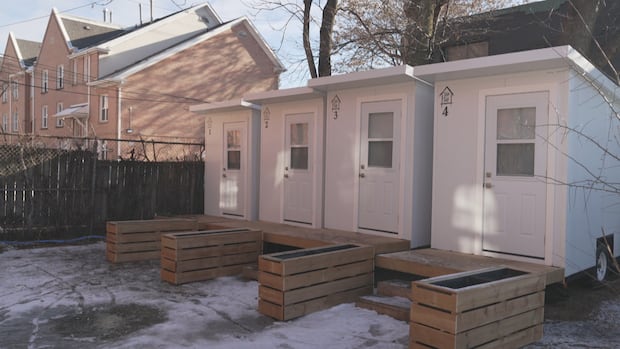
The regulatory backdrop is worth watching closely. This is not Donais’ first attempt at deploying tiny shelters in the city. A prior installation in St. James Park drew a cease and desist order from the city last winter, and the units were eventually relocated to Lazarus House, an emergency transitional shelter run by the Seeds of Hope Foundation. City spokesperson Nichole Jankowski confirmed the municipality is not yet aware of the Scarborough proposal, and noted that any micro shelter project on private land remains subject to standard zoning and building rules. Toronto is separately evaluating expression-of-interest applications for a two-year micro shelter pilot program, and Tiny Tiny Homes is among the applicants.
Everyone is chipping in to make this happen. It blows my mind and it really touches my heart.
That tension between grassroots speed and municipal process is the real story for anyone tracking housing supply strategy. Cities across Canada are short on both land and shelter capacity, and pilot programs like Toronto’s suggest a growing openness to legitimizing these smaller, faster-to-deploy models rather than treating them as one-off exceptions. If the Scarborough site clears its zoning hurdles and reaches winter completion as planned, it becomes a template other landowners and charities could replicate on similarly modest parcels throughout the city, turning idle lots into meaningful, near-term housing capacity rather than waiting years for larger developments to break ground.
Source: CBC News