Why Ontario’s Suburban Condo Glut Is a Warning Sign for Preconstruction Investors
Investors who chased affordability outside Toronto’s core are now sitting on some of the weakest positions in the entire Ontario condo market. New data from Zonda Urban shows the deepest inventory pileups are not in downtown Toronto towers, but in Vaughan Metropolitan Centre and downtown Hamilton, two markets that were pitched to buyers for years as the smart, cost effective alternative to the city.
The numbers are stark. Vaughan Metropolitan Centre had 966 unsold units at the end of the second quarter, representing 43 per cent of new supply in the area. Downtown Hamilton had 1,127 unsold units, or 34 per cent of inventory. Compare that with Toronto’s Entertainment District, a dense, established condo corridor, which sat at 27 per cent unsold. The thesis that suburban and secondary markets carried less risk has not held up.
For preconstruction buyers, this is where theory meets balance sheet. Rents in VMC have fallen to $3.52 a square foot in the first quarter of this year, down from $4.06 a square foot in the same period of 2024. That decline in cash flow, paired with values that are no longer appreciating, has pushed many small investors out of the market entirely. When an asset stops generating rental coverage and stops appreciating, the entire investment case collapses at once.
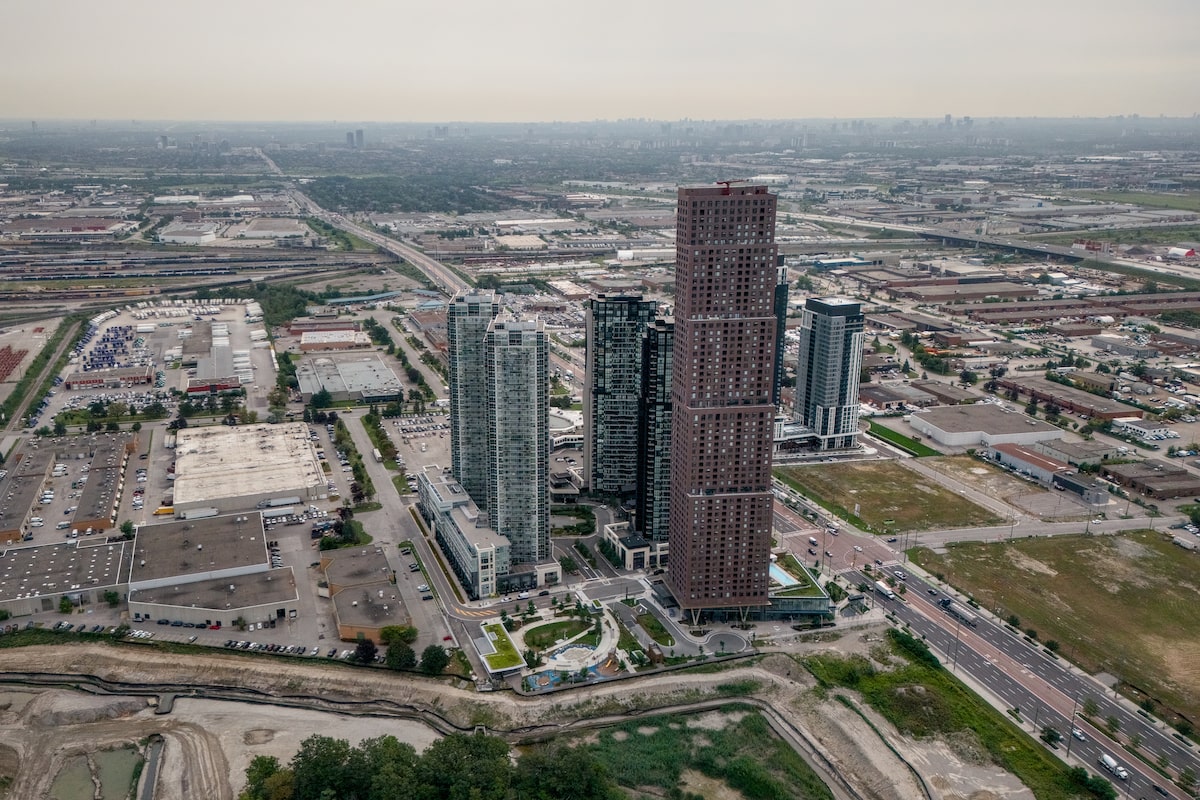
The closing risk deserves particular attention. Buyers who committed during the 2021 to 2022 boom are now discovering that the price gap between their contract and current market value can run into the hundreds of thousands of dollars. One buyer in the Vincent, a nearly 800 unit VMC project that sold out in six months back in 2021, agreed to pay roughly $1,258 a square foot. Comparable sales on the assignment market now value similar units near $763 a square foot, a 40 per cent shortfall that leaves the buyer exposed to default or forced resale at a steep discount.
There will be a sell-down when people realize they have to reduce their pricing to get rid of inventory.
Developers are adapting their capital strategy in response. Fengate’s rent to own structure in Hamilton and the temporary HST rebate on new home purchases both show how sellers are trying to manufacture demand rather than simply cut price. Meanwhile, the cancellation of the M6 project in Mississauga, which could not reach the 70 per cent presale threshold needed for construction financing, is a clear signal that lenders are no longer willing to fund projects on optimism alone.
For readers building a real estate portfolio, the lesson is about discipline, not fear. Preconstruction in oversupplied secondary markets now carries real closing and rental income risk that did not exist during the boom years. The better opportunities today are likely on the resale side, where pricing has already adjusted, or in markets where presale thresholds and construction financing remain intact. Location strength, financing discipline, and realistic rental yield still separate a sound investment from a stalled one.
Source: The Globe and Mail