
Behind the King St. W. Disruption: Why Aging Infrastructure Renewal Is a Growth Story
Toronto residents bracing for a year of detours along King St. W. might see this as nothing more than an inconvenience. I see it as something else entirely: a visible reminder of the invisible work that has to happen underneath a growing city before that growth can continue.
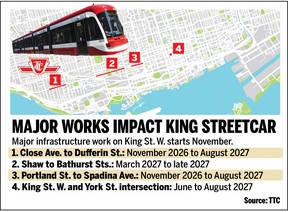
Starting in November, the City of Toronto and the TTC will begin a combined watermain replacement and streetcar track renewal project along King St. W., between Dufferin St. and Close Ave. The work will not wrap up until next August. During that stretch, 504 King streetcars will run as a single branch between Dundas West and Broadview stations, 304/504 King service will divert via Queen St. W., and the 508 Lake Shore streetcar will be suspended altogether. Replacement buses will cover the gap.
The headline disruption is traffic. The real story, for anyone thinking about long term city building, is underground. The twin watermains being replaced on King St. W. are 139 years old. That is not a maintenance footnote. That is a corridor that has carried water, and by extension development capacity, through more than a century of Toronto’s growth, and it is finally being brought to a state of good repair.
King St. W. through this stretch is not a quiet residential lane. It is a dense, transit oriented corridor that has absorbed significant residential intensification over the past two decades, from Liberty Village eastward toward the core. Water distribution capacity and reliable transit are not amenities for that kind of density, they are prerequisites. A watermain break under a corridor this built up does not just flood a street, it threatens the basic servicing that every condo tower and mixed use project along that line depends on.
Development is never just about land. It is about timing, access, infrastructure, policy, demand, and the future identity of a community.
That is exactly what is happening here. The city is pairing track renewal with watermain replacement rather than tackling them separately, which is the right sequencing discipline for anyone who understands how disruptive it is to reopen the same street twice. Around the clock rail work, seven days a week, tells you the city is treating the transit reliability piece as urgent, not optional, for a corridor this dependent on streetcar service.
For developers and investors watching this corridor, an eleven month disruption is a short term cost against a long term signal. Infrastructure renewal of this scale does not happen on corridors the city expects to stagnate. It happens where continued intensification is assumed. Anyone assembling sites or underwriting projects along King St. W. should read this construction notice less as an obstacle and more as confirmation that the servicing backbone for future density is finally catching up to where the neighbourhood already is.
Source: Toronto Sun