Regent Park Phase 4: What Building 4A Tells Us About the Next Decade of Urban Renewal
Every large scale revitalization has a moment when planning stops being a rendering and becomes a job site. For Regent Park, that moment has arrived at 325 Gerrard Street East, where concrete is now rising on Building 4A, the first rental replacement build of Phase 4. It is worth pausing on what this milestone actually represents, because it is not just a construction update. It is a signal of how Toronto intends to grow, replace, and reinvest in one of its most closely watched neighbourhoods.
The numbers tell a story of scale and intent. A 26-storey tower paired with a 10-storey mid-rise will deliver 271 rental homes, with 136 units earmarked as Rent-Geared-to-Income replacement housing and 135 as net-new affordable rental supply. That split matters. It reflects a development model built around dual obligations, honouring the tenure rights of returning families while genuinely expanding the housing stock rather than simply rebuilding what already existed. The decision to prioritize multi-bedroom layouts, driven directly by resident consultation, is the kind of detail that separates a development plan from a development strategy. It shows a project team responding to demand signals from the community it is meant to serve.
Mixed-use integration is another marker of long term thinking here. Roughly 10,000 square feet of retail alongside 14,000 square feet of community facility space, built to R-PATH accessibility standards and Tier 2 of the Toronto Green Standard, signals that this is not simply about units delivered. It is about building the civic infrastructure a neighbourhood needs to actually function, retail activation at grade, gathering space above it, and housing built around both.
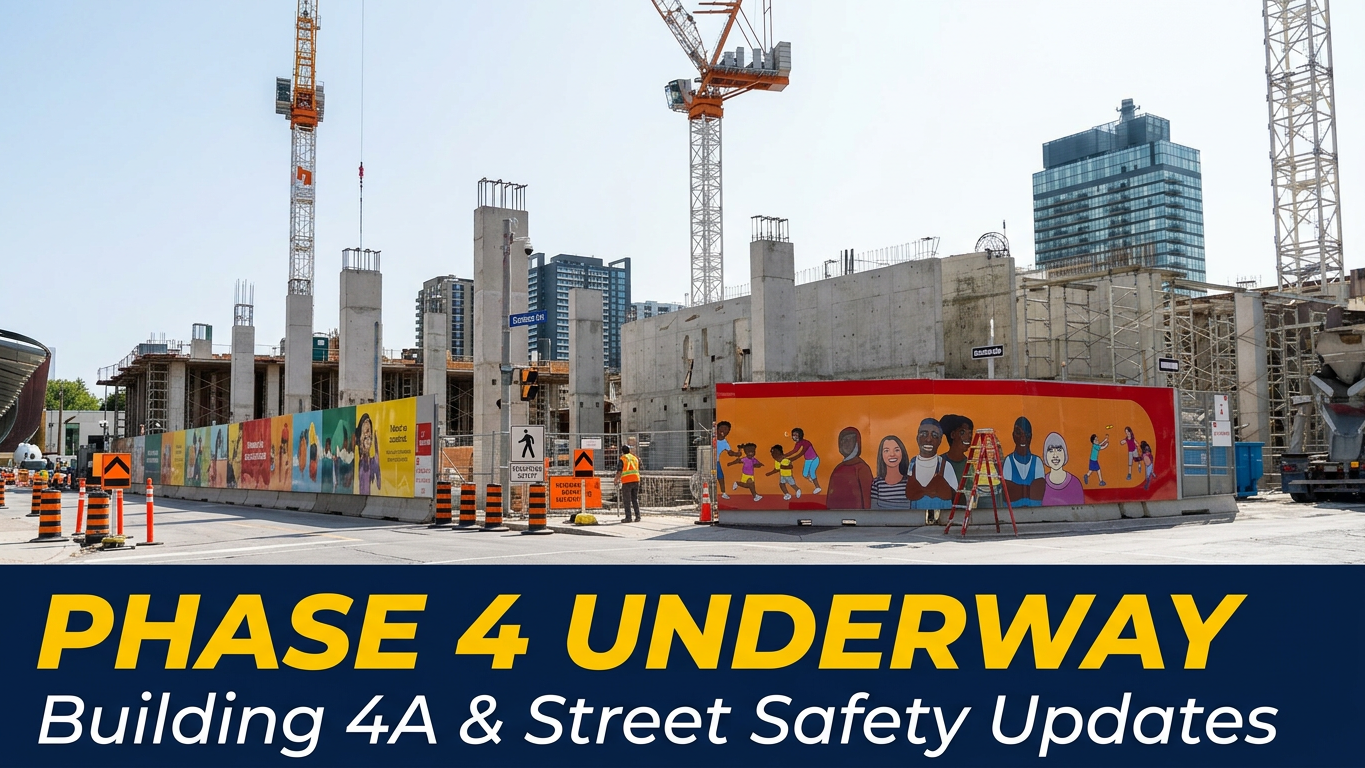
What stands out from a project feasibility lens is the sequencing. Excavation is complete and concrete has reached the mezzanine level, with five storeys projected by late 2026 and external structural completion targeted for Q2 2028, ahead of full occupancy in 2030. That is a disciplined timeline for a project of this density, and it depends heavily on the supporting infrastructure being coordinated in parallel. The new Thane Murray Way, closed to the public as a secured construction route until Q3 2030, along with staging closures on Dreamers Way authorized through City Council Decision TE34.121, shows how much of a large scale build actually happens around the tower, not just inside it.
Strong projects are built from a wider understanding of timing, access, infrastructure, and the future identity of a community.
The unresolved piece is governance. Finalizing the Phase 4 Community Benefits Agreement and establishing resident-led control of the new community space are the details that will determine whether this development becomes a model for revitalization elsewhere in the city, or simply another tower delivered on schedule. Toronto has no shortage of ambitious housing plans. What it needs are execution models that hold up once the cranes come down. Regent Park Phase 4 is now the test case worth watching.
Source: Frequency News