Toronto’s Social Medicine Housing Model Signals a New Blueprint for Large-Scale Supportive Development
Every so often a project comes along that is less about a single building and more about a new operating model for how a city deploys land, capital, and institutional partners together. Toronto’s plan to add roughly 200 supportive homes across three sites near Toronto Western Hospital is exactly that kind of project, and anyone tracking large-scale housing strategy should be paying close attention to how it is structured.
This is not a single developer chasing a single site. It is a coordinated capital stack involving the federal government through Build Canada Homes, the City of Toronto, and the University Health Network Foundation, with CreateTO, the city’s strategic real estate agency, tasked with identifying and assembling the remaining land. More than $25 million in federal funding, upwards of $19 million in municipal contributions and incentives, and $20 million from the UHN Foundation are being layered together for the first 80-unit phase alone. That is a template worth studying: institutional health partners co-funding real estate because the underlying economics of the project pencil out in their world too.
What makes this feasible as a development strategy, rather than just a social program, is the data behind Dunn House, the first project in this pipeline. Early results showed a 52 percent reduction in emergency department visits and a 79 percent reduction in hospital bed days among residents in their first year, translating into roughly $2 million in health-care cost savings. Less than five percent of tenants across the city’s supportive housing portfolio returned to the shelter system within a year. Numbers like that change the feasibility conversation entirely. They give a non-profit operator, a hospital system, and a municipal government a shared financial language for justifying land use decisions that might otherwise struggle to compete for capital against market-rate housing.
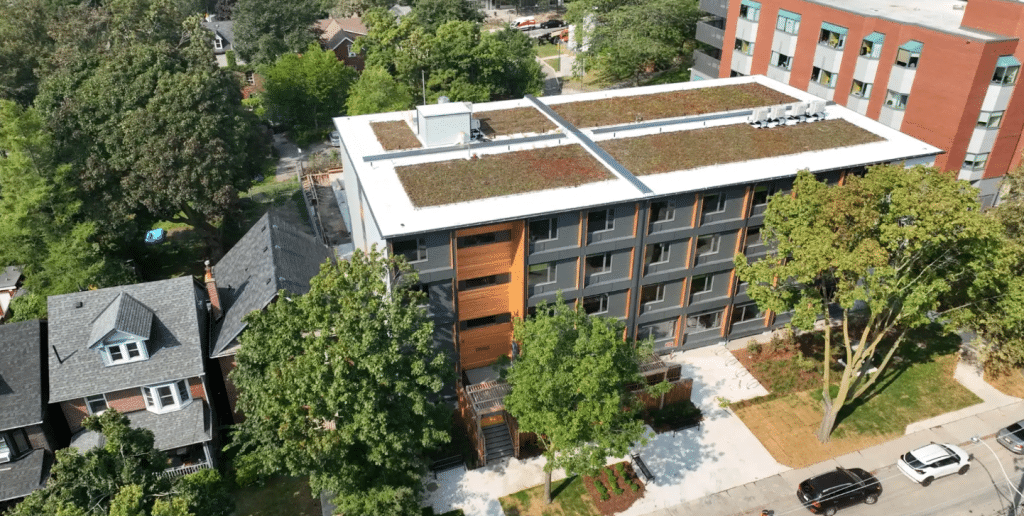
Spring House, the 54-unit second phase targeting seniors and older adults experiencing chronic homelessness, is slated to break ground in late 2026, and two further sites near Toronto Western Hospital are still being scoped by CreateTO. For developers and planners watching Toronto’s intensification strategy, this signals a growing appetite to anchor supportive housing directly around hospital infrastructure, effectively treating health campuses as a land-use driver in the same way transit corridors have shaped residential growth for the last decade.
The Dunn House model is working. It’s helping people build stable lives, access vital resources, and stay off the street and out of the emergency room.
Toronto Mayor Olivia Chow’s framing of the project is political, but the underlying logic is pure development strategy: pair land with a funding partner whose core mission benefits directly from the outcome, and the feasibility math starts to look very different. For cities wrestling with chronic homelessness, aging housing stock, and strained emergency health systems all at once, this kind of cross-sector land assembly may prove to be one of the more replicable models to watch over the next several years.
Source: Ontario Construction News