Why Muskoka’s Land Trust Model Deserves a Closer Look From Every Growth Market
A 150-home project breaking ground in Huntsville, Ontario is a reminder that affordability is not just a policy talking point. It is a development problem, and it can be solved with the right structure. The Muskoka Community Land Trust has started construction on a three phase, mass-timber community on Florence Street, and the real story here is not the building material. It is the model behind it.
Huntsville is a market under real pressure. More than 55 per cent of local households fall into the lower to modest income range, well above the provincial average, and many of those households have simply been priced out of ownership and, increasingly, out of rental housing too. That is the demand side of the equation. What makes this project worth studying is the supply side strategy MCLT has built to meet it.
Forty per cent of the units across all three phases will be permanently removed from the private market. The land stays in trust, the homes stay non-market, and that commitment is structural rather than promotional. Too many affordable housing pledges expire with the first resale. This one is designed not to. That is the kind of long term thinking that actually changes a community’s housing trajectory rather than just softening the headline numbers for a single project cycle.
The financing stack is equally instructive. The District of Muskoka has committed close to two million dollars in combined funding, FedNor has added more than half a million, Muskoka Futures is providing a conditional loan, and the project has conditional approval under Natural Resources Canada’s Green Construction Through Wood program. Layer on a donated site from the Town of Huntsville, and you have a textbook case of how public land, public capital, and a disciplined non-profit sponsor can be assembled to make a project feasible in a market where private margins alone would never justify this level of affordability.
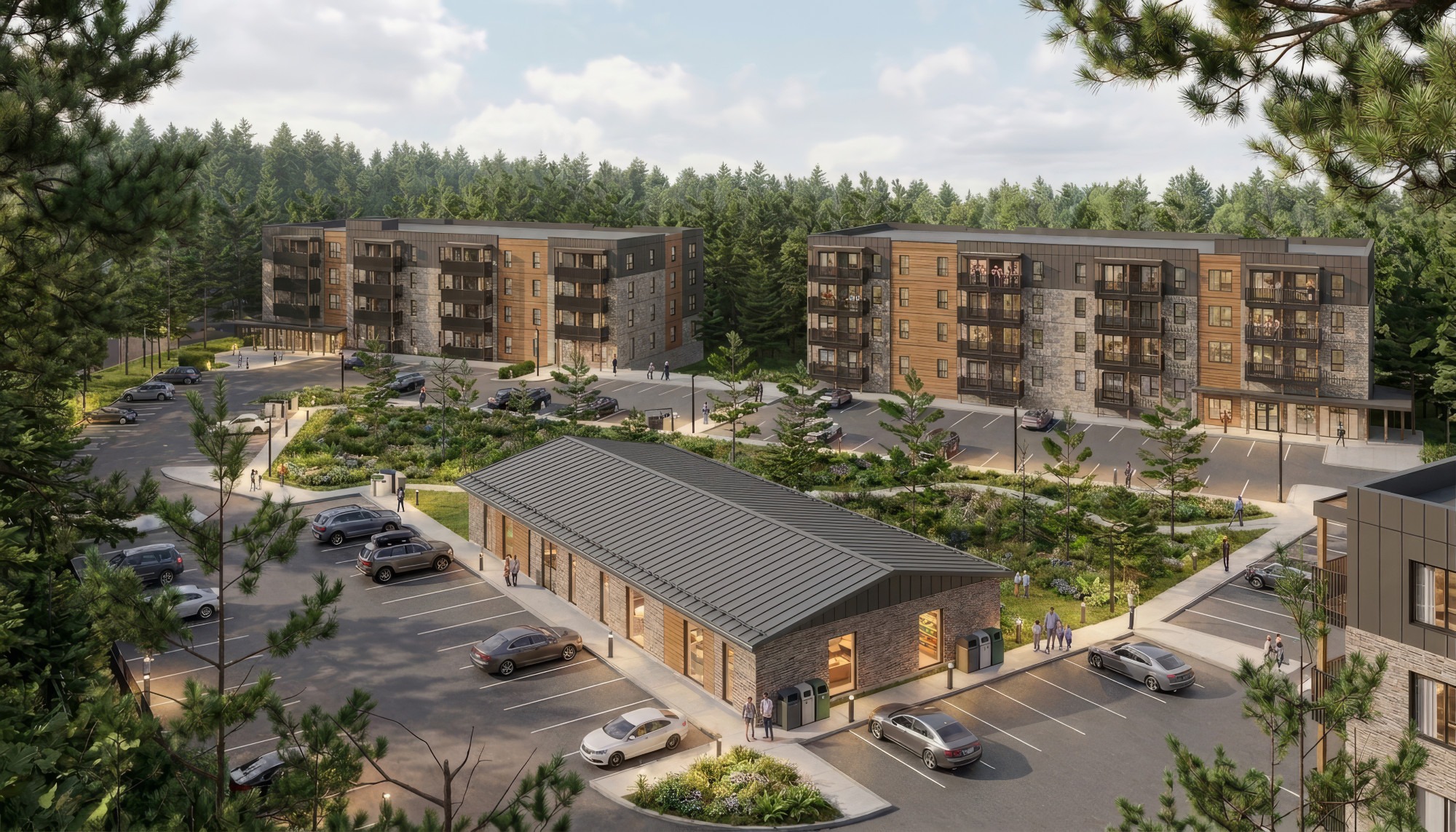
The phasing strategy also deserves attention. A 47-unit first phase, followed by 60 units, followed by a final 43-unit building, lets the trust test absorption, refine construction sequencing, and manage cash flow across a multi-year timeline rather than betting everything on a single large delivery. For developers and municipal partners watching housing targets slip across this province, that staged approach is a practical template, not just a Muskoka story.
A strong affordability commitment is only as good as the structure that protects it decades after the ribbon is cut.
There is a land value lesson buried in the design choices too. Buildings reaching up to 14 metres are being kept below the surrounding tree canopy, with a formal tree protection plan guiding construction so most of the site’s original forest remains intact. That is not incidental. In a region where natural character underpins property value and community identity, preserving the landscape protects the long term worth of the asset itself, not just its appearance.
With phase one underway and occupancy targeted for December 2027, Huntsville will have a real test case for whether a land trust, a patient funding coalition, and a wood-first construction method can deliver affordability at a scale that actually moves the needle. Other growth markets facing the same affordability math should be taking notes now, not after the ribbon cutting.
Source: Construction Canada, “Mass timber anchors Muskoka affordable housing project”.