


How to Safely Remove Snow and Debris from Your Solar Panels in Winter
Solar panels are often described as low maintenance, and for the most part that is true. Once a system is installed correctly, it can produce electricity quietly for years with relatively little hands on care. Still, winter introduces a few conditions that deserve more attention, especially in regions where snowfall lingers, roofs stay icy, or tree debris builds up as the seasons change. Snow, slush, ice, needles, leaves, and bird droppings can all reduce how much sunlight reaches the cells, which means less energy production at the time of year when daylight is already limited.
Table Of Content
- Why snow and debris matter for solar performance
- Do solar panels always need snow removal?
- When you should consider intervention
- Signs that waiting is reasonable
- The most important safety rule: stay off the roof
- What never to use on solar panels
- How to remove snow safely from the ground
- Step by step approach for homeowners
- How to handle ice on solar panels
- Cleaning debris the sustainable way
- Best practices for debris removal
- Use monitoring before you reach for a tool
- How roof pitch, system design, and climate affect snow buildup
- When to call a professional
- Common mistakes homeowners make
- Future facing solutions worth watching
- A practical winter maintenance routine for homeowners
- Final thoughts
The key is to approach winter maintenance with perspective. Not every snowy panel needs immediate cleaning, and not every drop in production signals a problem. In many homes, snow slides off naturally within hours or days as sunlight returns and temperatures shift. In other cases, particularly after heavy storms or on lower slope roofs, buildup can linger long enough to make thoughtful intervention worthwhile. The safest and most sustainable strategy is not to clean constantly, but to clean carefully, only when needed, and in ways that protect both the homeowner and the solar equipment.
This guide walks through how to remove snow and debris from solar panels safely, when it makes sense to do so, and when it is better to wait or call a professional. It also covers the difference between normal winter underperformance and a real maintenance concern, along with practical tips for reducing risk, minimizing water use, and preserving the long term health of your solar array.
For most homeowners, the goal is not perfect winter output at any cost. The goal is to restore production safely and sensibly when unusual buildup is meaningfully affecting performance.
Why snow and debris matter for solar performance
Solar panels work by absorbing sunlight, so anything that blocks light can reduce output. A thin dusting of snow may not shut a system down completely, especially if portions of the panel remain exposed and the sun is strong enough to begin melting the surface. Heavier accumulation is different. A thick blanket of snow can cover the active cells almost entirely, causing a noticeable drop in energy generation until the surface clears.
Debris affects performance in a similar but more gradual way. Leaves, pine needles, pollen, dirt, soot, and bird droppings may not cover a whole panel, yet they can still create localized shading and reduce efficiency over time. In some systems, particularly those with panel level electronics or string arrangements sensitive to shading, even a small area of obstruction can influence output more than homeowners expect. The effect may be temporary, but if soiling remains for weeks or months, it becomes a maintenance issue rather than a cosmetic one.
There is also a structural side to the conversation. Heavy snow and ice are not just visibility problems. Authoritative winter weather guidance warns that significant accumulation can place stress on modules and frames, and hidden cell cracks may form in severe conditions. Those cracks are not always visible from the ground, yet they can reduce production and may create longer term safety concerns. That is one reason why aggressive scraping or impact based cleaning is such a poor idea. The panel surface and the cells beneath it are more delicate than they appear.
Do solar panels always need snow removal?
Usually, no. This is one of the most important points for homeowners to understand. Solar panels are designed to live outdoors, and most roof mounted arrays in snowy climates are installed with enough tilt to encourage at least some natural shedding. Guidance from the U.S. Department of Energy notes that snow on roof mounted photovoltaic systems often melts off within several hours to several days, depending on the amount of snowfall, the temperature, the level of sunlight, and the roof or system pitch.
That means immediate action is often unnecessary. Winter solar output is already lower than summer production because the days are shorter and the sun angle is lower. If your panels are lightly covered after a storm, it may be perfectly reasonable to wait and see whether they clear on their own. In many cases, that is the most practical and safest choice. Natural Resources Canada also emphasizes that PV systems generally require little maintenance, and that cleaning is usually only needed when dust or dirt becomes significant.
Still, there are situations when manual removal can make sense. If a low slope roof allows snow to sit for a long period, if repeated storms keep the array buried, or if your monitoring system shows output staying near zero long after neighboring surfaces have thawed, then a careful response may be justified. The point is not to chase every watt, but to recognize when a temporary weather event has become prolonged obstruction.
When you should consider intervention
A thoughtful decision begins with context. Not all regions experience winter in the same way, and not all roof designs behave similarly under snow. A homeowner in coastal British Columbia or the Pacific Northwest may see occasional slush that melts quickly, while someone in Quebec, Ontario, the Prairies, the northern U.S., or a mountain community may deal with persistent accumulation and deep freeze conditions. Snow cover patterns also vary over time, which means past habits may not always match current weather realities.
In practical terms, consider removal when several factors line up. The first is duration. If the panels remain covered for days during a period when sun has returned and temperatures have moderated, natural shedding may not be happening effectively. The second is system visibility. If you can safely see from the ground that the array is still completely buried while nearby roof areas are beginning to clear, there may be enough surface friction or roof geometry to keep the snow in place. The third is performance data. A monitoring app that shows sustained underproduction compared with typical winter behavior can help confirm that snow coverage, not just seasonality, is the issue.
Debris follows a similar logic. If there are just a few dry leaves on the lower edge of a panel after autumn, the next rain may wash them away. But if there is a dense mat of needles, bird droppings, or grime that is clearly blocking light and not resolving through weather, gentle cleaning may be worthwhile. Homeowners with trees overhanging the roof often face this in late fall and early spring rather than deep winter.
Signs that waiting is reasonable
It often makes sense to leave the panels alone if the snow is light, the forecast suggests sun or warmer temperatures, and your roof is steep enough that shedding is likely. Tilt matters more than many people realize. Steeper panel angles tend to release snow more readily, and earlier Department of Energy guidance notes that snow generally sheds more easily from panels tilted above about 40 degrees. In some resilient system design guidance, steeper angles up to around 60 degrees may also help with snow and hail considerations.
Waiting is also wise if reaching the panels would require climbing onto an icy roof or leaning out from a window or ladder in unstable conditions. No amount of temporary production gain justifies a fall risk. Solar systems are long term assets. A skipped day of winter generation is inconvenient, but an injury or damaged array is far more serious.
The most important safety rule: stay off the roof
If there is one principle homeowners should remember, it is this: do not walk on a snow covered or icy roof to clean solar panels. Roof mounted systems are live electrical equipment installed at height, often on surfaces made more dangerous by frost, hidden ice, and unstable snow layers. Even homeowners who are comfortable with ladders in summer may underestimate how different roof work becomes in winter.
Walking on the roof also increases the chance of damaging the system. You may step near wiring, shift racking under load, or apply force to parts of the roof and array that are not meant to be touched. Snow can hide edges, mounting hardware, and slick transitions. In addition, falling snow from the panels themselves can create a sudden slide hazard once the surface starts to loosen.
If you cannot assess or clean the array safely from the ground, the next best option is usually to leave it alone or contact a qualified solar service provider. This is especially true for steep roofs, second or third story homes, complex rooflines, or panels installed above entries, decks, or walkways where falling snow could injure someone below.
Safe maintenance starts with accepting that some jobs are not appropriate DIY tasks. Winter roof access is often one of them.
What never to use on solar panels
Many well intentioned homeowners cause damage not because they clean too often, but because they use the wrong tools. Solar panels should not be scraped with metal shovels, ice choppers, hard edged push brooms, or abrasive brushes. These tools can scratch the protective glass, harm the module frame, and place uneven pressure on the cells beneath the surface. Damage may not be obvious immediately, yet even small abrasions and microcracks can reduce output over time.
You should also avoid pouring hot water onto freezing cold panels. The sudden temperature change can stress the glass and create thermal shock, particularly during very cold weather. De icing chemicals, salt, and harsh detergents are equally poor choices. They may leave residue, corrode adjacent materials, or void manufacturer recommendations. Guidance for dirty panels is conservative for good reason: mild soap or plain water and a soft cloth are generally all that should be used, and often only when normal precipitation is not enough.
Leaf blowers and pressure washers can also be problematic. A blower may seem gentle, but on icy roofs it can send debris unpredictably and encourage risky positioning. Pressure washers can force water into seals, damage frames, and turn a routine cleaning task into an avoidable repair. In winter especially, simplicity and softness matter.
How to remove snow safely from the ground
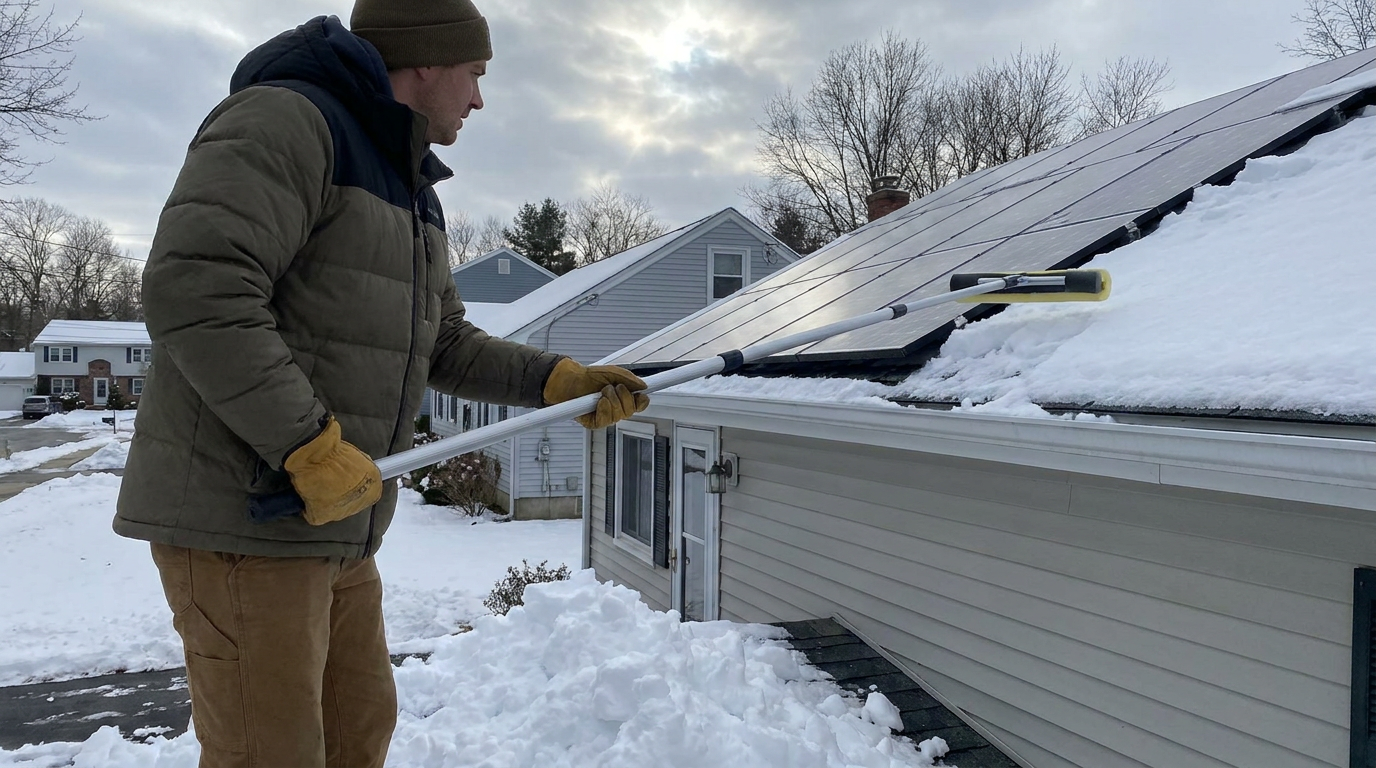
If the panels are reachable from the ground and the situation genuinely calls for intervention, the safest homeowner method is a long handled snow rake designed for roofs, ideally fitted with a soft, non abrasive edge. The goal is not to scrape the glass perfectly clean. The goal is to gently encourage loose snow to slide off without pressing hard on the modules. That distinction matters. You are nudging accumulation, not performing detailed surface cleaning.
Before you begin, choose a calm day with good visibility. Wear boots with traction and stand on stable, level ground well away from where snow may slide down. Keep children, pets, and vehicles clear of the fall zone beneath the array. If there are overhead utility lines, narrow side yards, or uncertain footing, stop there and reassess whether this is a job for a professional.
Position the rake so it contacts only the snow near the lower edge of the array or the roof surface immediately adjacent to it, not the panel face itself if you can avoid it. Use slow, controlled pulls to loosen the bottom layer and allow gravity to do the rest. Often, once a little snow begins to move, a larger sheet will slide free naturally. Do not jab upward, do not pry under panel frames, and do not continue if the snow is frozen solid against the surface.
Step by step approach for homeowners
-
Check your monitoring system first. Confirm that production is unusually low for conditions, rather than simply normal for a short winter day. This helps you avoid unnecessary work.
-
Inspect visually from the ground. Look at how much of the array is covered, whether the snow appears light and powdery or dense and icy, and whether there are hazards below.
-
Wait if sunlight or warmer temperatures are expected soon. Natural melting is often the lowest risk and lowest impact option.
-
If removal seems worthwhile, use a long handled roof rake with a soft edge. Work from stable ground and keep your body well outside the path of sliding snow.
-
Gently pull at the snow in small sections near the lower edge. Let gravity carry the rest. Stop immediately if the tool contacts the glass, catches on hardware, or requires force.
-
Once most of the snow is off, step back. There is usually no need to clear every last streak. Exposed surface area and sunlight will often finish the job.
This restrained approach protects the system and respects the reality that winter solar maintenance is about sensible recovery, not perfection. A partially cleared array may begin generating again even if a thin residue remains, and that is often enough.
How to handle ice on solar panels
Ice is where homeowners should become even more cautious. Snow can sometimes be nudged loose. Ice usually cannot, at least not safely. If a glazed or frozen layer is adhered to the panel, scraping it is likely to do more harm than good. This is a situation where patience is often the right maintenance strategy.
Allow sunlight and ambient warming to do the work whenever possible. Dark solar cells can absorb heat when exposed, and even cold air temperatures may still permit gradual thawing under bright conditions. If the panels remain iced over repeatedly, it may be worth discussing design factors with your installer, such as tilt, drainage patterns, or localized shade that keeps the surface colder for longer.
In climates with repeated freeze thaw cycles, ice can accumulate near lower frames where meltwater refreezes. That is frustrating, but still not a reason to pry or chip at the module. If the buildup appears severe or seems to be affecting the frame, mounts, or roof drainage, document it from the ground and contact a qualified service provider. Hidden damage is harder to catch when homeowners try to solve an ice problem with force.
Cleaning debris the sustainable way
Not every maintenance task happens in the middle of a snowstorm. Many homeowners notice debris after winter begins to ease, or during dry stretches when rain is not doing much cleaning. Leaves, dust, pollen, soot, and droppings can all accumulate, especially in neighborhoods with mature trees or nearby traffic. Here, a sustainability minded approach is both practical and recommended.
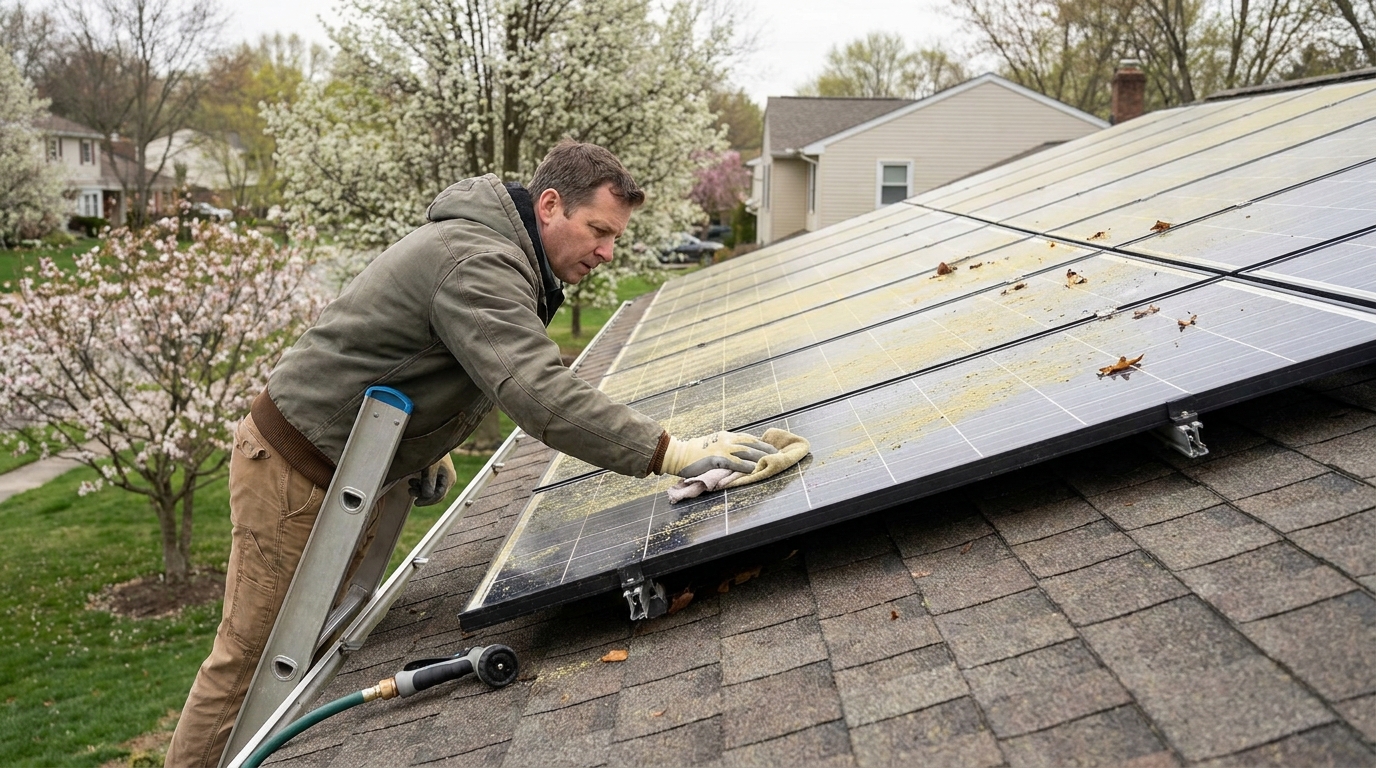
Start with the lightest possible intervention. In many cases, routine precipitation will wash away ordinary dirt. If that has not happened and the panels are notably soiled, plain water may be enough. A directed hose stream from the ground can help in some setups, provided water pressure is moderate and the stream does not forcefully strike seals or wiring areas. Use water sparingly and avoid unnecessary runoff, especially where local water conservation matters.
If residue remains and the array is safely accessible without roof walking, use mild soap or plain water with a soft cloth or sponge. Avoid solvents, strong detergents, and abrasive pads. The purpose is to lift grime gently, not polish the glass. Clean during cool parts of the day when possible, since very hot panel surfaces can cause water to evaporate quickly and leave streaks. In winter or shoulder seasons, this usually means choosing a dry, above freezing period with calm weather.
Best practices for debris removal
-
Use plain water first, since simple methods are often enough and reduce chemical use.
-
If needed, add only a small amount of mild soap and rinse thoroughly.
-
Choose soft cloths, soft sponges, or other non abrasive materials approved for delicate surfaces.
-
Stop if access requires unsafe ladder work, leaning across the roof, or contact with wiring and mounting hardware.
-
Let rain and seasonal weather do most of the cleaning whenever possible. This saves water and reduces risk.
This measured method aligns well with the larger sustainability story around solar energy. The cleanest energy system is not one maintained aggressively with unnecessary chemicals and water, but one cared for thoughtfully over time.
Use monitoring before you reach for a tool
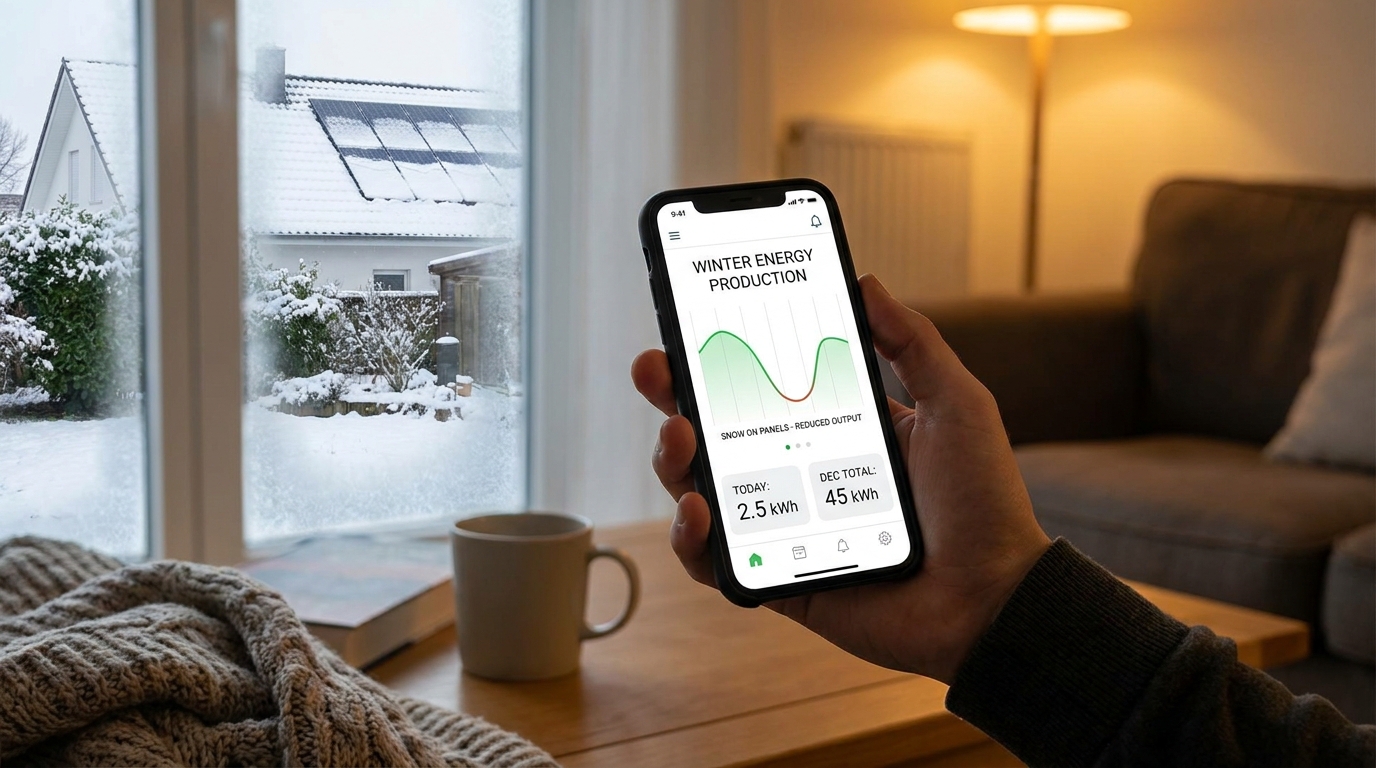
One of the most helpful developments in residential solar is better performance visibility. Many modern systems include app based monitoring, and some include panel level data that shows whether a drop in output is broad, temporary, or limited to a specific module. That matters in winter because it helps separate normal seasonal behavior from a maintenance issue without sending anyone onto the roof.
If your system has monitoring, review recent production patterns before doing anything physical. Compare the current day to similar weather days earlier in the season. If the whole array drops sharply right after snowfall and then begins recovering as the sun returns, you are probably seeing ordinary snow cover. If one panel or one section behaves differently from the rest after the roof has visually cleared, that may point to debris, shade, or a technical issue that deserves inspection.
Monitoring is also useful for peace of mind. Many homeowners assume the system is failing when winter output falls, when in fact the change is simply due to shorter days and lower sun angles. A quick look at trend data can prevent unnecessary cleaning and reduce the temptation to take risks for modest seasonal gains.
Panel level monitoring is one of the simplest ways to improve winter solar maintenance, because it turns guesswork into observation.
How roof pitch, system design, and climate affect snow buildup
Snow removal is not just about technique. It is also about design. The angle of the roof, the tilt of the modules, the frame style, the distance from the roof surface, and local snow conditions all influence how much buildup occurs and how easily it releases. A steeper array often sheds snow faster than a shallow one. Arrays with enough clearance may benefit from airflow and warming that encourage earlier melt. In some settings, wind scouring can also help keep panels cleaner.
Homeowners in northern climates should think about these design factors as part of long term resilience, not just winter inconvenience. If you are planning a new installation, ask the installer how the system is designed for snow load, drainage, access, and seasonal maintenance. If you already have a system that consistently traps snow, the answer may not be more frequent cleaning. It may be better diagnostics, adjusted expectations, or, in some cases, a design modification advised by a professional.
Climate variation across Canada and the northern United States adds another layer. Some regions have seen changes in snow cover patterns over time, including fewer snow cover days in milder southern or coastal areas, while interior and mountain climates may still see long lasting snowpack. That means there is no single winter solar rule that fits every homeowner. The right approach depends on your roof, your weather, your monitoring data, and your tolerance for risk.
When to call a professional
There are clear moments when professional help is the best decision. If the panels are on a steep roof, mounted high above ground, surrounded by ice, or blocked by architectural features that make ground access ineffective, bring in a qualified solar service provider. The same applies if snow appears to have bent framing, shifted hardware, damaged conduits, or caused unusual noises or visible deflection.
You should also call a professional if production remains abnormally low after the array appears clear. That could signal hidden cell damage, wiring issues, inverter faults, or shading changes rather than simple snow coverage. Because solar systems are electrical systems, diagnosing underperformance is not just about looking at the glass. A trained technician can inspect connectors, modules, mounting points, and data trends in a way homeowners should not attempt on their own.
After especially severe winter events, a professional inspection may be worthwhile even if the system seems functional. Heavy snow and ice can stress modules and frames, and some forms of damage are not visible from the ground. A preventative service visit can be more affordable than waiting for reduced production to persist unnoticed over multiple seasons.
Common mistakes homeowners make
The first common mistake is assuming every snow event requires action. This creates unnecessary risk and often yields little benefit. If snow is likely to melt within a day or two, the safest maintenance choice is usually patience. The second is using household tools that seem convenient but are too harsh for solar glass, including metal shovels, stiff brushes, and scrapers.
The third mistake is chasing spotless panels in winter conditions. Solar panels do not need to look perfectly clean to function. Once a meaningful portion of the surface is exposed, production often resumes enough for weather and sunlight to finish the job. Homeowners sometimes keep pushing past that point, which increases the chance of accidental contact and damage.
A fourth mistake is ignoring monitoring data and cleaning based only on appearance. A snowy panel may still be within the normal range for the day, while a seemingly clear panel with poor output may have an underlying fault. Finally, many people underestimate runoff and falling snow. Standing directly below an array while loosening compacted snow can be surprisingly dangerous, even when working from the ground.
Future facing solutions worth watching
There is promising research around winter performance improvements, including coatings designed to help snow and ice release more easily, frameless or differently framed module designs, and installation strategies that improve shedding. These ideas are interesting and may become more useful over time. For now, though, some of the most talked about consumer friendly solutions are still emerging rather than fully mature.
That means homeowners should be cautious about expecting technology to eliminate winter maintenance altogether. Even a steeper tilt or newer module design does not remove the need for proper snow load planning, safe access decisions, and realistic seasonal expectations. The best current tools are often the simplest ones: thoughtful system design, reliable monitoring, and restrained maintenance habits.
If you are shopping for a new system, it is reasonable to ask installers about winter weather hardening, snow shedding characteristics, and monitoring options. Just treat these as quality improvements, not permission to take more risks. Better design should reduce the need for intervention, not encourage it.
A practical winter maintenance routine for homeowners
The most effective winter routine is calm and consistent rather than intensive. After major snowfalls, glance at the array from the ground if it is visible. Check your monitoring app once conditions stabilize. If output begins to recover naturally, leave the system alone. If the panels stay buried and production remains unusually depressed, consider whether safe ground based removal is possible with a soft long handled tool.
Outside of active snow events, inspect for debris during seasonal transitions, especially in late fall, early spring, and after windstorms. Use rainfall as your first cleaning partner. If soiling remains significant, clean gently with plain water or mild soap and soft materials, always prioritizing minimal water use and safe access. Keep records of any recurring trouble spots so you can discuss them with your installer or maintenance provider later.
It can also help to think in terms of thresholds rather than impulses. Decide in advance what conditions would justify action, such as complete snow cover lasting several sunny days, or obvious debris buildup causing a measurable production drop. This reduces stress and makes maintenance more objective.
Final thoughts
Solar panels are durable, but winter care works best when it stays conservative. In most cases, snow will melt or slide away on its own, and routine precipitation will handle ordinary dirt. When buildup persists, homeowners can sometimes help safely from the ground using soft tools and gentle methods. The important thing is to avoid turning a manageable maintenance task into a safety hazard or a source of accidental system damage.
There is a quiet sustainability lesson in that approach. Good solar ownership is not about constant intervention. It is about understanding how the system behaves through the seasons, responding only when it makes sense, and choosing methods that preserve both energy performance and material longevity. A little patience, a little monitoring, and a strong respect for roof safety go a long way.
If you remember just a few essentials, make them these: stay off the roof, avoid abrasive tools, use water and soap sparingly, and let data guide your decisions. Winter solar maintenance does not have to be dramatic. Done well, it is simply another part of caring for a home with intention and good judgment.


No Comment! Be the first one.