


How to Change Your Air Filters: A Simple Guide for Clean Indoor Air
There are certain home tasks that feel small but quietly shape the way a house feels every day. Changing an air filter is one of them. It does not have the drama of a renovation or the instant visual reward of fresh paint, yet it affects something deeply personal: the air you and your family breathe. A clean filter can help reduce dust and airborne particles, support more even heating and cooling, and help your home feel fresher and more comfortable through every season.
Table Of Content
- Why Air Filter Changes Matter More Than People Realize
- What an Air Filter Can and Cannot Do
- How Often Should You Change Your Air Filter?
- Signs Your Filter May Need Attention Sooner
- Understanding Filter Sizes, Types, and MERV Ratings
- How to Choose the Right Replacement Filter
- Step by Step: How to Change Your Air Filter
- 1. Turn off the heating or cooling system
- 2. Locate the filter
- 3. Remove the old filter carefully
- 4. Check the size and orientation
- 5. Insert the new filter
- 6. Turn the system back on
- 7. Set a reminder for the next check
- A Quick Checklist You Can Save
- Common Mistakes to Avoid
- Why This Matters in Every Season
- Air Filter Changes for Renters
- Pairing Filter Changes With Other Healthy-Home Habits
- When to Call a Professional
- The Small Routine That Supports a Better-Feeling Home
For many people, air filter changes sit in the category of things they mean to do but keep postponing. It is easy to forget because the filter is often hidden in a utility closet, behind a return grille, or inside a furnace compartment. The good news is that this is one of the most approachable maintenance habits you can build. Once you know where your filter is, what size it is, and how to replace it, the job usually takes just a few minutes.
There is also a meaningful health angle to this simple routine. Health Canada notes that poor indoor air quality can affect health, and recommends replacing or cleaning HVAC filters according to the manufacturer’s instructions. The U.S. Environmental Protection Agency also explains that filtration can help improve indoor air quality, especially when paired with source control and ventilation. In other words, changing your filter is not the only thing that matters for healthy air, but it is one of the most practical and worthwhile things most households can do regularly.
This guide is designed to make the process feel easy rather than intimidating. Whether you own a house, rent an apartment, care for pets, manage allergies, or simply want your home to feel cleaner and more comfortable, learning how to change your air filters is a smart habit. We will walk through why it matters, how often to do it, how to choose the right filter, and exactly how to replace it step by step.
Why Air Filter Changes Matter More Than People Realize
Your HVAC filter is often the first line of defense between the air circulating through your home and the particles you would rather keep out of your living spaces. As air moves through the system, the filter helps capture dust, pollen, pet dander, and other fine particles before they continue recirculating from room to room. When the filter is reasonably clean and properly fitted, your heating and cooling system can move air more effectively while helping support a cleaner indoor environment.
That matters because indoor air affects far more than just a spotless shelf or a less dusty coffee table. It touches comfort, sleep, breathing, seasonal allergies, and the overall atmosphere of home life. If you have ever noticed a space feeling stuffy, dusty, or unevenly heated and cooled, a neglected filter may be part of the story. It is not always the only cause, but it is one of the easiest issues to address.
Natural Resources Canada notes that dirty filters reduce airflow and can, in some cases, damage equipment. Reduced airflow can make your furnace or air conditioner work harder than necessary, which may lead to extra strain over time. Clean filters help your system do its job more smoothly, which supports both comfort and efficiency. A home that heats and cools more evenly usually feels calmer and easier to live in.
There is also a broader lesson here about what healthy homes really are. They are not only beautiful rooms with good lighting and lovely textiles. They are also spaces that quietly support well-being through better air, better temperature balance, and sensible maintenance routines. Changing the air filter is a simple act of care that improves how your home functions behind the scenes.
Good indoor air quality is not about one perfect product. It comes from a combination of filtration, ventilation, and reducing pollution sources inside the home.
What an Air Filter Can and Cannot Do
It helps to have realistic expectations. Air filters are helpful, but they are not magic. According to Health Canada and the EPA, filtration works best as part of a broader strategy that includes source control and ventilation. Source control means limiting pollutants at their origin, such as minimizing indoor smoking, managing cooking fumes, using lower-emission products when possible, and cleaning up dust-producing messes promptly. Ventilation means bringing in fresh air when conditions allow and making sure fans and mechanical systems are working as intended.
Filters mainly target particles. That includes things like dust, pollen, smoke particles, and pet dander. They do not remove every indoor pollutant, especially gases such as many volatile organic compounds, often called VOCs. If a room smells strongly of paint, harsh cleaners, or another chemical source, a filter alone will not solve the issue. In those situations, reducing the source and improving ventilation matters too.
This distinction is especially useful during wildfire smoke events, allergy season, or times when the house is closed up for weather reasons. During those periods, filtration can play a valuable role in reducing particle pollution indoors. Public health guidance from the CDC and EPA supports the use of HVAC filtration and portable air cleaners to help reduce smoke particles indoors. Still, these tools work best when they are part of a larger plan, not treated as a total solution.
Knowing this actually makes the task more empowering. You do not need to believe that one filter change will transform every aspect of your indoor environment. Instead, you can view it as one strong, practical piece of a healthy-home routine, right alongside opening windows when outdoor air is good, using kitchen and bath fans, controlling moisture, and keeping dust under control.
How Often Should You Change Your Air Filter?
This is one of the most common questions, and the answer depends on both the filter and the household. CDC guidance says homes with pleated HVAC filters should change the filter every three months or follow the manufacturer’s instructions. That is a useful baseline for many homes, but it is not a one-size-fits-all rule. Some households need more frequent changes because of pets, allergies, smoking, renovation dust, heavy HVAC use, or outdoor smoke.
If your home includes shedding pets, several family members, or someone sensitive to pollen and dust, the filter may load up more quickly. If you run your heat or air conditioning almost constantly during very cold or very hot months, that can also shorten the filter’s practical life. During wildfire season or after home improvement projects that create fine dust, it is wise to inspect the filter sooner than usual. A filter that has worked much harder than normal may need replacing well before the three-month mark.
Seasonality also plays a real role in North American homes. In winter, homes are often closed up tightly, which can increase the importance of airflow and filtration. In spring, pollen can challenge households that are trying to keep allergens down. In summer, cooling demand can rise along with humidity concerns. In late summer and fall, some regions also contend with wildfire smoke. These changes make it sensible to think of filter checks as part of a seasonal home rhythm rather than a forgotten afterthought.
A good, realistic habit is to check the filter monthly and replace it based on condition, system use, and the manufacturer’s recommendation. This does not mean you must swap it out every month. It simply means you stay aware of its condition. That quick glance can prevent a filter from becoming overdue and quietly affecting both indoor air and HVAC performance.
Signs Your Filter May Need Attention Sooner
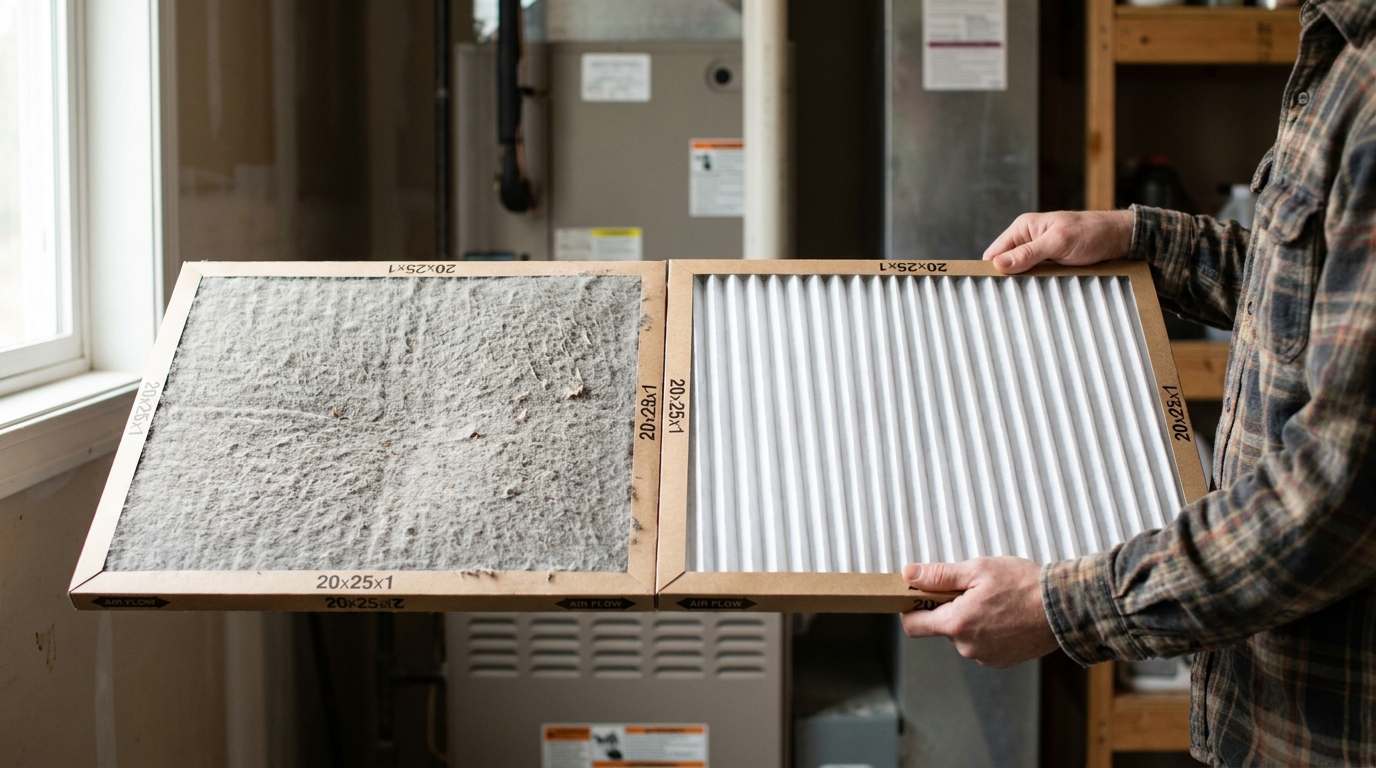
Sometimes a calendar reminder is not enough because real life is messier than a schedule. A filter may need changing sooner if you notice more visible dust settling on surfaces, reduced airflow from vents, or rooms that seem slower to heat or cool than usual. If your system sounds like it is running more often, or if your home feels stuffier than normal, the filter is worth checking. These signs do not always point only to the filter, but it is the easiest place to start.
Households with pets often learn quickly that fur and dander can shorten the time between filter changes. The same is true if someone in the home smokes indoors, if there has been recent sanding or construction work, or if outdoor air quality has been poor. Even a filter that looks only moderately dusty may be more loaded than it appears, especially if the home has had weeks of heavy use or smoke exposure.
Many people assume that if a filter does not look dramatic, it must still be fine. That can be misleading. Filter loading depends on more than visible dirt. Fine particles can accumulate in ways that affect performance before the filter looks obviously grimy. That is one reason routine checks and manufacturer guidance are more helpful than appearance alone.
If you ever feel unsure, it is reasonable to replace the filter rather than overthink it. This is a relatively low-cost maintenance step compared with the cost of unnecessary wear on heating and cooling equipment. In home care, simple habits often protect comfort and function better than complicated fixes later on.
Understanding Filter Sizes, Types, and MERV Ratings
Before you buy a replacement, it helps to understand a few basics. Most residential HVAC filters have a printed size on the frame, such as 16 x 20 x 1 or 20 x 25 x 4. That size matters because a poor fit can allow air to bypass the filter, reducing its effectiveness. When replacing your filter, use the exact size listed on the current filter or in your system manual unless a qualified professional has advised otherwise.
You will also notice that filters come in different materials and efficiencies. Fiberglass filters are usually the most basic. Pleated filters tend to capture more particles and are commonly recommended for everyday residential use. CDC guidance specifically mentions pleated filters in its every-three-month recommendation, which reflects how common they are in homes. For many households, a quality pleated filter offers a practical balance of filtration and airflow.
Then there is the MERV rating, which stands for Minimum Efficiency Reporting Value. This rating gives a general sense of how effectively a filter captures different particle sizes. ASHRAE consumer guidance recommends at least MERV 6 or higher for replacement filters in many residential settings. Many public-health recommendations also discuss MERV 13 for stronger particulate protection where the HVAC system can handle it. That last phrase matters quite a bit.
One of the biggest misconceptions is that a higher MERV filter is automatically the best choice for every system. In reality, higher-efficiency filters can increase pressure drop, which may reduce airflow if the system was not designed for them. In simple terms, a filter can be too restrictive for some equipment. That is why fit, manufacturer instructions, and system compatibility should always come before the impulse to buy the most advanced-looking option on the shelf.
HEPA filters are another point of confusion. They are highly effective for capturing particles, but they are not always practical as retrofit filters in residential central HVAC systems because of airflow resistance. In many homes, a properly matched pleated filter is the smarter choice. If you want extra support for particles, especially in a bedroom or during smoke events, a portable air cleaner may be a better addition than forcing an incompatible filter into your HVAC system.
How to Choose the Right Replacement Filter
The most sensible approach is to replace like with like unless you have confirmed your system can handle an upgrade. Start by looking at your current filter. You want to note the exact dimensions, the thickness, and the airflow arrow printed on the frame. If the old filter worked well and your system has had no airflow issues, choosing the same type and rating is often a safe place to begin.
If you are considering a higher-efficiency option, check the furnace or air handler manual, look for manufacturer guidance, or ask an HVAC professional. This is especially important if you are moving to a much denser pleated filter or trying to reach MERV 13. In some homes, that upgrade is completely appropriate and helpful. In others, it can reduce airflow in a way that undermines comfort and system performance. Better filtration should never come at the cost of a struggling system.
Renters should take a slightly more cautious approach. In some apartments and condos, maintenance staff handle filter changes, or the building may use a central system where access is not intended for residents. If that is your situation, check your lease or ask the property manager before replacing anything. If the filter is in your unit and clearly intended for resident maintenance, the process is often straightforward, but it is still wise to confirm the building’s expectations.
When in doubt, the best replacement filter is the one that fits correctly, matches your system’s needs, and gets changed regularly. Consistency often matters more than buying the most aggressive filter on the market and then delaying replacement because the process feels confusing or expensive.
Step by Step: How to Change Your Air Filter
If you have never changed an air filter before, this is the part that usually makes everything click into place. The process is simple, calm, and manageable. Once you have done it once, it becomes one of those home routines you can complete in just a few minutes.
1. Turn off the heating or cooling system
For safety and accuracy, start by turning off the HVAC system at the thermostat. This helps prevent the system from pulling air while you remove the old filter. It also gives you a moment to work without dust being stirred up. In most homes, turning the system off at the thermostat is enough for this task.
2. Locate the filter
The filter is often found in one of two places: inside the return air vent grille or in a slot near the furnace or air handler. In some homes, there may be more than one return grille, but usually only one main filter location for the central system. If you are unsure, check the owner’s manual or look for a narrow access slot on the ductwork near the equipment. The existing filter frame usually makes the location obvious once you find it.
3. Remove the old filter carefully
Slide the old filter out slowly to avoid knocking dust loose. You may notice arrows printed on the frame showing the direction of airflow. Take a moment to look at those before you discard the filter. If the filter is very dusty, placing it directly into a trash bag can keep loose particles from spreading through the room.
4. Check the size and orientation
Before opening the new filter, read the size printed on the old one and make sure it matches exactly. Also note the airflow direction arrow. Air filters must be installed facing the correct way, and the arrow should point in the direction that air is moving through the system. If the filter is in a return grille, the arrow typically points toward the duct. If it is near the furnace, the arrow usually points toward the equipment. If you are uncertain, your system manual can help confirm it.
5. Insert the new filter
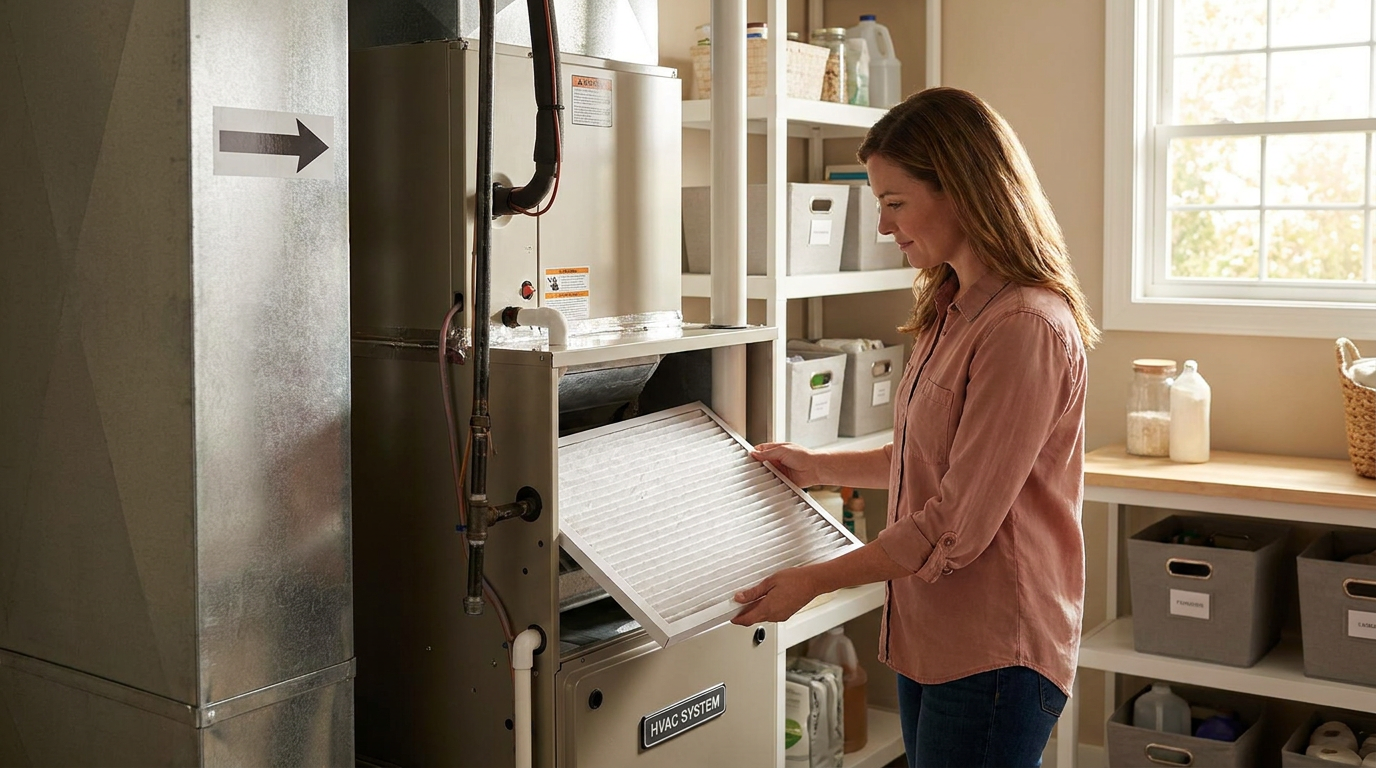
Slide the new filter into place gently so it fits snugly without bending. It should sit securely in the slot or frame without major gaps around the edges. A good fit matters because air that slips around the filter is not being filtered properly. Once it is in place, close the grille or access panel securely.
6. Turn the system back on
Return to the thermostat and switch the system back on. Let it run normally and pay attention to whether everything sounds and feels typical. You are not looking for perfection, only normal operation. In most cases, the change will be uneventful, which is exactly what you want.
7. Set a reminder for the next check
This last step is the one people most often skip, and it is also what turns a one-time task into a healthy routine. Set a reminder on your phone, note it on the family calendar, or use a smart home app if that fits your lifestyle. A monthly check and a regular replacement pattern make it far less likely that the filter will be forgotten until there is a comfort problem.
A Quick Checklist You Can Save
If you prefer a concise reference, here is the essential process in one place. These are the steps most homeowners and renters can follow for a standard residential HVAC filter change.
- Turn off the HVAC system at the thermostat.
- Find the filter location at the return grille or near the furnace or air handler.
- Remove the old filter slowly and note the airflow arrow.
- Confirm the exact size printed on the filter frame.
- Insert the new filter with the arrow pointing in the correct direction.
- Close the panel or grille securely.
- Turn the system back on and set a reminder for the next check.
Common Mistakes to Avoid
Even simple maintenance tasks have a few easy pitfalls. The most common mistake is installing the filter backward. The airflow arrow exists for a reason, and the filter performs best when positioned correctly. If the arrow is facing the wrong way, the system will not filter air as intended.
Another common mistake is choosing the wrong size. A filter that is too small can leave gaps that allow unfiltered air to bypass it. A filter that is too large may bend or fail to seat properly. Always check the exact dimensions rather than assuming a nearby standard size is close enough.
People also run into trouble when they upgrade to a much higher MERV rating without checking compatibility. A more efficient filter may sound like a clear improvement, but if it restricts airflow too much, it can work against the comfort and performance you are trying to protect. It is always smarter to choose a filter your system can handle well and replace it regularly than to overreach and create an airflow problem.
Finally, do not wait until the filter looks alarming. A lightly dirty-looking filter may still be loaded in ways that matter. Following manufacturer guidance and checking monthly is a more reliable habit than relying on appearance alone.
Why This Matters in Every Season
One reason this task deserves a place in your home routine is that indoor air challenges shift throughout the year. In winter, homes are often sealed against cold weather, which can make stale air and dust feel more noticeable. A clean filter helps support better circulation when windows stay closed and the heating system runs often. It is a quiet layer of comfort during the months when we spend so much time indoors.
Spring brings pollen, and many households feel the difference almost immediately. Shoes carry in debris, windows may open more often, and allergy symptoms can increase. A fresh filter can help reduce the circulation of airborne particles, especially when combined with regular cleaning and thoughtful ventilation. It does not remove every trigger, but it supports a calmer indoor environment.
Summer often means steady air conditioning use, which makes airflow especially important for comfort. A clogged filter can contribute to uneven cooling and force the system to work harder on hot days. At the same time, summer humidity can make indoor comfort feel more delicate. While the filter itself does not control humidity, a smoothly operating HVAC system plays an important role in how balanced the home feels.
In some regions, late summer and fall bring wildfire smoke concerns. During these periods, filtration becomes even more relevant. Public health guidance supports using HVAC filtration and portable air cleaners to reduce particle pollution indoors. If smoke events affect your area, checking and replacing your filter promptly can be part of a practical resilience plan that helps your home feel safer and more livable.
Air Filter Changes for Renters
Renters sometimes assume this topic only applies to homeowners, but that is not always true. Many rental homes, townhouses, and apartments have accessible filters that tenants are expected to check or replace. If your lease is unclear, ask the landlord or property manager. It is better to clarify responsibilities than to guess, especially in buildings with shared systems or maintenance policies.
If the filter in your unit is your responsibility, changing it is one of the simplest ways to improve day-to-day comfort without making any permanent changes to the property. It can help with dust, airflow, and overall freshness, which matters in small spaces just as much as large ones. Renters who work from home or spend a lot of time indoors often notice the quality-of-life benefits quickly.
In apartment buildings with central or shared HVAC systems, residents may not have direct access to the filter or may have a different type of in-unit filter setup. In those cases, your role may be more about requesting maintenance on time and using portable air cleaners if needed for a particular room. There is no one rental scenario, so a little communication goes a long way.
What matters most is remembering that you deserve healthy, comfortable indoor air whether you own your home or not. Filter maintenance may look different in a rental, but the basic goal remains the same: cleaner air, better comfort, and a system that is not working harder than it should.
Pairing Filter Changes With Other Healthy-Home Habits
Because filtration is only one part of the picture, it helps to build a few supportive habits around it. If outdoor air quality is good, opening windows occasionally can refresh the home. Using bathroom fans and range hoods helps remove moisture and cooking byproducts at the source. Vacuuming with a good machine, dusting regularly, and reducing clutter can also keep particles from endlessly cycling through the air.
Portable air cleaners can be especially helpful in bedrooms, nurseries, home offices, or living rooms where people spend long stretches of time. These devices do not make HVAC filter changes unnecessary, but they can add another layer of support for particle reduction. This can be especially worthwhile during wildfire smoke events, high-allergy weeks, or in homes with pets.
It is also wise to pay attention to moisture and humidity. Filters do not solve dampness, leaks, or mold issues. If your home feels persistently humid, smells musty, or shows signs of moisture problems, those issues need direct attention. Healthy air comes from systems and habits working together, not from putting too much pressure on one maintenance step.
The encouraging part is that none of this needs to feel overwhelming. You are not aiming for a perfect house. You are creating a home that supports real life with a little more ease, clarity, and care. Changing the filter regularly is simply one of the easiest places to begin.
When to Call a Professional
Most filter changes are simple enough for a homeowner or renter to manage without help. Still, there are times when a professional is the better choice. If you cannot locate the filter, if the system uses a specialized media cabinet, if airflow seems poor even after replacement, or if the equipment makes unusual noises, it may be time for an HVAC technician to take a look. The filter may not be the only issue.
It is also worth getting guidance if you want to upgrade to a higher MERV filter and are unsure whether your system can handle it. An HVAC professional can help you understand what your equipment is designed for and whether a better filter, a different configuration, or a portable air cleaner would give you the best result. This is especially useful in older homes where airflow may already be a little delicate.
If someone in your household has significant respiratory concerns, severe allergies, or sensitivity to smoke, you may also want a more personalized indoor air strategy. Filtration helps, but a whole-home assessment can reveal other opportunities involving ventilation, source reduction, and humidity control. The goal is not to overcomplicate things, only to match the solution to the home and the people living in it.
The Small Routine That Supports a Better-Feeling Home
There is something reassuring about maintenance tasks that deliver more than one kind of benefit. Replacing your air filter supports cleaner indoor air, helps your HVAC system maintain airflow, and contributes to a home that feels more comfortable through the seasons. It is quick, affordable, and deeply practical, which makes it one of the best low-effort habits for everyday well-being.
It also shifts the way we think about home care. A comfortable home is not only about the visible layer of decorating. It is also about the hidden systems that shape how the space feels to breathe in, sleep in, gather in, and move through each day. Clean indoor air is part of that experience, and regular filter changes are one of the simplest ways to care for it.
If you have been putting this task off, let this be the gentle nudge. Find the filter, check the size, replace it carefully, and set the next reminder before you forget. That one small action can support a fresher, calmer, healthier-feeling home, and sometimes the most meaningful improvements are the ones you feel before you ever see them.



No Comment! Be the first one.