



Creating the Perfect Reading Nook: A Step by Step Guide for Comfort, Style, and Everyday Wellness
There is something deeply comforting about a space that seems to ask nothing of you except that you sit down, exhale, and turn a page. In a busy home, that feeling can be surprisingly rare. Many families move quickly from work to school schedules to meals to screens to bedtime routines, and even the rooms we love can begin to feel crowded with demands. A reading nook offers a different rhythm. It becomes a gentle signal that rest is allowed, quiet is welcome, and a few minutes of mental escape can belong to everyday life.
Table Of Content
- Why a Reading Nook Matters More Than Ever
- Step 1: Choose the Right Spot in Your Home
- Good Locations to Consider
- Step 2: Start with Seating That Invites You to Stay
- What to Look for in the Best Reading Chair
- Step 3: Add Layered Lighting for Calm and Clarity
- Easy Lighting Formula for a Reading Nook
- Step 4: Give Books a Home Without Letting Clutter Take Over
- Step 5: Soften the Space with Textiles and Texture
- Step 6: Think About Noise, Privacy, and Emotional Boundaries
- Step 7: Make Air, Temperature, and Comfort Part of the Plan
- Step 8: Style the Nook So It Feels Personal, Not Performative
- Step 9: Create a Family Friendly Nook Everyone Can Use
- Step 10: Build Gentle Rituals Around the Space
- Common Mistakes to Avoid
- A Simple Reading Nook Checklist
- Final Thoughts: A Small Corner Can Change the Feeling of Home
That emotional value is part of what makes reading nooks so meaningful right now. Research on reading for pleasure has linked it with experiences such as getting away from daily stressors, feeling positive emotions, building empathy, and supporting self understanding. At the same time, housing and wellness research continues to show that clutter, noise, crowding, and general environmental discomfort can contribute to stress. A dedicated corner for reading cannot solve every pressure of modern life, but it can create a repeatable pause. That matters more than many of us realize.
The good news is that a beautiful reading nook does not require a spare room, custom millwork, or a large budget. It can begin with a chair by a window, a warm lamp, and a basket for books. The goal is not perfection. The goal is to shape a corner of your home so it supports calm, focus, and comfort for the people who actually live there.
In this guide, we will walk step by step through how to create a reading nook that feels stylish and deeply usable. We will look at choosing the best location, selecting comfortable seating, layering sleep friendly lighting, controlling clutter, improving comfort, and adding the details that make a nook feel personal rather than staged. Whether you live in a family house, a small apartment, or a shared home with children and pets, you can create a nook that makes reading feel less like another task and more like a ritual of restoration.
Why a Reading Nook Matters More Than Ever
A reading nook may seem like a decorative idea at first, but its real power is emotional. In family homes especially, a defined place for reading introduces a sense of environmental control. That means there is one spot in the house that consistently communicates what happens there. It tells your body and mind that this is where stimulation softens, the pace changes, and attention can settle. In homes filled with motion and multitasking, that predictability can feel incredibly calming.
Reading itself also brings benefits that go beyond entertainment. A recent realist review of forty three papers found that reading for pleasure was linked to wellbeing mechanisms such as escaping daily stressors, generating positive emotions, building empathy, increasing self understanding, and creating a more conducive environment for wellbeing. Another intervention study in adolescents found that story reading improved mindfulness, optimism, happiness, and positive emotions over five weeks, while reducing anxiety and pessimism. These findings do not mean reading replaces professional care when someone is struggling, but they do support the idea that reading routines can meaningfully support mental wellness in everyday life.
When you pair the emotional value of reading with a space designed for comfort, the effect becomes stronger. It is easier to return to a habit when the environment supports it. A chair that feels good, a lamp that is easy on the eyes, a small place to set tea, and a home for your current books all reduce friction. That practical ease matters because wellness is often built from repeated, modest experiences rather than dramatic transformations.
A reading nook is not about luxury for luxury’s sake. It is about creating a dependable little refuge that helps rest, focus, and pleasure fit inside real family life.
Step 1: Choose the Right Spot in Your Home
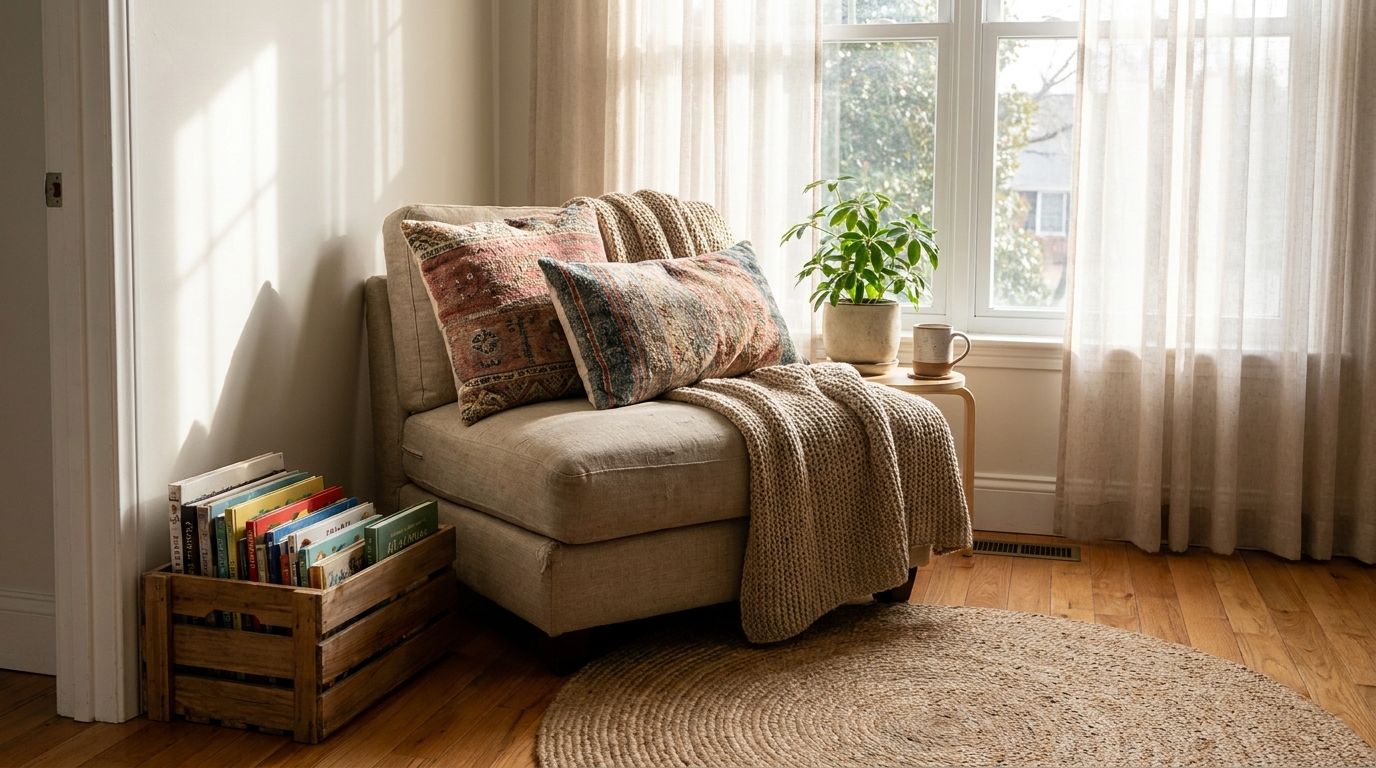
The first step is choosing a location that already has some potential for quiet and comfort. In many homes, the best reading nook is not in a formal room. It is in an underused corner of the living room, a landing near a window, a bedroom alcove, the end of a hallway, or even a wide spot beneath the stairs. You are looking for a place that feels naturally separate from the busiest circulation paths. It does not need to be completely silent, but it should feel slightly removed from the household flow.
Natural light is a wonderful advantage if you can find it. A window adds softness, variation, and a sense of openness that makes a nook feel emotionally inviting. Daylight also helps a small area feel more alive and less boxed in. If you can place a chair so that you can read beside a window without harsh glare directly in your eyes, that is often an ideal starting point.
At the same time, remember that location is about more than beauty. Family homes function better when spaces are easy to use. A reading nook should not block storage, create a tripping hazard, or make a room feel crowded. It should feel integrated into your routines rather than like an afterthought squeezed into a corner. If children or older adults will use the nook, consider how easy it is to reach, sit down, and stand up comfortably.
It is also wise to think about ventilation and indoor comfort. Guidance from Health Canada notes that efficient ventilation improves indoor air quality by reducing pollutant and moisture levels. In practical terms, that means your reading nook should feel breathable and fresh rather than stuffy. A corner near a window that can open, or in a room with good airflow, tends to be more pleasant for longer reading sessions.
Good Locations to Consider
- A quiet corner of the living room with enough room for a chair and side table
- A bedroom corner for evening reading and wind down routines
- A landing or wide hallway niche with strong natural light
- A family room edge where children and adults can read near one another
- An office corner that can transition into a screen free retreat after work hours
Step 2: Start with Seating That Invites You to Stay
If there is one place to prioritize comfort, it is the seat. The most stylish nook in the world will not support a reading habit if the chair feels stiff, shallow, or awkward after ten minutes. Look for seating that supports your back, allows your feet to rest comfortably, and gives your arms a natural place to land. Upholstered armchairs are a classic choice because they feel cocooning without requiring a lot of space, but they are not the only option. A chaise, a compact loveseat, a daybed, a cushioned bench with a back, or even a floor setup with supportive pillows can work beautifully depending on your home and how you like to read.
Think honestly about your reading style. Do you sit upright with a hardcover book and a cup of tea beside you, or do you curl up for long stretches with a novel and a blanket? Do your children love to sprawl on the floor while you read aloud nearby? The best nook reflects the way reading happens in your home rather than copying a showroom image. Comfort should be personal, not generic.
Scale matters too. In small spaces, oversized furniture can make a nook feel cramped and visually heavy. Instead, choose a piece with a comfortable seat depth and supportive shape, but a footprint that still leaves breathing room around it. If your nook is part of a larger room, visual lightness helps. Slim legs, rounded edges, and soft upholstery can all make a space feel more open while still being cozy.
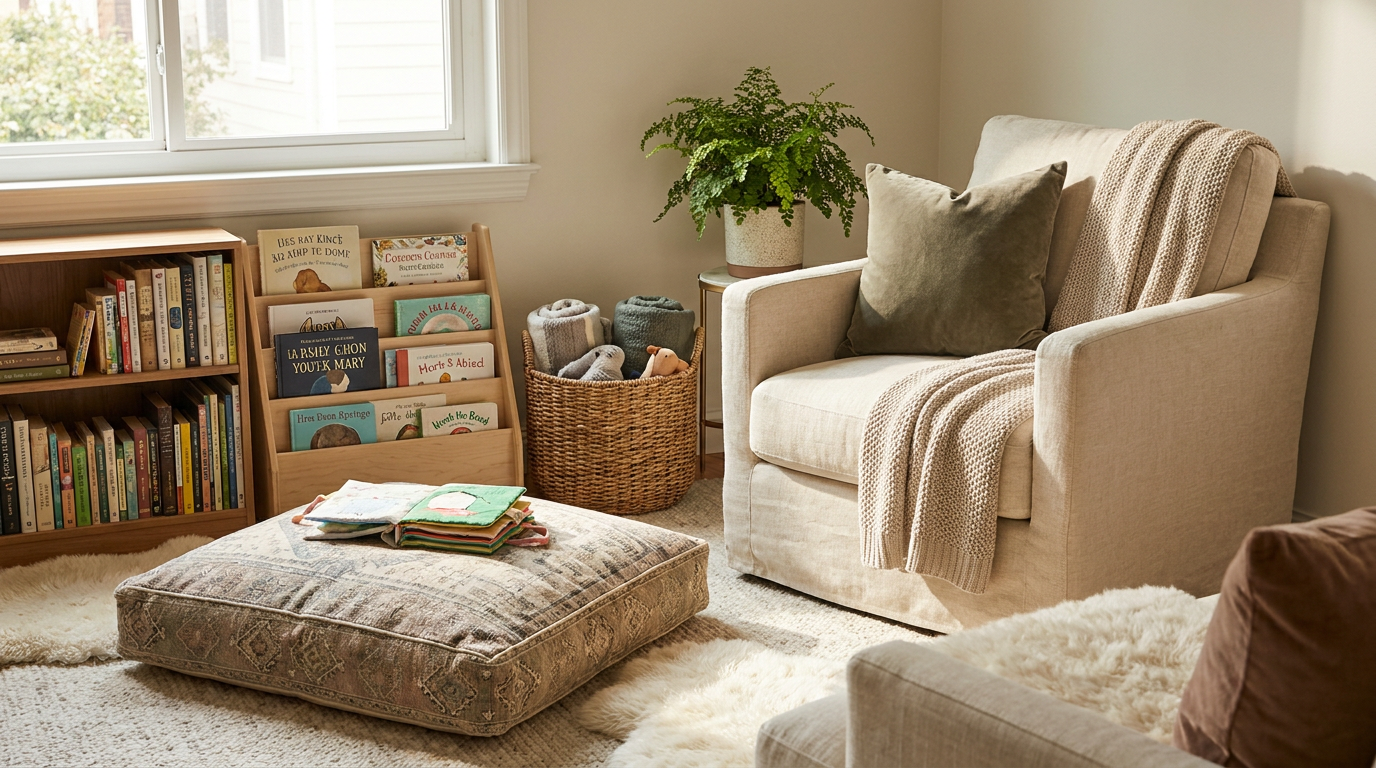
For family use, versatility can be especially helpful. A main chair paired with a pouf or floor cushion allows more than one person to settle in at once. That makes the nook useful for shared reading, bedtime stories, or quiet parallel time when one child flips through picture books while an adult reads nearby. The space then becomes not just a solo retreat but a gentle family ritual zone.
What to Look for in the Best Reading Chair
- Support for the lower back and shoulders so longer reading sessions feel comfortable
- A seat height that allows feet to rest easily on the floor or on an ottoman
- Arms or side support so books and e readers are easier to hold comfortably
- Fabric that feels inviting and durable for everyday family use
- A size that fits the room without crowding walkways or nearby furniture
Step 3: Add Layered Lighting for Calm and Clarity
Lighting is one of the most important elements in any reading nook because it affects both comfort and mood. A nook that is too dim strains the eyes, but one that relies on bright overhead light alone may feel more energizing than restful. The most successful reading nooks use layered light. That means combining a focused reading light with ambient warmth so the space feels softly illuminated rather than harshly lit.
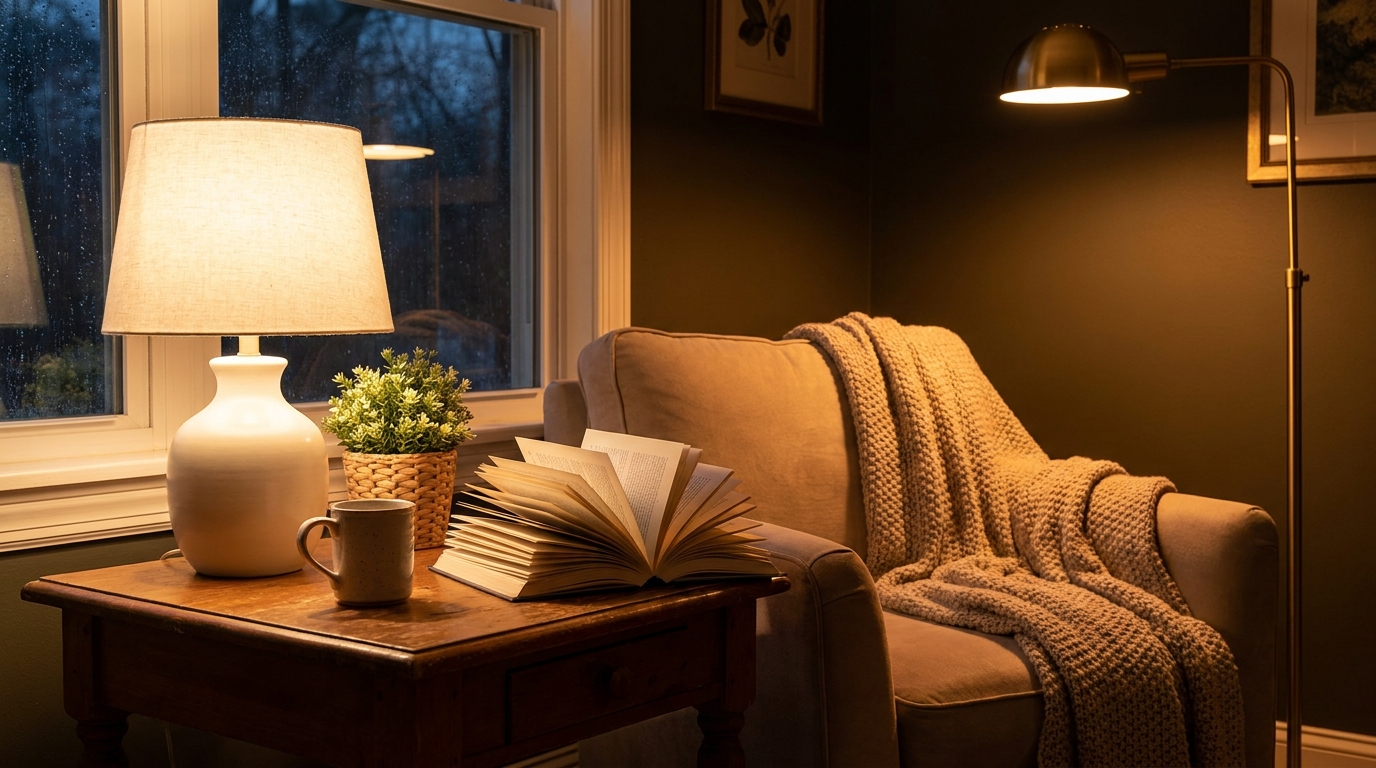
This is especially important for evening reading. Guidance from the CDC and NIOSH notes that blue and white light at night can make it harder to fall asleep and stay asleep. For a reading nook intended for winding down, warmer and dimmer light is less disruptive. U.S. Department of Energy guidance also notes that warm white lighting around 2,700K to 3,000K is commonly used in homes and supports a friendly, personal mood. In simple terms, a warm lamp will often feel better than a bright cool bulb when the goal is relaxation.
A floor lamp beside a chair is often the easiest solution, especially if it can be angled toward the page. A table lamp on a side table works well too, as long as the bulb gives enough task light for reading. If your nook is in a bedroom or a very small corner, a wall mounted swing arm lamp can save space while adding flexibility. Dimmable lighting is a lovely upgrade because it lets you shift the room from practical brightness to evening softness with almost no effort.
Try to avoid depending solely on ceiling fixtures, especially if they cast flat light over the entire room. A reading nook should feel a little sheltered and intimate. Layered lighting helps define that emotional atmosphere while still being practical. If possible, test your setup in both daylight and evening conditions before finalizing it. A nook that feels wonderful at noon may need one more lamp by 8 p.m.
Easy Lighting Formula for a Reading Nook
- Use one dedicated task light aimed near the page rather than directly at the eyes
- Choose warm white bulbs in the 2,700K to 3,000K range for a cozy feel
- Add dimming if possible so the nook can shift from daytime reading to evening wind down
- Layer with daylight, a soft overhead source, or nearby ambient lighting instead of relying on one harsh bulb
Step 4: Give Books a Home Without Letting Clutter Take Over
One of the quickest ways to lose the calming effect of a reading nook is to let it become a drop zone. Research on residential environments has found that higher home clutter is associated with more depressive and anxiety symptoms in older adults, and many people intuitively feel this in daily life. When a nook fills up with random papers, charging cords, unmatched toys, laundry, and stacks of things waiting to be put away, it no longer sends a clear signal of rest. It starts to carry the same mental noise as the rest of the house.
The answer is not to make the nook look sparse or impersonal. Instead, create simple, realistic storage so the space can hold what it needs and nothing more. A small shelf, a basket for current reads, a side table with a lower tier, or a slim bookcase nearby can be enough. The key is deciding in advance what belongs here. Usually that means books, a blanket, reading glasses, a journal, and perhaps one or two comfort objects like a candle or coaster.
Open storage can be lovely if you are naturally tidy, but baskets and lidded boxes are often better in family spaces because they keep visual clutter under control. They are also easy for children to use. A low bin for picture books, for example, invites independence and keeps the area feeling approachable rather than precious. If your nook is in a shared room, boundaries matter. Even one designated basket can preserve the sense that this corner has a purpose.
Think of storage as part of the wellness design rather than a practical afterthought. The fewer barriers there are to sitting down with a book, the more often the nook will actually be used. At the same time, the easier it is to reset the space in two minutes, the more likely it is to continue feeling like a retreat.
Step 5: Soften the Space with Textiles and Texture
Comfort is not only about furniture. It is also about the sensory experience of the space. Soft textiles help a nook feel welcoming, while layered textures make even a simple setup feel complete. A throw blanket over the arm of a chair, a pillow behind the lower back, a rug underfoot, and curtains that filter light can all change the emotional quality of a corner.
These details matter because they invite the body to relax. In a house full of hard surfaces and practical materials, softness signals care. It tells you that this is a place meant for staying a little longer. That emotional invitation is part of what turns reading into a restorative practice instead of just another good habit you keep meaning to start.
Natural textures are especially effective if you want the nook to feel grounded and current. Linen, cotton, wool, rattan, light wood, and woven baskets all bring warmth without making the space feel fussy. This also aligns with the growing appeal of biophilic design, which uses natural materials and plant life to make interiors feel more connected to the outdoors. You do not need a fully themed space. Even small touches can help.
Color should support the mood you want. Soft neutrals, earthy tones, muted greens, warm browns, dusty blues, and creamy whites all work beautifully in reading corners because they feel restful and timeless. If you love richer color, use it in a way that still feels cocooning rather than overstimulating. A deep olive chair, a rust throw, or a moody wallpaper panel can create a dramatic nook that remains deeply relaxing.
Step 6: Think About Noise, Privacy, and Emotional Boundaries
Not every home can offer complete silence, and that is okay. A reading nook does not need to be acoustically perfect to be emotionally effective. Still, it helps to reduce obvious disruptions where you can. The difference between a chair placed directly beside a television and one tucked slightly behind a bookshelf or near a quieter window can be significant. Small positional changes often matter more than expensive design solutions.
Soft materials help absorb sound, so rugs, curtains, pillows, and upholstered seating all contribute to a quieter feel. A nearby bookcase can also create a sense of separation in an open room. If your home is especially lively, consider adding a small sound machine, keeping the nook in a lower traffic room, or simply setting a family expectation that this corner is for quiet activities. Children often respond well to spaces with a clear identity, especially when that identity feels warm rather than restrictive.
Emotional boundaries are just as important as physical ones. Part of the reason a reading nook feels restorative is that it separates one type of time from another. Work happens elsewhere. Household chores happen elsewhere. Screens, notifications, and piles of unfinished tasks do not belong here if you can help it. This sense of separation is what helps the nook become a micro retreat inside ordinary life.
If your nook shares space with a family room or bedroom, use visual cues to reinforce its purpose. A lamp that is only switched on during reading time, a basket of current books, or a folded throw can all act as small rituals. Over time, the brain begins to associate that environment with settling down. That is one reason well designed nooks can feel so emotionally supportive even when they are physically simple.
Step 7: Make Air, Temperature, and Comfort Part of the Plan
When people imagine cozy corners, they often think about blankets and mood lighting first, but basic physical comfort deserves equal attention. A nook that feels too hot, too cold, too stale, or too dry will never be as inviting as one that feels fresh and balanced. Good ventilation contributes to indoor air quality and moisture control, which can affect wellbeing and comfort. If your chosen spot is in a room that tends to feel stuffy, think about how you can improve airflow before committing to the layout.
Temperature is also personal. Some people love reading in a sunlit corner during the day but find the same spot uncomfortable in late afternoon heat. Others enjoy a winter nook near a window as long as there is a throw blanket within reach. Notice how the room behaves across the day and season. The ideal reading nook is not just photogenic for one hour. It is comfortable enough to return to repeatedly.
Even scent and tactile comfort can play a role. Fresh air, a gentle linen spray, or simply avoiding harsh artificial fragrances may make the space feel more restful. This is especially true in homes with sensitivities or children. The aim is not to create a spa fantasy. It is to create a corner that feels easy on the senses.
Step 8: Style the Nook So It Feels Personal, Not Performative
Once the foundation is in place, styling gives the nook emotional depth. This is where the space begins to feel like yours. The most successful reading nooks are not overloaded with accessories, but they do carry small signs of personality. A ceramic mug you love, a framed print, a favorite candle, a family photo, a handmade quilt, or a stack of treasured novels can all make the nook feel lived in and real.
Try to choose decor that supports the mood rather than distracts from it. A reading nook should not feel visually chaotic. One or two artworks, a plant, and a few carefully chosen objects are often enough. Editing is important here. If every surface is filled, the space starts to lose the quiet clarity that makes it restful.
Plants are a particularly beautiful addition because they soften corners and connect the nook to natural rhythms. A small trailing plant on a shelf, a potted fern near the chair, or a simple branch in a vase can bring life without effort. This biophilic element complements the emotional role of a reading nook by making the space feel more grounded and serene.
If you love luxury interiors, remember that the feeling of luxury in a reading nook often comes from restraint and comfort rather than expense. Good light, soft fabric, a balanced palette, and a sense of order feel far more elevated than crowded styling. In other words, a nook does not need to be expensive to feel beautiful. It needs to feel intentional.
Step 9: Create a Family Friendly Nook Everyone Can Use
One common misconception is that reading nooks are either for children or for adults seeking a perfectly quiet solo corner. In reality, many of the best nooks are designed for both. A family friendly reading nook supports independent reading, shared story time, and quiet screen free moments across different ages. It becomes a flexible part of home life rather than a precious setup no one wants to disturb.
To make a nook family friendly, think in layers. An adult chair can be paired with a washable floor cushion for children. A low basket can hold picture books while a nearby shelf stores novels and magazines. A stool can become a perch for a parent during bedtime reading or a footrest during solo reading. This layered approach makes the space adaptable without losing its calm identity.
Durability matters in these spaces. Choose fabrics that can handle real life and furniture finishes that are easy to wipe down. A reading nook should invite use, not anxiety. If you are constantly worried about spills or marks, the space will feel more decorative than comforting. Family wellness spaces work best when beauty and practicality support each other.
There is also real emotional value in shared reading corners. Reading together can become part of evening routines, weekend slow mornings, or after school decompression. In homes where everyone is often doing different things at once, a nook can create a simple form of togetherness that feels peaceful rather than performative. That kind of quiet connection is worth making room for.
Step 10: Build Gentle Rituals Around the Space
A reading nook becomes powerful not only because of how it looks, but because of how it is used. This is where routine comes in. Even a beautifully designed corner will not support wellness if it remains mostly decorative. The secret is to attach the nook to small, realistic rituals. Perhaps you sit there for fifteen minutes before bed. Perhaps it becomes the place for Saturday morning coffee and a chapter. Perhaps children know this is the after dinner story spot.
These rituals do not need to be ambitious. In fact, the more modest they are, the more likely they are to last. A reading nook works best when it lowers the threshold for rest. You do not need an hour of total silence to enjoy it. You need a chair that is ready, a lamp that is warm, and a small habit that invites you to begin.
For people who struggle to disconnect from screens, a nook can also help mark a transition. Leaving a phone outside the space, keeping a paper book within reach, or using the lamp as a signal that the day is winding down can all support healthier evening rhythms. This is especially useful when paired with warm, dimmable light rather than bright cool light late at night.
The goal is not to create a perfect room. The goal is to make relaxation easier to choose.
Common Mistakes to Avoid
One of the biggest mistakes is assuming that a reading nook has to look elaborate to work well. In reality, a cramped chair with poor light and nowhere to place a book will not become more restorative because it is styled with expensive accessories. Another common mistake is focusing so much on appearance that function disappears. If you cannot comfortably read there for half an hour, the nook needs adjustment.
Too much brightness is another issue, especially in evening reading spaces. Brighter is not always better. Cool white or blue rich light may feel crisp, but it can undermine the calming experience many people want from a bedtime or after dinner nook. Warm layered light tends to support a more peaceful atmosphere while still giving enough visibility to read comfortably.
Clutter is also a major mood breaker. When the nook becomes a storage area for unrelated household overflow, its emotional identity disappears. Keep the space edited and easy to reset. Finally, avoid creating a nook that only one person in the home can realistically use if your goal is family wellness. The most beloved corners are often the ones that adapt easily to changing routines and ages.
A Simple Reading Nook Checklist
- A location with some separation from the busiest household traffic
- Comfortable seating that suits your reading style
- Warm task lighting, ideally dimmable for evening use
- Simple storage for books, blankets, and reading essentials
- Soft textiles for warmth, texture, and sound absorption
- Fresh air and a comfortable temperature whenever possible
- A few personal details that make the space feel emotionally inviting
- A small reading ritual that helps the nook become part of daily life
Final Thoughts: A Small Corner Can Change the Feeling of Home
There is something beautiful about the idea that one thoughtfully arranged corner can gently change the pace of a household. A reading nook does exactly that. It creates a place where the demands of the day soften, where stories and ideas can unfold, and where both adults and children can experience a little more stillness. In a culture that often celebrates productivity above all else, making room for reading is a quiet act of care.
What makes a nook meaningful is not its size or its price tag. It is the way it supports your life. A chair that welcomes you, light that flatters the evening, storage that keeps clutter from creeping in, and a few personal details can be enough to turn an ordinary corner into a place of restoration. That is why the reading nook continues to resonate as both a design idea and a wellness space. It is practical, emotional, and deeply human.
If you have been waiting for the right room, the right budget, or the right moment, consider this your invitation to begin smaller. Choose one corner. Add one lamp. Pull up one comfortable chair. Place a book within reach. From there, something lovely often starts to happen. Reading feels easier to return to, rest feels less abstract, and home begins to hold a little more softness than it did before.



No Comment! Be the first one.