



There was a time when home lighting was treated as a finishing touch, something chosen late in the design process and judged mainly by whether a room felt bright enough. Today, that perspective feels incomplete. Lighting has become one of the most expressive and intelligent layers of the modern home, shaping not only what we see but how we feel, move, rest, gather, and live. In this new design landscape, smart lighting stands out as a remarkable union of elegance and innovation, offering homeowners a way to bring beauty, flexibility, and efficiency into their daily routines.
Table Of Content
- Why Smart Lighting Has Become a Design Essential
- The Foundation: LEDs, Efficiency, and Long Term Value
- Understanding What Smart Lighting Really Means
- Layered Lighting: The Secret to Rooms That Feel Complete
- Tunable White Light and the Art of Atmosphere
- Smart Lighting Room by Room
- Living Rooms
- Kitchens
- Bedrooms
- Bathrooms
- Hallways and Staircases
- Outdoor Spaces
- Technology That Feels Seamless: Matter, Thread, and Better Compatibility
- Designing for Beauty, Not Brightness Alone
- What to Consider Before You Buy
- Common Mistakes to Avoid
- The Future of Home Lighting Is Both Intelligent and Timeless
- Practical Takeaways for a More Beautiful Smart Lighting Plan
Smart lighting is LED-based lighting, including bulbs, fixtures, and switches, that can be dimmed, scheduled, tuned in color temperature, and grouped into scenes through an app, voice assistant, or automated routine, rather than controlled only by a single wall switch. It is no longer just color-changing bulbs for technology enthusiasts; it has matured into a genuine design tool. Because it builds on LED technology, which the U.S. Department of Energy says uses at least 75 percent less energy and lasts up to 25 times longer than incandescent bulbs, smart lighting pairs efficiency with real design flexibility. Newer standards such as Matter and Thread let fixtures and sensors from different brands work together, while tunable white light, occupancy sensing, and scene control let one room shift from bright morning task lighting to a warm evening glow. The result is a home that feels more tailored, more atmospheric, and more responsive to the people who live in it.
In North America, this evolution has been strengthened by the widespread shift to LED technology, growing interest in connected home systems, and improved interoperability through standards such as Matter and Thread. For homeowners, that means more freedom to choose beautiful fixtures, integrated systems, and controls that work together more seamlessly. The conversation has expanded from isolated smart bulbs to include ceiling fixtures, recessed downlights, wall sconces, light strips, outdoor lighting, and scene based control that can elevate the entire visual identity of a home.
There is also a practical foundation beneath the beauty. According to the U.S. Department of Energy, residential LEDs use at least 75 percent less energy and last up to 25 times longer than incandescent lighting. The same broader guidance around lighting controls emphasizes the value of timers, dimmers, occupancy sensors, and connected technologies as part of energy efficient lighting design. Smart lighting therefore offers something genuinely rare in home improvement: a choice that can feel luxurious and artistic while also serving the quiet logic of performance, longevity, and efficiency.
This article explores how smart lighting can transform your home with both technology and style. We will look beyond the gadget narrative and into the deeper design potential of light itself, considering how it can enhance ambiance, support wellness, articulate architecture, and create a home that feels as graceful as it is intelligent.
Why Smart Lighting Has Become a Design Essential
The most important shift in the smart lighting conversation is that lighting is finally being appreciated as an experience rather than a utility. Good lighting does not merely fill darkness. It sculpts surfaces, brings depth to materials, softens transitions, highlights craftsmanship, and establishes emotional tone. A smart system makes these effects easier to control and personalize, allowing a room to change character throughout the day without the need for constant manual adjustment.
In a beautifully designed home, one room often serves many purposes. A living room may host morning coffee, afternoon reading, evening conversation, and late night films. A kitchen may need bright task lighting for preparation, flattering illumination for casual dining, and a softer mood for entertaining. Traditional switching offers limited nuance, but smart lighting allows these shifts to happen with intention. Light levels can be dimmed, color temperature can be adjusted, and several fixtures can work together in scenes that reflect the rhythm of daily life.
This is one reason smart lighting has moved so decisively into the mainstream. Recent market research places the North America smart lighting market in the multi billion dollar range, with 2025 estimates above USD 5.4 billion for the U.S. market and above USD 7.5 billion for North America overall. While those figures come from market research firms rather than government sources, they reinforce an obvious editorial truth: smart lighting is no longer niche. It has become part of renovation planning, decorating conversations, and a wider cultural desire for homes that feel more adaptive and more refined.
Its appeal also reflects a broader sophistication in how people think about interiors. Homeowners increasingly want spaces that support comfort and wellness while still feeling polished. Smart lighting answers that desire beautifully. It can enhance a minimalist apartment with quiet precision, warm a traditional family home with layered glow, or sharpen the clean geometry of contemporary architecture. Technology here does not have to look technical. At its best, it disappears into atmosphere.
The Foundation: LEDs, Efficiency, and Long Term Value
Before smart features even enter the picture, the move to LED lighting provides a strong case for change. The U.S. Department of Energy notes that lighting accounts for around 15 percent of an average U.S. home’s electricity use and says the average household saves about $225 per year by using LED lighting. That figure reminds us that lighting design is not solely aesthetic. It is also about choosing systems that are intelligent in the most fundamental sense, using resources with more care while delivering better performance.
LEDs have changed the visual and technical possibilities of home lighting. They are compact, long lasting, and available across a wide range of brightness levels and color temperatures. They can be integrated into recessed downlights, slender sconces, concealed cove lighting, under cabinet strips, pendants, landscape fixtures, and sculptural decorative pieces. This adaptability allows designers and homeowners to create more layered and more architectural lighting plans than was practical in the incandescent era.
ENERGY STAR adds another meaningful dimension to the value conversation. Replacing five frequently used fixtures or bulbs can save about $40 per year in energy costs, and a single certified bulb can prevent about 780 pounds of greenhouse gas emissions over its lifetime. These are not abstract benefits. They shape how a home performs over time, especially when paired with controls that ensure light is used thoughtfully rather than wastefully.
There is also a cultural ease to LED adoption now. More than 3 billion ENERGY STAR certified light bulbs have been sold in the United States since 1997, delivering over one trillion kilowatt hours in electricity savings. In other words, efficient lighting is no longer an experiment. It is a mature and trusted foundation. Smart lighting builds on that foundation by making illumination not just efficient, but responsive and beautifully managed.
Elegant lighting today is not about excess brightness. It is about using the right light, in the right place, at the right moment, with a sensitivity to both mood and function.
Understanding What Smart Lighting Really Means
One of the most persistent misconceptions around smart lighting is that it is synonymous with theatrical color effects. While RGB lighting certainly has its place, especially in playful or entertainment oriented spaces, the real strength of smart lighting lies in subtle control. For many homes, the most transformative features are dimming, scheduling, tunable white light, occupancy sensing, and the ability to create scenes that coordinate multiple fixtures at once.
Another misconception is that any connected light automatically saves energy. In reality, savings depend on what is being replaced and how the controls are used. If smart bulbs replace efficient LEDs and are always left at full brightness, the energy advantage may be modest. But if smart lighting is used with dimmers, occupancy sensors, schedules, and automated shutoff settings, it becomes a much more effective part of an energy conscious strategy. The design lesson is simple: intelligence is not only in the product, but in the way it is planned and lived with.
It is also worth clarifying the language of brightness. Many people still think in watts, but modern lighting guidance emphasizes lumens as the better measure of light output. ENERGY STAR notes that around 800 lumens is roughly equivalent to the light from a traditional 60 watt bulb. This matters because smart lighting works best when selections are based not on old habits but on the actual visual needs of each space. A room should feel luminous without glare, generous without harshness, and supportive of the activities it contains.
Once these misconceptions are cleared away, smart lighting becomes easier to appreciate as an interior design resource. It is not about making a home feel mechanical. It is about making the atmosphere more intentional, more adaptable, and more aligned with the architecture and the people inside it.
Layered Lighting: The Secret to Rooms That Feel Complete
If there is one principle that elevates lighting from functional to exceptional, it is layering. A single overhead fixture rarely gives a room the richness it deserves. Layered lighting combines different sources and purposes, typically including ambient lighting for overall illumination, task lighting for specific activities, and accent lighting to create drama or highlight features. Smart controls make this approach dramatically easier to manage, because multiple layers can be balanced through scenes rather than operated one by one.
Imagine a living room in the early evening. Recessed downlights provide a soft ambient base, a floor lamp brightens a reading corner, a wall washer brings texture to a lime plaster surface, and concealed shelf lighting adds visual depth. With smart control, these elements can become a single scene called Evening Calm, activated with one touch or by schedule. Instead of choosing between too bright and too dim, you create a composition of light that feels measured and graceful.
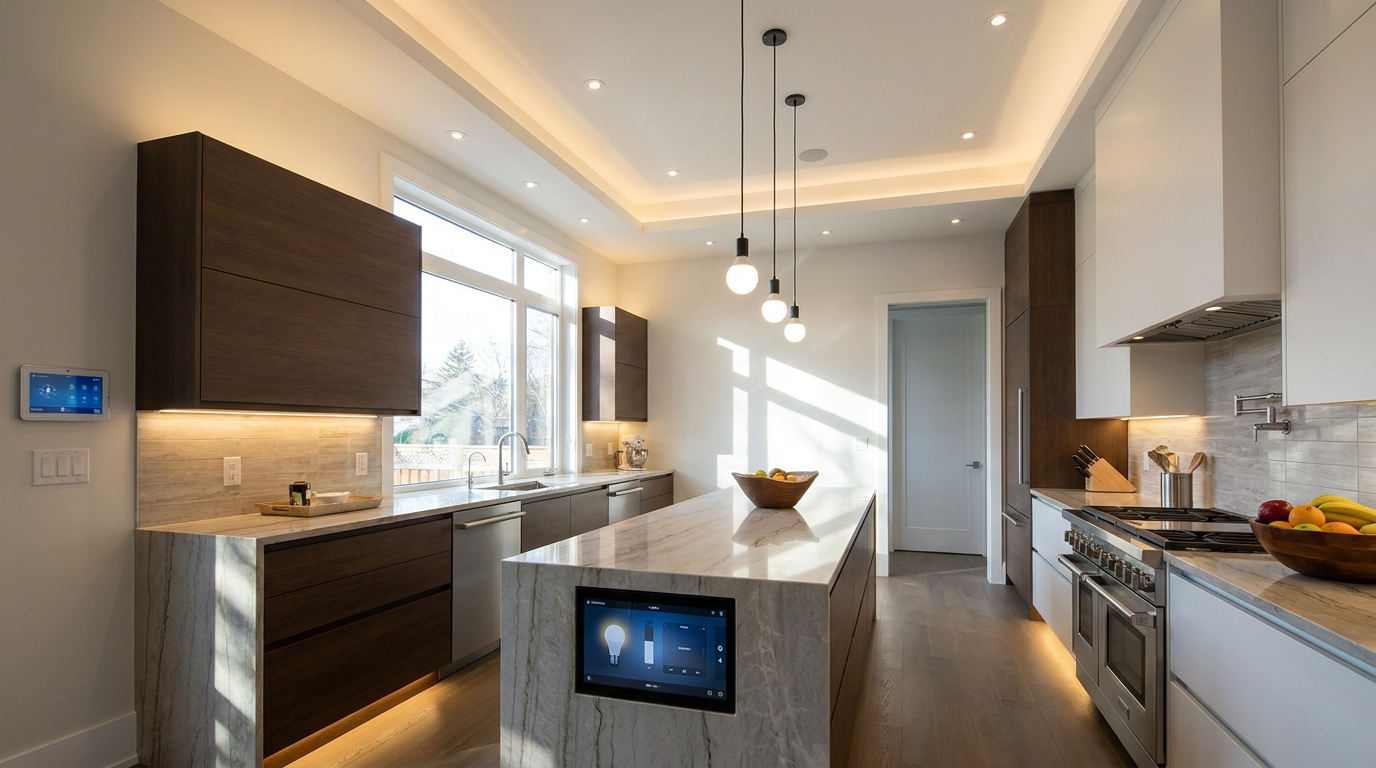
This principle applies across the home. In kitchens, layered lighting can combine ceiling illumination, under cabinet task lighting, accent lighting for open shelving, and pendants that add visual identity over an island. In dining rooms, the chandelier may provide presence while wall sconces soften the perimeter and dimmed downlights preserve intimacy. In hallways, a smart pathway scene can reduce brightness at night while maintaining safe circulation. Each layer contributes something distinct, and smart technology helps orchestrate the whole with quiet precision.
The Department of Energy notes that recessed downlights are widely used in North American homes, with more than 600 million installed in U.S. homes and businesses. This prevalence makes them especially relevant in discussions of smart lighting. Rather than treating downlights as purely utilitarian, homeowners can integrate them into more sophisticated schemes, adjusting intensity by time of day and pairing them with accent layers that keep rooms from feeling flat. The result is a home that appears more considered, more dimensional, and more inviting.
Tunable White Light and the Art of Atmosphere
Among the most refined developments in smart lighting is the rise of tunable white. Instead of offering only a fixed shade of white light, tunable systems allow homeowners to shift color temperature across a spectrum, from warmer golden tones to cooler brighter whites. This capability is profoundly useful because the quality of white light influences how materials appear, how a room feels, and how comfortably the space supports different activities.
Warm light tends to flatter wood, textiles, skin tones, and intimate evening settings. It creates softness, encourages relaxation, and pairs beautifully with bedrooms, living rooms, and dining areas. Cooler white light can feel clearer and more energizing, making it helpful in kitchens, bathrooms, work zones, and morning routines. A tunable system allows the home to move with the day rather than remain visually static from dawn to midnight.
This is where smart lighting begins to touch on the ideas often described as human centric or circadian lighting. While such concepts can sometimes be marketed too grandly, the core principle is sound: people generally benefit from lighting that aligns more naturally with daily rhythms. Brighter, cooler light can support alertness in the morning and during focused tasks. Softer, warmer light in the evening can create a gentler atmosphere that feels more restful and less jarring.
For design minded homeowners, the beauty of tunable white is that it serves both wellness and aesthetics. It can make a marble kitchen feel crisp and alive at breakfast, then transform the same room into a warmer, more convivial setting for dinner. It can keep a bathroom fresh and practical during the day while allowing a lower, spa like glow at night. Technology here becomes subtle choreography, shaping mood through nuances many people feel immediately even if they do not consciously name them.
Smart Lighting Room by Room
Living Rooms
The living room is often the clearest demonstration of what smart lighting can do well. It is rarely used for one fixed purpose, so flexibility becomes essential. During the day, a balanced relationship between daylight and electric light helps the room feel open and natural. In the evening, dimmed ambient lighting, gentle accent illumination, and a controlled perimeter glow can make the same room feel cocooning and elegant.
Scene setting is especially effective here. A Reading scene may prioritize a task lamp and moderate ambient light, while an Entertaining scene can warm the room and emphasize decorative elements. A Movie Night setting might leave only low level accent lighting and subtle wall wash to preserve comfort without overwhelming the screen. These variations enhance both utility and atmosphere, and they allow the room to feel curated rather than uniformly lit.
Kitchens
In kitchens, smart lighting brings particular value because the room must perform at a high level while often serving as a social center. Task zones should be clearly illuminated, but full brightness across every fixture at all times can make the space feel clinical. Smart controls allow under cabinet LEDs, pendants, ceiling fixtures, and accent lights to be adjusted according to the moment. Morning breakfast, midday cooking, and evening gatherings can each have their own visual cadence.
Motion sensing can also be useful in adjacent pantry areas, mudrooms, or connecting hallways, where hands are often full. Scheduling can ensure that practical zones are lit when needed and inactive when they are not. When done tastefully, this is not about spectacle. It is about creating a kitchen that is both efficient and beautifully composed.
Bedrooms
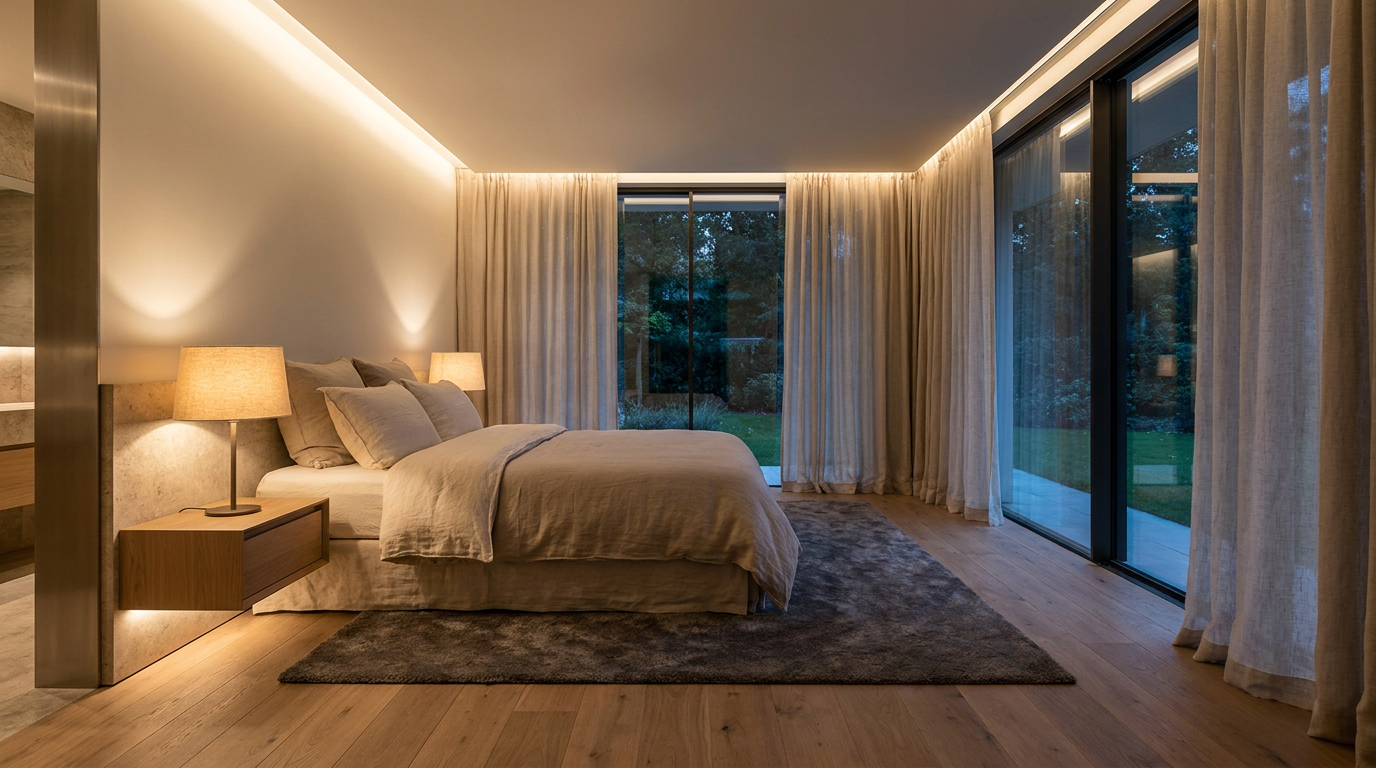
The bedroom benefits from a more intimate approach. Here, smart lighting can help soften transitions between waking and resting. Bedside fixtures may be dimmable through an app, voice control, or a simple bedside switch. Tunable white light can support brighter morning routines and much warmer evening settings. Integrated cove lighting or concealed accent light can introduce a layered, hotel like serenity that feels restorative rather than abrupt.
Bedrooms also reveal how smart lighting can reduce friction in daily life. A gentle wake up scene can gradually brighten the room, while a nighttime scene can dim circulation light to avoid harsh glare. When light is managed with sensitivity, the bedroom becomes more than a place to sleep. It becomes a sanctuary of visual calm.
Bathrooms
Bathrooms require careful balancing. Grooming tasks demand clarity, yet the room is also associated with privacy and unwinding. Smart lighting can support both. Vanity lighting should remain flattering and functional, while dimmable overhead lighting and niche accents can create a quieter spa mood later in the day. For homes with nighttime circulation needs, low level motion activated lighting can improve comfort without flooding the room with brightness.
Hallways and Staircases
These transitional spaces are often overlooked, yet they are among the most practical locations for smart controls. Occupancy sensors, timed scenes, and lower nighttime settings can improve both safety and energy use. Hallways can feel atmospheric rather than forgotten when downlights are carefully dimmed and paired with sconces or art lighting. A staircase, lit with restraint and precision, becomes an architectural moment rather than merely a passage.
Outdoor Spaces
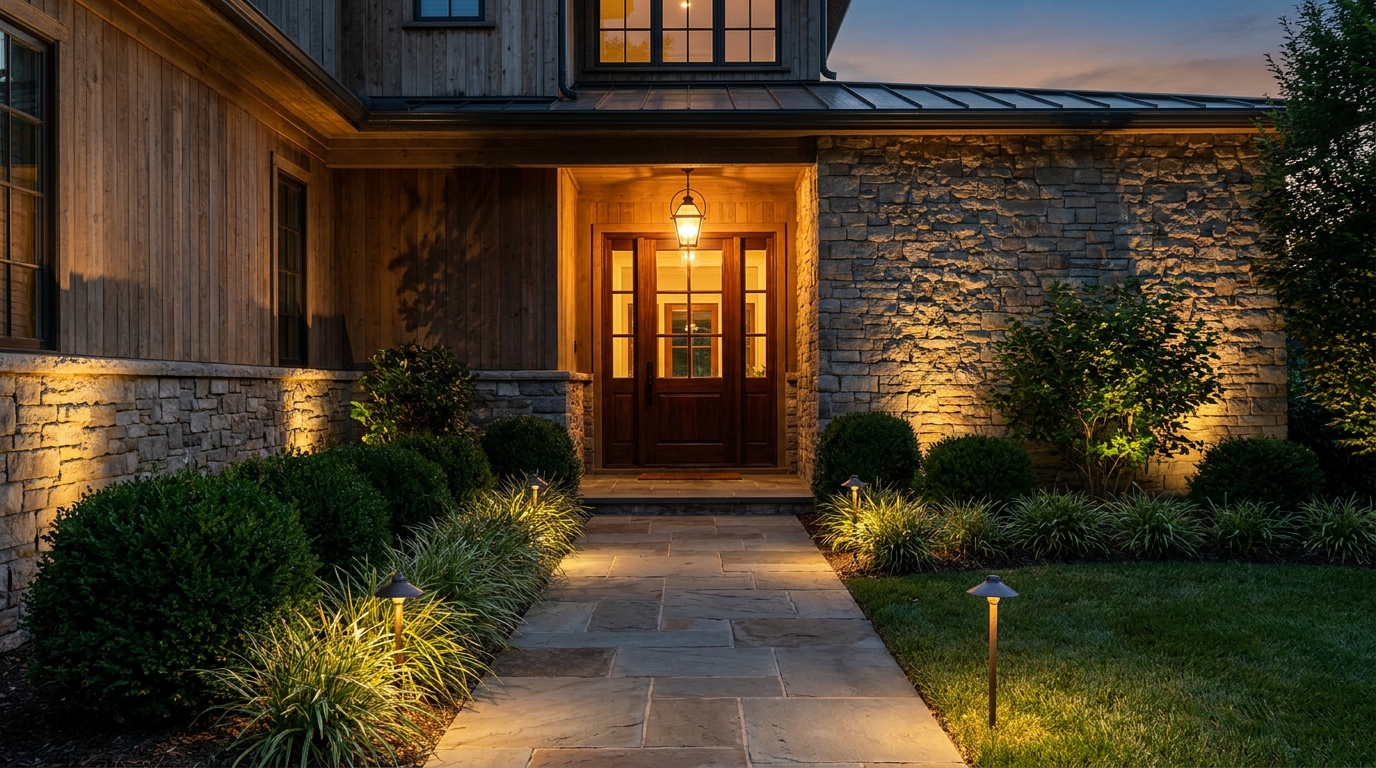
Outdoors, smart lighting can shape first impressions, safety, and evening enjoyment. Landscape lighting can illuminate paths, frame planting, and wash textured facades with subtle drama. Entry lighting can be scheduled to welcome residents home at dusk, while smart controls make it easy to manage seasonal shifts in daylight. Here, style and security naturally overlap. A beautifully lit exterior feels gracious, but it also supports orientation and peace of mind.
Technology That Feels Seamless: Matter, Thread, and Better Compatibility
One reason smart lighting has become more approachable is that the ecosystem itself is improving. For years, many homeowners hesitated because connected products could feel fragmented, with separate apps, limited compatibility, and a sense of brand lock in. Newer interoperability standards such as Matter and networking approaches like Thread are helping reduce that friction by making devices easier to integrate across major smart home ecosystems.
For the homeowner focused on design, this matters more than it may first appear. Greater compatibility means more freedom to choose lighting based on aesthetics and performance rather than only on platform restrictions. A sculptural ceiling fixture, a slim sconce, a discreet strip light, and a set of recessed fittings may increasingly be brought into one coordinated control experience. This flexibility supports better interiors because it allows the lighting plan to begin with the architecture and atmosphere, not merely with a single manufacturer’s catalog.
Another important trend is the growth of fixture based smart lighting, not just screw in bulbs. Integrated smart ceiling lights, linear systems, cove lighting, and architectural accent solutions are expanding the visual language of the category. This is encouraging because the most beautiful lighting is often embedded in the room’s composition rather than added as an afterthought. When smart functionality is built into the fixture or system itself, the result can feel cleaner and more resolved.
That said, a fully connected home does not have to begin with a full renovation. Many homeowners start with one room, one category of fixtures, or one practical need such as dimming or scheduling. The elegance of smart lighting lies partly in its scalability. It can begin simply and grow with the home over time.
Designing for Beauty, Not Brightness Alone
A beautifully lit home is not the brightest home. This point is essential, because one of the most common lighting mistakes is assuming that more output automatically means better design. In fact, excessive brightness can flatten texture, create glare, and erode the sense of comfort that makes interiors feel welcoming. The Department of Energy’s guidance around controls and daylighting supports a more thoughtful approach, one that adjusts quantity and quality of light to the task and takes natural light into account whenever possible.
Smart lighting excels here because it allows restraint. Instead of installing one fixed level meant to cover every scenario, you can calibrate multiple moods. Daylight harvesting, where lighting responds to available natural light, can help rooms remain balanced rather than overlit. Dimming preserves atmosphere. Scene control encourages intention. Accent layers add interest without demanding excessive output from the whole room.
This sensitivity is especially important when working with beautiful materials. Natural stone, brushed brass, dark timber, linen drapery, textured plaster, and matte painted surfaces all respond differently to light. Smart systems allow those materials to be appreciated in varied ways throughout the day. The home becomes more cinematic, not through drama for its own sake, but through a graceful awareness of how light reveals form.
The finest lighting is often the least obtrusive. It does not announce itself first. It enhances proportion, draws out material richness, and allows the room to feel quietly complete.
What to Consider Before You Buy
Although smart lighting can be wonderfully intuitive in use, it benefits from thoughtful planning. The first question is not which app or voice assistant you prefer, but how you want each room to feel and function. Consider where bright task light is necessary, where soft ambient light would be more appropriate, and which architectural or decorative features deserve accenting. A lighting plan built around experience will almost always outperform one built around product features alone.
It is also important to think in layers and controls together. Ask whether dimmers, schedules, occupancy sensors, or scene presets would solve real needs in your household. Kitchens, bathrooms, hallways, and outdoor paths often benefit from automation. Bedrooms and living rooms may benefit more from scene based dimming and tunable warmth. If you are selecting bulbs, fixtures, or switches, check compatibility carefully, especially if you want to work across ecosystems or integrate with existing smart home platforms.
Pay attention to lumens, color temperature range, and color rendering quality, not only connectivity. Good smart lighting should still be good lighting when judged on visual performance. A beautifully designed interface cannot compensate for poor glare control, unflattering color, or insufficient task illumination. If possible, choose products or fixture families that offer both technical reliability and aesthetic coherence.
Homeowners should also think about longevity. Standards like Matter may help preserve flexibility over time, while integrated smart fixtures can provide a cleaner appearance in key spaces. At the same time, replaceable smart bulbs can be a practical starting point for lamps and certain decorative fixtures. There is no single correct path. The best choice depends on the architecture of the home, the scale of the project, and how deeply you want to integrate controls into everyday life.
Common Mistakes to Avoid
Despite the sophistication of current systems, a few mistakes can undermine results. One is relying entirely on overhead lighting. Even when that overhead lighting is smart, a room without secondary layers can still feel blunt and unfinished. Another is overusing color effects in spaces that would benefit more from nuanced white light. Most timeless interiors depend on balance, warmth, and material sensitivity rather than novelty.
A third mistake is ignoring human behavior. The smartest system is only effective if it aligns with the way people actually live. Overcomplicated controls can become frustrating, while scenes that are too rigid may be abandoned. A successful setup should feel natural, offering ease rather than effort. In many homes, the most appreciated features are the simplest ones: a gentle evening dim, a lights off routine, an automatically lit hallway, a warm bedside scene.
Finally, do not judge a lighting scheme by specification sheets alone. Technical details matter, but the emotional quality of light matters just as much. A room should feel graceful in person. It should support tasks comfortably, flatter materials, and create a sense of visual harmony. Smart capability should enhance that result, not distract from it.
The Future of Home Lighting Is Both Intelligent and Timeless
The future of residential lighting is not merely more connected. It is more considered. We are moving toward homes where light responds gently to routines, integrates more seamlessly with architecture, and supports sustainability without sacrificing atmosphere. Decorative and architectural lighting products increasingly combine style, automation, and energy efficiency in one offering, making it easier than ever to choose systems that feel luxurious yet sensible.
This shift is deeply encouraging for anyone who cares about interiors. For too long, technology and beauty were treated as separate conversations. Smart lighting shows that they can belong to the same language. A well lit room can now be efficient, expressive, and adaptive at once. It can flatter a dinner table, guide a midnight walk to the kitchen, illuminate a work surface with clarity, and welcome guests with a composed glow at the entry.
In the end, embracing smart lighting is not just about convenience. It is about giving the home a more responsive soul. Light is one of the few design elements that changes a room without changing its structure. When that light becomes tunable, layered, efficient, and elegantly controlled, the home itself feels more alive to its purpose. It becomes a place where technology does not interrupt beauty, but quietly deepens it.
Practical Takeaways for a More Beautiful Smart Lighting Plan
If you are considering your own smart lighting project, begin with clarity rather than complexity. Define the moods and functions you want to support. Think of mornings, evenings, entertaining, reading, cooking, bathing, and arriving home after dark. Then consider how dimming, tunable white light, layered fixtures, and simple automation could support those moments with more grace.
-
Start with LED lighting as the core of your plan, since it offers substantial energy savings and long life.
-
Use lumens rather than watts to judge brightness, and match output to the actual needs of the space.
-
Prioritize layered lighting with ambient, task, and accent sources instead of relying on one overhead fixture.
-
Choose smart features that solve real daily needs, such as dimmers, schedules, occupancy sensors, and scenes.
-
Consider tunable white lighting for rooms where the mood should shift throughout the day.
-
Look for compatibility advantages through platforms and standards that reduce friction across devices.
-
Treat outdoor lighting as part of the overall design story, not merely a security add on.
Smart lighting is at its most beautiful when it feels natural, understated, and precisely attuned to the life of the home. It allows us to design not only how a room looks, but how it unfolds over time. In that sense, it is more than a technology trend. It is a modern expression of domestic elegance, where practicality and poetry meet in light.



No Comment! Be the first one.