



There are materials that decorate a room, and there are materials that define it. Marble finishes belong firmly in the second category. With their quiet luminosity, organic veining, and unmistakable sense of permanence, they bring an atmosphere of cultivated beauty into interiors that few other surfaces can replicate. Marble is at once architectural and artistic, practical and poetic, grounded in geology yet endlessly expressive in design.
Table Of Content
- What Are Marble Finishes?
- Why Marble Continues to Captivate Interior Design
- Understanding Marble as a Material
- The Different Types of Marble Finishes
- Polished Marble
- Honed Marble
- Leathered Marble
- How Marble Works in Traditional Interiors
- How Marble Enhances Contemporary Spaces
- Where Marble Performs Best in the Home
- Marble in Kitchens and Bathrooms: Beauty with Realistic Expectations
- Marble Maintenance Tips That Actually Matter
- Simple Daily Care Habits
- Common Misconceptions About Marble Finishes
- Choosing Between Marble and Other Natural Stone Options
- Designing with Marble for a Timeless Result
- The Lasting Allure of Marble Finishes
Part of marble’s enduring appeal lies in its remarkable versatility. In a traditional home, polished marble can frame a fireplace with classical grace, line an entry floor with ceremonial elegance, or turn a vanity into a jewel-like focal point. In a more contemporary setting, honed slabs, seamless wall cladding, and restrained detailing allow marble to feel pared back, sculptural, and unexpectedly modern. It is this ability to shift between eras and aesthetics that keeps marble relevant in today’s interiors.
Yet for all its beauty, marble is not a material that rewards fantasy over knowledge. It is a natural stone with specific characteristics, and understanding them is essential to using it well. Marble can patinate, etch, and mark over time, especially in busy kitchens and bathrooms. For many homeowners, that evolving surface is part of the charm. For others, it may require a more thoughtful approach to placement, finish selection, and care.
This is where the conversation becomes richer. The most successful marble interiors are not only visually beautiful, they are intelligently specified. They consider how the stone will be touched, cleaned, lit, and lived with every day. They balance aesthetic ambition with material honesty, allowing marble to perform beautifully while aging with dignity.
In this guide, we will look closely at how marble finishes can elevate both contemporary and traditional interiors, where the material performs best, how polished, honed, and leathered surfaces differ, and what practical maintenance truly involves. Along the way, we will also address some of the most common misconceptions about sealing, durability, and stone selection so you can make decisions with confidence as well as style.
What Are Marble Finishes?
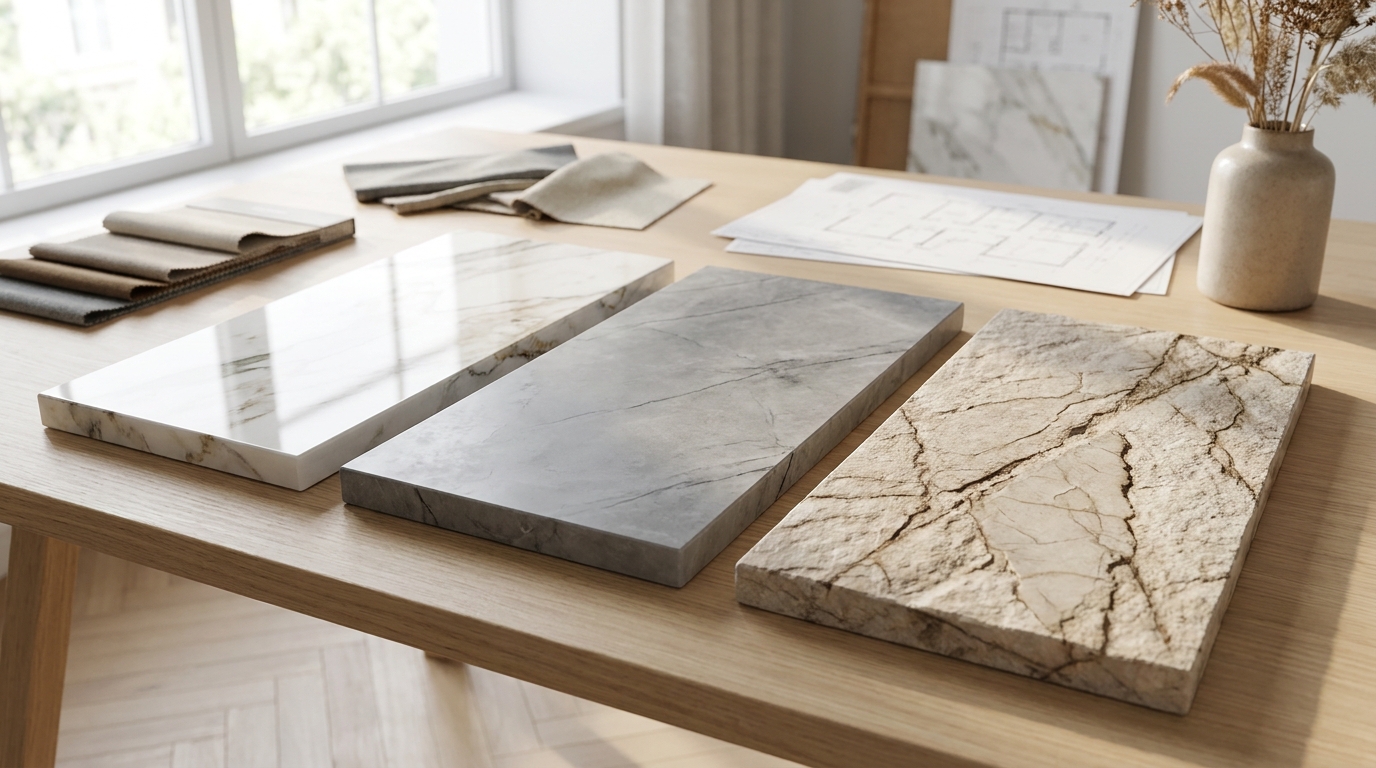
Marble finishes describe the different surface treatments applied to marble slabs and tiles, each shaping how the stone looks, feels, and performs in a room. Polished marble is buffed to a high-gloss, mirror-like sheen that intensifies color and veining, making it a classic choice for formal entries, fireplace surrounds, and traditional bathrooms. Honed marble is ground to a smooth, low-sheen matte finish that reads as quieter and more contemporary, and it tends to show etching less visibly than a polished surface. Leathered marble is textured rather than smooth, giving it a subtly rippled, tactile surface that adds depth and hides fingerprints and minor wear. Because marble is a calcareous stone, all three finishes remain sensitive to acidic substances and require routine, gentle care regardless of sheen. Choosing among them depends on the room’s style, lighting, and daily use rather than on finish alone.
Why Marble Continues to Captivate Interior Design
Marble has a rare ability to feel luxurious without seeming trendy. Even when it appears in the most modern spaces, it carries a sense of history, craftsmanship, and permanence. This quality is especially compelling in an era when many homeowners are looking for interiors that feel personal, layered, and built to last rather than merely fashionable. Marble answers that desire through depth, natural movement, and a visual richness that engineered uniformity often cannot imitate.
Across North American interiors, the appetite for timeless natural materials remains strong. Designers and homeowners continue to gravitate toward surfaces with subtle drama, warmer texture, and individual character, particularly in kitchens and bathrooms. Marble aligns beautifully with this direction because it can soften clean architectural lines, enrich a neutral palette, and introduce visual variation without overwhelming a room. Its veining gives life to stillness, and its tonal shifts create atmosphere.
There is also a tactile dimension to marble that deserves attention. Smooth polished slabs reflect light with formal brilliance, while honed finishes absorb light more softly and feel velvety under the hand. Leathered marble introduces texture and depth that can make a room feel grounded and artisanal. These sensory qualities matter because truly elegant interiors are not built on appearance alone. They are shaped by how materials sound, feel, and respond to everyday life.
Marble also speaks to a broader design idea that continues to gain momentum, namely the blending of functionality and artistry. A marble vanity, backsplash, or fireplace surround does more than serve a practical role. It becomes a visual composition within the room, almost like a framed work of nature. Every slab has its own rhythm of veins, clouds, and tonal drift, which means no two installations are exactly alike.
Marble is most beautiful when it is chosen not as a symbol of perfection, but as a material of character. Its elegance lies in its natural variation, its softness, and the graceful way it records time.
That perspective is important because it changes the conversation from one of flawlessness to one of authenticity. Marble is not a sterile material. It is expressive, responsive, and alive to use. When understood on those terms, it becomes easier to appreciate why it remains one of the most beloved finishes in interior design.
Understanding Marble as a Material
Before marble is selected for a room, it helps to understand what it is and how it behaves. Marble is a calcareous natural stone, which means it contains calcium carbonate and is therefore sensitive to acids. This is one of the most important facts a homeowner can know, because it directly affects cleaning methods, maintenance routines, and expectations for long term appearance. Lemon juice, vinegar, wine, and many common household cleaners can etch the surface, leaving dull marks that are not the same as stains.
Marble is also generally softer and more porous than some harder stones, such as granite or quartzite. That does not mean it is unsuitable for interiors. It means it should be specified with awareness. In lower wear areas, on vertical applications, or in rooms where a patinated look is welcome, marble can perform beautifully for decades. In heavily used zones, however, its sensitivity should be part of the design brief from the beginning.
One of the most useful educational points for homeowners is the distinction between stain resistance and etch resistance. Sealing marble can help reduce the absorption of some liquids and therefore lower the risk of staining. It does not make the surface immune to acid etching. This is a frequent source of confusion and disappointment, especially in kitchens where citrus, tomato sauce, or wine are common. A sealed marble countertop can still etch if exposed to acidic substances.
It is equally helpful to clarify stone terminology. Travertine is often grouped casually with marble, yet it is not marble. Travertine is a type of limestone, and limestone itself differs from marble in origin and appearance. These distinctions matter because each material has its own density, pore structure, maintenance profile, and visual language. A thoughtful selection process should always look beyond color alone and consider the stone family, finish, and intended use.
For clients or homeowners interested in sustainability, natural stone is also increasingly part of responsible specification conversations. Industry environmental product declarations, often referred to as EPDs, are now more commonly available for natural stone applications such as countertops, flooring, paving, and cladding. This allows marble to be evaluated not just as a luxury material, but as one that can contribute to discussions around long term value, material longevity, and informed sourcing.
The Different Types of Marble Finishes
When people speak about marble, they often focus on color and veining first. Yet the finish is just as influential in determining how the material looks, feels, and performs in a room. A polished slab and a honed slab of the same stone can create two entirely different atmospheres. Understanding finish choices is therefore essential to designing with marble in a nuanced way.
Polished Marble
Polished marble is perhaps the most iconic expression of the material. Its glossy surface reflects light, intensifies color, and gives veining a heightened visual clarity. In traditional interiors, polished marble often reads as formal, grand, and deeply classic. It pairs beautifully with detailed millwork, brass fixtures, paneling, and architectural symmetry, making it especially effective in entry halls, fireplace surrounds, and traditional bathrooms.
In practical terms, polished marble can be easier to wipe clean than more textured finishes, but it also shows etching and scratches more readily because of its reflective surface. The sheen can amplify wear in high use areas, especially if the room is brightly lit. For homeowners who love sparkle and ceremonial elegance, polished marble remains a superb choice, but it benefits from realistic expectations and gentle care.
Honed Marble
Honed marble has a matte or low sheen finish that feels softer, quieter, and more understated. This makes it a favorite in contemporary interiors, where the aim is often to create calm, architectural spaces rather than overtly formal ones. Honed marble works beautifully on bathroom walls, vanity tops, floors, and kitchen islands, especially when paired with natural wood, brushed metals, and restrained cabinetry.
Many designers appreciate honed marble because it can make etching less visually severe than a polished surface. The marks may still occur, but they often blend more gently into the finish. This quality does not remove the need for care, yet it can make the stone feel more forgiving in daily life. Honed marble also contributes a tactile richness that helps a room feel warm rather than slick.
Leathered Marble
Leathered marble introduces texture in a more artisanal way. The surface is subtly textured rather than smooth, which creates a sense of movement and softness under changing light. It can feel wonderfully tactile and grounded, especially in contemporary interiors that rely on layered textures to avoid visual coldness. Leathered finishes are less common than polished or honed options, but when used well, they bring a sophisticated sense of depth.
This finish can also make fingerprints, minor marks, and wear less conspicuous, depending on the stone and installation. In spaces that benefit from a more relaxed form of luxury, leathered marble offers an appealing middle ground between refinement and naturality. It is especially beautiful in vanities, feature walls, and statement islands where touch and texture are part of the experience.
How Marble Works in Traditional Interiors
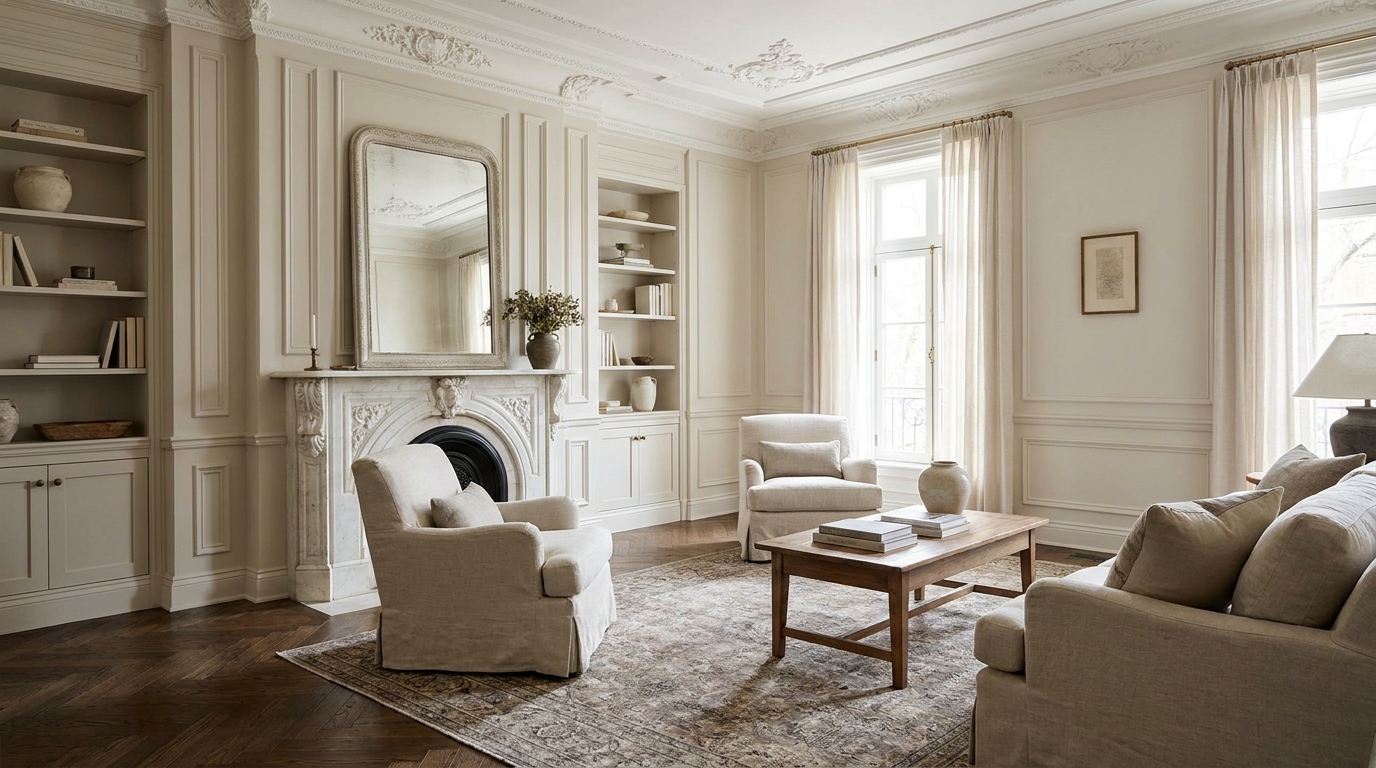
In traditional design, marble is not simply a finish. It is a language of refinement. It recalls old houses, classical architecture, and the ceremonial beauty of carefully composed rooms. White or pale marble with elegant grey veining remains a perennial favorite in these settings because it harmonizes with moldings, fireplaces, paneled walls, and richly detailed furnishings. The effect is timeless rather than nostalgic, especially when the detailing is restrained and proportioned with care.
One of the most natural homes for marble in a traditional interior is the fireplace surround. Here, the stone becomes a frame for the room itself, lending weight, brightness, and historical resonance. A carved or panelled marble mantel can introduce formality, while a simpler slab surround offers a more tailored interpretation. In both cases, marble has the ability to anchor the room and create a focal point that feels enduring rather than decorative.
Traditional bathrooms are another ideal setting. A polished marble vanity top, mosaic floor, or full-height wall treatment can make even a modest bath feel composed and elevated. The stone’s subtle movement brings visual softness to otherwise rigid architectural lines, while its cool brightness suits the freshness associated with bathing spaces. Paired with unlacquered brass, nickel, or dark wood, marble creates a palette of quiet luxury that never loses relevance.
Entryways and formal halls also benefit from marble’s presence. Floors in checkerboard, basketweave, or more restrained slab formats can transform the threshold of a home into an experience of arrival. The key is not excess, but coherence. Traditional marble interiors are most elegant when every element, from hardware to lighting, supports the material’s inherent dignity.
How Marble Enhances Contemporary Spaces
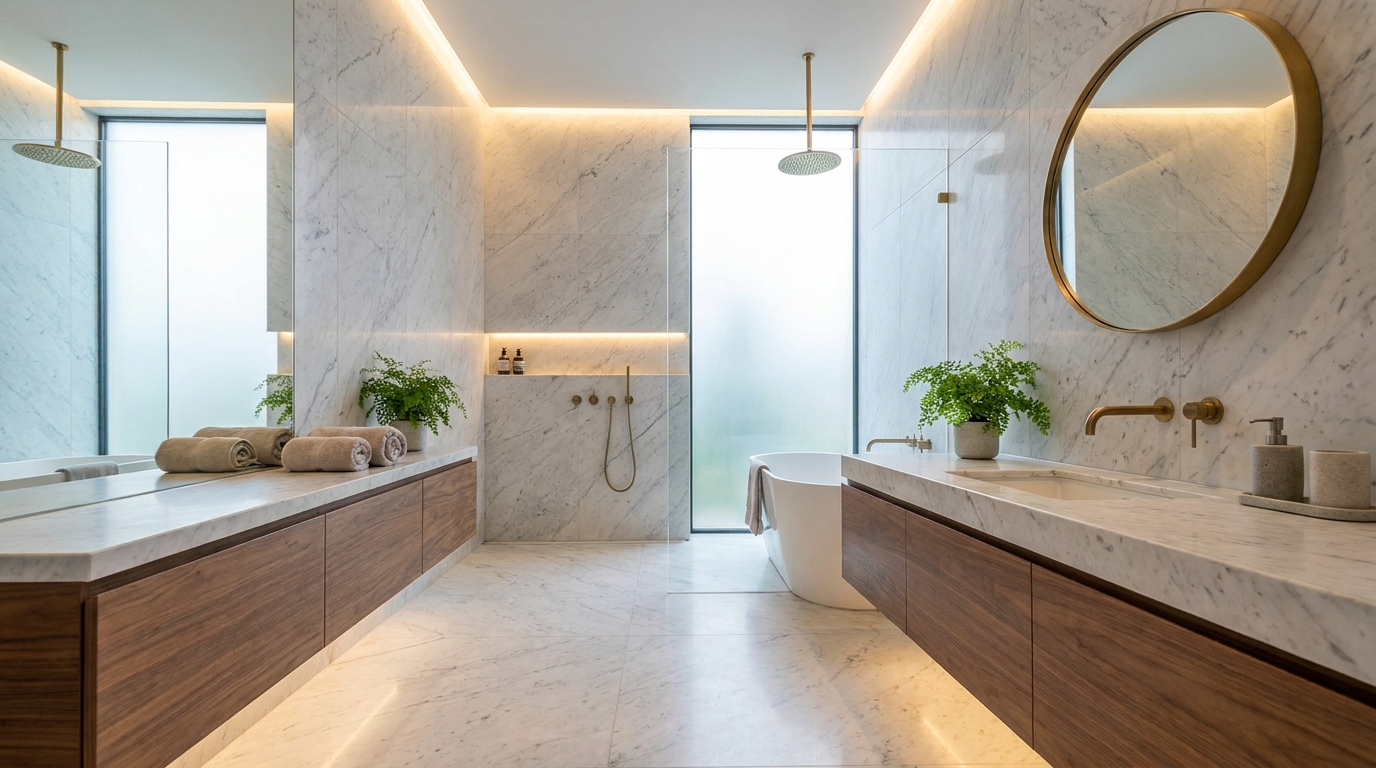
If traditional interiors emphasize marble’s classical beauty, contemporary spaces reveal its architectural power. In modern design, marble often appears in larger, more continuous applications. Instead of ornate detailing, the focus shifts to scale, proportion, and the expressive beauty of the slab itself. A waterfall island, a seamless shower wall, or a monolithic vanity can make marble feel almost sculptural.
Large format slabs are particularly effective in contemporary rooms because they reduce visual clutter and allow the veining to read as a fluid composition. This creates a sense of calm and continuity, especially in open plan kitchens and spa-like bathrooms. When grout lines are minimized and edges are clean, the stone becomes less decorative and more elemental. It feels integrated into the architecture rather than applied to it.
Honed and leathered finishes are often especially successful in these interiors. They temper marble’s formality and complement softer, warmer palettes that are increasingly common in North American homes. Beige stones, smoky greys, and marbles with understated movement pair beautifully with oak cabinetry, limewashed walls, brushed bronze, and tactile fabrics. The resulting atmosphere is elegant, but never brittle.
Contemporary marble interiors also benefit from restraint. Because marble already carries visual complexity, the surrounding palette can remain simple. Flat front cabinetry, concealed storage, matte metals, and quiet lighting allow the stone to breathe. In this way, marble becomes both the artwork and the architecture, lending the room a depth that feels sophisticated rather than busy.
Where Marble Performs Best in the Home
Marble can be used in many interior applications, but performance depends on thoughtful placement. Some of the most successful uses are in areas where the stone can be appreciated visually without being subjected to constant abrasion, acidic spills, or heavy impact. Vertical applications are particularly rewarding because they allow marble’s beauty to take center stage while reducing day to day wear.
Bathroom vanities, powder rooms, wall cladding, fireplace surrounds, accent walls, and decorative niches are among marble’s strongest placements. In these spaces, the material offers atmosphere, brightness, and tactile elegance while remaining relatively easy to manage. Shower walls and slab backsplashes can also work beautifully, especially when paired with a finish that supports the desired look and maintenance level.
Flooring requires a bit more consideration. Marble floors can be breathtaking, but they should be chosen with attention to slip resistance, finish, and traffic patterns. Honed surfaces often feel more relaxed and may be more suitable for bathrooms or entry areas than highly polished finishes, especially where water is present. Grit from shoes can wear surfaces over time, so mats and regular dust mopping become essential.
Kitchen countertops are perhaps the most debated application, and for good reason. Marble can look extraordinary in a kitchen, especially when the goal is to create warmth, authenticity, and timeless appeal. However, it does require a willingness to live with patina. For avid cooks who use acidic ingredients daily and want a pristine surface, a harder stone such as quartzite may be a better fit. For those who appreciate character and understand maintenance, marble can still be a deeply beautiful choice.
Marble in Kitchens and Bathrooms: Beauty with Realistic Expectations
Kitchens and bathrooms are the rooms where marble is often most desired and most misunderstood. In both spaces, the material can elevate the atmosphere dramatically. A marble backsplash can turn simple cabinetry into something quietly luxurious. A vanity wrapped in stone can make an ordinary bathroom feel like a private retreat. Yet these are also wet, active, and product-heavy rooms, which means design decisions must be informed by use.
In kitchens, marble works particularly well on islands, backsplashes, statement counters, and pastry surfaces where its naturally cool temperature is an advantage. It is worth acknowledging, however, that oils, wine, citrus, and tomato can all challenge the surface. The goal should not be to eliminate every risk, but to understand the material’s nature and choose it intentionally. If a kitchen is the social and visual heart of the home, marble can bring incomparable elegance, but it should be selected by someone comfortable with a gently evolving finish.
Kingsgate brought this exact vision to life in one of its recent North York builds — the marble waterfall kitchen at 205 Newton Dr uses marble countertops as the anchoring material for the entire main floor, pairing the stone with walnut beam ceilings for exactly the kind of warmth described here.
Bathrooms offer a somewhat easier environment, particularly in powder rooms or guest baths where use is lighter. Here, marble can shine in vanity tops, wall panels, integrated sinks, and shower surrounds. The trend toward spa-like bathrooms has made natural stone especially appealing because it conveys serenity, permanence, and softness all at once. When large slabs are used with minimal interruption, marble can create an enveloping, tranquil atmosphere.
For family bathrooms and high use kitchens, finish selection becomes even more significant. Honed marble may feel more forgiving visually, while polished marble may require more vigilant upkeep to preserve its shine. Edge profiles, sink details, and backsplash height also affect maintenance. The more thoughtfully these practical details are integrated, the more naturally marble can support everyday life.
Marble Maintenance Tips That Actually Matter
The most useful way to think about marble care is not as aggressive cleaning, but as prevention and gentle stewardship. Guidance from the Natural Stone Institute consistently emphasizes simple habits that protect the surface over time. Neutral cleaners, immediate spill response, regular dust removal, and protection from abrasion matter far more than harsh products or elaborate routines. Marble rewards consistency, not intensity.
The first principle is to avoid acidic cleaners and acidic spills whenever possible. Because marble is calcareous, substances such as vinegar, citrus, or bathroom cleaners formulated with acid can damage the finish. If a spill occurs, it should be blotted rather than wiped, as wiping can spread the liquid across a larger area. After cleaning, surfaces should be rinsed thoroughly if needed and dried with a soft cloth.
On floors, dust and grit are significant concerns because they can abrade the surface underfoot. Frequent dust mopping helps remove particles before they scratch the finish, and entry mats can reduce how much grit enters the room in the first place. On countertops and vanities, coasters, trivets, and trays create a small but important barrier between daily life and the stone. These simple gestures preserve appearance without making a room feel untouchable.
Sealing is often useful, especially in kitchens and baths, but it should be understood correctly. A sealer may help reduce the absorption of staining agents, yet it does not make marble indestructible and it does not prevent etching from acids. Resealing schedules vary depending on stone type, finish, and use, so it is best to follow manufacturer or fabricator guidance rather than assume one universal timeline. The point of sealing is support, not invincibility.
When a marble surface begins to show wear, the response should be thoughtful rather than panicked. Some marks are part of normal patina, and for many people they add depth and authenticity. If etching, staining, or dullness becomes visually disruptive, a stone professional can often assess whether repolishing, honing, poulticing, or other restoration methods are appropriate. Natural stone can often be renewed, which is one of the reasons it remains such a valued material.
Simple Daily Care Habits
-
Use a pH neutral cleaner made specifically for natural stone rather than general household sprays.
-
Blot spills immediately, especially wine, coffee, citrus, vinegar, and oils.
-
Place coasters under glasses and trivets under hot cookware to reduce moisture rings and thermal stress.
-
Dust mop marble floors frequently so grit does not scratch the finish over time.
-
Use soft cloths and avoid abrasive pads or powders that can dull the surface.
-
Understand that sealing helps with absorption but does not stop acid etching.
Common Misconceptions About Marble Finishes
One of the most persistent misconceptions is that marble should behave like a flawless synthetic surface. In reality, marble is a living material in the sense that it responds visibly to use. Expecting it to remain perfectly untouched in a busy family kitchen is often unrealistic. A better approach is to decide whether you want a surface that hides life or one that records it gracefully.
Another misunderstanding concerns sealing. Many homeowners are told that once sealed, marble is effectively protected from everything. This is not true. Sealing can improve resistance to certain stains, but it does not prevent etching caused by acidic substances. Understanding this distinction helps avoid disappointment and leads to more intelligent placement choices.
It is also common to assume that polished marble is the most luxurious and therefore the only desirable finish. Yet luxury today is often quieter and more tactile. Honed and leathered finishes can be more suitable for contemporary interiors, warmer palettes, and everyday use because they soften glare and make minor wear less conspicuous. The best finish is not the shiniest one, but the one that aligns with the room, the lifestyle, and the desired atmosphere.
Finally, marble is sometimes dismissed as too fragile for any meaningful interior use. That view is unnecessarily rigid. Marble has served architecture and interiors for centuries because it is both beautiful and serviceable when specified thoughtfully. The real question is not whether marble can be used, but where, how, and by whom.
Choosing Between Marble and Other Natural Stone Options
Marble does not need to be the answer to every design question in order to be a wonderful one. In some projects, a related stone may offer a more suitable balance of aesthetics and durability. Quartzite, for example, is often chosen when a client wants natural veining but needs greater hardness and better resistance to wear in a heavily used kitchen. Dolomite can also enter the conversation, depending on the visual effect desired and the performance required.
Limestone and travertine offer their own kind of softness and earthiness, but they should not be confused with marble. Travertine is a type of limestone, and both have different pore structures, textures, and maintenance considerations. Where marble feels cool, luminous, and often more formal, limestone and travertine can read as warmer, more rustic, or more quietly grounded. Each has its place, and the best interiors are often those that choose stone by character rather than by status.
If the desired look is classic white veining with minimal upkeep expectations, it may even be worth exploring surfaces beyond natural marble altogether. Still, for many homeowners, the subtle unpredictability of authentic stone remains irreplaceable. The key is to align the material with the emotional tone of the room and the practical demands of daily life.
Designing with Marble for a Timeless Result
Marble is at its most elegant when it is given room to breathe. This can mean allowing a single slab to become the room’s focal point, or it can mean repeating the material in quieter ways across a space so that it feels integrated rather than isolated. The scale of the veining should relate to the room, the lighting should flatter the stone’s depth, and the surrounding materials should support rather than compete with it.
For a timeless effect, it is often wise to let marble carry the complexity while other elements remain composed. Warm woods, painted cabinetry, brushed metals, plaster walls, and natural textiles all partner beautifully with stone because they introduce softness and contrast. When everything in a room is visually loud, marble can lose its specialness. When the composition is balanced, it becomes quietly unforgettable.
Color also matters. White and grey marbles remain classics, but warmer marbles with cream, taupe, green, or smoky undertones are increasingly appealing as interiors move away from cool minimalism and toward richer, more layered palettes. These stones can make a room feel more intimate and more individual. The right slab should be selected in person whenever possible, as photographs rarely capture the full nuance of movement and tone.
Scale, edge detailing, and continuity should all be considered early in the design process. A waterfall island may celebrate marble’s dramatic movement, while a bookmatched wall can turn a bathroom into a serene visual composition. Conversely, smaller applications such as ledges, side tables, or a simple backsplash can offer just enough stone to add distinction without overcommitting. Marble does not need to dominate a room to transform it.
The Lasting Allure of Marble Finishes
Marble finishes endure because they offer something rare in interior design: a true union of utility and poetry. They can function as floors, walls, vanities, counters, and fireplaces, yet they always carry an emotional charge beyond mere performance. Marble gives a room memory, depth, and a sense of cultural continuity. It feels grounded in the earth and elevated by craft.
To live beautifully with marble is to accept a more mature idea of luxury. It is not the luxury of perfection sealed away from life. It is the luxury of material honesty, of surfaces that age with grace, and of rooms that feel increasingly soulful as they are lived in. With the right finish, the right placement, and realistic maintenance habits, marble can remain not only beautiful, but deeply rewarding for years to come.
For contemporary homes, it offers restraint, tactility, and sculptural presence. For traditional interiors, it brings ceremony, polish, and timeless refinement. In both contexts, marble proves that elegance is never just about appearance. It is about how a material makes a space feel, how it supports the rituals of everyday life, and how it continues to reveal its beauty over time.
If you are considering marble for your home, the most important step is not asking whether it is perfect. It is asking whether its character matches the way you want to live. For those who value artistry, permanence, and the quiet drama of natural materials, the answer is often a graceful and resounding yes.


No Comment! Be the first one.