


Waterfront mega developments are large-scale, multi-phase redevelopment projects that turn former port, industrial, or logistics land along a city’s shoreline into mixed-use districts anchored by housing, transit, and public space. They have become some of the most consequential urban projects of this era, no longer simply about converting old industrial land into attractive addresses near the water. Today, they sit at the intersection of housing supply, climate resilience, public infrastructure, ecological restoration, and long-term economic strategy. In practical terms, that means a waterfront project now has to do far more than deliver towers and promenades. It has to protect communities from future flood risk, improve access to transit, create inclusive public space, and justify enormous public and private investment over decades.
Table Of Content
- Why Waterfront Mega Developments Matter More Than Ever
- The Climate Imperative Reshaping Waterfront Strategy
- Waterfront Toronto and the Canadian Model of Integrated Delivery
- Case Studies Showing the New Waterfront Playbook
- Clippership Wharf in Boston
- Lower Manhattan and The Battery in New York City
- What These Cases Have in Common
- Designing Waterfront Districts for Growth and Durability
- The Economic Logic Behind Waterfront Mega Projects
- Key Economic Drivers in Successful Waterfront Redevelopment
- Community Impact, Equity, and Public Legitimacy
- Common Misconceptions About Waterfront Mega Developments
- What the Next Generation of Waterfront Development Will Look Like
- Conclusion: The Waterfront as a Test of Urban Leadership
That shift matters because the strategic value of waterfront land has never been higher. In many major cities across Canada and North America, underused port lands, former industrial parcels, and obsolete logistics zones are among the few large tracts left near central business districts. They offer rare opportunities to add new neighbourhoods at meaningful scale. Yet their value comes with a hard constraint. Much of this land is exposed to sea-level rise, storm surges, erosion, and increasingly severe rainfall. As a result, the future of waterfront development is not just a design question. It is a test of whether cities can grow intelligently in places that are both economically important and environmentally vulnerable.
Canada offers a particularly important lens for this conversation. The country has the longest coastline in the world, which makes waterfront and coastal redevelopment a national issue as much as a local one. Canada’s National Adaptation Strategy has made clear that rising seas, storm surges, flooding, saltwater intrusion, and coastal erosion are already affecting communities, infrastructure, and heritage assets. That reality is changing the development equation. Resilience can no longer be treated as an optional enhancement. It must be embedded into the land use plan, the servicing plan, the financing structure, and the long-term operations model from the very beginning.
This is why waterfront mega projects are increasingly being framed as city-building platforms rather than isolated real estate ventures. They can unlock land value, support housing delivery, attract employment, expand tax bases, and create major public amenities. At the same time, they can provide flood protection, rebuild damaged shorelines, strengthen ecological systems, and create more adaptable urban edges. The most successful projects understand that these goals are not competing objectives. They are interconnected parts of the same urban strategy.
For decision-makers, investors, and communities, the real question is not whether waterfront mega developments will shape the next generation of cities. They already are. The more important question is how they can be planned and delivered in ways that are financially viable, socially credible, and resilient enough to perform for the next hundred years.
Why Waterfront Mega Developments Matter More Than Ever
The renewed focus on waterfronts is driven by a basic urban reality. Cities need land, and large sites close to employment centres are increasingly scarce. Former port lands and industrial shorelines often represent some of the last opportunities to add substantial mixed-use growth in locations that can support transit, walkability, and high-value public realm. In growth markets, these sites can accommodate thousands of housing units, major office space, cultural institutions, parks, and community facilities in a way that small infill parcels simply cannot.
But scale alone does not explain their importance. Waterfront districts carry symbolic weight in the life of a city. Historically, they were the places where cities traded, manufactured, and connected to the wider world. Many later became fragmented landscapes of contamination, heavy infrastructure, and restricted public access. Their redevelopment creates a chance to repair not only land but also the relationship between the city and the water. That has economic implications, civic implications, and political implications.
There is also a fiscal dimension that cannot be ignored. Large waterfront projects can generate substantial land value uplift if they are supported by transit, remediation, and public infrastructure. That uplift can help fund parks, roads, flood protection, utilities, and civic uses. This is where concepts like land value capture become strategically important. If managed effectively, the increase in land value created through public planning and infrastructure investment can support broader public objectives rather than accruing only to private gain.
At the same time, waterfront mega developments are being asked to solve more than one problem at once. They are expected to deliver housing in constrained markets, create jobs, improve mobility, and advance environmental performance. This integrated expectation marks a clear departure from earlier eras, when waterfront redevelopment was often driven by prestige architecture, entertainment uses, or luxury housing. Today, the public case for these projects is much broader. That is why affordable housing, public access, ecological restoration, and climate adaptation are becoming central to their legitimacy.
Modern waterfront development is no longer judged only by what it builds on the shoreline. It is judged by how well it protects the city behind it, connects people to opportunity, and performs under future climate conditions.
The Climate Imperative Reshaping Waterfront Strategy
Climate change has fundamentally altered how waterfront land must be evaluated. In the past, a developer or public agency might have treated flood protection as a technical requirement to be addressed through engineering later in the process. That model is increasingly obsolete. Today, resilience has to be foundational. Shoreline protection, stormwater management, backup infrastructure, emergency access, and long-range sea-level rise scenarios now shape what can be built, where it can be built, and how much it will cost to maintain over time.
What makes this especially challenging is that climate risk unfolds across different timelines. Some threats are immediate, such as intense rainfall events that overwhelm storm systems or short-term erosion that compromises assets. Others are cumulative, including sea-level rise and recurrent storm surge exposure over many decades. Waterfront districts therefore need designs that perform today while remaining adaptable for tomorrow. That often means using layered systems rather than relying on a single defensive measure.
There is a common misconception that resilience on the waterfront simply means constructing a higher wall. In reality, the most sophisticated projects use combinations of elevated landforms, green infrastructure, upgraded drainage systems, restored wetlands, stabilized seawalls, floodable parks, and adaptable public realm elements. This layered approach recognizes that water moves in multiple ways and under different conditions. A barrier alone may not address intense surface runoff. A landscaped edge alone may not protect critical utilities. Strategy lies in combining systems so the district remains functional as conditions change.
Another critical shift is the rise of scenario planning. Leading agencies are no longer designing to a single climate assumption. Waterfront Toronto, for example, has reported that climate resilience assessments and life-cycle carbon assessments are required for new public realm and development projects, with design scenarios that consider 1.5 degrees Celsius, 2 degrees Celsius, and higher warming pathways. This is significant because it embeds uncertainty directly into project planning. It signals that resilience is not a static standard but an ongoing framework for decision-making.
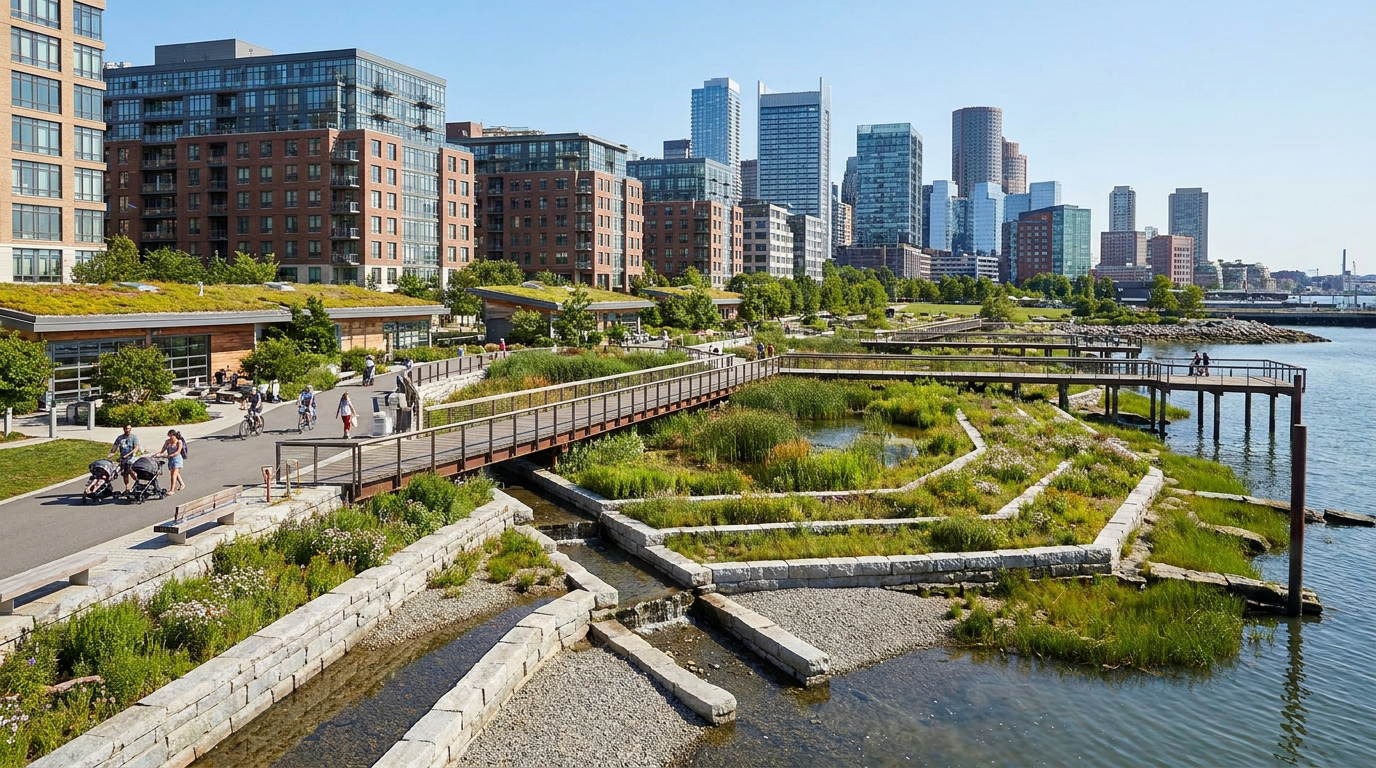
Nature-based solutions are increasingly central to that framework. Wetlands, marshes, beaches, bioswales, rain gardens, and restored naturalized edges do more than improve aesthetics. They absorb water, reduce erosion, support biodiversity, and often create richer public spaces than hard infrastructure alone. Organizations such as UN-Habitat and the National Research Council of Canada have reinforced the value of these approaches in urban regeneration. This does not eliminate the need for engineered systems, but it does change the balance. The future waterfront is likely to be more hybrid, ecological, and flexible than the concrete-heavy waterfronts of the twentieth century.
For cities, the climate imperative is also a governance test. Designing resilient infrastructure is only the beginning. It must be funded, maintained, updated, and monitored over long time horizons. That means municipalities, special agencies, utilities, and private partners need clear roles. Resilience fails when no one is responsible for its long-term performance. In that sense, climate adaptation is not just a design exercise. It is an institutional discipline.
Waterfront Toronto and the Canadian Model of Integrated Delivery
Waterfront Toronto remains one of the strongest North American examples of a public-interest model for large-scale waterfront redevelopment. Its significance goes beyond the design quality of individual sites. What makes it especially important is the way it combines long-range planning, public infrastructure coordination, climate adaptation, public realm investment, and development sequencing across a broad geography. That integrated model has become increasingly relevant as cities confront the limits of piecemeal redevelopment.
The Toronto waterfront demonstrates how modern mega projects are evolving from simple regeneration schemes into complex, multi-objective districts. The Toronto Waterfront Enabling Initiative was renewed in 2024 to support climate-resilient infrastructure, affordable housing, and inclusive public spaces. That framing is revealing. It shows that senior governments and local partners now see waterfront investment as a platform for broader economic and social outcomes, not just a corridor for private development. In a high-growth region with severe housing pressure, this kind of integrated public mandate matters.
One of the most compelling lessons from Toronto is the role of ecological infrastructure at metropolitan scale. Waterfront Toronto highlights features such as the flood protection landform in the West Don Lands and a target of about 34,000 new trees across the revitalization area. These are not cosmetic gestures. They shape hydrology, reduce heat, improve air quality, build habitat, and enhance urban liveability while supporting the value and usability of surrounding development. This is exactly the kind of systems thinking that future waterfronts require.
The social dimension is equally important. Waterfront redevelopment often attracts criticism when it appears disconnected from affordability or local inclusion. Toronto’s experience shows why social outcomes must be visible and measurable. Waterfront Toronto has stated that the West Don Lands contributed 496 affordable housing units to Toronto’s rental stock. While no single figure resolves a broader housing crisis, it demonstrates that mixed-income delivery can be built into the logic of redevelopment. For waterfront mega projects to retain public legitimacy, they need to show tangible social returns alongside financial and physical transformation.
There is also a governance lesson here. Large waterfront sites typically involve land assembly, remediation, infrastructure phasing, approvals coordination, and long investment cycles. These conditions often exceed the capacity or time horizon of conventional private development models alone. Public agencies or quasi-public delivery entities therefore remain important. They can absorb early risk, coordinate infrastructure, protect public objectives, and maintain continuity across political cycles. In a project category defined by complexity, institutional architecture is often as important as architectural design.
Case Studies Showing the New Waterfront Playbook
Clippership Wharf in Boston
Boston’s Clippership Wharf offers a useful example of how climate resilience can be integrated into a contemporary mixed-use waterfront project. According to the Urban Land Institute resilience case study, the development combined a raised ground plane, seawall stabilization, wetlands, rain gardens, bioswales, and stormwater upgrades in response to sea-level rise risk. What stands out is not any one intervention by itself. It is the way these moves were assembled into a coherent strategy that supports both urban development and environmental performance.
This matters because many waterfront sites still face a false choice between economic viability and resilient design. Clippership Wharf suggests that the two can reinforce each other when planning is disciplined and site conditions are understood early. A more resilient ground plane protects investment. Green infrastructure can improve amenity value. Stabilized edges preserve access and long-term functionality. In short, resilience can become part of the development proposition rather than a cost added reluctantly at the end.
Lower Manhattan and The Battery in New York City
New York’s Lower Manhattan Coastal Resiliency initiatives and The Battery Coastal Resilience project reflect a different but equally important pattern. Here, the challenge is not simply redeveloping an underused site. It is protecting intensely valuable urban land, major transportation networks, public parks, and critical civic assets through the end of the century. The response has increasingly involved layered and modular defenses that can adapt over time. This is a crucial model for cities where the waterfront is already densely built and retreat is politically or economically unrealistic.
The New York example reinforces a central principle of future waterfront strategy. Adaptation pathways matter. A city may not be able to build every future protection measure immediately, but it can establish frameworks that allow upgrades, expansions, and redesign as conditions evolve. That is a more realistic and fiscally credible approach than pretending uncertainty does not exist. Waterfront resilience should be thought of as a sequence of decisions, not a single finished object.
What These Cases Have in Common
Although Toronto, Boston, and New York operate at different scales and under different governance structures, they share several characteristics. They all treat waterfronts as strategic urban systems. They all recognize that climate resilience has to be integrated with land use, infrastructure, and public space. They all rely on more than one form of defense. And they all illustrate that the value of waterfront transformation depends on long-term stewardship, not just initial construction.
Designing Waterfront Districts for Growth and Durability
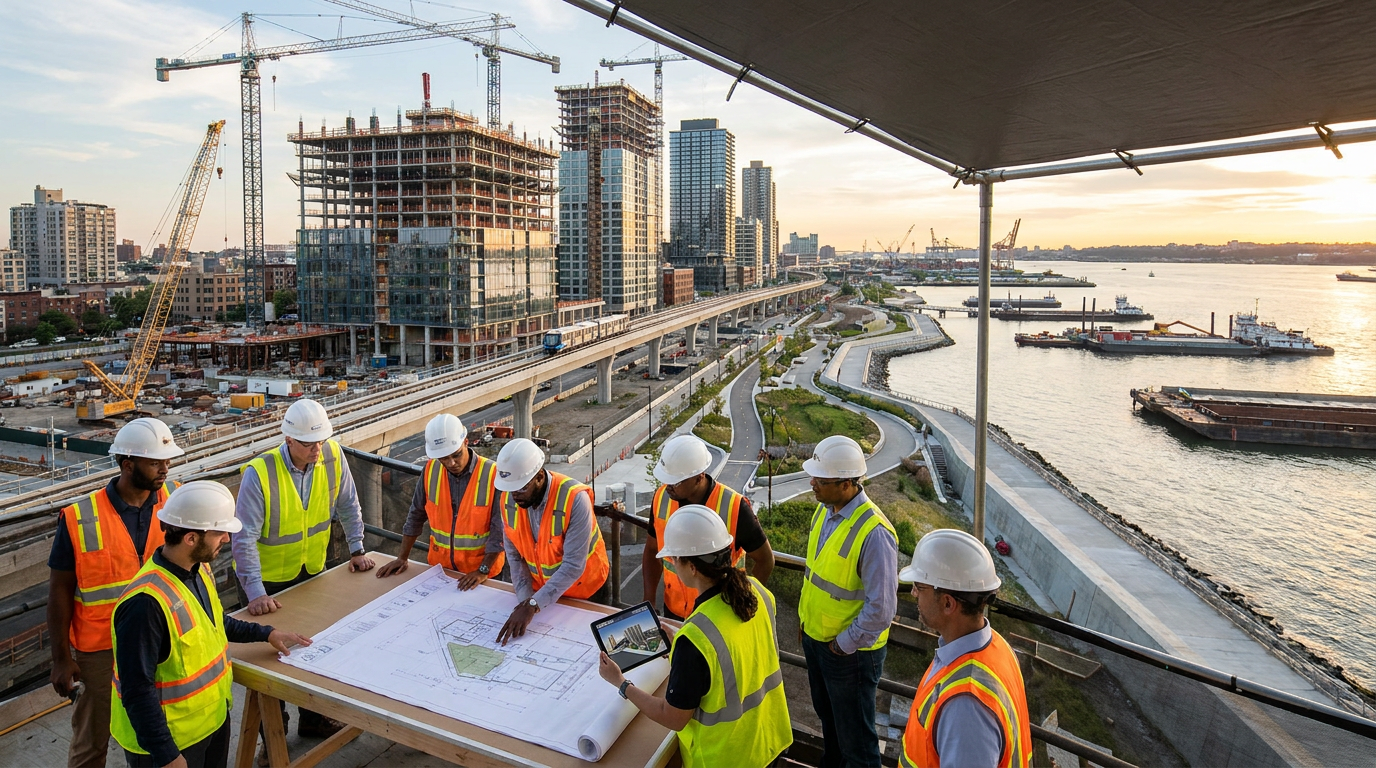
The design of a waterfront mega development begins with a simple but demanding question: what kind of district should this become over time? If the answer is merely a collection of buildings facing the water, the project will likely underperform. The strongest districts are planned as complete urban environments where housing, employment, mobility, ecology, and public life reinforce one another. That requires a master-planning approach that can accommodate change without losing strategic direction.
Mixed-use intensity is often essential. Waterfronts near downtowns can support residential towers, office space, institutional uses, cultural destinations, and active ground-floor retail. But intensity must be paired with infrastructure. Transit access, district energy possibilities, servicing capacity, street networks, and pedestrian connectivity are all critical to feasibility. A beautiful waterfront with weak mobility will not achieve its full economic potential. Likewise, a high-density district without meaningful public realm will fail to build civic value.
Public space deserves special attention because it often determines whether a waterfront feels like part of the city or a privatized edge. Promenades, parks, cycling routes, beaches, plazas, and community facilities create access and identity. Increasingly, these spaces are also being designed as resilient infrastructure. A floodable park can absorb water during extreme events. A raised promenade can function as a protective edge. A naturalized shoreline can reduce erosion while offering habitat and recreation. The best projects align civic experience with environmental performance.
Design must also account for remediation and legacy conditions. Many prime waterfront sites are former industrial lands with contamination, unstable soils, obsolete utilities, and fragmented ownership. These constraints affect costs, phasing, and risk allocation. They can also influence what forms of development are realistic in the early stages. Successful waterfront planning does not ignore these burdens. It integrates them into the project timeline and financial structure from the start.
Another emerging consideration is carbon. As agencies such as Waterfront Toronto move toward requiring life-cycle carbon assessments, waterfront projects are being evaluated not only for climate risk exposure but also for their contribution to emissions over time. That pushes design teams to think more carefully about materials, building performance, landscape systems, and long-term maintenance. The next generation of leading waterfronts will likely be measured on both resilience and decarbonization.
The Economic Logic Behind Waterfront Mega Projects
From an economic standpoint, waterfront mega developments succeed when they connect high-value land transformation to strong enabling infrastructure. Waterfront parcels can become extremely valuable once they are remediated, serviced, connected to transit, and supported by high-quality public realm. But none of that happens automatically. The uplift in value is created through planning decisions, public investment, and risk management. This is why governance and financing strategy are so central to project outcomes.
There is a tendency in public debate to assume that proximity to water guarantees profitability. That is not how large-scale development works. A site near the shoreline may face expensive soil remediation, flood mitigation obligations, utility relocations, and transportation constraints that materially affect its viability. The development economics improve only when these challenges are addressed through coherent phasing, realistic density assumptions, and strong market positioning. Waterfront land can be immensely valuable, but it is often capital intensive before it becomes productive.
When these projects are structured well, the upside can be transformational. They can expand municipal assessment bases, attract employers, support tourism, and generate long-term tax revenue. They can also catalyze investment in surrounding districts by changing perceptions of previously underused areas. Importantly, they can create a virtuous cycle where public infrastructure improves development value, and that value helps fund more infrastructure and community amenities. This is the strategic economic promise of the waterfront model.
Still, economic strategy must be balanced with public accountability. If value creation is not tied to affordability, inclusive access, and durable infrastructure, the project can become politically fragile. Cities increasingly understand this. That is why affordable housing, community benefits, and open public access are now central to waterfront narratives. The market opportunity is real, but so is the expectation that public investment should produce broad public return.
Key Economic Drivers in Successful Waterfront Redevelopment
- Land assembly and control that allows coordinated planning rather than fragmented redevelopment
- Transit and mobility investment that connects the district to major employment and activity nodes
- Remediation and servicing that remove barriers to construction and occupancy
- Public realm quality that increases desirability for residents, tenants, and visitors
- Resilience infrastructure that protects asset value and reduces long-term disruption risk
- Clear governance that manages approvals, phasing, maintenance, and accountability over time
Community Impact, Equity, and Public Legitimacy
No waterfront mega development can be considered successful today if it ignores equity. These projects often occur on highly visible land that belongs, historically or symbolically, to the broader public. Communities therefore expect more than visual improvement. They expect access, inclusion, affordability, and transparency. If a waterfront is rebuilt only for high-income households, it may generate short-term value but undermine long-term public trust.
This is one reason affordable housing has become such an important political and policy dimension of waterfront regeneration. In Toronto and elsewhere, adding below-market or affordable rental units to high-opportunity areas is increasingly central to the public rationale for redevelopment. The issue is not only fairness. It is also city function. Mixed-income neighbourhoods near jobs, transit, and amenities support a more resilient labour market and a healthier urban structure overall.
Public access matters just as much. Waterfronts should not become exclusive edges where the most valuable views are effectively privatized. Continuous promenades, parks, beaches, cultural spaces, and community-serving uses help ensure that the shoreline remains part of the shared city. This is particularly important in projects receiving substantial public infrastructure support. The broader the public investment, the stronger the case for broad and meaningful public benefit.
There is also a deeper civic question around who is included in planning. Indigenous engagement, local consultation, heritage recognition, and anti-displacement measures are increasingly expected in major waterfront initiatives. These are not peripheral issues. They shape legitimacy, help surface local knowledge, and influence whether a project is experienced as regeneration or replacement. Mega development without social credibility rarely remains stable over time.
Common Misconceptions About Waterfront Mega Developments
One of the most persistent misconceptions is that waterfront mega developments are simply luxury real estate plays wrapped in public language. That critique can apply in some cases, but it is increasingly incomplete. Many of today’s projects are justified not just by private development value but by flood protection, transit upgrades, ecological repair, affordable housing, and public realm expansion. The public case is broader because the urban challenges are broader.
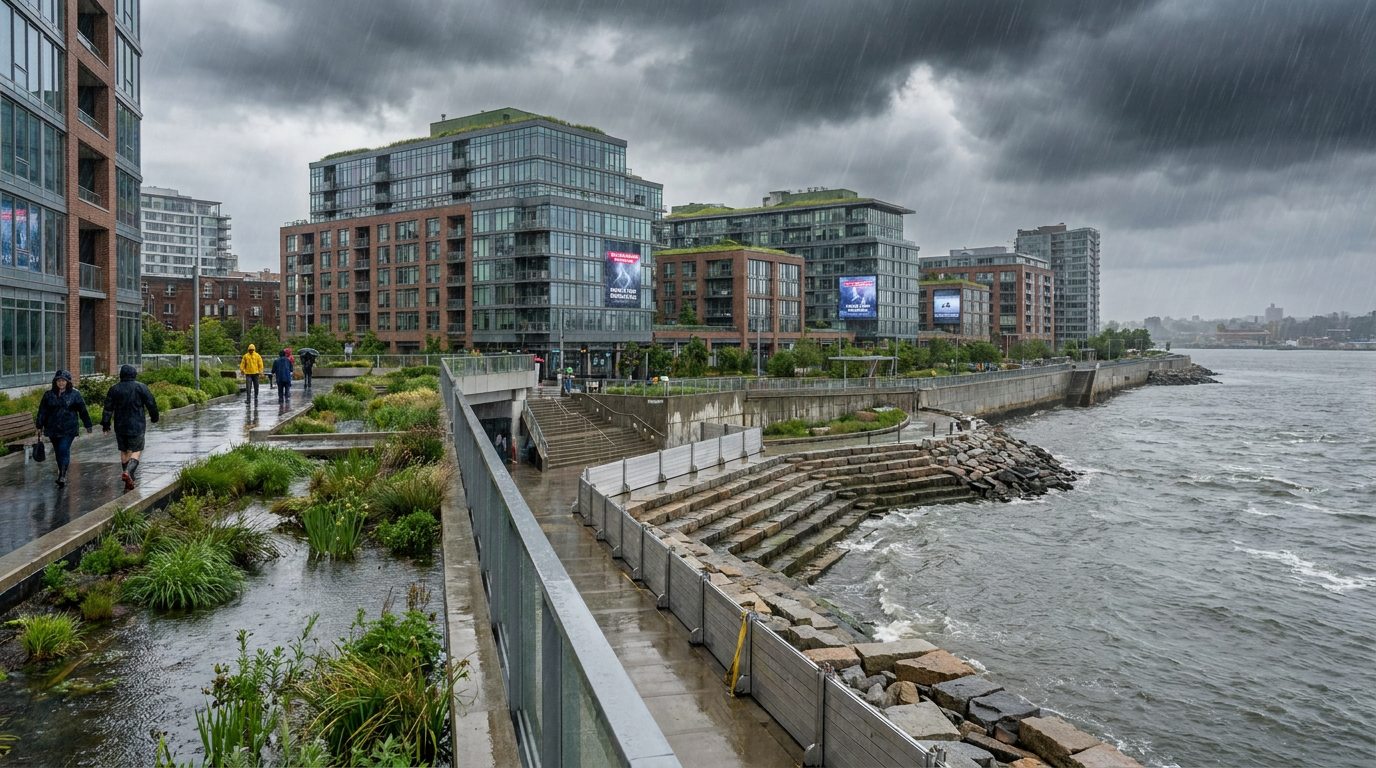
Another misconception is that seawalls alone solve climate exposure. In reality, waterfront resilience increasingly depends on layered and adaptable systems. Elevated parks, restored shorelines, bioswales, wetlands, upgraded drainage, and modular barriers often work together. A waterfront that relies on one line of defence without redundancy may look secure on paper but remain vulnerable in practice.
It is also a mistake to assume that any site near water is automatically development-ready. Some waterfront lands are constrained by contamination, poor access, fragmented ownership, or massive infrastructure deficits. Strategic location is an advantage, but it is not a substitute for feasibility analysis. The projects that move from vision to reality are usually those with disciplined phasing, strong public coordination, and credible financing structures.
Finally, resilience should never be treated as a one-time feature. Climate conditions will keep changing, and waterfront districts must be managed accordingly. Monitoring, maintenance, periodic upgrades, and scenario review are all part of the long-term project. In other words, resilience is a governance commitment as much as it is a design decision.
What the Next Generation of Waterfront Development Will Look Like
Looking ahead, the next generation of waterfront mega developments will likely be more integrated, more ecological, and more performance-driven than earlier models. We can expect continued movement toward districts that combine housing, jobs, transit, public space, and climate defense in a single planning framework. The strongest projects will not separate urban growth from adaptation. They will see them as mutually dependent.
We should also expect greater reliance on hybrid shorelines and nature-based systems. This reflects both environmental logic and public preference. People are increasingly drawn to waterfronts that feel alive, accessible, and ecologically rich rather than over-engineered and disconnected. That does not mean abandoning hard infrastructure where it is necessary. It means using it more intelligently and pairing it with landscape systems that provide multiple benefits.
Phased adaptation will become more common as uncertainty grows. Instead of pretending that one design solution can answer every future climate condition, cities will develop pathways that allow infrastructure and public spaces to evolve. This approach is financially prudent and technically realistic. It also aligns with the long life cycle of major urban districts, where land use and infrastructure decisions unfold over decades.
There will likely be stronger demands for measurable social outcomes as well. Affordable housing, community access, local employment, and inclusive public amenities will become more prominent in approvals and political negotiations. In high-cost urban regions, the legitimacy of large waterfront projects will increasingly depend on who benefits from them and how visible those benefits are.
Finally, delivery models will continue to matter. Public-sector and quasi-public entities will remain important where projects require land assembly, environmental remediation, flood protection, and long-term phasing. In many cases, the future of the waterfront will depend less on whether a city has ambition and more on whether it has institutions capable of converting that ambition into durable outcomes.
Conclusion: The Waterfront as a Test of Urban Leadership
Waterfront mega developments represent some of the most ambitious choices cities can make. They involve large capital commitments, visible political stakes, long delivery horizons, and real climate risk. But they also offer extraordinary upside. Done well, they can unlock scarce land for housing and employment, reconnect communities to the shoreline, restore ecological systems, and build resilient public infrastructure that protects entire districts.
The strategic importance of these projects will only increase as cities continue to grow and climate pressures intensify. What once may have been considered prime development land must now also function as an adaptive urban edge. That raises the standard for planning, finance, and design. It requires leaders to think beyond short-term absorption rates and architectural images. The real measure of success is whether the district remains inclusive, functional, and defensible over generations.
In that sense, the future of waterfront mega development is about far more than the water’s edge. It is about how cities define value in a century shaped by scarcity, climate uncertainty, and the need for better urban growth models. The most effective waterfronts will not be the ones that simply look impressive at opening. They will be the ones that prove, year after year, that city-building can be bold, resilient, and broadly beneficial at the same time.


No Comment! Be the first one.