Wardlaw Crescent Shows How Toronto Is Using Public Land to Deliver Supportive Housing at Neighbourhood Scale
Toronto’s 9 Wardlaw Crescent project is small by unit count, but strategically important by delivery model. As outlined by the City of Toronto, the development will bring 51 rent-geared-to-income supportive homes to Rexdale in a four-storey building, with construction now underway. For developers, planners, and housing decision makers, the signal is clear: the City is continuing to move public land, zoning authority, and non-profit partnerships into a more direct housing production role.
This is not a conventional market project. It is not being positioned around absorption, pricing, or investor return. Its importance sits in a different part of the urban growth equation: how Toronto can create deeply affordable housing on constrained sites, inside established communities, without waiting for large master-planned redevelopments or major private-sector cross-subsidy.
The Wardlaw site also reflects a shift in how supportive housing is being integrated into neighbourhood form. A four-storey building on a corner lot is a modest built form intervention, but it carries substantial policy weight. It demonstrates that housing with supports does not need to be isolated in institutional formats or pushed to peripheral locations. It can be delivered through mid-scale buildings that fit into low-rise and mixed residential contexts, provided the approvals framework, operating model, and community management structure are aligned.
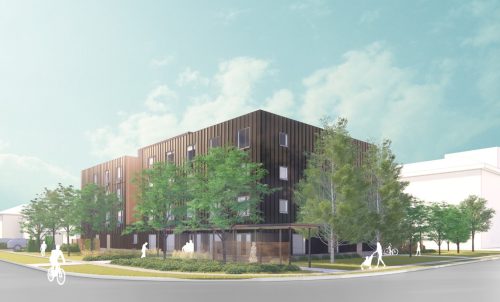
The zoning path matters. City Council adopted a City-initiated zoning by-law amendment in April 2025 to permit the 51-unit building at 7-9 Wardlaw Crescent. That detail is not administrative noise. It shows municipal government using its planning tools to reduce friction on a public-interest housing file. In a city where approval timelines can determine whether a project remains feasible, City-initiated rezoning is a material instrument. It lowers entitlement uncertainty and signals political alignment before capital is fully deployed.
The operating structure is equally important. The City selected YWS as the non-profit housing provider, working with Midaynta Community Services, Rexdale Women’s Centre, Delta Family Resource Centre, and Albion Neighbourhood Services. That “Made in Rexdale” partnership model is a recognition that supportive housing is not only a real estate asset. It is a service platform embedded in a local social infrastructure network. For future projects, this points to a broader feasibility test: the strength of the operating ecosystem may become as important as the parcel itself.
Supportive housing delivery is becoming a land-use strategy, not only a social services response.
There is also a land value lesson here. Public or municipally controlled sites can carry a different economic logic than private parcels. When rents are capped at no more than 30 per cent of resident income, the project cannot compete under standard residual land value assumptions. That means the land, approvals, capital stack, and operating subsidy must be coordinated from the outset. These projects are not “affordable versions” of market rental. They are separate delivery systems with different constraints and different success metrics.
The community liaison process is another feature worth watching. The City, provider, and local councillor have established a Community Liaison Committee to manage dialogue between residents, service providers, and municipal staff. For sensitive housing projects, this type of structure can help reduce implementation risk after approvals. It does not eliminate opposition, but it creates a formal channel for operational issues, expectations, and accountability.
For developers and planners, Wardlaw should be read as part of a larger pattern. Toronto’s housing crisis is forcing the City to use every available lever: public land, zoning amendments, non-profit delivery, modular or compact building forms, and local service partnerships. The next question is scale. If Toronto wants meaningful impact, it will need many Wardlaw-sized projects across many neighbourhoods, supported by repeatable approvals, predictable funding, and sites that are politically and physically ready to move.
Source: City of Toronto