Beijing’s AI Boom Is Rewriting the Office Investment Map, One District at a Time
China’s property market has been sending investors a fairly consistent message for the past few years: proceed with caution. But strong markets rarely move as a single block, and Beijing’s Zhongguancun district is proof of that. While the capital’s citywide Grade A office vacancy rate crept up to 15.9% in the second quarter, Zhongguancun’s vacancy rate fell to 8.2%, down from more than 14% just six months earlier. That is not a modest divergence. That is a district decoupling entirely from its own city’s trend line.
For investors, the story here is not really about office towers. It is about where demand actually originates and how fast capital should follow it. According to Knight Frank’s latest report, cited by the South China Morning Post, Zhongguancun was the only district in Beijing to post an increase in Grade A rents this quarter, reaching 251.4 yuan per square meter, roughly $37.12. That places it second only to Beijing’s Financial Street, a district long considered the city’s premium benchmark. Meanwhile, the tenants driving that demand are not banks or insurers. They are AI companies: ByteDance, DeepSeek, Moonshot AI, RankComputing, and XuanMiao all expanded their footprints there in the second quarter.
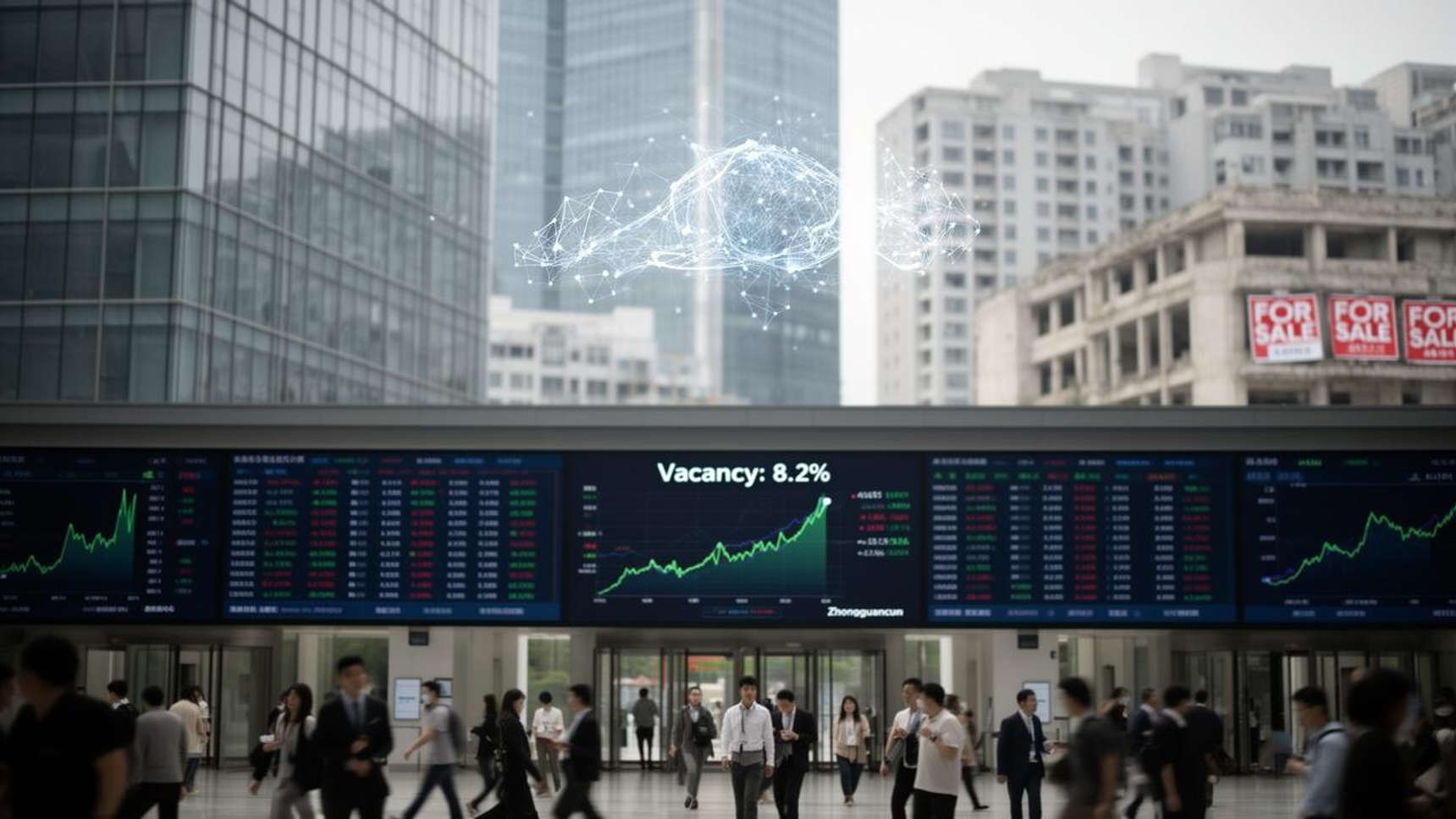
This is the kind of signal disciplined capital pays attention to. Across Beijing, the technology, media, and telecom sector now accounts for 49% of office leasing activity, more than double the 17% share held by the financial sector that traditionally anchored the market. When the tenant base of a market shifts that decisively, the properties tied to that tenant base tend to reprice ahead of the broader recovery, not with it.
This year marks the arrival of the AI super cycle, and it is only just beginning.
That line from Knight Frank is worth sitting with, because it comes paired with a sober caveat. The firm does not expect Beijing’s broader office market to reach a full recovery until late 2029 or early 2030, even as Zhongguancun outperforms. In other words, this is not a market-wide green light. It is a concentrated opportunity, tied specifically to AI-driven demand in a district with real innovation infrastructure behind it, from Baidu’s and JD.com’s roots to the semiconductor and quantum computing research now clustered there.
For investors watching China from abroad, or evaluating exposure through REITs, joint ventures, or cross-border capital vehicles, the lesson translates cleanly regardless of geography. Sector-specific demand can outrun macro sentiment, and the districts anchored to genuine technology growth, rather than broad economic momentum, may offer a clearer risk-adjusted entry point than the headline numbers suggest. The gap between Zhongguancun’s 8.2% vacancy and the citywide 15.9% is the kind of spread that tends to draw capital ahead of the crowd, not after it.
Source: BigGo Finance