

The migration data underneath this is instructive too. Canada’s sharp cut to net overseas migration removed one of the last props under a housing market that was already, by most measures, overvalued. Toronto condo prices are down 26.2 percent from peak, Vancouver’s apartment segment has been hit hard, and yet Winnipeg just posted an all time high. That divergence matters for anyone allocating capital across Canadian markets. Blended national figures hide where real value and real risk actually sit.
Table Of Content
- Ottawa’s Condo Buyback Is a Signal, Not a Rescue: What Investors Should Read Into It
- Ottawa’s Condo Buyback Is a Signal, Not a Rescue: What Investors Should Read Into It
- Ottawa’s Condo Buyback Is a Signal, Not a Rescue: What Investors Should Read Into It
- Ottawa’s Condo Buyback Is a Signal, Not a Rescue: What Investors Should Read Into It
- Ottawa’s Condo Buyback Is a Signal, Not a Rescue: What Investors Should Read Into It
- Ottawa’s Condo Buyback Is a Signal, Not a Rescue: What Investors Should Read Into It
- Ottawa’s Condo Buyback Is a Signal, Not a Rescue: What Investors Should Read Into It
A government willing to buy the losses out of a soft market is telling investors exactly how soft that market has become.
For investors, the practical takeaway is twofold. First, government intervention on this scale puts a soft floor under certain segments, which changes the risk calculus for anyone considering distressed condo inventory in Vancouver or Toronto over the coming cycle. Second, it is a reminder that policy risk now cuts both ways. Markets that rely on government demand to clear inventory are not free markets, and returns built on that assumption carry a different kind of exposure than returns built on genuine buyer demand. Watching whether Australia, facing its own acute housing shortage, ever reaches for a similar tool would tell investors a great deal about how portable this playbook has become.
Source: MacroBusiness, “Canada moves to stop house prices falling”
Strip away the language about affordable housing supply and look at the mechanics. Prime Minister Mark Carney himself said the quiet part out loud, noting that developers facing higher interest rates and weaker investment demand “don’t want to sell at a loss” and “can’t afford to hold those empty units indefinitely.” That is a description of distressed inventory, not a supply strategy. For anyone tracking capital allocation in residential real estate, a government stepping in to absorb unsold stock at an estimated cost of up to 1.5 billion CAD is a clear marker of where developer balance sheets sit right now.
This is not an isolated event either. Ontario ran a similar 1.3 billion CAD buyback of unsold Toronto condos back in March 2025. Two provinces, two bailouts, and now a federal program layered on top. Investors should treat this pattern as a repeating signal rather than a one off. When governments step in twice to prevent price discovery from running its course, it tells you the underlying demand from private buyers and investors has not returned on its own, even after prices fell sharply.
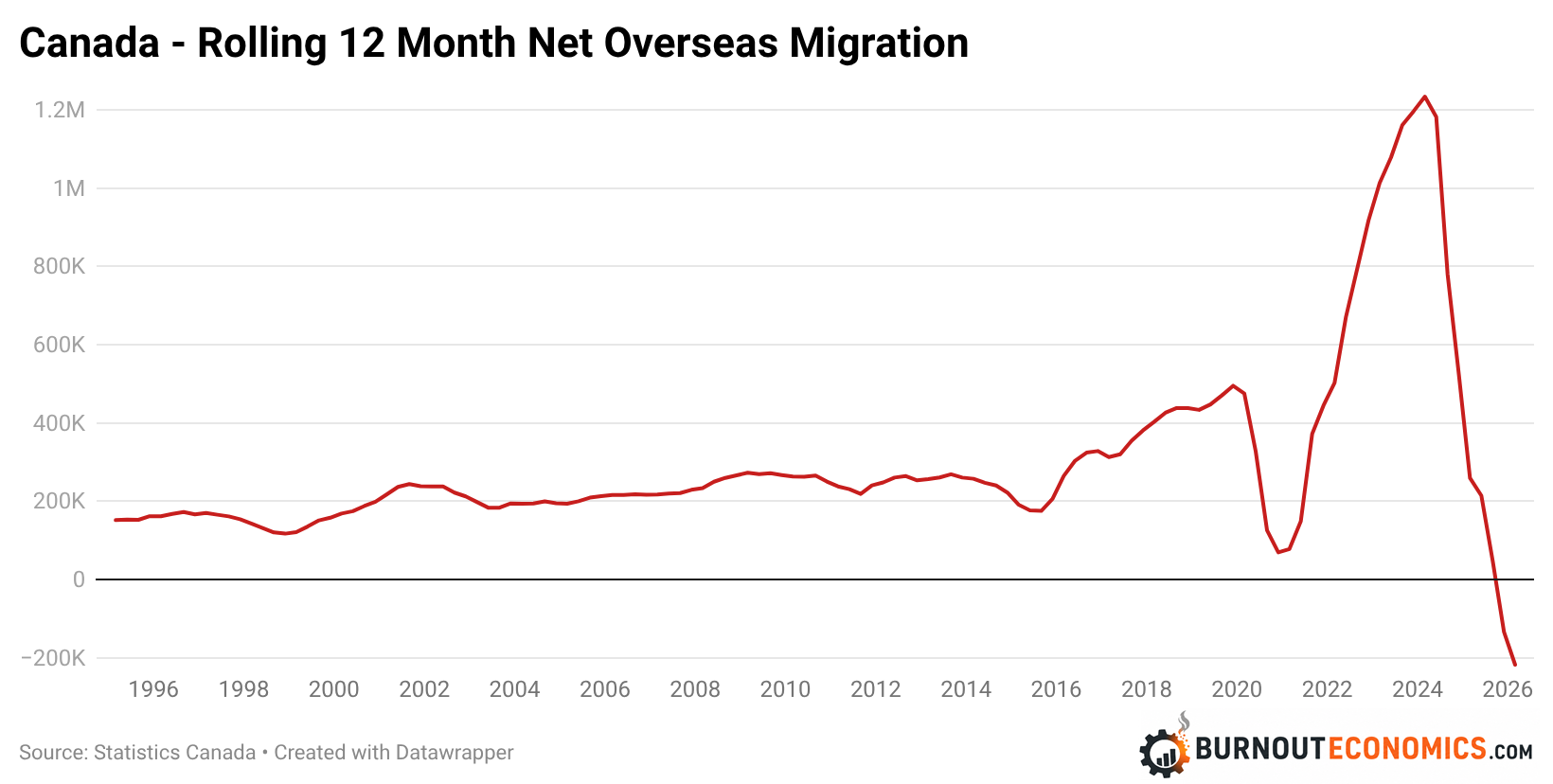
The migration data underneath this is instructive too. Canada’s sharp cut to net overseas migration removed one of the last props under a housing market that was already, by most measures, overvalued. Toronto condo prices are down 26.2 percent from peak, Vancouver’s apartment segment has been hit hard, and yet Winnipeg just posted an all time high. That divergence matters for anyone allocating capital across Canadian markets. Blended national figures hide where real value and real risk actually sit.
A government willing to buy the losses out of a soft market is telling investors exactly how soft that market has become.
For investors, the practical takeaway is twofold. First, government intervention on this scale puts a soft floor under certain segments, which changes the risk calculus for anyone considering distressed condo inventory in Vancouver or Toronto over the coming cycle. Second, it is a reminder that policy risk now cuts both ways. Markets that rely on government demand to clear inventory are not free markets, and returns built on that assumption carry a different kind of exposure than returns built on genuine buyer demand. Watching whether Australia, facing its own acute housing shortage, ever reaches for a similar tool would tell investors a great deal about how portable this playbook has become.
Source: MacroBusiness, “Canada moves to stop house prices falling”
When a federal government starts buying unsold condos to keep them off the open market, that is not a footnote for real estate investors, it is a market signal worth reading closely. Canada’s housing correction, now down more than 20 percent nationally from its early 2022 peak according to Bank for International Settlements data, has entered a new phase. The Carney government’s newly announced Canada-British Columbia Partnership on Condo Conversion, aimed at absorbing up to 2,200 unsold Vancouver condos, tells investors far more about where the market actually stands than any official talking point does.
Strip away the language about affordable housing supply and look at the mechanics. Prime Minister Mark Carney himself said the quiet part out loud, noting that developers facing higher interest rates and weaker investment demand “don’t want to sell at a loss” and “can’t afford to hold those empty units indefinitely.” That is a description of distressed inventory, not a supply strategy. For anyone tracking capital allocation in residential real estate, a government stepping in to absorb unsold stock at an estimated cost of up to 1.5 billion CAD is a clear marker of where developer balance sheets sit right now.
This is not an isolated event either. Ontario ran a similar 1.3 billion CAD buyback of unsold Toronto condos back in March 2025. Two provinces, two bailouts, and now a federal program layered on top. Investors should treat this pattern as a repeating signal rather than a one off. When governments step in twice to prevent price discovery from running its course, it tells you the underlying demand from private buyers and investors has not returned on its own, even after prices fell sharply.
The migration data underneath this is instructive too. Canada’s sharp cut to net overseas migration removed one of the last props under a housing market that was already, by most measures, overvalued. Toronto condo prices are down 26.2 percent from peak, Vancouver’s apartment segment has been hit hard, and yet Winnipeg just posted an all time high. That divergence matters for anyone allocating capital across Canadian markets. Blended national figures hide where real value and real risk actually sit.
A government willing to buy the losses out of a soft market is telling investors exactly how soft that market has become.
For investors, the practical takeaway is twofold. First, government intervention on this scale puts a soft floor under certain segments, which changes the risk calculus for anyone considering distressed condo inventory in Vancouver or Toronto over the coming cycle. Second, it is a reminder that policy risk now cuts both ways. Markets that rely on government demand to clear inventory are not free markets, and returns built on that assumption carry a different kind of exposure than returns built on genuine buyer demand. Watching whether Australia, facing its own acute housing shortage, ever reaches for a similar tool would tell investors a great deal about how portable this playbook has become.
Source: MacroBusiness, “Canada moves to stop house prices falling”
When a federal government starts buying unsold condos to keep them off the open market, that is not a footnote for real estate investors, it is a market signal worth reading closely. Canada’s housing correction, now down more than 20 percent nationally from its early 2022 peak according to Bank for International Settlements data, has entered a new phase. The Carney government’s newly announced Canada-British Columbia Partnership on Condo Conversion, aimed at absorbing up to 2,200 unsold Vancouver condos, tells investors far more about where the market actually stands than any official talking point does.
Strip away the language about affordable housing supply and look at the mechanics. Prime Minister Mark Carney himself said the quiet part out loud, noting that developers facing higher interest rates and weaker investment demand “don’t want to sell at a loss” and “can’t afford to hold those empty units indefinitely.” That is a description of distressed inventory, not a supply strategy. For anyone tracking capital allocation in residential real estate, a government stepping in to absorb unsold stock at an estimated cost of up to 1.5 billion CAD is a clear marker of where developer balance sheets sit right now.
This is not an isolated event either. Ontario ran a similar 1.3 billion CAD buyback of unsold Toronto condos back in March 2025. Two provinces, two bailouts, and now a federal program layered on top. Investors should treat this pattern as a repeating signal rather than a one off. When governments step in twice to prevent price discovery from running its course, it tells you the underlying demand from private buyers and investors has not returned on its own, even after prices fell sharply.
The migration data underneath this is instructive too. Canada’s sharp cut to net overseas migration removed one of the last props under a housing market that was already, by most measures, overvalued. Toronto condo prices are down 26.2 percent from peak, Vancouver’s apartment segment has been hit hard, and yet Winnipeg just posted an all time high. That divergence matters for anyone allocating capital across Canadian markets. Blended national figures hide where real value and real risk actually sit.
A government willing to buy the losses out of a soft market is telling investors exactly how soft that market has become.
For investors, the practical takeaway is twofold. First, government intervention on this scale puts a soft floor under certain segments, which changes the risk calculus for anyone considering distressed condo inventory in Vancouver or Toronto over the coming cycle. Second, it is a reminder that policy risk now cuts both ways. Markets that rely on government demand to clear inventory are not free markets, and returns built on that assumption carry a different kind of exposure than returns built on genuine buyer demand. Watching whether Australia, facing its own acute housing shortage, ever reaches for a similar tool would tell investors a great deal about how portable this playbook has become.
Source: MacroBusiness, “Canada moves to stop house prices falling”
Ottawa’s Condo Buyback Is a Signal, Not a Rescue: What Investors Should Read Into It
When a federal government starts buying unsold condos to keep them off the open market, that is not a footnote for real estate investors, it is a market signal worth reading closely. Canada’s housing correction, now down more than 20 percent nationally from its early 2022 peak according to Bank for International Settlements data, has entered a new phase. The Carney government’s newly announced Canada-British Columbia Partnership on Condo Conversion, aimed at absorbing up to 2,200 unsold Vancouver condos, tells investors far more about where the market actually stands than any official talking point does.
Strip away the language about affordable housing supply and look at the mechanics. Prime Minister Mark Carney himself said the quiet part out loud, noting that developers facing higher interest rates and weaker investment demand “don’t want to sell at a loss” and “can’t afford to hold those empty units indefinitely.” That is a description of distressed inventory, not a supply strategy. For anyone tracking capital allocation in residential real estate, a government stepping in to absorb unsold stock at an estimated cost of up to 1.5 billion CAD is a clear marker of where developer balance sheets sit right now.
This is not an isolated event either. Ontario ran a similar 1.3 billion CAD buyback of unsold Toronto condos back in March 2025. Two provinces, two bailouts, and now a federal program layered on top. Investors should treat this pattern as a repeating signal rather than a one off. When governments step in twice to prevent price discovery from running its course, it tells you the underlying demand from private buyers and investors has not returned on its own, even after prices fell sharply.
The migration data underneath this is instructive too. Canada’s sharp cut to net overseas migration removed one of the last props under a housing market that was already, by most measures, overvalued. Toronto condo prices are down 26.2 percent from peak, Vancouver’s apartment segment has been hit hard, and yet Winnipeg just posted an all time high. That divergence matters for anyone allocating capital across Canadian markets. Blended national figures hide where real value and real risk actually sit.
A government willing to buy the losses out of a soft market is telling investors exactly how soft that market has become.
For investors, the practical takeaway is twofold. First, government intervention on this scale puts a soft floor under certain segments, which changes the risk calculus for anyone considering distressed condo inventory in Vancouver or Toronto over the coming cycle. Second, it is a reminder that policy risk now cuts both ways. Markets that rely on government demand to clear inventory are not free markets, and returns built on that assumption carry a different kind of exposure than returns built on genuine buyer demand. Watching whether Australia, facing its own acute housing shortage, ever reaches for a similar tool would tell investors a great deal about how portable this playbook has become.
Source: MacroBusiness, “Canada moves to stop house prices falling”
Strip away the language about affordable housing supply and look at the mechanics. Prime Minister Mark Carney himself said the quiet part out loud, noting that developers facing higher interest rates and weaker investment demand “don’t want to sell at a loss” and “can’t afford to hold those empty units indefinitely.” That is a description of distressed inventory, not a supply strategy. For anyone tracking capital allocation in residential real estate, a government stepping in to absorb unsold stock at an estimated cost of up to 1.5 billion CAD is a clear marker of where developer balance sheets sit right now.
This is not an isolated event either. Ontario ran a similar 1.3 billion CAD buyback of unsold Toronto condos back in March 2025. Two provinces, two bailouts, and now a federal program layered on top. Investors should treat this pattern as a repeating signal rather than a one off. When governments step in twice to prevent price discovery from running its course, it tells you the underlying demand from private buyers and investors has not returned on its own, even after prices fell sharply.
The migration data underneath this is instructive too. Canada’s sharp cut to net overseas migration removed one of the last props under a housing market that was already, by most measures, overvalued. Toronto condo prices are down 26.2 percent from peak, Vancouver’s apartment segment has been hit hard, and yet Winnipeg just posted an all time high. That divergence matters for anyone allocating capital across Canadian markets. Blended national figures hide where real value and real risk actually sit.
A government willing to buy the losses out of a soft market is telling investors exactly how soft that market has become.
For investors, the practical takeaway is twofold. First, government intervention on this scale puts a soft floor under certain segments, which changes the risk calculus for anyone considering distressed condo inventory in Vancouver or Toronto over the coming cycle. Second, it is a reminder that policy risk now cuts both ways. Markets that rely on government demand to clear inventory are not free markets, and returns built on that assumption carry a different kind of exposure than returns built on genuine buyer demand. Watching whether Australia, facing its own acute housing shortage, ever reaches for a similar tool would tell investors a great deal about how portable this playbook has become.
Source: MacroBusiness, “Canada moves to stop house prices falling”
Ottawa’s Condo Buyback Is a Signal, Not a Rescue: What Investors Should Read Into It
When a federal government starts buying unsold condos to keep them off the open market, that is not a footnote for real estate investors, it is a market signal worth reading closely. Canada’s housing correction, now down more than 20 percent nationally from its early 2022 peak according to Bank for International Settlements data, has entered a new phase. The Carney government’s newly announced Canada-British Columbia Partnership on Condo Conversion, aimed at absorbing up to 2,200 unsold Vancouver condos, tells investors far more about where the market actually stands than any official talking point does.
Strip away the language about affordable housing supply and look at the mechanics. Prime Minister Mark Carney himself said the quiet part out loud, noting that developers facing higher interest rates and weaker investment demand “don’t want to sell at a loss” and “can’t afford to hold those empty units indefinitely.” That is a description of distressed inventory, not a supply strategy. For anyone tracking capital allocation in residential real estate, a government stepping in to absorb unsold stock at an estimated cost of up to 1.5 billion CAD is a clear marker of where developer balance sheets sit right now.
This is not an isolated event either. Ontario ran a similar 1.3 billion CAD buyback of unsold Toronto condos back in March 2025. Two provinces, two bailouts, and now a federal program layered on top. Investors should treat this pattern as a repeating signal rather than a one off. When governments step in twice to prevent price discovery from running its course, it tells you the underlying demand from private buyers and investors has not returned on its own, even after prices fell sharply.
The migration data underneath this is instructive too. Canada’s sharp cut to net overseas migration removed one of the last props under a housing market that was already, by most measures, overvalued. Toronto condo prices are down 26.2 percent from peak, Vancouver’s apartment segment has been hit hard, and yet Winnipeg just posted an all time high. That divergence matters for anyone allocating capital across Canadian markets. Blended national figures hide where real value and real risk actually sit.
A government willing to buy the losses out of a soft market is telling investors exactly how soft that market has become.
For investors, the practical takeaway is twofold. First, government intervention on this scale puts a soft floor under certain segments, which changes the risk calculus for anyone considering distressed condo inventory in Vancouver or Toronto over the coming cycle. Second, it is a reminder that policy risk now cuts both ways. Markets that rely on government demand to clear inventory are not free markets, and returns built on that assumption carry a different kind of exposure than returns built on genuine buyer demand. Watching whether Australia, facing its own acute housing shortage, ever reaches for a similar tool would tell investors a great deal about how portable this playbook has become.
Source: MacroBusiness, “Canada moves to stop house prices falling”
When a federal government starts buying unsold condos to keep them off the open market, that is not a footnote for real estate investors, it is a market signal worth reading closely. Canada’s housing correction, now down more than 20 percent nationally from its early 2022 peak according to Bank for International Settlements data, has entered a new phase. The Carney government’s newly announced Canada-British Columbia Partnership on Condo Conversion, aimed at absorbing up to 2,200 unsold Vancouver condos, tells investors far more about where the market actually stands than any official talking point does.
Strip away the language about affordable housing supply and look at the mechanics. Prime Minister Mark Carney himself said the quiet part out loud, noting that developers facing higher interest rates and weaker investment demand “don’t want to sell at a loss” and “can’t afford to hold those empty units indefinitely.” That is a description of distressed inventory, not a supply strategy. For anyone tracking capital allocation in residential real estate, a government stepping in to absorb unsold stock at an estimated cost of up to 1.5 billion CAD is a clear marker of where developer balance sheets sit right now.
This is not an isolated event either. Ontario ran a similar 1.3 billion CAD buyback of unsold Toronto condos back in March 2025. Two provinces, two bailouts, and now a federal program layered on top. Investors should treat this pattern as a repeating signal rather than a one off. When governments step in twice to prevent price discovery from running its course, it tells you the underlying demand from private buyers and investors has not returned on its own, even after prices fell sharply.
The migration data underneath this is instructive too. Canada’s sharp cut to net overseas migration removed one of the last props under a housing market that was already, by most measures, overvalued. Toronto condo prices are down 26.2 percent from peak, Vancouver’s apartment segment has been hit hard, and yet Winnipeg just posted an all time high. That divergence matters for anyone allocating capital across Canadian markets. Blended national figures hide where real value and real risk actually sit.
A government willing to buy the losses out of a soft market is telling investors exactly how soft that market has become.
For investors, the practical takeaway is twofold. First, government intervention on this scale puts a soft floor under certain segments, which changes the risk calculus for anyone considering distressed condo inventory in Vancouver or Toronto over the coming cycle. Second, it is a reminder that policy risk now cuts both ways. Markets that rely on government demand to clear inventory are not free markets, and returns built on that assumption carry a different kind of exposure than returns built on genuine buyer demand. Watching whether Australia, facing its own acute housing shortage, ever reaches for a similar tool would tell investors a great deal about how portable this playbook has become.
Source: MacroBusiness, “Canada moves to stop house prices falling”
Ottawa’s Condo Buyback Is a Signal, Not a Rescue: What Investors Should Read Into It
When a federal government starts buying unsold condos to keep them off the open market, that is not a footnote for real estate investors, it is a market signal worth reading closely. Canada’s housing correction, now down more than 20 percent nationally from its early 2022 peak according to Bank for International Settlements data, has entered a new phase. The Carney government’s newly announced Canada-British Columbia Partnership on Condo Conversion, aimed at absorbing up to 2,200 unsold Vancouver condos, tells investors far more about where the market actually stands than any official talking point does.
Strip away the language about affordable housing supply and look at the mechanics. Prime Minister Mark Carney himself said the quiet part out loud, noting that developers facing higher interest rates and weaker investment demand “don’t want to sell at a loss” and “can’t afford to hold those empty units indefinitely.” That is a description of distressed inventory, not a supply strategy. For anyone tracking capital allocation in residential real estate, a government stepping in to absorb unsold stock at an estimated cost of up to 1.5 billion CAD is a clear marker of where developer balance sheets sit right now.
This is not an isolated event either. Ontario ran a similar 1.3 billion CAD buyback of unsold Toronto condos back in March 2025. Two provinces, two bailouts, and now a federal program layered on top. Investors should treat this pattern as a repeating signal rather than a one off. When governments step in twice to prevent price discovery from running its course, it tells you the underlying demand from private buyers and investors has not returned on its own, even after prices fell sharply.
The migration data underneath this is instructive too. Canada’s sharp cut to net overseas migration removed one of the last props under a housing market that was already, by most measures, overvalued. Toronto condo prices are down 26.2 percent from peak, Vancouver’s apartment segment has been hit hard, and yet Winnipeg just posted an all time high. That divergence matters for anyone allocating capital across Canadian markets. Blended national figures hide where real value and real risk actually sit.
A government willing to buy the losses out of a soft market is telling investors exactly how soft that market has become.
For investors, the practical takeaway is twofold. First, government intervention on this scale puts a soft floor under certain segments, which changes the risk calculus for anyone considering distressed condo inventory in Vancouver or Toronto over the coming cycle. Second, it is a reminder that policy risk now cuts both ways. Markets that rely on government demand to clear inventory are not free markets, and returns built on that assumption carry a different kind of exposure than returns built on genuine buyer demand. Watching whether Australia, facing its own acute housing shortage, ever reaches for a similar tool would tell investors a great deal about how portable this playbook has become.
Source: MacroBusiness, “Canada moves to stop house prices falling”
When a federal government starts buying unsold condos to keep them off the open market, that is not a footnote for real estate investors, it is a market signal worth reading closely. Canada’s housing correction, now down more than 20 percent nationally from its early 2022 peak according to Bank for International Settlements data, has entered a new phase. The Carney government’s newly announced Canada-British Columbia Partnership on Condo Conversion, aimed at absorbing up to 2,200 unsold Vancouver condos, tells investors far more about where the market actually stands than any official talking point does.
Strip away the language about affordable housing supply and look at the mechanics. Prime Minister Mark Carney himself said the quiet part out loud, noting that developers facing higher interest rates and weaker investment demand “don’t want to sell at a loss” and “can’t afford to hold those empty units indefinitely.” That is a description of distressed inventory, not a supply strategy. For anyone tracking capital allocation in residential real estate, a government stepping in to absorb unsold stock at an estimated cost of up to 1.5 billion CAD is a clear marker of where developer balance sheets sit right now.
This is not an isolated event either. Ontario ran a similar 1.3 billion CAD buyback of unsold Toronto condos back in March 2025. Two provinces, two bailouts, and now a federal program layered on top. Investors should treat this pattern as a repeating signal rather than a one off. When governments step in twice to prevent price discovery from running its course, it tells you the underlying demand from private buyers and investors has not returned on its own, even after prices fell sharply.
The migration data underneath this is instructive too. Canada’s sharp cut to net overseas migration removed one of the last props under a housing market that was already, by most measures, overvalued. Toronto condo prices are down 26.2 percent from peak, Vancouver’s apartment segment has been hit hard, and yet Winnipeg just posted an all time high. That divergence matters for anyone allocating capital across Canadian markets. Blended national figures hide where real value and real risk actually sit.
A government willing to buy the losses out of a soft market is telling investors exactly how soft that market has become.
For investors, the practical takeaway is twofold. First, government intervention on this scale puts a soft floor under certain segments, which changes the risk calculus for anyone considering distressed condo inventory in Vancouver or Toronto over the coming cycle. Second, it is a reminder that policy risk now cuts both ways. Markets that rely on government demand to clear inventory are not free markets, and returns built on that assumption carry a different kind of exposure than returns built on genuine buyer demand. Watching whether Australia, facing its own acute housing shortage, ever reaches for a similar tool would tell investors a great deal about how portable this playbook has become.
Source: MacroBusiness, “Canada moves to stop house prices falling”
Ottawa’s Condo Buyback Is a Signal, Not a Rescue: What Investors Should Read Into It
When a federal government starts buying unsold condos to keep them off the open market, that is not a footnote for real estate investors, it is a market signal worth reading closely. Canada’s housing correction, now down more than 20 percent nationally from its early 2022 peak according to Bank for International Settlements data, has entered a new phase. The Carney government’s newly announced Canada-British Columbia Partnership on Condo Conversion, aimed at absorbing up to 2,200 unsold Vancouver condos, tells investors far more about where the market actually stands than any official talking point does.
Strip away the language about affordable housing supply and look at the mechanics. Prime Minister Mark Carney himself said the quiet part out loud, noting that developers facing higher interest rates and weaker investment demand “don’t want to sell at a loss” and “can’t afford to hold those empty units indefinitely.” That is a description of distressed inventory, not a supply strategy. For anyone tracking capital allocation in residential real estate, a government stepping in to absorb unsold stock at an estimated cost of up to 1.5 billion CAD is a clear marker of where developer balance sheets sit right now.
This is not an isolated event either. Ontario ran a similar 1.3 billion CAD buyback of unsold Toronto condos back in March 2025. Two provinces, two bailouts, and now a federal program layered on top. Investors should treat this pattern as a repeating signal rather than a one off. When governments step in twice to prevent price discovery from running its course, it tells you the underlying demand from private buyers and investors has not returned on its own, even after prices fell sharply.
The migration data underneath this is instructive too. Canada’s sharp cut to net overseas migration removed one of the last props under a housing market that was already, by most measures, overvalued. Toronto condo prices are down 26.2 percent from peak, Vancouver’s apartment segment has been hit hard, and yet Winnipeg just posted an all time high. That divergence matters for anyone allocating capital across Canadian markets. Blended national figures hide where real value and real risk actually sit.
A government willing to buy the losses out of a soft market is telling investors exactly how soft that market has become.
For investors, the practical takeaway is twofold. First, government intervention on this scale puts a soft floor under certain segments, which changes the risk calculus for anyone considering distressed condo inventory in Vancouver or Toronto over the coming cycle. Second, it is a reminder that policy risk now cuts both ways. Markets that rely on government demand to clear inventory are not free markets, and returns built on that assumption carry a different kind of exposure than returns built on genuine buyer demand. Watching whether Australia, facing its own acute housing shortage, ever reaches for a similar tool would tell investors a great deal about how portable this playbook has become.
Source: MacroBusiness, “Canada moves to stop house prices falling”
Strip away the language about affordable housing supply and look at the mechanics. Prime Minister Mark Carney himself said the quiet part out loud, noting that developers facing higher interest rates and weaker investment demand “don’t want to sell at a loss” and “can’t afford to hold those empty units indefinitely.” That is a description of distressed inventory, not a supply strategy. For anyone tracking capital allocation in residential real estate, a government stepping in to absorb unsold stock at an estimated cost of up to 1.5 billion CAD is a clear marker of where developer balance sheets sit right now.
This is not an isolated event either. Ontario ran a similar 1.3 billion CAD buyback of unsold Toronto condos back in March 2025. Two provinces, two bailouts, and now a federal program layered on top. Investors should treat this pattern as a repeating signal rather than a one off. When governments step in twice to prevent price discovery from running its course, it tells you the underlying demand from private buyers and investors has not returned on its own, even after prices fell sharply.
The migration data underneath this is instructive too. Canada’s sharp cut to net overseas migration removed one of the last props under a housing market that was already, by most measures, overvalued. Toronto condo prices are down 26.2 percent from peak, Vancouver’s apartment segment has been hit hard, and yet Winnipeg just posted an all time high. That divergence matters for anyone allocating capital across Canadian markets. Blended national figures hide where real value and real risk actually sit.
A government willing to buy the losses out of a soft market is telling investors exactly how soft that market has become.
For investors, the practical takeaway is twofold. First, government intervention on this scale puts a soft floor under certain segments, which changes the risk calculus for anyone considering distressed condo inventory in Vancouver or Toronto over the coming cycle. Second, it is a reminder that policy risk now cuts both ways. Markets that rely on government demand to clear inventory are not free markets, and returns built on that assumption carry a different kind of exposure than returns built on genuine buyer demand. Watching whether Australia, facing its own acute housing shortage, ever reaches for a similar tool would tell investors a great deal about how portable this playbook has become.
Source: MacroBusiness, “Canada moves to stop house prices falling”
When a federal government starts buying unsold condos to keep them off the open market, that is not a footnote for real estate investors, it is a market signal worth reading closely. Canada’s housing correction, now down more than 20 percent nationally from its early 2022 peak according to Bank for International Settlements data, has entered a new phase. The Carney government’s newly announced Canada-British Columbia Partnership on Condo Conversion, aimed at absorbing up to 2,200 unsold Vancouver condos, tells investors far more about where the market actually stands than any official talking point does.
Strip away the language about affordable housing supply and look at the mechanics. Prime Minister Mark Carney himself said the quiet part out loud, noting that developers facing higher interest rates and weaker investment demand “don’t want to sell at a loss” and “can’t afford to hold those empty units indefinitely.” That is a description of distressed inventory, not a supply strategy. For anyone tracking capital allocation in residential real estate, a government stepping in to absorb unsold stock at an estimated cost of up to 1.5 billion CAD is a clear marker of where developer balance sheets sit right now.
This is not an isolated event either. Ontario ran a similar 1.3 billion CAD buyback of unsold Toronto condos back in March 2025. Two provinces, two bailouts, and now a federal program layered on top. Investors should treat this pattern as a repeating signal rather than a one off. When governments step in twice to prevent price discovery from running its course, it tells you the underlying demand from private buyers and investors has not returned on its own, even after prices fell sharply.
The migration data underneath this is instructive too. Canada’s sharp cut to net overseas migration removed one of the last props under a housing market that was already, by most measures, overvalued. Toronto condo prices are down 26.2 percent from peak, Vancouver’s apartment segment has been hit hard, and yet Winnipeg just posted an all time high. That divergence matters for anyone allocating capital across Canadian markets. Blended national figures hide where real value and real risk actually sit.
A government willing to buy the losses out of a soft market is telling investors exactly how soft that market has become.
For investors, the practical takeaway is twofold. First, government intervention on this scale puts a soft floor under certain segments, which changes the risk calculus for anyone considering distressed condo inventory in Vancouver or Toronto over the coming cycle. Second, it is a reminder that policy risk now cuts both ways. Markets that rely on government demand to clear inventory are not free markets, and returns built on that assumption carry a different kind of exposure than returns built on genuine buyer demand. Watching whether Australia, facing its own acute housing shortage, ever reaches for a similar tool would tell investors a great deal about how portable this playbook has become.
Source: MacroBusiness, “Canada moves to stop house prices falling”
Ottawa’s Condo Buyback Is a Signal, Not a Rescue: What Investors Should Read Into It
When a federal government starts buying unsold condos to keep them off the open market, that is not a footnote for real estate investors, it is a market signal worth reading closely. Canada’s housing correction, now down more than 20 percent nationally from its early 2022 peak according to Bank for International Settlements data, has entered a new phase. The Carney government’s newly announced Canada-British Columbia Partnership on Condo Conversion, aimed at absorbing up to 2,200 unsold Vancouver condos, tells investors far more about where the market actually stands than any official talking point does.
Strip away the language about affordable housing supply and look at the mechanics. Prime Minister Mark Carney himself said the quiet part out loud, noting that developers facing higher interest rates and weaker investment demand “don’t want to sell at a loss” and “can’t afford to hold those empty units indefinitely.” That is a description of distressed inventory, not a supply strategy. For anyone tracking capital allocation in residential real estate, a government stepping in to absorb unsold stock at an estimated cost of up to 1.5 billion CAD is a clear marker of where developer balance sheets sit right now.
This is not an isolated event either. Ontario ran a similar 1.3 billion CAD buyback of unsold Toronto condos back in March 2025. Two provinces, two bailouts, and now a federal program layered on top. Investors should treat this pattern as a repeating signal rather than a one off. When governments step in twice to prevent price discovery from running its course, it tells you the underlying demand from private buyers and investors has not returned on its own, even after prices fell sharply.
The migration data underneath this is instructive too. Canada’s sharp cut to net overseas migration removed one of the last props under a housing market that was already, by most measures, overvalued. Toronto condo prices are down 26.2 percent from peak, Vancouver’s apartment segment has been hit hard, and yet Winnipeg just posted an all time high. That divergence matters for anyone allocating capital across Canadian markets. Blended national figures hide where real value and real risk actually sit.
A government willing to buy the losses out of a soft market is telling investors exactly how soft that market has become.
For investors, the practical takeaway is twofold. First, government intervention on this scale puts a soft floor under certain segments, which changes the risk calculus for anyone considering distressed condo inventory in Vancouver or Toronto over the coming cycle. Second, it is a reminder that policy risk now cuts both ways. Markets that rely on government demand to clear inventory are not free markets, and returns built on that assumption carry a different kind of exposure than returns built on genuine buyer demand. Watching whether Australia, facing its own acute housing shortage, ever reaches for a similar tool would tell investors a great deal about how portable this playbook has become.
Source: MacroBusiness, “Canada moves to stop house prices falling”
When a federal government starts buying unsold condos to keep them off the open market, that is not a footnote for real estate investors, it is a market signal worth reading closely. Canada’s housing correction, now down more than 20 percent nationally from its early 2022 peak according to Bank for International Settlements data, has entered a new phase. The Carney government’s newly announced Canada-British Columbia Partnership on Condo Conversion, aimed at absorbing up to 2,200 unsold Vancouver condos, tells investors far more about where the market actually stands than any official talking point does.
Strip away the language about affordable housing supply and look at the mechanics. Prime Minister Mark Carney himself said the quiet part out loud, noting that developers facing higher interest rates and weaker investment demand “don’t want to sell at a loss” and “can’t afford to hold those empty units indefinitely.” That is a description of distressed inventory, not a supply strategy. For anyone tracking capital allocation in residential real estate, a government stepping in to absorb unsold stock at an estimated cost of up to 1.5 billion CAD is a clear marker of where developer balance sheets sit right now.
This is not an isolated event either. Ontario ran a similar 1.3 billion CAD buyback of unsold Toronto condos back in March 2025. Two provinces, two bailouts, and now a federal program layered on top. Investors should treat this pattern as a repeating signal rather than a one off. When governments step in twice to prevent price discovery from running its course, it tells you the underlying demand from private buyers and investors has not returned on its own, even after prices fell sharply.
The migration data underneath this is instructive too. Canada’s sharp cut to net overseas migration removed one of the last props under a housing market that was already, by most measures, overvalued. Toronto condo prices are down 26.2 percent from peak, Vancouver’s apartment segment has been hit hard, and yet Winnipeg just posted an all time high. That divergence matters for anyone allocating capital across Canadian markets. Blended national figures hide where real value and real risk actually sit.
A government willing to buy the losses out of a soft market is telling investors exactly how soft that market has become.
For investors, the practical takeaway is twofold. First, government intervention on this scale puts a soft floor under certain segments, which changes the risk calculus for anyone considering distressed condo inventory in Vancouver or Toronto over the coming cycle. Second, it is a reminder that policy risk now cuts both ways. Markets that rely on government demand to clear inventory are not free markets, and returns built on that assumption carry a different kind of exposure than returns built on genuine buyer demand. Watching whether Australia, facing its own acute housing shortage, ever reaches for a similar tool would tell investors a great deal about how portable this playbook has become.
Source: MacroBusiness, “Canada moves to stop house prices falling”
When a federal government starts buying unsold condos to keep them off the open market, that is not a footnote for real estate investors, it is a market signal worth reading closely. Canada’s housing correction, now down more than 20 percent nationally from its early 2022 peak according to Bank for International Settlements data, has entered a new phase. The Carney government’s newly announced Canada-British Columbia Partnership on Condo Conversion, aimed at absorbing up to 2,200 unsold Vancouver condos, tells investors far more about where the market actually stands than any official talking point does.
Strip away the language about affordable housing supply and look at the mechanics. Prime Minister Mark Carney himself said the quiet part out loud, noting that developers facing higher interest rates and weaker investment demand “don’t want to sell at a loss” and “can’t afford to hold those empty units indefinitely.” That is a description of distressed inventory, not a supply strategy. For anyone tracking capital allocation in residential real estate, a government stepping in to absorb unsold stock at an estimated cost of up to 1.5 billion CAD is a clear marker of where developer balance sheets sit right now.
This is not an isolated event either. Ontario ran a similar 1.3 billion CAD buyback of unsold Toronto condos back in March 2025. Two provinces, two bailouts, and now a federal program layered on top. Investors should treat this pattern as a repeating signal rather than a one off. When governments step in twice to prevent price discovery from running its course, it tells you the underlying demand from private buyers and investors has not returned on its own, even after prices fell sharply.
The migration data underneath this is instructive too. Canada’s sharp cut to net overseas migration removed one of the last props under a housing market that was already, by most measures, overvalued. Toronto condo prices are down 26.2 percent from peak, Vancouver’s apartment segment has been hit hard, and yet Winnipeg just posted an all time high. That divergence matters for anyone allocating capital across Canadian markets. Blended national figures hide where real value and real risk actually sit.
A government willing to buy the losses out of a soft market is telling investors exactly how soft that market has become.
For investors, the practical takeaway is twofold. First, government intervention on this scale puts a soft floor under certain segments, which changes the risk calculus for anyone considering distressed condo inventory in Vancouver or Toronto over the coming cycle. Second, it is a reminder that policy risk now cuts both ways. Markets that rely on government demand to clear inventory are not free markets, and returns built on that assumption carry a different kind of exposure than returns built on genuine buyer demand. Watching whether Australia, facing its own acute housing shortage, ever reaches for a similar tool would tell investors a great deal about how portable this playbook has become.
Source: MacroBusiness, “Canada moves to stop house prices falling”
Ottawa’s Condo Buyback Is a Signal, Not a Rescue: What Investors Should Read Into It
When a federal government starts buying unsold condos to keep them off the open market, that is not a footnote for real estate investors, it is a market signal worth reading closely. Canada’s housing correction, now down more than 20 percent nationally from its early 2022 peak according to Bank for International Settlements data, has entered a new phase. The Carney government’s newly announced Canada-British Columbia Partnership on Condo Conversion, aimed at absorbing up to 2,200 unsold Vancouver condos, tells investors far more about where the market actually stands than any official talking point does.
Strip away the language about affordable housing supply and look at the mechanics. Prime Minister Mark Carney himself said the quiet part out loud, noting that developers facing higher interest rates and weaker investment demand “don’t want to sell at a loss” and “can’t afford to hold those empty units indefinitely.” That is a description of distressed inventory, not a supply strategy. For anyone tracking capital allocation in residential real estate, a government stepping in to absorb unsold stock at an estimated cost of up to 1.5 billion CAD is a clear marker of where developer balance sheets sit right now.
This is not an isolated event either. Ontario ran a similar 1.3 billion CAD buyback of unsold Toronto condos back in March 2025. Two provinces, two bailouts, and now a federal program layered on top. Investors should treat this pattern as a repeating signal rather than a one off. When governments step in twice to prevent price discovery from running its course, it tells you the underlying demand from private buyers and investors has not returned on its own, even after prices fell sharply.
The migration data underneath this is instructive too. Canada’s sharp cut to net overseas migration removed one of the last props under a housing market that was already, by most measures, overvalued. Toronto condo prices are down 26.2 percent from peak, Vancouver’s apartment segment has been hit hard, and yet Winnipeg just posted an all time high. That divergence matters for anyone allocating capital across Canadian markets. Blended national figures hide where real value and real risk actually sit.
A government willing to buy the losses out of a soft market is telling investors exactly how soft that market has become.
For investors, the practical takeaway is twofold. First, government intervention on this scale puts a soft floor under certain segments, which changes the risk calculus for anyone considering distressed condo inventory in Vancouver or Toronto over the coming cycle. Second, it is a reminder that policy risk now cuts both ways. Markets that rely on government demand to clear inventory are not free markets, and returns built on that assumption carry a different kind of exposure than returns built on genuine buyer demand. Watching whether Australia, facing its own acute housing shortage, ever reaches for a similar tool would tell investors a great deal about how portable this playbook has become.
Source: MacroBusiness, “Canada moves to stop house prices falling”
Strip away the language about affordable housing supply and look at the mechanics. Prime Minister Mark Carney himself said the quiet part out loud, noting that developers facing higher interest rates and weaker investment demand “don’t want to sell at a loss” and “can’t afford to hold those empty units indefinitely.” That is a description of distressed inventory, not a supply strategy. For anyone tracking capital allocation in residential real estate, a government stepping in to absorb unsold stock at an estimated cost of up to 1.5 billion CAD is a clear marker of where developer balance sheets sit right now.
This is not an isolated event either. Ontario ran a similar 1.3 billion CAD buyback of unsold Toronto condos back in March 2025. Two provinces, two bailouts, and now a federal program layered on top. Investors should treat this pattern as a repeating signal rather than a one off. When governments step in twice to prevent price discovery from running its course, it tells you the underlying demand from private buyers and investors has not returned on its own, even after prices fell sharply.
The migration data underneath this is instructive too. Canada’s sharp cut to net overseas migration removed one of the last props under a housing market that was already, by most measures, overvalued. Toronto condo prices are down 26.2 percent from peak, Vancouver’s apartment segment has been hit hard, and yet Winnipeg just posted an all time high. That divergence matters for anyone allocating capital across Canadian markets. Blended national figures hide where real value and real risk actually sit.
A government willing to buy the losses out of a soft market is telling investors exactly how soft that market has become.
For investors, the practical takeaway is twofold. First, government intervention on this scale puts a soft floor under certain segments, which changes the risk calculus for anyone considering distressed condo inventory in Vancouver or Toronto over the coming cycle. Second, it is a reminder that policy risk now cuts both ways. Markets that rely on government demand to clear inventory are not free markets, and returns built on that assumption carry a different kind of exposure than returns built on genuine buyer demand. Watching whether Australia, facing its own acute housing shortage, ever reaches for a similar tool would tell investors a great deal about how portable this playbook has become.
Source: MacroBusiness, “Canada moves to stop house prices falling”
When a federal government starts buying unsold condos to keep them off the open market, that is not a footnote for real estate investors, it is a market signal worth reading closely. Canada’s housing correction, now down more than 20 percent nationally from its early 2022 peak according to Bank for International Settlements data, has entered a new phase. The Carney government’s newly announced Canada-British Columbia Partnership on Condo Conversion, aimed at absorbing up to 2,200 unsold Vancouver condos, tells investors far more about where the market actually stands than any official talking point does.
Strip away the language about affordable housing supply and look at the mechanics. Prime Minister Mark Carney himself said the quiet part out loud, noting that developers facing higher interest rates and weaker investment demand “don’t want to sell at a loss” and “can’t afford to hold those empty units indefinitely.” That is a description of distressed inventory, not a supply strategy. For anyone tracking capital allocation in residential real estate, a government stepping in to absorb unsold stock at an estimated cost of up to 1.5 billion CAD is a clear marker of where developer balance sheets sit right now.
This is not an isolated event either. Ontario ran a similar 1.3 billion CAD buyback of unsold Toronto condos back in March 2025. Two provinces, two bailouts, and now a federal program layered on top. Investors should treat this pattern as a repeating signal rather than a one off. When governments step in twice to prevent price discovery from running its course, it tells you the underlying demand from private buyers and investors has not returned on its own, even after prices fell sharply.
The migration data underneath this is instructive too. Canada’s sharp cut to net overseas migration removed one of the last props under a housing market that was already, by most measures, overvalued. Toronto condo prices are down 26.2 percent from peak, Vancouver’s apartment segment has been hit hard, and yet Winnipeg just posted an all time high. That divergence matters for anyone allocating capital across Canadian markets. Blended national figures hide where real value and real risk actually sit.
A government willing to buy the losses out of a soft market is telling investors exactly how soft that market has become.
For investors, the practical takeaway is twofold. First, government intervention on this scale puts a soft floor under certain segments, which changes the risk calculus for anyone considering distressed condo inventory in Vancouver or Toronto over the coming cycle. Second, it is a reminder that policy risk now cuts both ways. Markets that rely on government demand to clear inventory are not free markets, and returns built on that assumption carry a different kind of exposure than returns built on genuine buyer demand. Watching whether Australia, facing its own acute housing shortage, ever reaches for a similar tool would tell investors a great deal about how portable this playbook has become.
Source: MacroBusiness, “Canada moves to stop house prices falling”
When a federal government starts buying unsold condos to keep them off the open market, that is not a footnote for real estate investors, it is a market signal worth reading closely. Canada’s housing correction, now down more than 20 percent nationally from its early 2022 peak according to Bank for International Settlements data, has entered a new phase. The Carney government’s newly announced Canada-British Columbia Partnership on Condo Conversion, aimed at absorbing up to 2,200 unsold Vancouver condos, tells investors far more about where the market actually stands than any official talking point does.
Strip away the language about affordable housing supply and look at the mechanics. Prime Minister Mark Carney himself said the quiet part out loud, noting that developers facing higher interest rates and weaker investment demand “don’t want to sell at a loss” and “can’t afford to hold those empty units indefinitely.” That is a description of distressed inventory, not a supply strategy. For anyone tracking capital allocation in residential real estate, a government stepping in to absorb unsold stock at an estimated cost of up to 1.5 billion CAD is a clear marker of where developer balance sheets sit right now.
This is not an isolated event either. Ontario ran a similar 1.3 billion CAD buyback of unsold Toronto condos back in March 2025. Two provinces, two bailouts, and now a federal program layered on top. Investors should treat this pattern as a repeating signal rather than a one off. When governments step in twice to prevent price discovery from running its course, it tells you the underlying demand from private buyers and investors has not returned on its own, even after prices fell sharply.
The migration data underneath this is instructive too. Canada’s sharp cut to net overseas migration removed one of the last props under a housing market that was already, by most measures, overvalued. Toronto condo prices are down 26.2 percent from peak, Vancouver’s apartment segment has been hit hard, and yet Winnipeg just posted an all time high. That divergence matters for anyone allocating capital across Canadian markets. Blended national figures hide where real value and real risk actually sit.
A government willing to buy the losses out of a soft market is telling investors exactly how soft that market has become.
For investors, the practical takeaway is twofold. First, government intervention on this scale puts a soft floor under certain segments, which changes the risk calculus for anyone considering distressed condo inventory in Vancouver or Toronto over the coming cycle. Second, it is a reminder that policy risk now cuts both ways. Markets that rely on government demand to clear inventory are not free markets, and returns built on that assumption carry a different kind of exposure than returns built on genuine buyer demand. Watching whether Australia, facing its own acute housing shortage, ever reaches for a similar tool would tell investors a great deal about how portable this playbook has become.
Source: MacroBusiness, “Canada moves to stop house prices falling”
Ottawa’s Condo Buyback Is a Signal, Not a Rescue: What Investors Should Read Into It
When a federal government starts buying unsold condos to keep them off the open market, that is not a footnote for real estate investors, it is a market signal worth reading closely. Canada’s housing correction, now down more than 20 percent nationally from its early 2022 peak according to Bank for International Settlements data, has entered a new phase. The Carney government’s newly announced Canada-British Columbia Partnership on Condo Conversion, aimed at absorbing up to 2,200 unsold Vancouver condos, tells investors far more about where the market actually stands than any official talking point does.
Strip away the language about affordable housing supply and look at the mechanics. Prime Minister Mark Carney himself said the quiet part out loud, noting that developers facing higher interest rates and weaker investment demand “don’t want to sell at a loss” and “can’t afford to hold those empty units indefinitely.” That is a description of distressed inventory, not a supply strategy. For anyone tracking capital allocation in residential real estate, a government stepping in to absorb unsold stock at an estimated cost of up to 1.5 billion CAD is a clear marker of where developer balance sheets sit right now.
This is not an isolated event either. Ontario ran a similar 1.3 billion CAD buyback of unsold Toronto condos back in March 2025. Two provinces, two bailouts, and now a federal program layered on top. Investors should treat this pattern as a repeating signal rather than a one off. When governments step in twice to prevent price discovery from running its course, it tells you the underlying demand from private buyers and investors has not returned on its own, even after prices fell sharply.
The migration data underneath this is instructive too. Canada’s sharp cut to net overseas migration removed one of the last props under a housing market that was already, by most measures, overvalued. Toronto condo prices are down 26.2 percent from peak, Vancouver’s apartment segment has been hit hard, and yet Winnipeg just posted an all time high. That divergence matters for anyone allocating capital across Canadian markets. Blended national figures hide where real value and real risk actually sit.
A government willing to buy the losses out of a soft market is telling investors exactly how soft that market has become.
For investors, the practical takeaway is twofold. First, government intervention on this scale puts a soft floor under certain segments, which changes the risk calculus for anyone considering distressed condo inventory in Vancouver or Toronto over the coming cycle. Second, it is a reminder that policy risk now cuts both ways. Markets that rely on government demand to clear inventory are not free markets, and returns built on that assumption carry a different kind of exposure than returns built on genuine buyer demand. Watching whether Australia, facing its own acute housing shortage, ever reaches for a similar tool would tell investors a great deal about how portable this playbook has become.
Source: MacroBusiness, “Canada moves to stop house prices falling”