
Toronto’s Condo Market Is Quietly Moving From Glut to Scarcity
The Toronto condo market has been treated as a weak spot for the past several years. For investors, that is precisely why the latest numbers deserve attention. When a market remains unpopular long enough, the more important question is not whether sentiment is poor today. It is whether future supply is being permanently reduced while demand waits on the sidelines.
According to CP24, citing new data from Urbanation, new condo sales across the Greater Toronto and Hamilton Area rose year-over-year last quarter for the first time since 2023. There were 702 new condo sales in the second quarter, up 52 per cent from the same period in 2025. That sounds constructive, but investors should keep the number in perspective. Sales remain 86 per cent below the 10-year average for the quarter.
This is not a broad recovery yet. It is an early market signal.
The rebound was driven largely by completed new condos, where sales more than tripled to 535 units. That matters because completed inventory offers something pre-construction cannot currently provide: certainty. Buyers can see the unit, negotiate the price, close faster, and potentially benefit from the expanded HST rebate structure where eligible.
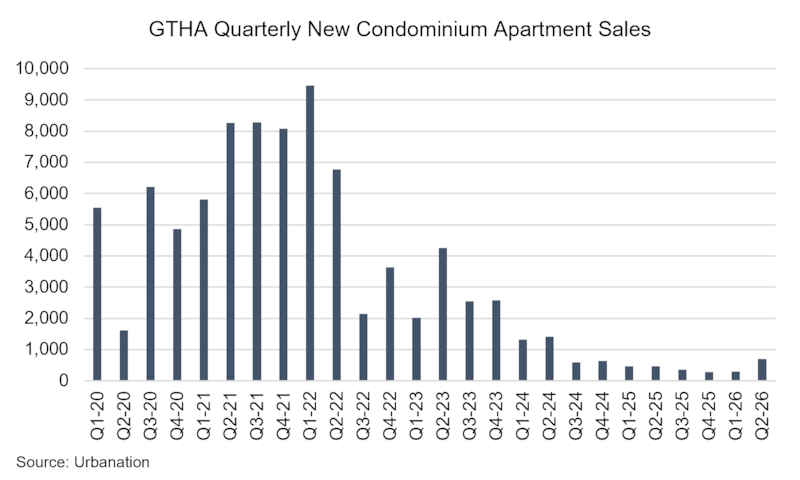
Pre-construction sales tell a very different story. Only 50 units sold, an 80 per cent decline. The reason is structural. The HST rebate requires construction to start before March 31, 2027, and be substantially completed by December 31, 2029. That creates qualification risk for buyers considering projects that have not yet meaningfully advanced.
For investors, this shifts the opportunity set. Completed developer-held inventory may offer the strongest near-term negotiation leverage. Urbanation reported that asking prices for completed, unsold new condos fell two per cent to an average of $1,186 per square foot. Yet that remains a 43 per cent premium over average resale pricing in newer projects, where the average was around $830 per square foot.
That spread is important. It suggests the best deals are unlikely to be found by accepting list prices. They are more likely to emerge through disciplined negotiation, especially with developers carrying completed units and facing financing pressure.
The opportunity is not in chasing a headline rebound. It is in understanding where today’s weak construction pipeline becomes tomorrow’s shortage.
The deeper investment signal is supply. Total new and resale condo inventory across the GTHA sat at 12,106 units at quarter-end, only one per cent higher than a year earlier. Developer-held inventory reached just over 5,000 units, but active resale listings fell 21 per cent to a three-year low of 7,105 units.
More importantly, the future pipeline is shrinking fast. Urbanation said pre-construction and under-construction inventory fell 37 per cent year-over-year and is down 62 per cent from the 2022 peak of roughly 127,000 units. There were no new project launches for the second consecutive quarter, more than 1,000 cancelled units, and only 448 units that started construction.
This creates a familiar real estate setup. Weak current demand discourages new supply. Developers delay or cancel projects. Population growth and rental demand continue to absorb housing. Several years later, the market discovers that too little was built.
Investors should remain selective. Financing costs, condo fees, rent controls, tenant quality, and resale liquidity all matter. But the GTHA condo market is no longer only a story about oversupply. It is becoming a story about timing, price discovery, and future scarcity. The buyers who benefit most will be those who underwrite conservatively today while watching the pipeline, not the mood, for direction.
Source: CP24