AI Homebuying Is Turning Buyer Agency Into a Measurable Workflow
The signal in Homa’s Texas launch is not simply that another brokerage is using artificial intelligence. It is that buyer representation is being broken into measurable tasks: search, valuation, leverage analysis, showing coordination, offer construction and closing management. As reported by the San Antonio Express-News, the Austin-based platform has entered Texas after launching in Florida, using AI and a reduced commission model to give buyers more control over the transaction.
For data-minded housing readers, the most important shift is the conversion of agent judgment into structured decision support. Homa gives users access to MLS listings, neighborhood comparables and a bargaining power score based on indicators such as price reductions and listing views. That matters because homebuying has traditionally mixed market data, personal preference and sales pressure inside one relationship. Platforms like this separate the signals from the persuasion layer.
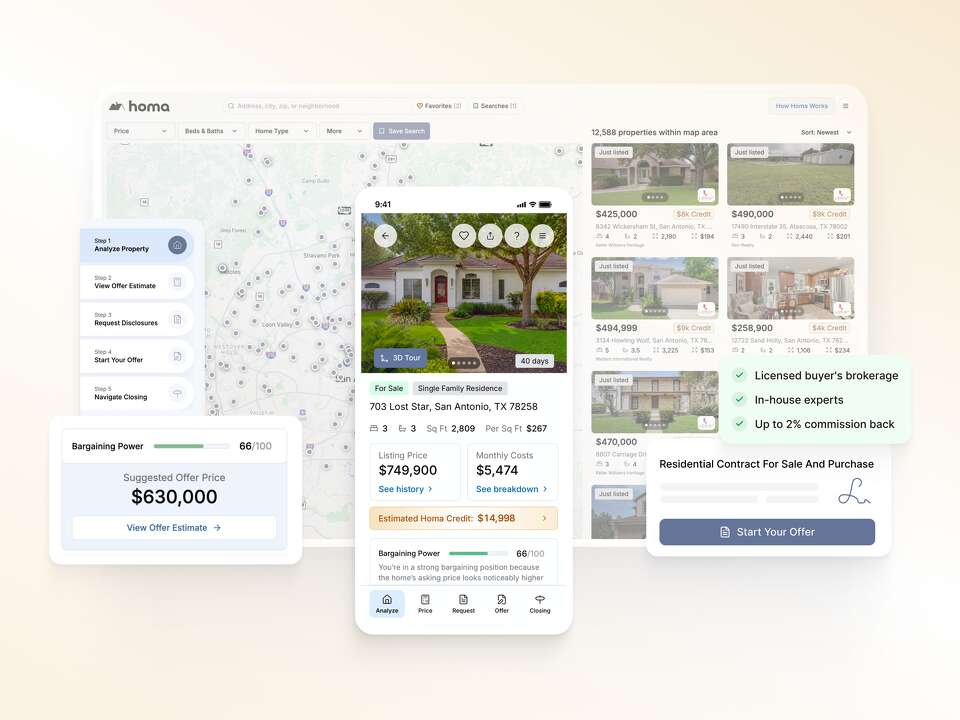
The commission math is also becoming a product feature. Homa says it takes 1% rather than the typical 3% buyer agent commission and returns the rest to the buyer at closing. In San Antonio, one buyer purchasing a $321,990 new-construction home received about $6,440 and used it to buy down the mortgage rate. In the Dallas area, another buyer under contract on an $800,000 home expects to receive $16,000 toward the down payment. Those are not abstract savings. They are liquidity events inside affordability-constrained transactions.
The next competitive edge in brokerage may be less about who controls the client relationship and more about who controls the cleanest transaction data.
Homa’s model also points to an operational redesign. Showings are routed through a network of listing agents paid hourly, with the first available agent able to accept the request. That resembles on-demand logistics more than traditional brokerage scheduling. If this scales, the key performance metrics will not be brand awareness alone. They will be response time, showing conversion, offer acceptance rate, inspection fallout, closing cycle length and buyer savings after concessions and credits.
The technology risk is just as important as the opportunity. A real estate-specific AI trained on state laws and transaction documents can help buyers review contracts, solar agreements and financing terms. But accuracy, liability and explainability will matter. A model that flags a $30,000 solar obligation is useful. A model that misses a deed restriction, HOA exposure or repair credit deadline can create real financial harm. The strongest platforms will need licensed professional review built into the workflow, not added after the fact.

There is also a market-selection signal. Homa launched first in Florida, described as a strong buyer’s market, then expanded into Texas and plans to enter California. Buyer-side AI is easier to prove when inventory, price cuts and seller flexibility create negotiation room. In tighter markets, the same platform must demonstrate speed, not just savings.
What should KG Data readers track next? Watch repeat usage among experienced buyers, referral growth beyond paid social ads, broker productivity per transaction and whether returned commission dollars consistently improve affordability through rate buydowns or down payment support. If these metrics hold, AI brokerage will not replace every agent. It will expose which parts of the agent role were advice, which were coordination and which were simply priced too opaquely.
Source: San Antonio Express-News