The Quiet Edit: Why Designers Are Simplifying the Outdoor Room
There is a particular kind of restraint that separates a garden from a landscape, and it has little to do with budget. It has to do with editing. Landscape architects working on some of the most refined residential projects are increasingly steering clients away from the instincts that once defined luxury outdoor living: paved perimeters, oversized permitted structures, and furniture arrangements stacked simply because the space allows it. What they are choosing instead reveals something deeper about how outdoor rooms are meant to feel.
Take the pool surround. For years, the assumption was that more hardscape meant more usability, a flat plane of stone extending to the property line so loungers could go anywhere. But as one Connecticut landscape architect notes, the strongest pool environments do the opposite. They soften the geometry with lawn, planting beds, and mature shade trees so the water feels woven into the property rather than dropped onto it. A pool bordered only by pavement reads as an installation. A pool framed by planting reads as a place.
The same philosophy is reshaping how amenities like saunas, plunge pools, and fountains get built. Prefabricated versions are gaining ground over bespoke, permitted structures, not as a compromise but as a design decision. A cedar hot tub set into a Los Angeles garden by one AD PRO Directory studio sidesteps the engineering reports and lengthy approvals a built-in version would demand, at a fraction of the cost. There is an elegance in that efficiency. A modular piece can also be reconfigured or removed as a family’s needs change, which built-in concrete never allows. Permanence, it turns out, is not always the more sophisticated choice.
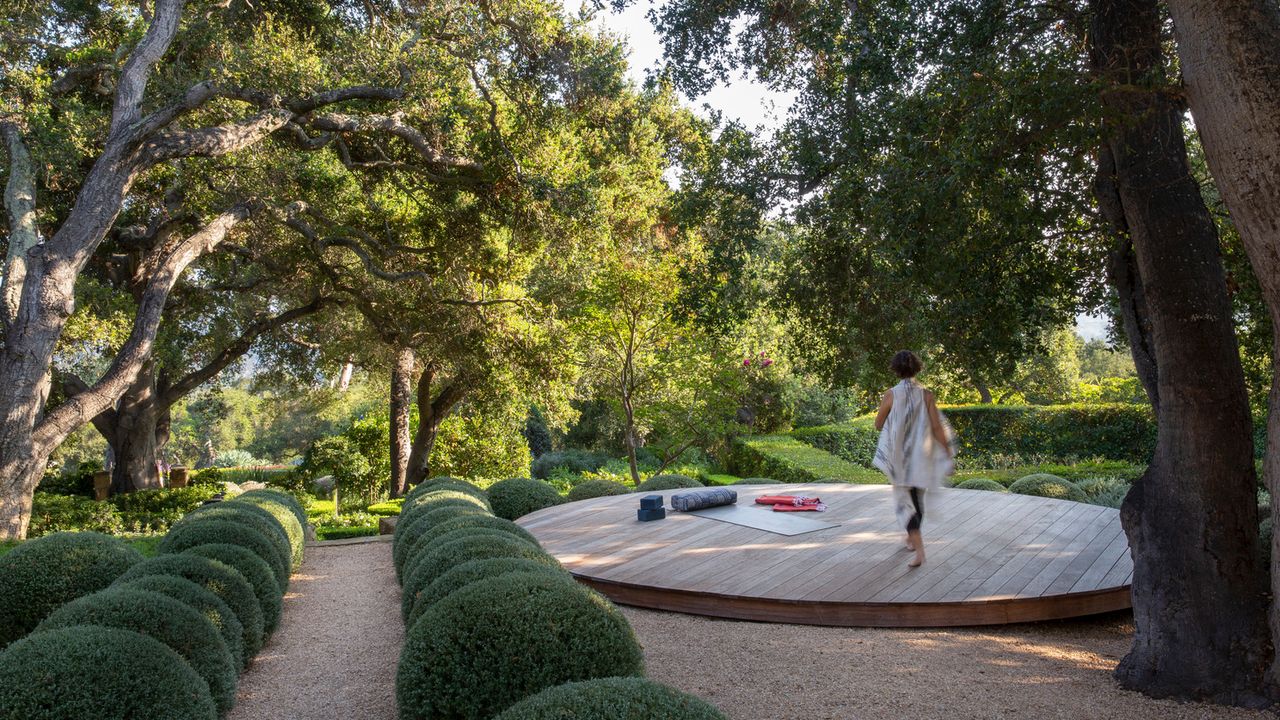
Perhaps the most telling shift is in seating. Where once a garden might hold several furniture groupings simply because the square footage permitted it, designers now describe the result as a kind of chaos, a space where the eye and body never fully settle.
You’re bouncing around but no space is truly comfortable because it’s set up to cram in objects, not with a true sense of the body.
That single line, from a Brooklyn based landscape designer, captures the whole argument. Editing out one seating arrangement in a smaller garden does not diminish the space. It gives the remaining one room to breathe, and gives the person sitting in it somewhere to actually land.
What connects all of this is a broader idea about outdoor architecture that mirrors the best interior work: proportion and restraint outlast trend. A garden designed with fewer, better considered elements tends to age more gracefully than one filled to capacity. It is the outdoor equivalent of a well edited room, where every piece earns its place rather than simply occupying it.
Source: Architectural Digest