Danforth’s Twin Towers Show What Aligned Land Strategy Can Deliver
Every so often a project comes along that is less about a single building and more about how two adjoining sites, two very different sponsors, and one municipal partner can be sequenced to move faster together than either could alone. That is exactly what is happening at 1111 and 1117 Danforth Ave. in Toronto’s east end, where a private developer and a non-profit housing provider have broken ground on twin buildings that will bring 400 homes and a new cultural anchor to a corridor that has needed both for years.
What makes this site worth studying is not the unit count on its own. It is the structure behind it. Woodbourne, a private developer, and Neighbours Community Homes, a non-profit with roughly five decades of operating experience, chose to design their neighbouring projects to share infrastructure rather than build in isolation. That decision compresses timelines and lowers hard costs on both sides of the property line, which is precisely the kind of feasibility thinking that separates a project that gets built from one that sits in a pipeline for years.
The 1117 Danforth building alone replaces 27 existing rental homes with 81 new units, including 40 affordable and 41 rent-controlled homes. That is a net gain in supply on a site that was already occupied, which is the harder and more valuable version of intensification. Adding density where infrastructure, transit, and services already exist is the kind of growth that strengthens a neighbourhood instead of straining it, and it is why City officials aligned the approvals for the non-profit and private components so both could proceed on the same timeline.
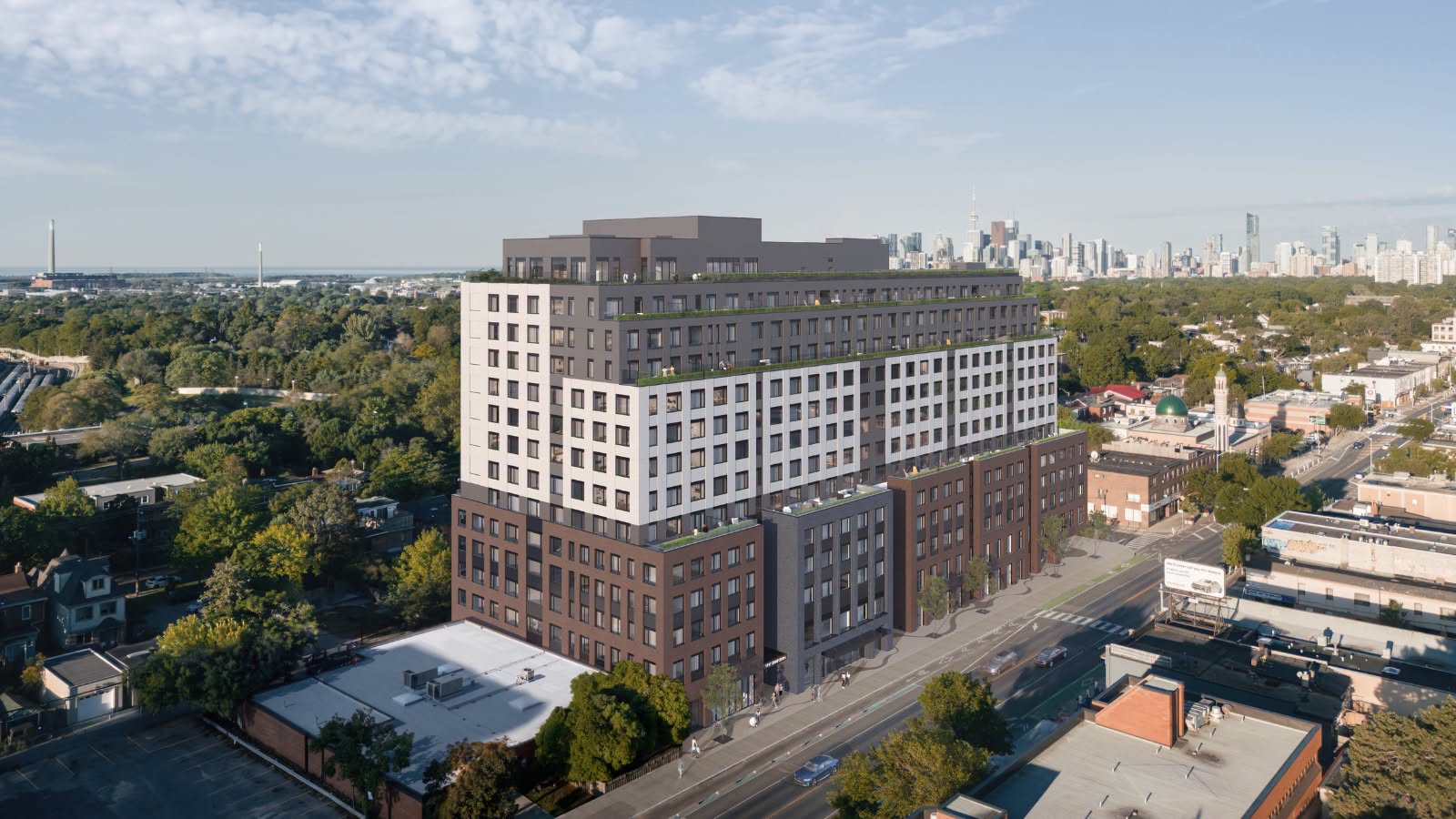
There is also a placemaking dimension here that developers too often treat as an afterthought. Le Théâtre français de Toronto will take a permanent ground floor home in the 1111 Danforth building, giving the project a cultural draw that supports the retail and street life around it. Mixed-income housing paired with a cultural institution is a deliberate bet that a complete community, not just a residential tower, is what makes density politically and socially durable over the long run.
Toronto needs more housing of every kind, and getting it built requires new ways of working together.
That line from Woodbourne president Nick Macrae is the real headline for anyone tracking development strategy in this market. The City is backing the project with more than 13 million dollars in capital funding and more than 14 million dollars in incentives through its Rental Housing Supply Program, but the public dollars are only part of the story. The bigger signal is that municipal staff were willing to synchronize approvals across a private and non-profit sponsor to unlock a shared site. This is one of 50 affordable housing developments currently under construction across Toronto, together expected to deliver about 14,000 homes, and it is a template worth watching as occupancy approaches in 2029.
Source: Ontario Construction News