



Real estate has always been a high stakes market, but the way people move through it is changing quickly. What was once a process dominated by phone calls, office visits, print listings, and fragmented paperwork is now being reorganized around digital property platforms. These platforms do more than display homes for sale. They increasingly function as the intelligence layer behind search, comparison, financing, communication, and transaction management.
Table Of Content
- What property platforms actually are
- Why the timing is right for platform-led real estate
- How property platforms help buyers make better decisions
- AI is adding a new decision layer
- How property platforms create value for sellers
- Digital visibility is not the same as guaranteed price
- Why agents and brokers remain central
- The infrastructure behind transparency and efficiency
- What features define the next generation of property platforms
- Canada’s market conditions make platforms especially relevant
- Common misconceptions about property platforms
- Myth one: property platforms replace agents
- Myth two: digital listings guarantee a better sale outcome
- Myth three: property platforms are just listing websites
- Myth four: more technology means less risk
- What buyers and sellers should look for in a platform
- The future of real estate transactions is connected, not purely digital
- Final thoughts
That shift matters because buying or selling a property is rarely simple. It is expensive, emotional, data-heavy, and time-sensitive all at once. In Canada, this complexity is especially visible in affordability pressures and delayed purchase timelines. According to CMHC’s 2026 Mortgage Consumer Survey, 77% of mortgage consumers conducted research online, 88% searched online for interest rates, and 72% used online calculators to estimate payments. Even more telling, 16% of those who searched online used AI for mortgage information, which shows that digital behavior in housing is no longer limited to browsing listings.
For buyers, property platforms can reduce friction by centralizing information that used to live in disconnected places. For sellers, they can improve visibility, speed up distribution, and make marketing more measurable. For agents, brokers, lenders, and legal professionals, they can streamline repetitive tasks and improve coordination while preserving the human judgment that still defines successful transactions. The future of real estate is not platform versus professional. It is platform plus professional, with better data, cleaner workflows, and fewer blind spots.
This is why property platforms now sit at the center of the broader PropTech conversation. They reflect a deeper transition in real estate from static listing portals to connected ecosystems that support decisions from first search to signed documents. As PwC’s 2026 proptech coverage suggests, AI in real estate is moving from experimentation to practical adoption. That means the most valuable platforms are no longer just digital storefronts. They are becoming operating systems for property transactions.

What property platforms actually are
When people hear the term property platform, they often think of a listing website. That is part of the picture, but only part. A modern property platform is a digital environment that connects discovery, data, communication, and workflow. In practical terms, it can include listing search, neighborhood insights, mortgage comparison tools, affordability calculators, virtual tours, appointment scheduling, document management, CRM systems for agents, and transaction coordination.
The most important distinction is that platforms are designed to reduce fragmentation. Real estate is full of handoffs between buyers, sellers, agents, lenders, inspectors, lawyers, and appraisers. Every handoff creates delay, confusion, or risk if the underlying information is incomplete or hard to access. Platforms try to solve that by creating a more continuous experience where users can move from one step to the next without losing context.
In Canada, the MLS ecosystem remains central to this infrastructure. CREA’s Stats Centre confirms the importance of MLS and REALTOR-branded services within the country’s organized real estate system. That means many of the most effective property platforms are not operating outside the real estate establishment. They are built on top of, or in coordination with, existing professional structures. This is one reason digital adoption has accelerated without making licensed expertise irrelevant.
The category is also widening. A property platform today might be a search portal for consumers, a transaction management suite for brokers, a mortgage marketplace for comparison shopping, or an integrated system that combines all of those functions. The common thread is not the interface alone. It is the ability to turn a fragmented transaction into a more connected workflow.
Why the timing is right for platform-led real estate
The rise of property platforms is not happening by accident. It is being pulled forward by market conditions. Housing has become harder to navigate for many households, especially first-time buyers. In CMHC’s 2025 survey, first-time buyers took an average of 3.7 years to save for a down payment. In the 2026 survey, the average for homebuyers overall reached 4.4 years. When people invest years preparing for a purchase, they demand better tools for analyzing options, understanding tradeoffs, and avoiding mistakes.
Interest rates have added another layer of uncertainty. CMHC’s 2024 survey found that 13% of buyers delayed purchasing because of high interest rates, up from 5% in 2023. That is a meaningful jump because it reflects not just affordability stress, but decision paralysis. In volatile financial conditions, people do more research, compare more products, and revisit assumptions more often. Platforms that offer live rate comparison, affordability estimates, and payment simulations become significantly more valuable in that environment.
There is also a behavioral shift underway. Digital research is now normal across the purchase journey. Buyers begin online, continue online, and often return online between conversations with agents, lenders, and family members. The transaction may still involve office meetings, in-person showings, and legal review, but the information loop is increasingly digital. This is exactly where platforms create leverage. They support repeated decision-making over a process that can stretch across months or years.
From an industry perspective, timing matters for another reason. Platforms are becoming more integrated. Instead of offering one narrow function, many are consolidating search, communication, financing, marketing, and workflow in one environment. That mirrors the broader trend highlighted by PwC, which points to a market shift toward integrated operating platforms rather than isolated tools. In transaction terms, the value now comes from connection, not just convenience.
How property platforms help buyers make better decisions
For buyers, the clearest benefit of a property platform is information accessibility. Search used to be constrained by geography, office hours, and local gatekeepers. Today, buyers can compare homes, neighborhoods, price histories, and financing scenarios from a single screen. This is especially important for first-time buyers who may not yet know how to evaluate tradeoffs between price, location, monthly cost, and long-term potential.
CMHC’s consumer data show how central digital tools have become in this process. When 88% of mortgage consumers search online for interest rates and 72% use online calculators, it suggests that buyers are not simply browsing homes. They are building decision models. They want to know whether a property is affordable under current rates, whether small changes in down payment affect monthly carrying costs, and how much flexibility they have before stretching too far.
A strong property platform turns that demand into a usable workflow. A buyer can move from seeing a listing to estimating monthly payments, comparing nearby inventory, checking commute times, and contacting an agent or broker without switching systems repeatedly. That continuity reduces cognitive overload. It also makes it easier to compare properties on the basis of total ownership cost rather than asking price alone.
Another major advantage is speed. In fast-moving markets, time matters. A buyer who can receive listing alerts, review disclosures, book viewings, and connect with a mortgage professional quickly is more likely to act with confidence. Speed does not guarantee success, but it narrows the gap between interest and action. In a market where attractive listings can move quickly, that responsiveness is meaningful.
There is also a transparency benefit. Buyers often struggle with hidden complexity, especially around financing and transaction steps. Platforms can make timelines, required documents, and budget scenarios more visible. This does not remove uncertainty entirely, but it turns opaque processes into clearer sequences. For a buyer already balancing rent, savings, and rate anxiety, that clarity reduces stress.
AI is adding a new decision layer
One of the most interesting signals in the market is the emergence of AI-assisted housing research. CMHC found that 16% of online searchers used AI for mortgage information in 2026. That share is still developing, but it is important because it marks a shift from passive search to interactive guidance. Instead of merely retrieving information, platforms can now help interpret it.
AI can support buyers by summarizing mortgage options, surfacing relevant listings based on behavioral patterns, identifying comparable properties, and answering common questions in plain language. It can also flag affordability risks, estimate carrying costs under different rate scenarios, or suggest where a buyer may be over-indexing on one preference at the expense of another. Used well, this makes research more structured and less overwhelming.
Still, the role of AI should be framed carefully. It is a support layer, not a substitute for regulated financial advice or legal interpretation. Real estate remains too local, too consequential, and too regulated for automation alone to carry the transaction. The best use of AI is not to replace expertise. It is to help people reach expert conversations better prepared.
How property platforms create value for sellers
Sellers benefit from property platforms in a different but equally important way. Their priority is often exposure, presentation, timing, and process control. A digital platform improves all four. It can distribute listings across organized MLS-based systems, generate visibility across search channels, support virtual tours, and allow agents to monitor inquiries or showing activity more efficiently.
That exposure matters because digital discovery now shapes first impressions. Buyers often decide whether to engage with a property before they ever step inside it. High-quality photos, floor plans, neighborhood data, map views, and mobile-friendly presentation all influence click-through behavior and inquiry volume. A property platform gives sellers a more scalable storefront than traditional methods ever could.
It also improves measurement. Instead of relying on informal feedback alone, sellers and agents can track listing views, engagement patterns, saved searches, lead sources, and showing requests. These signals do not determine the final sale price, but they help diagnose whether a listing is resonating with the market. If traffic is high but inquiries are weak, presentation may need adjustment. If engagement is low, pricing or timing may be the issue.
This is where digital platforms support a more analytical selling strategy. They create feedback loops earlier in the marketing cycle. That allows sellers and their agents to make informed decisions rather than waiting for a small number of anecdotal signals. In softer markets, that speed of feedback can be especially valuable because mispricing costs time and momentum.

Digital visibility is not the same as guaranteed price
One common misconception is that more online exposure automatically leads to better pricing. That is not how markets work. Visibility improves reach, but price still depends on supply, demand, condition, presentation, local competition, and negotiation dynamics. A platform can increase the probability that the right buyers see a home. It cannot manufacture demand that the market does not support.
That said, better visibility does improve the quality of the selling process. More buyers seeing a property can generate stronger competition, especially if the listing is well presented and strategically priced. More importantly, sellers gain a clearer picture of how their property is performing relative to comparable inventory. This turns platforms into diagnostic tools as much as marketing channels.
Why agents and brokers remain central
Technology changes workflow, but it does not erase the need for professional judgment. In CMHC’s 2025 survey, 28% of first-time homebuyers said the real estate agent was the most valued person on the homebuying team. That is a crucial statistic because it clarifies how consumers experience digital real estate. They use online tools heavily, yet still rely on people when decisions become nuanced, stressful, or high stakes.
Agents and brokers continue to add value in pricing strategy, negotiation, local knowledge, offer management, contract interpretation, and coordination across multiple parties. Those are not minor details. They are often the points where transactions either succeed or become costly. Platforms can automate reminders, centralize documents, and reduce duplicate work, but they cannot fully replace the relational and tactical expertise required in a live deal.
This is equally true for legal professionals and mortgage specialists. Lawyers and notaries remain essential for title review, closing compliance, and document execution. Mortgage brokers and lenders interpret financing options within a borrower’s real context. A property platform can organize inputs and improve access, but regulated advice still matters. The more efficient digital systems become, the more valuable human expertise can become at the moments that truly require it.
The most effective model is not human versus platform. It is human expertise supported by better data, cleaner workflow, and faster coordination.
That hybrid model also scales more effectively. NAR’s 2025 Profile of Home Buyers and Sellers found that 21% of buyers were first-time buyers and 79% were repeat buyers. Those groups have different needs. First-time buyers often need education and reassurance. Repeat buyers may prioritize efficiency and precision. Platforms allow professionals to serve both groups more effectively by adjusting the level of guidance while keeping the workflow consistent.
The infrastructure behind transparency and efficiency
To understand why property platforms matter, it helps to look beneath the user interface. Their real advantage is infrastructure. They unify data that used to be isolated across listing systems, financing channels, email threads, calendars, and document folders. Once that information is connected, a transaction becomes easier to manage and easier to understand.
Transparency starts with data visibility. Buyers can compare homes with more context. Sellers can see how their listing is performing. Agents can track workflow status. Lenders can collect documents more systematically. This reduces the informational asymmetry that has long made real estate feel opaque to consumers. Not every question is solved by data, but far fewer steps remain hidden.
Efficiency comes from reducing repetition. The traditional transaction process often requires users to re-enter information, resend files, repeat explanations, and manually coordinate milestones. Platforms replace some of that duplication with shared workflows, saved profiles, automated notifications, and integrated task management. The result is not just speed. It is fewer opportunities for error.
There is also a user experience effect. Consumers judge digital products against the best tools they use in other parts of life. They expect search to be intuitive, mobile access to work smoothly, and progress tracking to be visible. Real estate platforms that still feel fragmented or slow create mistrust. Platforms that feel coherent and responsive can lower the emotional temperature of the process, even when the financial stakes are high.
What features define the next generation of property platforms
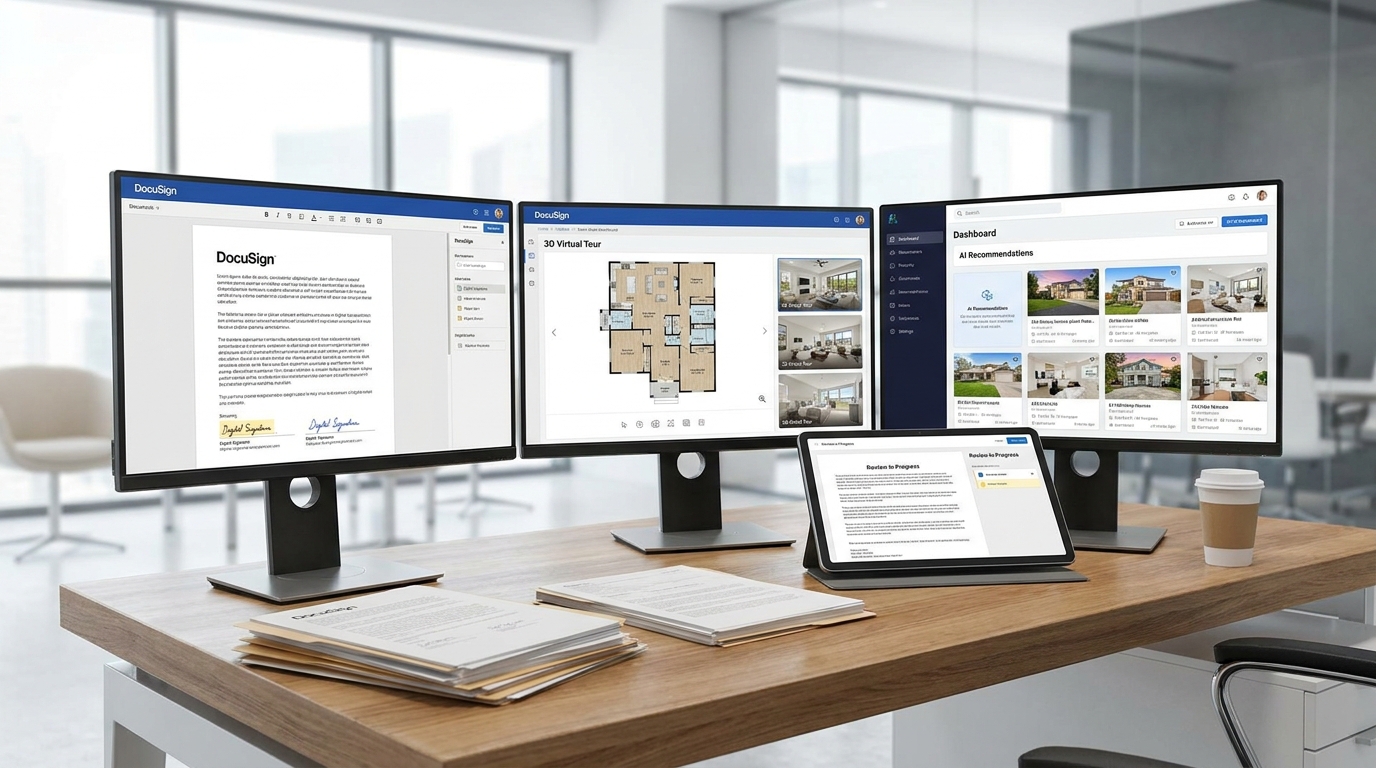
The next phase of property platforms is being shaped by integration, intelligence, and interoperability. Integration means users can move from search to financing to documents to communication without leaving the system. Intelligence means the platform can prioritize useful information rather than simply displaying everything. Interoperability means the system can still connect with agents, brokers, lenders, legal professionals, and MLS-based infrastructure.
Several capabilities are becoming especially important across North American markets.
- Mortgage comparison and affordability modeling are moving closer to property search, allowing users to evaluate homes based on real monthly costs rather than rough assumptions.
- AI-powered search and recommendations are helping users filter noise, discover relevant inventory, and interpret market information faster.
- Virtual tours and remote showing tools continue to improve early-stage screening, especially for busy or out-of-market buyers.
- Transaction management and e-signature workflows are reducing friction in document-heavy stages of the deal.
- Performance dashboards for sellers and agents are making digital marketing more measurable and adaptive.
None of these features is valuable in isolation if the broader experience remains fragmented. The strategic advantage comes from putting them together in a way that respects how people actually buy and sell homes. The strongest platforms do not just add tools. They sequence them intelligently.
Canada’s market conditions make platforms especially relevant
Canada offers a particularly strong case for the importance of property platforms. Buyers often face long savings periods, financing sensitivity, and significant regional variation in prices and inventory. These conditions raise the cost of bad decisions. When people are spending years preparing for a purchase, they need tools that help them test scenarios, compare options, and avoid false starts.
CMHC’s survey data highlight this reality clearly. First-time buyers in the 2025 survey rented an average of 6.3 years before buying. That means many enter the market after an extended planning period and with a strong need for clarity. At the same time, online behavior has become deeply embedded in the mortgage process. Consumers are actively using digital tools to compare rates, estimate payments, and conduct pre-decision research.
That does not make the process easy. If anything, it makes it more data-intensive. More available information can be empowering, but it can also be confusing. Platforms add value when they organize the information in a way that supports action. A clean experience that links listings, affordability, and professional support can be more useful than a larger but disconnected set of tools.
Canada’s organized real estate infrastructure also supports this platform evolution. MLS-based systems, professional broker networks, and lender ecosystems create a foundation that digital tools can build upon. The future is likely to involve more coordination between these systems, not less. In that sense, property platforms are not disrupting the market from outside alone. They are modernizing how the market already functions.
Common misconceptions about property platforms
The enthusiasm around real estate technology can sometimes create unrealistic expectations. It is worth correcting a few common misconceptions because understanding the limits of property platforms is just as important as understanding their strengths.
Myth one: property platforms replace agents
They do not. Platforms automate search, comparison, reminders, and coordination, but agents still play a critical role in negotiation, pricing strategy, local interpretation, and transaction management. In many cases, the platform makes the agent more effective rather than less necessary. It removes repetitive administrative work so expertise can be applied where it matters most.
Myth two: digital listings guarantee a better sale outcome
They improve visibility, not certainty. A well distributed listing has a better chance of reaching qualified buyers, but pricing still depends on market dynamics and execution. Sellers still need strong presentation, sound strategy, and realistic expectations. Technology amplifies process quality. It does not override fundamentals.
Myth three: property platforms are just listing websites
This view is outdated. Modern platforms can include mortgage tools, AI search, virtual tours, CRM systems, document workflows, transaction coordination, and market analytics. The listing is only the entry point. The real value lies in the connected services around it.
Myth four: more technology means less risk
Digital systems improve transparency and reduce certain types of friction, but they do not eliminate legal, financial, or fraud-related risk. Buyers still need due diligence. Sellers still need to verify information and protect privacy. Legal review remains essential, especially in complex transactions. A faster process is only better if it remains a careful process.
What buyers and sellers should look for in a platform
Not all property platforms deliver the same value. For consumers, the best choice is usually the one that combines trustworthy data, clear usability, and access to professional support. A platform should help users make better decisions, not simply keep them clicking. Design matters, but substance matters more.
Buyers should look for search tools that connect directly to affordability analysis, market insights, and communication channels with qualified professionals. A platform that only surfaces listings without helping interpret financial implications is incomplete. Given how many consumers already compare rates and use calculators online, the financing layer should feel native to the experience, not added as an afterthought.
Sellers should prioritize platforms that improve listing presentation, distribution, and reporting. Visibility is important, but feedback is equally valuable. Knowing how a listing is performing can guide decisions around pricing, staging, and timing. The best platforms help sellers and agents learn from the market while the listing is active.
Both buyers and sellers should also consider security, data quality, and the role of human support. A platform handling sensitive financial or personal information must inspire trust. It should be clear who is responsible for advice, what the platform can automate, and where professional review is still needed. Good technology clarifies these boundaries instead of obscuring them.
The future of real estate transactions is connected, not purely digital
The phrase digital transformation can sometimes imply that every part of a process will eventually move online. In real estate, that is too simplistic. Homes are physical assets, local markets behave differently, and transactions involve regulated steps that cannot be reduced to interface design alone. The future is better described as connected real estate. That means digital where digital adds value, and human where judgment, trust, and accountability are essential.
Property platforms fit that future well because they do not need to replace the transaction. They need to improve it. They make discovery smarter, communication faster, financing clearer, and paperwork more manageable. They also generate data trails that can help consumers and professionals learn from the process rather than simply endure it.
This is why platform adoption should be viewed as infrastructure development rather than a passing tech trend. Once people experience a more transparent and coordinated workflow, it becomes difficult to return to fragmentation. The expectation shifts. Buyers want better tools. Sellers want measurable exposure. Agents want systems that reduce admin load. Lenders and legal teams want cleaner documentation. The market begins to reward coordination.
As AI capabilities mature, this trend will deepen. Recommendation engines will become more context-aware. Mortgage guidance will become more interactive. Listing analysis will become more predictive. But the underlying principle will stay the same. The goal is not to make real estate feel automated. The goal is to make it feel more intelligible.
Final thoughts
Property platforms are reshaping real estate because they address a basic market problem: too much complexity spread across too many disconnected steps. In a housing environment defined by affordability pressure, long saving periods, digital-first research, and rising expectations around transparency, that problem is no longer acceptable. Consumers want tools that help them understand what they are doing before they commit to one of the biggest financial decisions of their lives.
The data show that this transition is already underway. Canadians are researching mortgages online, comparing interest rates digitally, using calculators at scale, and beginning to experiment with AI-assisted guidance. Sellers and agents are relying on platform-based visibility and analytics to manage marketing more effectively. Industry infrastructure in Canada and across North America continues to support MLS-connected, professionally anchored digital workflows rather than purely isolated tools.
The most useful way to think about property platforms is not as replacements for traditional real estate roles, but as force multipliers. They improve efficiency, expand access to information, and reduce friction across the journey. At the same time, they leave space for the expertise that still matters most: negotiation, interpretation, compliance, and local judgment. That balance is exactly why they are becoming central to the future of real estate transactions.
For buyers, the benefit is better clarity in a process filled with uncertainty. For sellers, it is better exposure and stronger feedback loops. For professionals, it is the chance to spend less time on repetitive coordination and more time on high-value advice. And for the industry as a whole, it is a step toward a housing market that feels not only more digital, but more understandable, responsive, and efficient.



No Comment! Be the first one.