


Why Hitachi’s New Scarborough Headquarters Is a Signal for Toronto’s Next Growth Corridor
When a global rail technology company commits C$30 million and 1,100 jobs to a single building, it is rarely just about that building. Hitachi Rail’s decision to open a 125,000 square foot technology center and headquarters in Scarborough is, at its core, a statement about where Toronto’s infrastructure and its growth are headed next. For those of us who track land value, transit corridors, and long term city strategy, this is the kind of investment that reshapes a neighbourhood’s trajectory long before a single new housing unit breaks ground nearby.
Hitachi Rail is not a speculative tenant testing the market. It is the company behind the signaling systems on the Ontario Line and the modernization work on the TTC’s Line 2, and its SelTrac communications-based train control technology, developed right in Toronto, now runs on more than 150 transit lines in 70 cities worldwide. Anchoring that kind of global engineering operation in Scarborough is a long term commitment, not a short term lease decision. That distinction matters enormously to anyone evaluating a neighbourhood’s development potential.
What makes this significant from a development lens is the layering effect. Major employment anchors, especially ones tied to transit infrastructure delivery, tend to pull public investment, talent, and eventually housing demand toward them. Scarborough has spent years positioned as a growth frontier for Toronto, and this headquarters arrives alongside Ontario’s broader C$236 billion infrastructure commitment to roads, highways, and transit. Infrastructure spending at that scale does not move in isolation. It changes access, it changes commute patterns, and over time it changes which neighbourhoods developers prioritize for density.
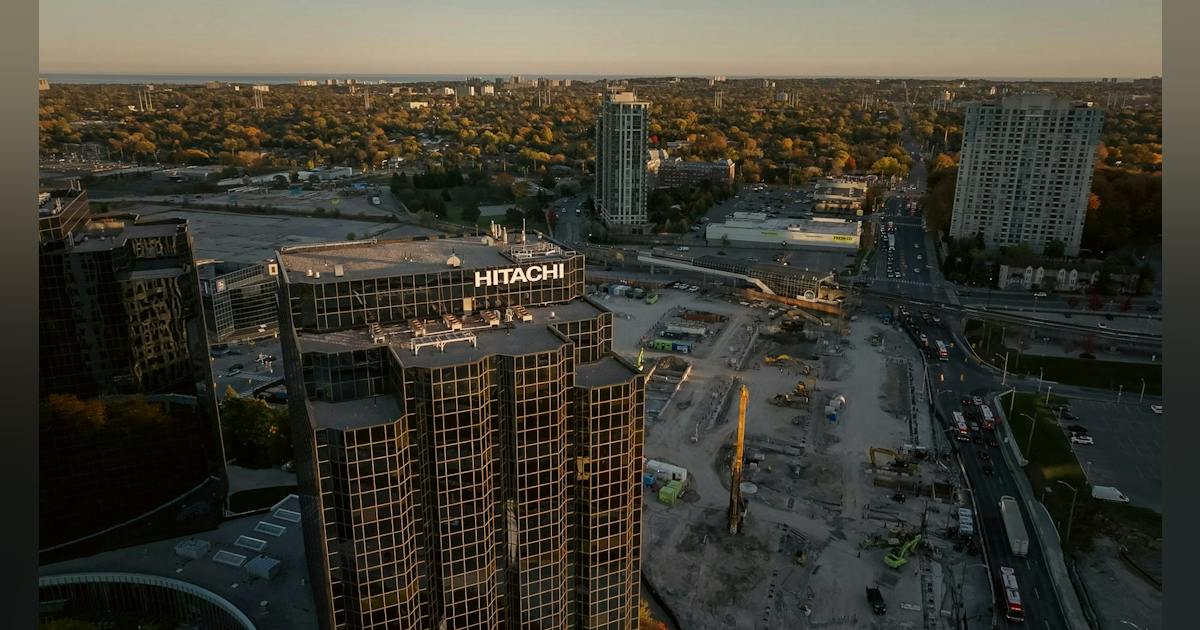
There is also a workforce dimension that deserves attention. Hitachi Rail’s partnerships with Ontario Tech University and McMaster University to build dedicated railway engineering programs, combined with roughly 100 paid internships placed each year, signal an intent to put down roots rather than simply staff a satellite office. A steady pipeline of skilled graduates choosing to live near their work is precisely the kind of demand driver that supports sustained housing absorption in a district, not a short lived spike.
Infrastructure anchors like this rarely arrive alone. They tend to be the first visible marker of a neighbourhood’s next growth cycle.
For developers and planners watching Scarborough, the practical takeaway is straightforward. A company does not build five and a half floors of engineering simulators, digital twin labs, and global operations capacity in a location it expects to be an afterthought. Combined with transit modernization already underway on Line 2 and construction progressing on the Ontario Line, the fundamentals around this site are shifting in a direction that favours forward looking land strategy, whether that means mixed use intensification near transit nodes or simply recalibrating long range timelines for residential projects in the surrounding corridor.
None of this guarantees an immediate housing boom. But development decisions are rarely made on finished infrastructure alone. They are made on signals like this one: a company with a 50 year history in the city choosing to double down, government backing the surrounding transit build out, and a workforce pipeline designed to stay. That combination is worth watching closely over the next several planning cycles.
Source: Mass Transit Magazine